Concrete work options and costs in Huntington Hills
Concrete work in Huntington Hills is a big part of making a home feel finished, from crisp driveway edges to durable patios and walkways. In this neighbourhood with a population of 13,120 (Statistics Canada, 2021 Census), most concrete flatwork supports long-term home use—typically single-detached and low-rise residential properties where driveways, walk paths, and patio slabs see daily traffic. Calgary’s concrete market is busy in the warmer months, and that labour demand shows up in pricing, especially when multiple crews are competing for the same frost-safe excavation days.
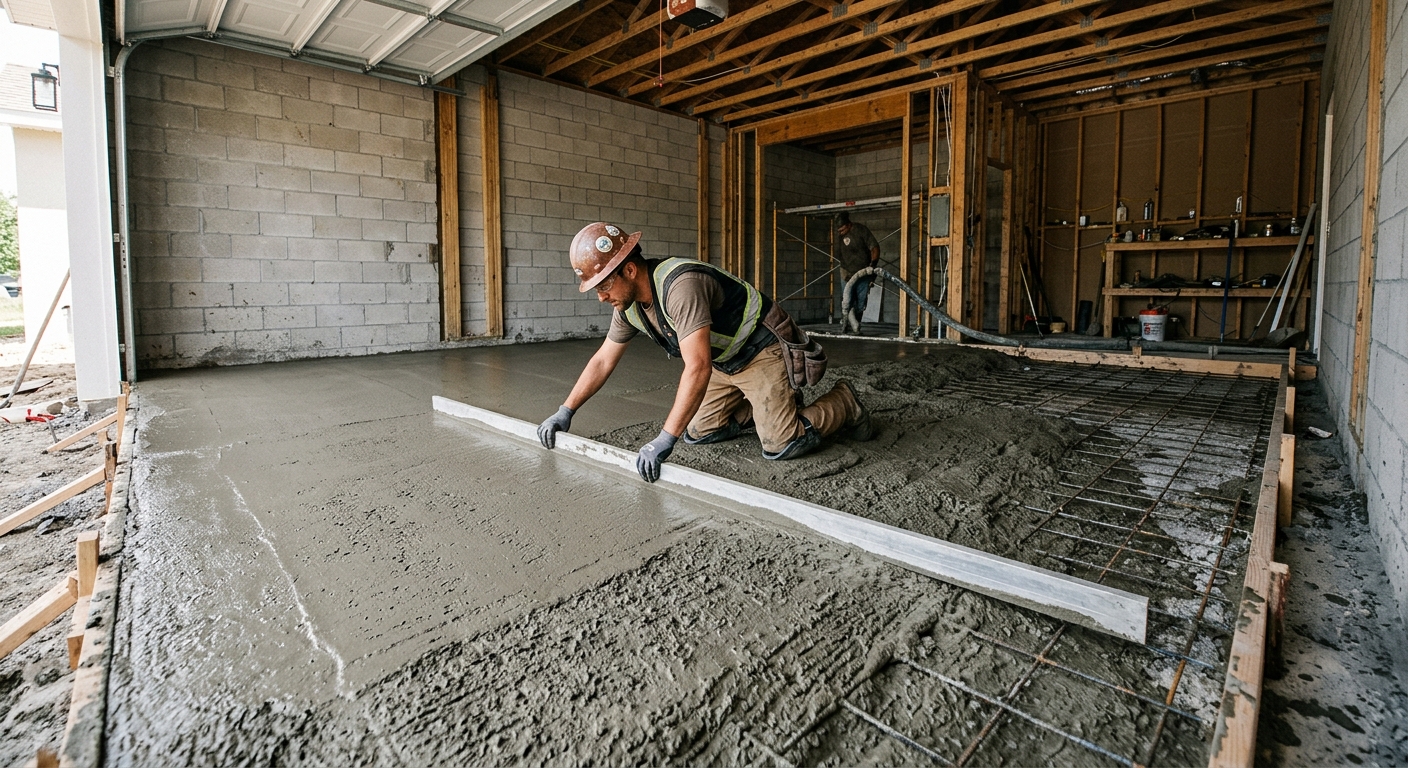
In the cold continental climate around Huntington Hills, costs aren’t just about concrete and finishing—they’re engineered around frost and freeze–thaw. With design frost depth commonly around 1.2 m (about 4 ft) in local engineering practice, footings and any slab-on-grade designed for long service must be built on undisturbed soil below that depth where required. Exterior slabs also need air-entrained mixes, proper base preparation, and a careful curing approach; pouring too late in the season or skipping winter-grade precautions increases the risk of scaling and spalling. That’s why foundation and flatwork quotes often reflect excavation volume, rebar/detailing, and cold-weather labour planning more than people expect.
Because demand concentrates where homeowners are actively improving curb appeal, trades are especially busy along parts of the community near major access routes toward Calgary, where driveway replacements and backyard patio upgrades are common. Below is a straightforward comparison of common options so you can align your quote with the right scope before you call for measurements.
| Application |
Typical Size |
Key Spec |
Finish Option |
Price Range |
| Concrete driveway (standard broom finish) |
18 m² (approx. 200 sq ft) |
Air-entrained mix, compacted granular base |
Broom-finished, control joints |
$12,000–$18,000 |
| Exposed aggregate driveway |
18 m² (approx. 200 sq ft) |
Air-entrained mix, aggregate exposure process |
Exposed aggregate, sealed for salt resistance |
$15,000–$22,000 |
| Stamped concrete driveway or patio |
28 m² (approx. 300 sq ft) |
Air-entrained mix, proper release and curing |
Stamped pattern, optional colouring and sealer |
$15,000–$26,000 |
| Plain concrete patio or walkway |
14 m² (approx. 150 sq ft) |
Air-entrained mix, compacted base |
Steel-trowel to broom/sack texture, joints |
$5,000–$9,000 |
| Garage floor (interior slab) |
36 m² (approx. 390 sq ft) |
Vapour barrier, reinforcing as required |
Standard trowel finish, saw-cut joints |
$7,500–$13,500 |
| Foundation footings (structural, below frost) |
Typical single-detached bearing area |
Engineered rebar, excavation below frost depth |
Structural concrete, frost-protected detail |
$28,000–$45,000 |
Prices are estimates only and vary by project scope, site access and material selection.
What affects the price of concrete work in Huntington Hills
In Huntington Hills, you can see the same general job—like a driveway replacement—come in 30–50% apart across Calgary-area quotes because the “real” scope is usually different. One contractor prices a simple pour; another prices the correct frost-safe system: deeper excavation, thicker compacted granular base, engineered reinforcement, air-entrained concrete, and time for curing. Labour pricing also fluctuates with the short practical exterior season; when freeze–thaw cycles ramp up and weather windows tighten, crews must work faster and use winter-grade procedures that cost more.
Frost depth and freeze–thaw cycles dictate every major spec here. Footings must extend below the local design frost depth (commonly about 1.2 m in Alberta engineering practice) to prevent frost heave and seasonal movement. Exterior slabs require air-entrained concrete mixes so the mix can withstand repeated freezing and thawing without surface scaling. In colder conditions, curing is more sensitive: winter-grade mixes, insulated blankets, and temporary heat can be required to reach proper strength development. Finally, Calgary-area use of de-icing salt is harsh on unprotected surfaces; sealing helps reduce surface breakdown and spalling, particularly on driveways and patios.
Two local examples that move price up or down: (1) if your soil is weaker or frost-sensitive and the contractor has to remove and replace more granular base, the cost rises quickly; (2) if truck access is limited (tight turns or boulevard constraints), placement and finishing time increases. As a result, a standard broom driveway often lands in the $12,000–$18,000 range, while higher-spec finishes like stamped or exposed aggregate commonly push toward $15,000–$26,000 depending on size and sealer requirements.
| Price Factor |
Why It Matters |
Cost Impact |
| Frost line depth — determines footing depth and form height |
Deeper excavation and taller forms increase concrete volume and labour |
Can add thousands on foundation work |
| Site preparation — excavation, grading, compacted granular base |
Proper base controls settlement and cracking |
Large variance if soil is removed/replaced |
| Reinforcement — rebar or wire mesh requirement |
Controls cracking and improves load capacity |
Material + placement labour |
| Mix design — air-entrainment and compressive strength spec |
Helps durability through freeze–thaw cycles |
Higher-spec mix costs more, but reduces failures |
| Finish type — broom vs. stamped vs. exposed aggregate |
Complex finishing impacts crew time and materials |
Stamped/exposed typically cost more |
| Pour size and concrete truck access to site |
Smaller access issues can delay placement |
Adds labour and potential rework time |
| Cold-weather curing precautions — heating and blankets |
Ensures strength gain and reduces scaling |
Winter setup can noticeably increase total price |
| Control joint pattern and sealing cost |
Manages cracking and protects from de-icing salt |
Sealer/extra joints add line-item cost |
Permits & regulations in Alberta
In Alberta, structural concrete work—think foundation footings, foundation walls, and grade beams—usually requires a building permit, and engineered drawings are commonly required and reviewed through the municipality’s permitting process. That’s because structural loads and frost protection details have to be checked for safety and durability. Concrete flatwork like patios, walkways, and driveways typically does not require a permit by default, unless it affects lot grading, interferes with drainage, changes impervious surface coverage, or impacts municipal right-of-way or drainage patterns. Before you break ground in Huntington Hills, confirm the exact permit trigger with the City/municipality—your contractor can help, but you should still verify.
Step-by-step, here’s how to verify a contractor in Huntington Hills (Alberta): first, ask for their certificate of insurance showing liability coverage (and request the expiry date and project address). Second, confirm they have WSIB/WCB coverage appropriate to Alberta work—your contractor should provide proof (or a clearance/coverage documentation letter where applicable). Third, confirm licensing/registration status through the relevant Alberta professional/contractor registry channels (the exact listing depends on the company structure and whether they are acting as a contractor or specialty trade). Lastly, ask for references on similar-scale projects like exterior slab work in cold-weather conditions.
If a quote bypasses permits for structural items or can’t show insurance/coverage documents, treat that as a major red flag and move to another bidder.
Getting concrete right in Huntington Hills's freeze-thaw climate
Concrete failure in Huntington Hills most often traces back to the freeze–thaw cycle: water gets into the slab or surface micro-pores, then expands when temperatures drop, leading to scaling, spalling, and premature cracking. In Calgary’s cold continental climate, “good looking” at pour day isn’t enough—your specs must be engineered for durability. Start with base preparation: the granular sub-base has to be excavated to the correct frost-safe depth and compacted properly so the slab doesn’t settle and crack. Next is mix design: exterior flatwork should use air-entrained concrete (commonly 5% to 7% air content) and a minimum compressive strength (often 32 MPa for typical exterior pours). Control joints must be spaced so cracks form where they’re intended, and curing needs to be protected for at least 7 days under suitable conditions. In cold weather, this means insulating blankets and sometimes heat to keep temperature within acceptable ranges for strength gain.
Finally, sealing matters here because de-icing salt is a year-over-year stress test. A penetrating sealer applied after the slab cures helps reduce water and salt absorption, which helps prevent surface breakdown.
To keep your quote honest, ask what’s being installed—not just the finish. For example, bumping from a basic plain walkway to a broom-to-sack finish patio is often modest, but stamped concrete requires extra steps and materials; that’s why stamped jobs frequently sit in the higher $15,000–$26,000 range when size and colours are considered. You’re paying for preparation, detailing, and controlled curing—not just stamps.
| Spec |
Why It Matters in Huntington Hills |
What to Ask For |
Impact if Skipped |
| Compacted granular base (depth?) |
Reduces settlement and controls cracking under freeze–thaw |
Documented excavation depth and compacted granular layer thickness |
Uneven settlement, early cracks, water pooling |
| Air-entrained concrete mix (target air %?) |
Prevents freeze–thaw surface scaling and spalling |
Target 5%–7% air content for exterior flatwork |
Higher risk of scaling and rough surface failure |
| Compressive strength (MPa rating) |
Ensures durability and strength development |
Minimum 32 MPa for typical exterior slabs |
Weak surfaces, faster wear and cracking |
| Control joints (spacing per ACI guidelines) |
Directs cracking to predetermined lines |
Stated joint spacing pattern and saw-cut timing |
Random cracking through finish and reduced service life |
| Minimum 7-day curing period |
Strength gain is temperature- and protection-dependent |
Written curing plan; cold-weather protection when needed |
Surface damage, scaling, and long-term durability issues |
| Penetrating sealer (when applied after cure) |
Reduces salt and water penetration |
Application at ~28 days after pour (after full cure) |
Faster breakdown and more noticeable spalling around edges |
How to choose a concrete work contractor in Huntington Hills
Choosing the right contractor in Huntington Hills starts with verification, not just the lowest number. In Alberta, confirm the company carries liability insurance and WSIB/WCB coverage (ask for the certificate or proof documents and check the dates). If they can’t provide insurance/coverage information up front, don’t proceed—this is exactly the type of gap that can leave homeowners exposed during injury or job-site damage. Also ask how they handle permit requirements for structural work (footings, foundation walls, grade beams) and whether they take responsibility for municipal coordination.
Next, get 2–3 itemised written quotes instead of one lump sum. The best bids break out labour versus materials and include allowances for rebar/mesh, concrete mix grade, excavation and disposal, base preparation, reinforcement placement, finishing (broom vs stamped vs exposed aggregate), and sealing. Make sure they specify what’s included: permit pull (if required), truck access considerations, topsoil restoration, and whether saw-cut joints and sealing are part of the plan. For warranty, ask for two layers: a workmanship warranty (how many months/years) and product/manufacturer warranty where applicable. Clarify whether warranties are transferable to future owners.
Finally, handle payment responsibly: never pay more than 10–15% upfront, and hold back a portion until cleanup, joint finishing, curing protection, and (when scheduled) sealing are complete. Get the start date and completion estimate in writing so weather-driven changes are documented.
- Provide insurance certificate with project-specific coverage details.
- Show WSIB/WCB proof and coverage dates.
- Use an itemised quote (materials, labour, excavation, disposal, reinforcement, finishing, sealer).
- Confirm whether structural concrete needs permits and how it’s handled.
- Document base preparation depth and compaction method.
- Specify air-entrainment target and compressive strength (typically 5%–7% air and 32 MPa for exterior).
- State control joint spacing and saw-cut timing.
- List cold-weather curing precautions (blankets/heating) if temperatures may drop.
- Include finishing details (broom, exposed aggregate process, stamped release/colour plan).
- Confirm disposal of removed material (haul-away costs can surprise homeowners).
- Define warranty terms and whether they cover cracking/spalling.
- Use a payment schedule with a holdback until final inspection/cleanup.
Red flags in Huntington Hills concrete projects: a quote that can’t clearly explain frost-safe excavation depth, skipping air-entrainment details for exterior slabs, vague wording like “standard concrete” with no strength spec, no proof of WSIB/WCB or liability insurance, and asking for most payment upfront before any prep work or rebar placement is done.
Frequently asked questions — concrete work in Huntington Hills
Why does concrete crack in Huntington Hills and how is it prevented?
Concrete can crack in Huntington Hills because it shrinks as it cures and then expands/contracts under freeze–thaw cycles. If the slab is built on an uneven or frost-sensitive base, tiny movements become larger over time, leading to cracking and sometimes edge spalling. The main prevention is a full “system”: compacted granular base to the correct depth, an air-entrained exterior mix, and a deliberate control joint layout so cracks form where they can be managed. Proper curing for at least 7 days is also critical, especially when pours are close to colder shoulder seasons. In our Calgary-area experience, the biggest driver of persistent cracking is usually skipping joint timing or base preparation, not the finish itself.
Stamped vs broom-finish concrete — cost difference?
Stamped concrete costs more than broom-finish primarily because of extra labour time and materials—forms/release agents, colour steps, pattern stamping, and careful curing to keep edges crisp in a cold-weather market like Huntington Hills. A plain driveway or patio with a broom finish typically aligns with the $12,000–$18,000 driveway band for standard work, while stamped concrete driveway or patio projects often land higher in the $15,000–$26,000 range depending on size, colour complexity, and whether sealing is included. If your stamped plan is late-season, contractors may also add cold-weather precautions, which can increase totals. The best comparison is to ask for the same base prep and mix spec across both options—otherwise you’re not comparing the finish, you’re comparing the durability system.
When is the best time to pour concrete in Huntington Hills?
In Huntington Hills, timing is about protecting curing and avoiding freezing during the strength-development window. Most homeowners get best results with mid-spring to early fall pours, when temperatures are consistently warm enough for proper curing without heavy winter heating setups. Calgary’s freeze–thaw cycles can begin impacting surfaces when nights cool, so late-season exterior slabs (driveways, patios, walkways) may require insulated blankets and sometimes temporary heat to meet the curing requirements. If you’re planning work around the shoulder months, ask your contractor how they’ll manage cold-weather curing and whether they’re using winter-grade mixes. A well-timed pour helps prevent scaling and surface deterioration that can show up weeks or months later—especially on driveway edges where salt spray is worse.
How long does concrete take to cure?
Concrete curing has two practical milestones. For strength development for typical flatwork, plan on a minimum 7-day curing period under suitable conditions. That’s the window where cold-weather protection matters most in Alberta—temperature and moisture protection affect how well the slab reaches early strength and resists damage. Full durability and readiness for surface protection (like penetrating sealer) is typically addressed at around 28 days after the pour. For homeowners, that means you shouldn’t schedule heavy use too quickly, and you shouldn’t assume a cold snap won’t affect curing. If sealing is in your plan for salt resistance in Huntington Hills, ask when it can be applied after cure and what curing documentation is provided.
Do I need a permit for concrete work in Alberta?
In Alberta, structural concrete like foundation footings, foundation walls, and grade beams generally requires a building permit and often engineered drawings reviewed by the municipality. For concrete flatwork—patios, walkways, and driveways—permits are typically not required unless the work affects lot grading, drainage, impervious surface limits, or the municipal right-of-way. For Huntington Hills homeowners, the safest approach is to confirm with the municipality before work starts, especially if you’re regrading around the house or changing where water flows. Also verify your contractor’s documentation: structural jobs should be aligned with the permit scope, and they should be able to provide insurance and WSIB/WCB coverage proof for the project.
Concrete vs pavers for a patio in Huntington Hills?
Concrete and pavers can both perform well in Huntington Hills, but they fail differently in freeze–thaw. Concrete flatwork relies on air-entrainment, a strong base, correct joint spacing, and proper curing; when those are right, it’s often cost-effective over the long term. Pavers can be easier to repair locally if a section shifts, but their performance depends heavily on base construction and edge restraints. In pricing terms, a plain concrete patio commonly falls in the $5,000–$9,000 band depending on size and site access, while pavers usually come out higher once you include base, edging, and more labour. If you want a dramatic look, stamped concrete may land in the $15,000–$26,000 range, but it typically creates a monolithic slab without individual unit movement.