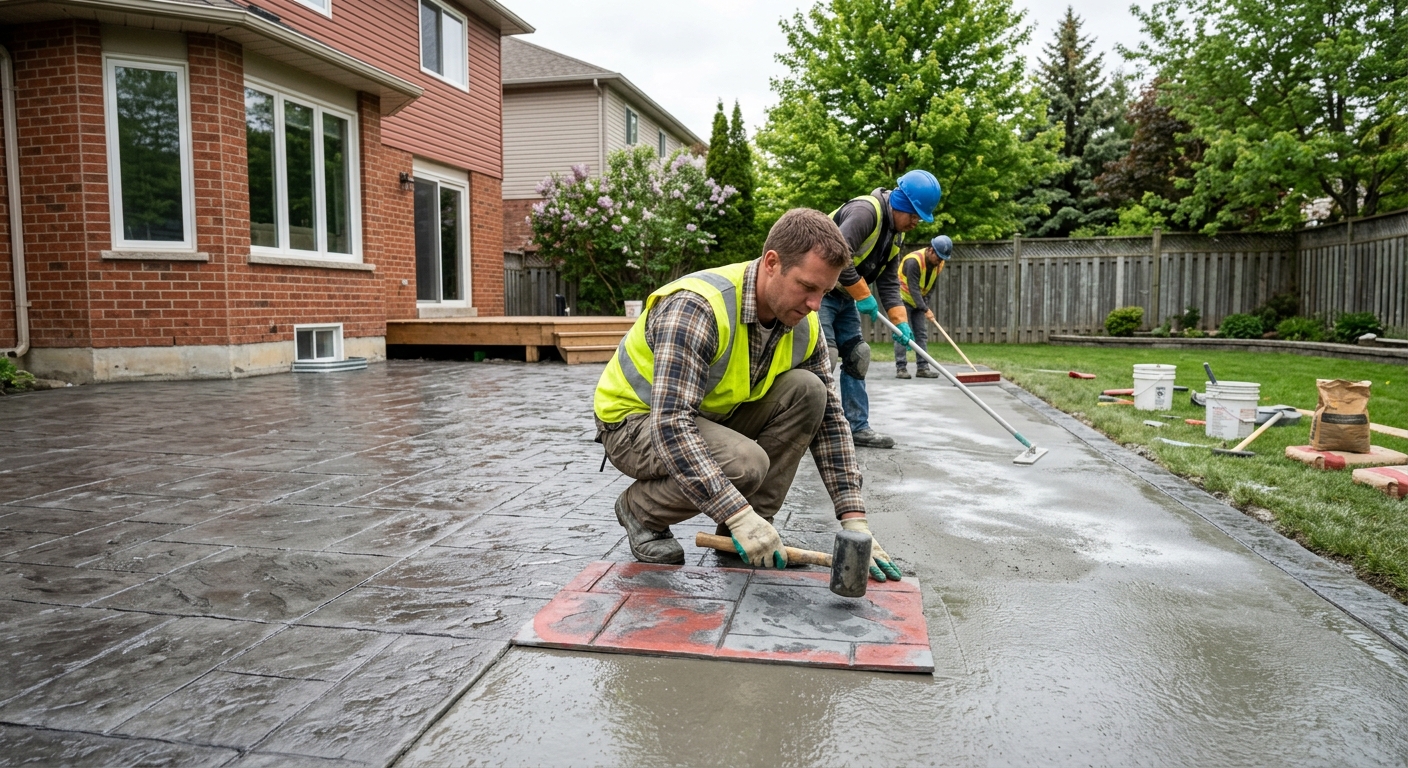
Concrete work options and costs in Wedgewood Heights
Wedgewood Heights concrete projects typically fall into a few clear categories, from driveways and patios to structural foundation work. In a community of about 1,470 residents (Statistics Canada, 2021 Census), the demand often tracks nearby growth around the Calgary area—especially as homeowners refresh older properties and add garages, decks, and concrete flatwork. That matters because flatwork like driveways, patios and walkways is one of the most common upgrades in this neighbourhood, and it’s also one of the most sensitive to Calgary’s frost-and-freeze–thaw reality.
In the Calgary economic region, concrete pricing is engineered around a design frost depth of roughly 1.2 m (about 4 ft). For houses, garages, and retaining structures, footings must sit on undisturbed soil below that depth to reduce frost heave and seasonal movement. Add frequent freeze–thaw cycles and you get tighter requirements for air-entrained mixes, granular base prep, and control joints—plus a shorter practical pour season for exterior slabs. In late fall or early spring, crews may use winter-grade mixes, insulated blankets, or temporary heating to protect curing, which can raise costs but protects durability.
Here in Wedgewood Heights, this trade is especially in demand for residential streets where driveways and front walks see heavy use—commonly around the busier connector roads and near homes adding parking pads and backyard patio expansions. With those local conditions in mind, here’s a practical comparison of typical scopes and what they usually cost before we discuss what drives the numbers.
| Application |
Typical Size |
Key Spec |
Finish Option |
Price Range |
| Concrete driveway (standard broom finish) |
24 ft x 10 ft (~240 sq ft) |
Air-entrained mix, rebar/wire as needed, granular base |
Broom finish, basic control joints |
$12,000–$18,000 |
| Exposed aggregate driveway |
24 ft x 10 ft (~240 sq ft) |
Air-entrained mix, proper curing, surface wash exposure |
Exposed aggregate, slip-resistant texture |
$14,500–$21,500 |
| Stamped concrete driveway or patio |
16 ft x 12 ft (~192 sq ft) |
Air-entrained mix, base + reinforcement, integral colour |
Stamp pattern + colour release/antique look |
$15,000–$26,000 |
| Plain concrete patio or walkway |
12 ft x 10 ft (~120 sq ft) |
Air-entrained mix, compacted base, joints |
Plain finish, trowel or broom edge |
$5,000–$9,000 |
| Garage floor (interior slab) |
20 ft x 22 ft (~440 sq ft) |
Min. 32 MPa, vapour barrier as recommended, reinforcement |
Float/smooth finish, sealed as an option |
$8,500–$15,000 |
| Foundation footings (structural, below frost) |
Typical single-family footprint (~900–1,400 sq ft of affected perimeter) |
Structural concrete, engineered rebar, excavation to frost depth |
Below-grade concrete (no decorative finish) |
$28,000–$45,000 |
Prices are estimates only and vary by project scope, site access and material selection.
What affects the price of concrete work in Wedgewood Heights
In Wedgewood Heights (and across Calgary and surrounding Alberta communities), two contractors can quote the “same” concrete job and still land 30–50% apart. The reasons usually aren’t just profit or brand name materials—they’re the engineered parts of the scope: how deep they excavate, how they build the granular base, what reinforcement they place, and how they protect curing in cold weather. In a market where multiple crews compete for limited winter-grade labour and equipment time, the cost swings can be noticeable even for standard driveway pours.
First, the frost line depth and freeze–thaw cycles dictate nearly everything. Footings must extend below the design frost depth (about 1.2 m here), and exterior slabs generally require air-entrained concrete to survive repeated expansion and contraction. Because the practical pour season for exterior work is shorter in Alberta, contractors may need cold-weather curing precautions—insulated blankets, temporary heat, or better scheduling to avoid weak early strength gains. Those precautions can push a job from the lower end of the range to the higher end.
Second, de-icing salt accelerates surface wear and spalling over time. That makes sealing timing and product choice more important than many homeowners expect. For a driveway that lands around $12,000–$18,000, a higher-cost spec (better base, correct reinforcement, and proper curing) can be justified because it reduces early cracking and scaling. By contrast, stamped finishes that sit in the $15,000–$26,000 band only make financial sense when the base prep and jointing are done right—otherwise the extra decorative work doesn’t fix underlying durability problems.
Two Wedgewood Heights examples: (1) If your existing subgrade is soft or you’ve got poor drainage, excavation and replacement granular base can add thousands because the slab must bear on stable material below the frost-affected zone. (2) If you’re pouring late fall and the contractor builds a protected curing plan, you may pay more up front, but you’re buying a stronger surface instead of risking scaling and premature spalling.
| Price Factor |
Why It Matters |
Cost Impact |
| Frost line depth — determines footing depth and form height |
Footings must bear below the design frost depth to prevent frost heave and seasonal movement. |
Higher excavation volume typically moves foundation work toward the upper band. |
| Site preparation — excavation, grading, compacted granular base |
Stable bearing and correct base thickness reduce settlement-related cracking. |
Soft soils or poor drainage can add significant labour and material. |
| Reinforcement — rebar or wire mesh requirement |
Reinforcement controls cracking and supports slabs under load and freeze–thaw stress. |
Proper reinforcement placement often adds cost but improves longevity. |
| Mix design — air-entrainment and compressive strength spec |
Air-entrainment reduces freeze–thaw damage; strength spec supports structural performance. |
Correct mix usually costs more than “standard,” but lowers failure risk. |
| Finish type — broom vs. stamped vs. exposed aggregate |
Decorative work adds finishing time, product handling, and curing/colour processes. |
Stamped/exposed typically pushes pricing into higher flatwork ranges. |
| Pour size and concrete truck access to site |
Long carries, tight access, and multiple mobilizations increase labour and logistics. |
Bad access can add crew hours or require pumps/extra materials. |
| Cold-weather curing precautions — heating and blankets |
Protected curing helps concrete reach strength before freeze conditions slow hydration. |
Extra equipment and time can raise exterior slab costs. |
| Control joint pattern and sealing cost |
Joints guide cracking and sealing helps resist de-icing salt wear. |
Skipping or cheaping this step leads to earlier repairs. |
Permits & regulations in Alberta
In Alberta, structural concrete work typically needs a building permit. That usually includes footings, foundation walls, grade beams, and any other structural concrete elements that support the house or affect the building’s load path. In many cases, engineered drawings are required or reviewed as part of the permit process, especially for foundation and structural reinforcement details.
Concrete flatwork—like patios, walkways, driveways, and garage floor slabs—often does not require a permit by default. However, there are exceptions: if your work changes lot grading, impacts drainage, affects impervious surface coverage limits, or touches municipal right-of-way concerns (for example, reshaping edges near boulevard areas), the municipality may require approvals. Because Wedgewood Heights homeowners can have different servicing and grading situations depending on the lot, the safest approach is to confirm with the local authority before breaking ground.
Before you sign with any contractor, verify they carry the right coverage. Step-by-step for Wedgewood Heights: (1) Ask for their current certificate of insurance—ensure it lists general liability coverage and that it’s active for the job dates. (2) Confirm worker coverage (WSIB/WCB). (3) Request a recent clearance letter or coverage verification document, then keep it with your contract. (4) For licensing, use the appropriate Alberta online registry/lookup tools to confirm the contractor’s standing. Finally, insist on references for similar concrete scopes (driveways and frost-depth footings behave differently than interior slabs).
Getting concrete right in Wedgewood Heights's freeze-thaw climate
In Wedgewood Heights, concrete most often fails because water gets into the slab edge, joints, or an under-built base—then freeze–thaw cycles do the rest. The biggest driver is spalling from inadequate air-entrainment and poor curing, followed by cracking from settlement or joints that are too far apart. If you want long-term performance in the Calgary climate, the spec has to be built for frost depth, not for “average summer conditions.”
Spec it in five steps. (1) Base preparation: excavate and place compacted granular sub-base to the correct depth and profile for your soil conditions, so the slab bears on stable material. (2) Mix design: order air-entrained concrete for exterior flatwork—commonly targeting 5–7% air content—and a minimum 32 MPa compressive strength. (3) Control joints: cut or form joints at a spacing that limits random cracking, then keep them clean so they seal well. (4) Curing: plan for at least 7 days of proper curing conditions; in cold weather, contractors often need blankets or heated enclosures to protect strength development. (5) Sealing: apply a penetrating sealer after the proper cure window (often 28 days) so de-icing salts don’t pound the surface.
Ask technical questions to avoid the common spalling problem: “What air-entrainment target are you using for this exposure?” “How will you protect curing if the temperature drops overnight?” “What is your planned base thickness and compaction method?” A common budget decision: homeowners sometimes compare a plain broom-finish driveway to stamped concrete. If a stamped option moves you from roughly $12,000–$18,000 up toward $15,000–$26,000, the extra cost is justified only if the base, reinforcement, joints, and curing plan are top-tier—otherwise you’re paying more for the same durability risk.
| Spec |
Why It Matters in Wedgewood Heights |
What to Ask For |
Impact if Skipped |
| Compacted granular base (depth?) |
Stable bearing reduces settlement cracks and keeps edges from breaking down in freeze–thaw. |
Confirm base depth for your driveway/patio and soil, plus compaction testing or documented compaction method. |
Cracking, uneven slab, and accelerated deterioration at edges. |
| Air-entrained concrete mix (target air %?) |
Air-entrainment helps concrete resist freeze–thaw damage common in Calgary’s cold winters. |
Ask for the air-entrainment target (commonly 5–7% for exterior flatwork) and how it will be verified. |
Spalling and scaling, especially with de-icing salts. |
| Compressive strength (MPa rating) |
Adequate strength supports early and long-term performance under load and temperature cycling. |
Confirm minimum 32 MPa spec for the slab or structural element. |
Surface weakness, deeper cracking, and reduced service life. |
| Control joints (spacing per ACI guidelines) |
Proper joint spacing controls where cracks happen instead of letting them wander. |
Ask for the joint spacing plan and whether joints will be tooled/cut on schedule. |
Random cracking that’s harder to repair and can allow water intrusion. |
| Minimum 7-day curing period |
Cold snaps slow hydration; correct curing builds strength before freeze conditions take over. |
Ask what curing protection is planned if temperatures drop (blankets/heating). |
Low early strength, higher risk of scaling and long-term surface breakdown. |
| Penetrating sealer (when applied after cure) |
Sealers help repel de-icing salt impacts and reduce water uptake during thaw cycles. |
Confirm product type and that sealing is applied after full cure (often around 28 days). |
Faster surface wear and more frequent maintenance. |
How to choose a concrete work contractor in Wedgewood Heights
Choosing a contractor in Wedgewood Heights is mostly about proof—proof they can build to spec in Alberta’s freeze–thaw conditions and proof they’re properly insured. Start with coverage. Ask for a current certificate of insurance showing general liability and confirming it’s valid for the project period. Next, verify WSIB/WCB clearance (or equivalent coverage documentation) so you’re not exposed to liability if a worker is injured on your site. You should also confirm licensing/registration standing in Alberta using the relevant online registry tools, and keep screenshots or reference numbers for your records.
Then demand itemised quotes rather than one big lump sum. Get 2–3 written estimates that break out labour and materials: excavation and hauling, granular base and compaction, reinforcement, formwork, the concrete mix spec (including air-entrainment), finishing, curing protection, joints, and sealing. Carefully read what’s excluded—common exclusions include permit handling (if applicable), disposal/haul-away, regrading for drainage, and saw-cutting schedule details. Clarify whether a permit pull is included for structural work.
On warranty, look for a workmanship warranty length stated in writing, and ask whether product/manufacturer warranties apply to admixtures, sealers, or other systems. Also confirm if warranties are transferable if you sell the home. For payments, never pay more than about 10–15% upfront; hold back a portion until key milestones are complete (base inspection, rebar inspection where applicable, successful finishing and curing completion). Finally, insist on a timeline in writing: a start date and a realistic completion estimate that includes curing protection during cold spells.
- Provides a written scope with dimensions, thicknesses, and reinforcement details.
- States the concrete mix spec for Alberta exposure (air-entrainment and strength).
- Shows how they build the granular base and how they verify compaction.
- Explains joint spacing and whether joints will be cut/tool cut on schedule.
- Details cold-weather curing plan (blankets/heating if needed).
- Includes whether snow/ice removal and surface protection are part of prep.
- Lists reinforcement method (rebar spacing or wire mesh type) if required.
- Confirms site access plan for the truck and concrete pour logistics.
- Provides disposal/haul-away for excess soil and concrete debris (if applicable).
- Includes sealing plan only if it’s part of your scope and states timing.
- Supplies insurance and WSIB/WCB clearance documentation before work starts.
- Offers references from similar Wedgewood Heights/Calgary climate concrete jobs.
Concrete red flags in Wedgewood Heights: vague air-entrainment answers (“it’s the usual mix”), skipping base thickness details, refusing to discuss curing and temperature protection, proposing too-wide joint spacing or not cutting joints on time, and requiring a large upfront payment without an inspection or milestone schedule.
Frequently asked questions — concrete work in Wedgewood Heights
What is the difference between concrete and cement?
In Wedgewood Heights, people often use the words “cement” and “concrete” interchangeably, but they’re not the same. Cement is one ingredient—typically Portland cement—that binds everything together. Concrete is the full engineered material: cement plus water, sand, gravel (or crushed stone), and often performance admixtures. For exterior flatwork and foundation work in Alberta’s freeze–thaw climate, the design focus is on the full concrete mix—especially air-entrainment for durability and the target strength (commonly at least 32 MPa for many structural and flatwork specs). When you’re getting quotes, ask what the supplier/carrying contractor is using for the full mix design, not just the cement brand.
How much does concrete work cost in Wedgewood Heights?
Typical concrete pricing in Wedgewood Heights follows the Calgary market’s frost-driven realities. For a driveway or slab, many homeowners land in the $12,000–$18,000 range depending on size, base prep, reinforcement, and whether cold-weather curing protection is needed. Patios and walkways often run $5,000–$9,000 for smaller projects, while stamped or highly decorative concrete commonly lands in the $15,000–$26,000 band due to extra finishing labour and materials. Foundation/footings for structural work are usually a larger ticket item, often $28,000–$45,000. The biggest cost swings come from excavation volume, subgrade condition, reinforcement requirements, and the curing plan during shoulder seasons.
How deep must footings be for Wedgewood Heights's frost line?
For Wedgewood Heights homeowners, footings are generally designed around a frost depth of about 1.2 m (roughly 4 ft) in the Calgary region. The key concept is that the footing must bear on undisturbed soil below the design frost depth to reduce frost heave and seasonal movement. That’s why quotes for foundation footings can differ even among “similar” homes: excavation depth and soil conditions aren’t identical lot-to-lot. Before work begins, the engineer/architect spec and the permit drawings govern the exact depth and reinforcement. If you’re comparing contractor estimates, make sure they’re describing excavation to the specified depth and not guessing based on what was done on a neighbouring property.
Why does concrete crack in Wedgewood Heights and how is it prevented?
Cracking is common in Alberta, but good design prevents it from becoming a failure. In Wedgewood Heights, the usual causes are: (1) freeze–thaw stress plus water intrusion through poorly sealed or unprotected edges and joints; (2) inadequate air-entrainment, which can lead to spalling and then cracking; and (3) settlement from insufficient base preparation or weak subgrade. Prevention is about building the slab to manage shrinkage and thermal movement: correct air-entrained mix, proper granular base prep and compaction, and a control joint pattern that guides where cracks happen. Contractors should cut/tool joints on schedule and keep them clean for sealing if your scope includes it. Proper curing—especially in cold snaps—is also crucial to reduce early-age cracking.
Stamped vs broom-finish concrete — cost difference?
Stamped concrete costs more than broom-finish because it’s not just a surface—it’s an added production process. In Wedgewood Heights, the typical driveway price band is $12,000–$18,000 for a standard broom-finish driveway, assuming the base prep and reinforcement are properly built. Stamped concrete usually falls into $15,000–$26,000 because of labour-intensive finishing steps (colouring, stamping, release agents, and extra attention to timing), plus sometimes added material and detailing around edges and joints. The important takeaway: if the base, reinforcement, joints, and curing plan aren’t correct, stamped concrete won’t last longer—it only looks better until it fails.
When is the best time to pour concrete in Wedgewood Heights?
For Wedgewood Heights (Calgary area), the best time is when you can cure without fighting freezing temperatures. Late spring to early fall is typically most straightforward because concrete hydration and curing conditions are easier to maintain. In late fall or early spring, the pour can still work, but you need winter-grade mix options, insulated blankets, and sometimes temporary heating to protect the slab while it gains strength. The curing window matters—rushing it increases the risk of surface scaling and long-term durability problems. Ask your contractor what temperature range they’ll pour in, what curing protection they plan, and whether they schedule jointing/cutting and sealing timing to match Alberta freeze–thaw conditions. A contractor who plans curing protection usually provides better long-term performance than one who just “pours when convenient.”