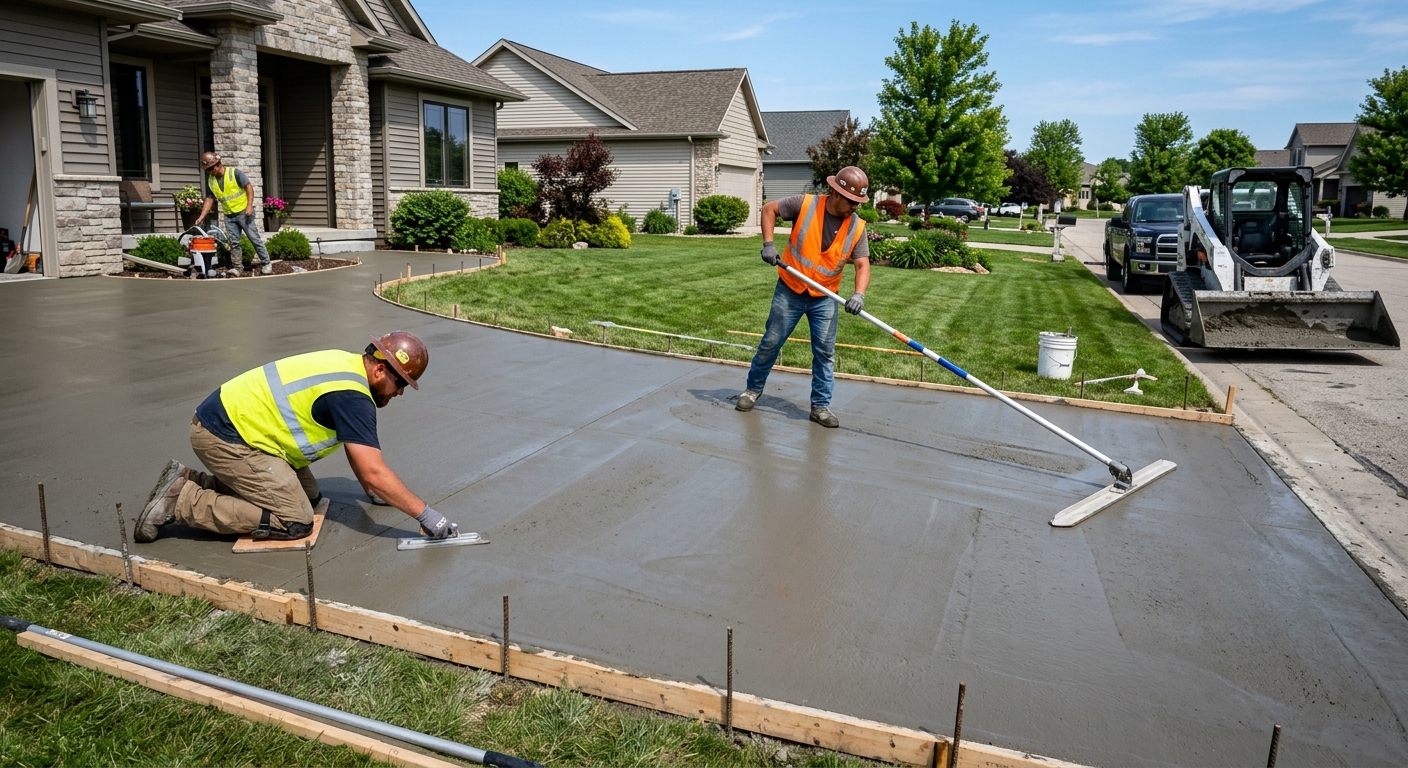
Concrete work options and costs in West Hillhurst
West Hillhurst is a neighbourhood where homeowners expect clean, long-lasting exterior concrete—especially around driveways, patios and walkways. With West Hillhurst’s population at 6,635 (Statistics Canada, 2021 Census), there’s steady demand for replacement and upgrades in the older, established housing blocks. A lot of properties here are single-detached homes or well-used small lots, which makes access, excavation depth, and finish quality more important than in newer subdivisions.
In Calgary’s cold continental climate, concrete pricing isn’t just about the slab—it’s about frost and freeze–thaw performance. Alberta’s design frost depth is deeper than many homeowners expect, so footing and foundation work is engineered to bear below the frost line (and exterior slabs need robust base prep). Frequent freeze–thaw cycles also push requirements for air-entrained mixes, well-spaced control joints, and winter-grade curing when exterior placement falls near the shoulder seasons.
That’s why in pockets of West Hillhurst like the areas closer to 10 Avenue SW and the Beltline edge (busier streets with tighter access), you’ll often see higher costs—not because concrete is more expensive, but because excavation, forming, and truck access planning take more labour. If you’re comparing options, the finish choice can be the biggest visible cost difference: a standard broom finish is the most economical, while stamped or exposed aggregate adds material and extra finishing time.
Below is a practical cost comparison you can use as a baseline for budgeting before you request itemized quotes.
| Application |
Typical Size |
Key Spec |
Finish Option |
Price Range |
| Concrete driveway (standard broom finish) |
20 ft x 10 ft (200 sq ft) |
Air-entrained mix, compacted granular base |
Broom finish + edging |
$12,000–$18,000 |
| Exposed aggregate driveway |
20 ft x 10 ft (200 sq ft) |
Air-entrained mix, controlled wash/exposure |
Exposed aggregate finish |
$15,000–$22,000 |
| Stamped concrete driveway or patio |
15 ft x 12 ft (180 sq ft) |
Air-entrained mix, colour hardeners (as specified) |
Stamped pattern + sealer |
$15,000–$26,000 |
| Plain concrete patio or walkway |
12 ft x 10 ft (120 sq ft) |
Air-entrained mix, correct base thickness |
Plain trowel/wood float or light broom |
$5,000–$9,000 |
| Garage floor (interior slab) |
24 ft x 22 ft (528 sq ft) |
Interior slab, vapour control as needed |
Plain finish (steel trowel) |
$10,500–$18,500 |
| Foundation footings (structural, below frost) |
Typical house footprint (engineered) |
Reinforced, designed depth below frost |
N/A (structural concrete) |
$28,000–$45,000 |
Prices are estimates only and vary by project scope, site access and material selection.
What affects the price of concrete work in West Hillhurst
In West Hillhurst and across Calgary, two contractors can quote the “same” concrete job and still be 30–50% apart once you account for engineering details, excavation realities, and finishing/spec choices. The market here also has a rhythm: cold-weather scheduling tightens labour capacity and the crew time needed for proper curing. When the weather window is short, finishing crews and concrete suppliers prioritize jobs that meet performance specs, and that can influence pricing.
The biggest technical driver is frost. Calgary’s design frost depth is about 1.2 m (roughly 4 ft), which means footings, form height, and excavation volumes are bigger than in milder regions. For exterior slabs, Calgary’s frequent freeze–thaw cycles also dictate air-entrained concrete mixes and a granular base built to resist pumping and movement. Add on winter-grade placement and curing precautions—insulated blankets, sometimes temporary heat—and you’ll see cost increases on projects scheduled in late fall or early spring.
De-icing salt is another local reality. It can accelerate surface scaling and spalling if the concrete mix and finishing aren’t right, so sealing becomes less of an “upgrade” and more of a protection step.
To make it concrete: upgrading from a plain patio/walkway to stamped concrete can move you within the $5,000–$9,000 patio range up into the $15,000–$26,000 stamped tier when you add colouring, release agents, labour-intensive patterning and higher-end sealing systems. On foundation work, excavation and reinforcement details can push footing budgets toward the higher end of $28,000–$45,000 even before we talk finish at all. In a neighbourhood with older underground services and tighter access routes, that excavation and disposal line item can be the difference between a mid-range and top-of-band quote.
| Price Factor |
Why It Matters |
Cost Impact |
| Frost line depth |
Determines footing depth and form height |
Major driver—deeper excavation increases concrete, labour, and disposal |
| Site preparation |
Excavation, grading, compacted granular base |
Can swing quotes 10–25% depending on soil, rock, and access |
| Reinforcement |
Rebar or wire mesh requirement |
Higher for foundations; slab reinforcement may be reduced or omitted incorrectly if not engineered |
| Mix design |
Air-entrainment and compressive strength spec |
Air-entrained and engineered mixes cost more but reduce freeze–thaw damage |
| Finish type |
Broom vs. stamped vs. exposed aggregate |
Stamped/exposed requires more steps, materials and skilled finishing time |
| Pour size and concrete truck access to site |
Limits how much can be placed efficiently |
Tighter lots can add labour and equipment; rework risk increases |
| Cold-weather curing precautions |
Heating and blankets |
Often adds cost in shoulder months but protects long-term performance |
| Control joint pattern and sealing cost |
Controls cracking and repels salt intrusion |
Sealers/joint work cost more upfront but reduce costly surface failures |
Permits & regulations in Alberta
In Alberta, structural concrete work typically needs a building permit and often engineered drawings that the municipality reviews. That includes things like foundation footings, foundation walls, and grade beams, because they’re part of the load-bearing system. For concrete flatwork—patios, walkways, and driveways—permits are commonly not required, but they can become relevant if the work affects lot grading, drainage, or municipal impervious surface coverage limits, or if you’re changing slopes near a property line/right-of-way.
Before breaking ground in West Hillhurst, confirm the exact scope with the local authority and make sure your contractor can document what does (and doesn’t) require approval for your project. Also verify coverage: a solid contractor should carry liability insurance and have the correct worker coverage (WSIB/WCB depending on the work setup).
How a homeowner can verify a contractor in Alberta (step-by-step):
- Ask for the contractor’s current certificate of insurance (liability) and verify the coverage is active and matches the work scope.
- Request proof of clearance/coverage documentation for workers (WSIB/WCB, as applicable), not just a promise that “we’re insured.”
- For licensing/registration, use the relevant public online registry for the contractor’s status (and confirm the company name matches the quote).
- Ask for references on similar-scale flatwork and foundation-related concrete scopes, ideally in Calgary-area weather conditions.
- Confirm who will pull any permit if it’s required and whether that cost is included in the written quote.
Getting concrete right in West Hillhurst's freeze-thaw climate
Concrete fails in West Hillhurst most often due to moisture movement through the slab and poor freeze–thaw durability. When water gets under or into the concrete and the freeze–thaw cycle repeats, you can see spalling (flaking), scaling, and wider cracks—especially on edges and areas hit by vehicle traffic or de-icing salt.
To spec the job correctly, focus on five areas. (1) Base preparation: build a compacted granular sub-base to the right depth for local frost behaviour and soil conditions, so the slab doesn’t pump or settle. (2) Mix design: require air-entrainment for exterior flatwork (target about 5% to 7% air content) and a minimum 32 MPa compressive strength, consistent with engineered needs. (3) Control joints: provide a joint layout that limits random cracking—your contractor should explain spacing and finishing timing. (4) Curing: plan for a minimum 7-day curing period under proper conditions; in cold snaps, that may mean insulated blankets or temporary heat to avoid surface scaling. (5) Sealing: use a penetrating sealer applied after the concrete has cured (often around 28 days) to help repel salt intrusion.
When homeowners ask why the “good” quote costs more, here’s a real example: moving from a basic broom-finished patio to an engineered exterior patio can mean paying more for air-entrained mix, thicker base, and better curing support. That extra spend is often justified because the alternative—scaling in a couple winters—typically costs far more to repair later, especially when you factor in demolition and reinstatement. In a city like Calgary with longer freeze–thaw exposure, the most common failure is spalling driven by inadequate air-entrainment and rushed curing.
| Spec |
Why It Matters in West Hillhurst |
What to Ask For |
Impact if Skipped |
| Compacted granular base (depth?) |
Prevents settlement and pumping under repeated freeze–thaw cycles |
Base depth and compaction plan matched to your soil and frost behaviour |
Cracks widen, edges fail, slab heaves or settles |
| Air-entrained concrete mix (target air %?) |
Improves freeze–thaw durability in Calgary winters |
Air content target around 5% to 7% for exterior flatwork |
Higher risk of spalling and scaling within a few seasons |
| Compressive strength (MPa rating) |
Ensures structural and abrasion resistance under traffic and weather |
Minimum 32 MPa (or higher if engineered for your application) |
Surface wear, premature deterioration, reduced load capacity |
| Control joints (spacing per ACI guidelines) |
Controls where cracks happen when shrinkage and movement occur |
Joint spacing and timing (sawcut vs. tooled) described in writing |
Random cracking that compromises drainage and appearance |
| Minimum 7-day curing period |
Builds strength and reduces early surface defects in cold conditions |
How curing will be protected (blankets/heat) if temps drop |
Surface scaling, reduced long-term strength and durability |
| Penetrating sealer (when applied after cure) |
Helps repel de-icing salt and reduces moisture uptake |
Confirm timing (often around 28 days after pour) and product type |
Faster salt-related deterioration and more frequent repairs |
How to choose a concrete work contractor in West Hillhurst
Choosing a contractor in West Hillhurst comes down to verification, clarity, and workmanship controls. First, confirm Alberta coverage and compliance. Ask for a certificate of liability insurance that’s current and names the legal entity quoting the job. Then request worker coverage documentation (WSIB/WCB as applicable) so you’re not exposed if there’s an injury on-site. If the contractor claims they’re “licensed,” ask what that covers and verify through the appropriate public online registry for business status.
Next, get 2–3 itemised written quotes. You want line items that break out labour and materials, including excavation and disposal, base prep, reinforcement details, concrete mix specs, finishing, joints, and any sealing—rather than a single lump sum. Make sure you understand what’s excluded: changes in site conditions, removal of existing concrete, protection of landscaping, permit fees, and right-of-way constraints.
Warranty matters too. Ask for a clear workmanship warranty length and confirm whether it’s tied to the specific installed scope. Product/manufacturer warranty on sealer or admixtures should be documented, and you should ask if it’s transferable to future owners.
For payment, never pay more than 10–15% upfront. Holdback is reasonable until the forms are removed, curing steps are complete, joints are installed, and you’ve done a final walk-through. Finally, require a written timeline: start date and a realistic completion estimate based on weather risk in Calgary.
- Confirm insured status and worker coverage before signing.
- Ask for at least two similar West Hillhurst or Calgary-area references.
- Request a written scope that includes base depth and compaction method.
- Require air-entrained mix and minimum compressive strength in the quote.
- Get joint layout details and whether they’ll be sawcut or tooled.
- Clarify curing plan for cold nights (blankets/heating if needed).
- Ask about sealing type and when it will be applied after pour.
- Make disposal and existing concrete removal explicit (or excluded).
- Confirm access constraints for concrete trucks and how they’ll manage them.
- Ensure the quote lists reinforcement type (if applicable) and thickness.
- Check warranty terms: workmanship duration and what triggers it.
- Use a payment schedule with a holdback until final completion.
Red flags in West Hillhurst: quotes that don’t specify air-entrainment or curing steps, unusually low prices that skip proper base prep, no written joint layout (or vague “we’ll do joints”), pressure to pay the majority upfront, and contractors who won’t provide insurance/worker coverage documentation.
Frequently asked questions — concrete work in West Hillhurst
What is air-entrained concrete and why does it matter here?
Air-entrained concrete has tiny, evenly distributed air bubbles built into the mix. In West Hillhurst and across Alberta, those bubbles give the water in concrete space to expand during freeze–thaw cycles, which greatly reduces spalling and surface scaling risk. That’s why exterior flatwork needs a durable mix rather than a “basic” concrete—especially when de-icing salt is used in Calgary winters. If a quote for a driveway or walkway only mentions strength and not air content, it’s incomplete. A properly specified exterior job also ties into other specs like base prep and control joints, so the whole system performs together. For budgeting, a standard broom-finished driveway is typically in the $12,000–$18,000 tier, while premium finishes increase price partly due to added labour and materials, but the freeze–thaw durability needs to be present in all exterior options.
How do I prepare the base for a concrete slab?
Base prep is where most long-term problems are won or lost. In West Hillhurst, preparation usually starts with removing unsuitable material and excavating to a depth that supports the slab below expected frost movement—Calgary’s design frost depth is about 1.2 m, so you can’t treat this like a shallow “top-up” job. Then the contractor grades the sub-base, supplies a compacted granular layer, and compacts to the right density before concrete placement. Proper drainage and edge support matter for driveways and patios; if water can migrate under the slab, it will freeze and expand. Ask your contractor to explain the granular base depth, compaction method, and what they’ll do if they encounter rock, soft spots, or utility conflicts. These line items are often where quotes differ by 30–50%, and they’re also why cheaper concrete sometimes fails earlier.
How do I compare concrete quotes?
To compare concrete quotes in West Hillhurst, don’t just compare the bottom line—compare what’s included. First, require itemized pricing that shows labour, removal/disposal, excavation, base material, reinforcement, concrete mix spec (including air-entrainment for exterior), finishing steps, and curing precautions. Second, check whether the quote includes joint layout and sealing where appropriate. Third, confirm the access plan for concrete truck placement, because tight streets and drive widths in older neighbourhoods can add labour. Fourth, ask about timing: if they plan to pour near cold nights, ask what winter curing support they’ll use (insulated blankets or heat) to protect curing. Finally, look at how they handle exclusions like permit pull, landscaping protection, or grading changes. A broom-finished driveway commonly falls around the $12,000–$18,000 range, while stamped work often sits higher in the $15,000–$26,000 tier—finishes matter, but specs and curing should be non-negotiable.
Can concrete be poured in cold weather in West Hillhurst?
Yes, concrete can be poured in cold weather in West Hillhurst, but it has to be engineered and protected during curing. Calgary’s freeze–thaw cycle means the risk isn’t just “cold today”—it’s whether the concrete reaches early strength without freezing at the surface or in the first curing window. That typically requires winter-grade mix, plus operational precautions like insulating blankets and, in some cases, temporary heat around the pour area. The goal is to maintain curing conditions long enough to build strength and reduce scaling. A responsible contractor will tell you what temperature triggers their cold-weather protocol and how they’ll monitor and document curing conditions. If someone proposes to “just pour and hope,” that’s a red flag. If you’re scheduling near late fall or early spring, it’s reasonable to expect winter curing precautions to increase labour and material costs compared to summer pours.
How do I maintain concrete in West Hillhurst's freeze-thaw climate?
Maintenance is mostly about controlling moisture and protecting the surface from salt and abrasion. Start with sealing: penetrating sealers applied after cure (often around 28 days post-pour) help repel de-icing salt and slow moisture uptake. Use de-icers carefully—avoid excess salt piles and switch to less aggressive options when possible. For driveways and sidewalks, keep edges clear of debris so meltwater doesn’t pool and refreeze. If you see small surface scaling, address it early with appropriate repair products rather than waiting until it spalls deeper. Also, keep an eye on drainage: if water runs toward the slab and freezes, you’ll accelerate deterioration. For stamped or exposed aggregate surfaces, maintenance usually includes compatible cleaning and avoiding harsh tools that can abrade the finish. Well-built concrete with air entrainment, joints, and proper curing is your best foundation for low-maintenance winters.
What causes concrete to spall in West Hillhurst winters?
Spalling is usually a freeze–thaw durability issue combined with moisture exposure. In West Hillhurst winters, the most common causes are inadequate air-entrainment, poor curing, and weak surface protection—especially when de-icing salt is used. If the concrete mix doesn’t have the right air content, water in the paste can expand during freezing and push off small surface layers. Poor base prep can also contribute by allowing pumping or movement, which creates additional cracking paths for water. If control joints are missing, poorly spaced, or sealed incorrectly, cracks can form randomly and hold water. Another contributor is rushing placement or curing in cold weather without insulating blankets or heat. Spalling can also start at edges where water concentrates. The fix is rarely “just patch the top”—you need the right specs and prep to stop the moisture cycle. That’s why exterior concrete durability is tied to engineering and mix design, not only to appearance.