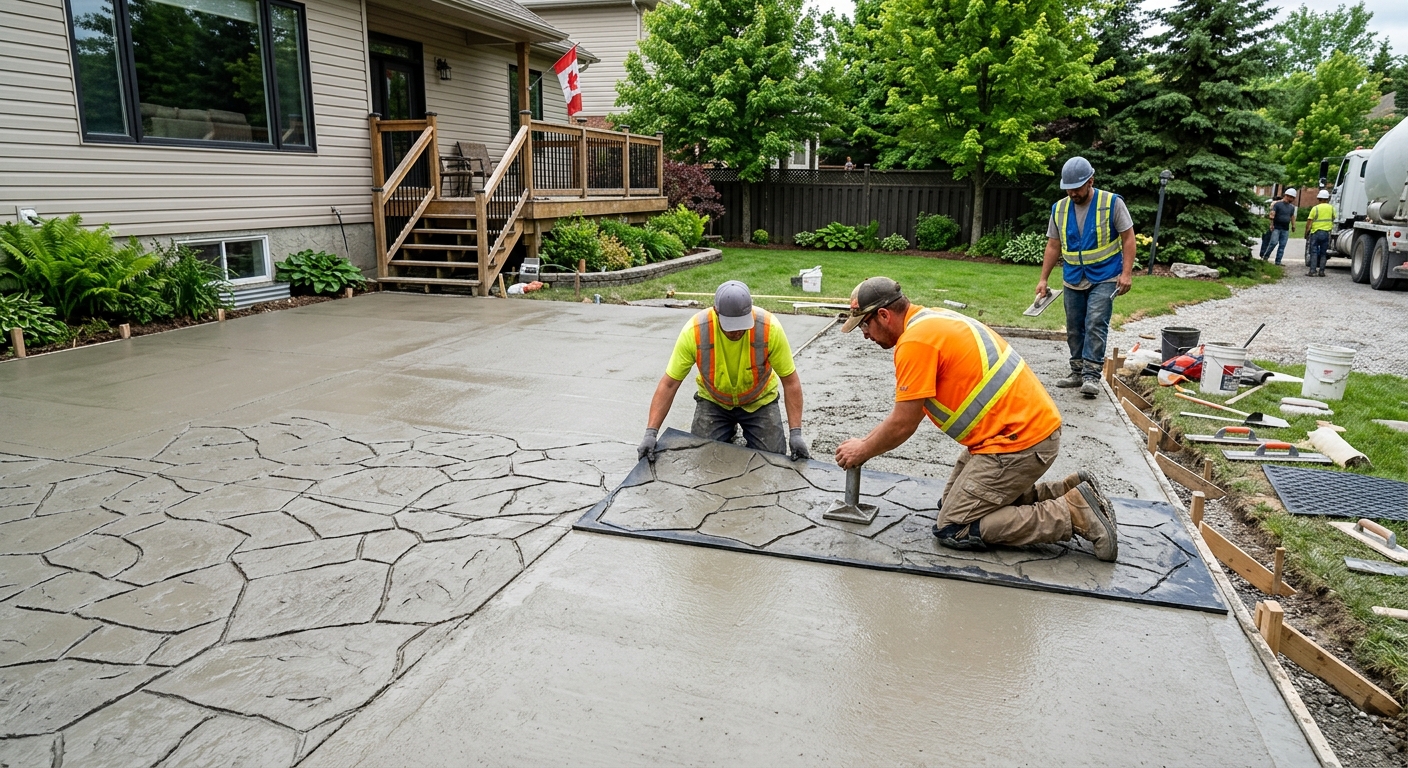
Concrete work options and costs in Cedarbrae
Cedarbrae homeowners typically look at concrete as a long-term, low-maintenance part of the property—especially for driveways, patios and walkways that take the brunt of winter salt, ploughing and freeze–thaw. In a community of about 5,935 people (Statistics Canada, 2021 Census), the market is dominated by established suburban lots and ongoing renos, which keeps demand strong for exterior flatwork and foundation upgrades. While new builds come and go, the most frequent concrete calls are for replacing worn surfaces and improving drainage around single-detached homes.
In the Calgary economic region, pricing is shaped by engineering and scheduling. The design frost depth is roughly 1.2 m (about 4 ft), so exterior work often requires deeper excavation and larger footing/grade beams than in milder areas. Freeze–thaw cycling also drives the need for air-entrained mixes, well-compacted granular base and a control-joint layout that limits random cracking. Contractors in Cedarbrae (and nearby Calgary communities) are busiest during the short exterior concrete window, so late-season pours can require winter-grade measures—insulated blankets, controlled curing heat, or adjusted mix requirements—which increases labour and material costs.
Another cost lever is where you are in Cedarbrae: pockets near busier commercial corridors often mean more constraints for truck access and staging, and that can add labour time even for the same slab size. With those variables in mind, the table below is a realistic snapshot of typical scope and pricing so you can compare bids apples-to-apples.
| Application |
Typical Size |
Key Spec |
Finish Option |
Price Range |
| Concrete driveway (standard broom finish) |
24’ x 12’ (288 sq. ft.) |
Air-entrained exterior mix; compacted granular base |
Broomed, light saw-cut control joints |
$12,000–$18,000 |
| Exposed aggregate driveway |
24’ x 12’ (288 sq. ft.) |
Air-entrained exterior mix; proper finishing timing |
Exposed aggregate (washed finish) |
$14,500–$21,500 |
| Stamped concrete driveway or patio |
20’ x 14’ (280 sq. ft.) |
Air-entrained mix; integral colour or dry-shake colouring |
Stamp pattern + release agent + seal coat |
$15,000–$26,000 |
| Plain concrete patio or walkway |
12’ x 16’ (192 sq. ft.) |
Air-entrained mix; broom or steel-trowel edge work |
Plain broom finish; saw-cut joints |
$5,000–$9,000 |
| Garage floor (interior slab) |
22’ x 22’ (484 sq. ft.) |
Vapour barrier; reinforced where required by design |
Steel trowel; sealed or densified optional |
$10,000–$16,000 |
| Foundation footings (structural, below frost) |
Typical single-detached: approx. 1,200–1,600 sq. ft. of footing area |
Engineered depth below frost; rebar per design |
Formed structural concrete (no decorative finish) |
$28,000–$45,000 |
Prices are estimates only and vary by project scope, site access and material selection.
What affects the price of concrete work in Cedarbrae
It’s normal to see quotes for the same “simple” concrete job swing by 30–50% in Calgary and across Alberta. The reason isn’t usually the concrete itself—it’s everything around it: excavation depth, base prep, reinforcement requirements, the mix design (especially air content), and how the contractor manages curing in cold weather. In Cedarbrae, contractors are also balancing seasonal demand, so scheduling and crew availability can move labour costs noticeably.
Every bid is driven by the frost and freeze–thaw reality. Footings and below-grade components must extend below the design frost depth (about 1.2 m), and exterior slabs need durable specs to resist repeated ice formation. That typically means an air-entrained mix and a granular base that’s compacted to the right thickness and grade. In late fall or early spring, the pour season tightens: cold-weather placement may call for winter-grade admixtures, insulated blankets, and sometimes temporary heat. Those steps protect the curing process—rush it, and you can see scaling or spalling earlier. On top of that, de-icing salt common in Calgary winters accelerates surface wear, so sealing is often recommended for driveways and patios.
Two Cedarbrae examples that frequently change the number: (1) a 24’ x 12’ driveway poured with “standard base” versus a properly compacted granular base engineered for local soil can move labour and materials enough that broom-finished work can land closer to the lower end of the $12,000–$18,000 band, while a more engineered, reinforced option with winter curing precautions can push toward the higher end; (2) switching from plain to stamped concrete may be a jump toward the $15,000–$26,000 band, but it’s only justified when the contractor uses the right release process, colour control and sealing plan to keep the decorative surface looking consistent.
| Price Factor |
Why It Matters |
Cost Impact |
| Frost line depth — determines footing depth and form height |
Deeper excavation/formwork to bear below frost prevents heave and seasonal movement |
Higher excavation and concrete volume; can add thousands on foundations and retaining work |
| Site preparation — excavation, grading, compacted granular base |
Proper base prevents settlement and reduces cracking when temperatures swing |
More granular and compaction time increases labour/materials |
| Reinforcement — rebar or wire mesh requirement |
Controls cracking and improves load capacity (especially on driveways/garage slabs) |
Material plus labour for tying/spacing can raise the quote |
| Mix design — air-entrainment and compressive strength spec |
Durable exterior performance in Alberta freeze–thaw cycles depends on air content |
Winter-grade mixes/admixtures and tested strength specs can add cost |
| Finish type — broom vs. stamped vs. exposed aggregate |
Decorative methods require more labour time, timing skill and sealing |
Stamped/exposed usually increases overall pricing versus plain broom finishes |
| Pour size and concrete truck access to site |
Long carries or multiple placements slow the crew and increase labour hours |
Access constraints can raise labour and pumping/handwork requirements |
| Cold-weather curing precautions — heating and blankets |
Maintains strength gain to reduce scaling, spalling and surface deterioration |
Heaters/blankets and added supervision can add meaningful cost |
| Control joint pattern and sealing cost |
Joints manage where cracks occur; sealing helps resist salt scaling |
More saw cuts and sealer are typically a small cost compared to repairs later |
Permits & regulations in Alberta
In Alberta, structural concrete work generally requires oversight and permitting. If your project includes structural elements such as foundation footings, foundation walls, grade beams, or any cast-in-place components tied to engineered structural design, you should expect to apply for a building permit and, in many cases, submit engineered drawings for review. For exterior flatwork—patios, walkways, driveways—permits are often not required unless the work changes lot grading, impacts stormwater management, or triggers municipal limits around impervious surface coverage or drainage patterns. Because requirements can vary based on the exact scope and where the slab sits on your lot, confirm directly with the local authority before breaking ground.
For Cedarbrae homeowners, contractor qualification is just as important as permits. Start by asking for proof of liability insurance and WSIB/WCB (where applicable). Then verify the contractor’s Alberta registration/licensing status through the appropriate online registry. Next, request a current Certificate of Insurance (COI) and check that the work you’re hiring is covered. If the contractor is using subcontractors, make sure they’re included in the insurance coverage plan and that WSIB/WCB obligations are confirmed before work begins.
Finally, get references for similar-scale jobs done recently in the Calgary area, and ask whether they required winter curing measures. With Edmonton/Red Deer rules not being relevant here, the key is Alberta compliance plus a crew that can execute freeze–thaw-ready concrete specifications on schedule.
Getting concrete right in Cedarbrae's freeze-thaw climate
Cedarbrae’s freeze–thaw climate can be brutal on concrete when the job is spec’d like a “fair weather” product. The most common failures I see are surface scaling and spalling, usually caused by inadequate air-entrainment, rushed curing, or a weak/unstable base. When moisture gets into the slab and freezes repeatedly, it expands and breaks down the surface—especially where de-icing salts splash during ploughing and daily traffic.
To avoid that, you want the job engineered around five basics. First is base preparation: the compacted granular sub-base must be installed to the right thickness and to grade, so the slab doesn’t settle and pull cracks open. Second is mix design: for exterior flatwork, air-entrainment is critical (often targeting about 5–7% air content) and the concrete should meet a minimum strength commonly specified around 32 MPa for durable exterior use. Third is control joints: they must be cut/formed on a spacing plan that limits random cracking. Fourth is curing: plan for at least 7 days of proper curing under conditions that allow strength gain; in cold snaps, insulating blankets or heat may be necessary. Fifth is sealing: apply a penetrating sealer after proper cure (commonly 28 days post-pour) to help repel de-icing salts and reduce moisture ingress.
When comparing options, the price jump from plain broom finishes to stamped concrete can be justified because it requires labour-intensive finishing and colour consistency, but the real durability still depends on the base, air content, joints and curing. For example, if a plain patio at about $5,000–$9,000 is offered with “regular” non-air-entrained mix to reduce cost, it often creates early maintenance problems—so the cheaper upfront bid isn’t the bargain it looks like.
| Spec |
Why It Matters in Cedarbrae |
What to Ask For |
Impact if Skipped |
| Compacted granular base (depth?) |
Prevents settlement and reduces flex during freeze–thaw cycles |
Confirm engineered granular depth/thickness and compaction testing method |
Cracking, uneven surface, and premature failure of edges |
| Air-entrained concrete mix (target air %?) |
Durability against ice formation and salt scaling in Alberta winters |
Ask for target air content for exterior flatwork (commonly 5–7%) |
Higher risk of spalling/scaling over the first few winters |
| Compressive strength (MPa rating) |
Ensures strength gain and better long-term performance under load |
Specify minimum 32 MPa and confirm mix design on the ticket |
Surface wear accelerates; cracking may happen sooner |
| Control joints (spacing per ACI guidelines) |
Controls where cracks form as the slab contracts/expands |
Ask for joint spacing plan and whether joints are saw-cut at the right timing |
Random cracking and difficult-to-repair damage |
| Minimum 7-day curing period |
Proper curing supports strength development through Calgary temperature swings |
Ask how curing is handled, including blankets/heat in cold conditions |
Weak surface layer, increased scaling risk, and reduced durability |
| Penetrating sealer (when applied after cure) |
Repels moisture and helps protect against de-icing salts |
Confirm penetrating sealer and timing (commonly after 28 days cure) |
Moisture ingress, faster wear from salts, and greater maintenance |
How to choose a concrete work contractor in Cedarbrae
Choosing the right concrete contractor in Cedarbrae is mostly about proof and process—especially in Alberta’s freeze–thaw climate. Start by verifying licensing/registration where applicable, then confirm liability insurance is active and that workers are covered under WSIB/WCB (where the contractor’s role triggers coverage). How to check: (1) look up their registration/licence status on the appropriate Alberta online registry; (2) request a current Certificate of Insurance and ensure the policy is not expired; (3) ask for WSIB/WCB clearance documentation (or equivalent proof of coverage) before work begins; and (4) verify the COI includes your address/project as the work location if possible.
Next, request 2–3 itemised, written quotes with a labour + materials breakdown. A true itemisation will separate concrete supply, base/gravel, reinforcement (if any), forming, saw-cutting, removal/disposal, and finishing/sealing. Avoid “lump sum” quotes that don’t say what’s included. Ask: is the permit pull included (when needed), is excavation and disposal included, and who handles hauling away old concrete?
Warranty matters too. Ask for a workmanship warranty length and whether it’s tied to crack control, sealing requirements, and slab curing practices. Also confirm product/manufacturer warranties for coatings or sealers and whether they transfer if you sell the home.
For payments, don’t agree to large upfront deposits. In general, keep upfront at about 10–15%, and hold back until substantial completion. Get the start date and completion estimate in writing, and make sure schedule plans account for winter curing precautions if you’re pouring late in the season.
- Provide a written scope for demolition/removal, excavation, and haul-away/disposal.
- List concrete mix details: air-entrainment and specified strength (e.g., 32 MPa minimum where applicable).
- Confirm granular base type and thickness, plus how compaction will be verified.
- Specify reinforcement plan: rebar spacing or mesh type if required by design.
- Show how control joints will be spaced and when saw cuts will be made.
- Include curing plan for cold weather (blankets, heat, curing protection).
- State whether sealing is included (and the timing, commonly after full cure).
- Provide a materials list for decorative work (integral colour, release agent, aggregate sizing).
- Give a truck access/staging plan for Cedarbrae driveways to avoid long carries.
- Include a detailed payment schedule with a holdback until completion.
- Confirm liability insurance, and WSIB/WCB coverage where required, before any pour.
- Ask for 2–3 recent project references in the Calgary area with photos.
Red flags I hear about from homeowners in Cedarbrae include: contractors who won’t show insurance/WSIB proof, bids that omit air-entrainment and curing steps, vague scopes that don’t define base depth or joint spacing, pressure for large upfront payments, and promises to pour without winter protection near the end of the season.
Frequently asked questions — concrete work in Cedarbrae
What is rebar and when is it required in Alberta?
Rebar is steel reinforcement that’s placed inside concrete to control cracking and improve strength where loads or movement risk are higher. In Alberta—including around Cedarbrae—rebar requirements are usually driven by engineering/design and the slab’s intended use: foundation footings and many structural elements typically require reinforcement per engineered drawings. For driveways and garage slabs, reinforcement may be specified depending on thickness, soil conditions, and traffic/loading; sometimes a thicker slab is used instead of heavy steel, but you’ll still see reinforcement plans tied to the design. A qualified contractor should reference the structural plan and place rebar at the correct cover/spacing, not just “in the middle.” If a bid for exterior slabs doesn’t mention reinforcement when it’s clearly needed, that’s a serious comparison problem—especially because freeze–thaw can widen small cracks over time.
How long does a concrete project take in Cedarbrae?
In Cedarbrae, timelines depend on the scope and the temperature window. A typical interior garage floor can move quickly—often a few days from prep through finishing, with the slab requiring proper curing before full load. Exterior work is more sensitive: driveway and patio schedules hinge on excavation, base prep, curing protection, and when the concrete supplier can deliver. Even when pours happen in a single day, you’ll usually need at least 7 days of curing for minimum strength development before heavy traffic, and more time before sealing or decorative maintenance. In winter conditions, curing protection (insulating blankets/heat) can extend the schedule, and contractors may adjust pour timing to protect the surface from scaling. As a ballpark, a straightforward driveway project often fits within about 1–2 weeks including prep and curing considerations, but that can lengthen if access or weather forces re-scheduling.
What is a concrete overlay and is it suited to Cedarbrae?
A concrete overlay is a new concrete layer placed over an existing slab after preparation (often grinding, patching, and sometimes bonding systems). In Cedarbrae, overlays can be suited to driveways or patios when the base concrete is still structurally sound and the existing slab isn’t badly heaving or failing underneath. However, freeze–thaw cycling means any hidden voids, drainage issues, or failed base can cause the overlay to crack, debond, or spall as the seasons change. Overlays also still need proper mix design and a joint/edge approach so the new surface doesn’t reflect or magnify old issues. Pricing varies widely based on prep, but if you’re targeting the lower end of exterior flatwork—near the $5,000–$9,000 band for smaller patios—remember overlays can become more expensive once surface prep and bonding systems are included. The right contractor will inspect the existing slab closely before suggesting an overlay.
How do I seal concrete to protect it in Cedarbrae?
Sealing in Cedarbrae is about moisture and salt resistance. First, the concrete must cure properly before sealing—commonly around 28 days after the pour—so you’re not trapping moisture inside the slab. For exterior driveways and patios, ask for a penetrating sealer designed to repel water (not just a surface film), since Alberta winters bring meltwater, snow, and de-icing salts that can accelerate surface scaling. Surface prep matters: it should be clean and dry, with any loose particles removed before application. Apply sealer evenly and follow coverage rates from the product label; under-application creates weak spots. If you want decorative work, sealing is also part of colour protection, but you still must respect curing time. A good contractor will tell you when sealing is scheduled and whether maintenance re-application is recommended after a set number of years.
What is the difference between concrete and cement?
Concrete is the finished construction material you see—made by combining cement (the binder) with aggregates like sand and gravel, plus water and sometimes admixtures. Cement is only one ingredient inside concrete; it’s what reacts with water to create strength. In Alberta, “cement vs concrete” comes up when homeowners compare bids, because some suppliers may talk about cement content, but durability for Cedarbrae’s freeze–thaw environment depends more on the full mix design: air-entrainment, water-cement ratio, curing approach, and the specified compressive strength (commonly minimums around 32 MPa for exterior use). So when you’re comparing quotes—especially for driveways where the range can sit around $12,000–$18,000—ask for the actual mix specifications and ticket details, not just marketing phrases about cement.
How much does concrete work cost in Cedarbrae?
Concrete costs in Cedarbrae typically track the Calgary region’s frost-depth and freeze–thaw engineering needs. For exterior flatwork, a standard broom-finished driveway is often in the $12,000–$18,000 range depending on size, base prep, reinforcement, and access. Patios and walkways commonly fall near $5,000–$9,000 for smaller projects, while decorative stamped concrete can reach $15,000–$26,000 because of additional finishing labour, colour control and sealing. Foundation footings are a different category and often sit around $28,000–$45,000 because excavation is deeper to get below the design frost depth and the structure requires engineered reinforcement. For the most reliable estimate, compare itemised bids that spell out base depth, air-entrainment, reinforcement, joint layout, and curing measures—because those are the levers that make the price (and performance) meaningful.