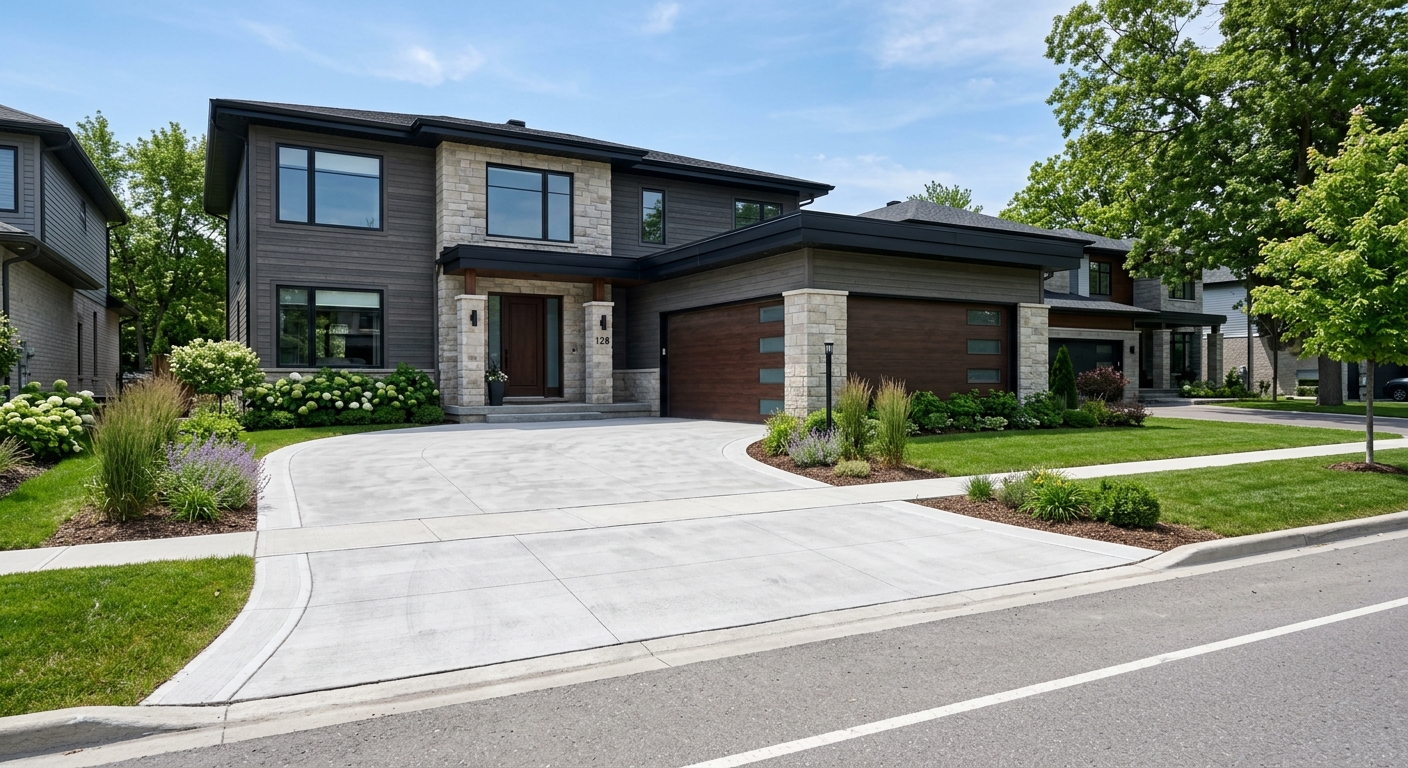
Concrete work options and costs in Eastwood
Concrete work in Eastwood comes up year-round, but it’s engineered for winter—because Calgary’s cold, continental swings demand good frost protection and proper curing. Eastwood’s housing mix is similar to much of Calgary’s urban fringe, where single-detached homes are a common driver of demand for driveways, patios, walkways and garage slabs. With Eastwood’s population at 3,985 (Statistics Canada, 2021 Census), you’ll find a smaller but steady market for contractors who can coordinate excavation, granular base, and cold-weather concrete finishing without rushing curing. In neighbourhood pockets like the newer home developments around 52nd Street and the surrounding residential corridors, flatwork often gets scheduled right after foundations are complete—meaning trades are more available, and quotes can be tighter when scheduling aligns.
Prices in the Calgary region can shift noticeably because freeze–thaw cycles affect every step: air-entrained mixes, deeper excavation, well-compacted granular base, and more control joints to manage cracking. The design frost depth in Alberta means exterior footings for houses, garages, decks and retaining structures must bear on undisturbed soil below the frost line (roughly 1.2 m in this region), which increases footing volumes and labour. Exterior slabs also have a shorter practical pour season, so late-fall and early-spring pours may require winter-grade mixes, insulated blankets, and sometimes temporary heat to achieve curing. These climate-driven realities explain why a “simple” broom-finished driveway can cost far less than a stamped job with decorative options—and why foundation work tends to be the most sensitive to site conditions.
Use the table below to compare typical scopes and ballpark ranges, then we’ll break down what affects pricing and how to spec the job correctly for Eastwood’s conditions.
| Application |
Typical Size |
Key Spec |
Finish Option |
Price Range |
| Concrete driveway (standard broom finish) |
400–500 sq. ft. |
Air-entrained mix, compacted granular base, control joints |
Broom finish + standard saw cuts |
$12,000–$18,000 |
| Exposed aggregate driveway |
400–500 sq. ft. |
Air-entrained mix, proper curing, washed surface process |
Exposed aggregate with curing/sealer-ready surface |
$14,000–$20,500 |
| Stamped concrete driveway or patio |
300–500 sq. ft. |
Air-entrained mix, integral colour, release agent + stamps |
Stamped pattern + colouring |
$15,000–$26,000 |
| Plain concrete patio or walkway |
200–350 sq. ft. |
Air-entrained mix, compacted granular base, edge forms |
Float/trowel then light broom (or broom only) |
$5,000–$9,000 |
| Garage floor (interior slab) |
400–500 sq. ft. |
6 in. slab typical, reinforcement as specified |
Standard trowel finish |
$9,000–$14,500 |
| Foundation footings (structural, below frost) |
Varies by plan |
Engineered rebar cage, below frost-bearing depth |
Structural formwork + foundation concrete |
$28,000–$45,000 |
Prices are estimates only and vary by project scope, site access and material selection.
What affects the price of concrete work in Eastwood
In Eastwood and the broader Calgary market, it’s common to see quote differences of 30–50% for what looks like the “same” concrete job—because the cheaper option often assumes less excavation, a thinner base, fewer reinforcements, or a simpler finish than you actually need for Alberta’s freeze–thaw reality. Frost depth and freeze–thaw cycles dictate almost every specification: footings must extend below the design frost depth (about 1.2 m for this region) to reduce frost heave and seasonal movement. Exterior slabs also need air-entrained concrete mixes to survive repeated freezing and thawing, and the colder conditions shorten the practical exterior pour season. When crews pour in late fall or early spring, they may need cold-weather curing precautions—insulated blankets, curing protection and sometimes temporary heat—which can add real labour and equipment cost. Finally, de-icing salts in winter accelerate surface spalling on poorly specified mixes; sealing helps, but it’s only effective when applied correctly after curing.
Concrete costs can rise quickly in Eastwood when site prep is complicated. For example, a driveway expansion on a sloped or poorly drained lot may require deeper excavation and extra granular base to build a stable, compacted sub-base. Conversely, a straightforward patio removal-and-replacement on flat, accessible ground can land closer to the lower end of the $5,000–$9,000 patio/walkway band because you’re not fighting haul distances or complicated grades. On the other hand, if you’re choosing stamped work from the $15,000–$26,000 range, you’re paying for formwork detailing, more prep, more labour time, integral colour or colouring systems, and additional finishing steps—all worth it when you want curb appeal that holds up to Alberta winters.
Even housing age matters. Newer builds often have cleaner access and consistent grades, while older lots can include buried debris or soft spots that increase excavation and base thickness—turning “minor” concrete work into a bigger earthwork scope measured in cubic yards and truckloads.
| Price Factor |
Why It Matters |
Cost Impact |
| Frost line depth |
Determines footing depth and form height |
More excavation and concrete volume; labour increases fast |
| Site preparation |
Excavation, grading, compacted granular base |
Harder access/soil conditions can add truckloads and hours |
| Reinforcement |
Rebar or wire mesh requirement |
Additional materials and labour time; may be required for thicker slabs |
| Mix design |
Air-entrainment and compressive strength spec |
Winter-grade and air-entrained mixes cost more but reduce failure risk |
| Finish type |
Broom vs. stamped vs. exposed aggregate |
Stamped/exposed processes add steps and supervision time |
| Pour size and concrete truck access to site |
Truck reach affects pumping/extra equipment |
Pumping, smaller loads or delays increase total cost |
| Cold-weather curing precautions |
Heating and blankets |
Thermal protection and labour can materially raise the price |
| Control joint pattern and sealing cost |
Crack control + surface protection from salts |
More joints/layout time and sealer add line-item cost |
Permits & regulations in Alberta
In Alberta, structural concrete work generally needs permitting and, in many cases, engineered drawings. That includes footings, foundation walls, and grade beams—anything that becomes part of the building’s primary structural system. For these scopes, municipalities commonly require permit applications and may review engineering details before work proceeds. Concrete flatwork like patios, walkways and driveways typically does not require a building permit on its own, unless it affects lot grading or impervious surface considerations, or impacts drainage and municipal right-of-way requirements. When in doubt, confirm with the local authority before you break ground—especially if you’re altering swales, adding slope corrections, or re-routing drainage near the sidewalk.
To verify a contractor in Eastwood the right way, do it step-by-step:
- Confirm the contractor’s business registration status and any applicable provincial licensing/standing (check the contractor’s official information through public resources).
- Ask for a Certificate of Liability Insurance and verify it covers concrete-related work and the project address.
- Request proof of WSIB/WCB coverage (workers’ compensation) and verify the coverage is current.
- Look for a clear clearance letter or proof of account status if provided—this helps avoid payroll and safety issues during the job.
- Verify references on similar-scale Calgary-area projects, ideally in winter seasons.
Also ensure the quote clearly separates permit responsibilities—whether the contractor pulls any related permit or you do—and confirm who handles inspections for structural components.
Getting concrete right in Eastwood's freeze-thaw climate
Concrete failures in Eastwood almost always come down to three things: inadequate base preparation, the wrong mix design for freeze–thaw, and rushed curing. Alberta’s winter can drive damage at the surface first—spalling, scaling, and premature cracking—especially where de-icing salts meet a low-quality surface. To get the job spec’d correctly, you want the full system working together: (1) base preparation engineered for frost and movement—compact a granular sub-base to the right depth so the slab doesn’t “float” on weak or thaw-prone soils; (2) mix design with proper air-entrainment—exterior flatwork typically targets about 5–7% air content, plus minimum compressive strength (often 32 MPa for common residential exterior slabs); (3) control joints placed to limit random cracking; (4) curing—minimum 7 days under proper conditions, and in cold weather that may mean insulated blankets or controlled heat to keep early strength development on track; and (5) sealing applied after cure, typically 28 days post-pour for best performance against salt exposure.
Ask technical questions that tie directly to freeze–thaw survival. For example: “What air-entrainment target are you using?” and “How are you curing and protecting the slab when temperatures drop?” If a contractor can’t clearly answer those, that’s a red flag for inadequate air-entrainment or premature finishing. In practice, paying for correct mix design and protection is often cheaper than repairs later: upgrading to an air-entrained winter-safe mix and including proper curing protection can be the difference between a driveway that looks good for a few seasons and one that holds up through multiple freeze–thaw cycles. If you’re comparing options, the price swing between a plain patio in the $5,000–$9,000 range and stamped concrete in the $15,000–$26,000 range should be justified by finish labour and materials—not by cutting technical specs that protect the concrete.
| Spec |
Why It Matters in Eastwood |
What to Ask For |
Impact if Skipped |
| Compacted granular base (depth?) |
Reduces frost-related movement and supports load without pumping |
Confirm base depth and compaction testing/verification approach |
Settling, uneven cracking, and accelerated deterioration |
| Air-entrained concrete mix (target air %?) |
Improves freeze–thaw durability in Calgary-area winters |
Ask for target air content (commonly 5–7% for exterior flatwork) |
Spalling and scaling, especially where salts collect |
| Compressive strength (MPa rating) |
Ensures the slab reaches sufficient early and long-term performance |
Confirm minimum compressive strength (often 32 MPa for typical exterior slabs) |
Surface wear, cracking, and reduced strength development |
| Control joints (spacing per ACI guidelines) |
Limits random cracking caused by shrinkage and temperature movement |
Ask for intended joint layout and spacing, and saw-cut timing |
Wider random cracks and more moisture ingress |
| Minimum 7-day curing period |
Critical for strength gain before thermal stress and traffic exposure |
Ask how they protect curing concrete at cold temperatures |
Weak surface, scaling risk, and long-term performance loss |
| Penetrating sealer (when applied after cure) |
Repels de-icing salt moisture and reduces surface deterioration |
Confirm sealer type and application timing (often after full cure, around 28 days) |
Faster salt damage and higher maintenance/repair costs |
How to choose a concrete work contractor in Eastwood
Choosing a contractor in Eastwood is less about flashy photos and more about verification and clarity. First, confirm Alberta compliance: ask for liability insurance (and ensure the certificate lists the project address), and proof of WSIB/WCB coverage for their workers. You should also request any clearance letter or current status documentation they can provide. If you can’t get clean paperwork up front, don’t proceed—concrete is a high-risk trade, and winter work can compound safety concerns.
Next, require 2–3 itemised written quotes rather than a single lump sum. You want a breakdown that separates labour, concrete supply, excavation/granular base, reinforcement, forming, finishing, joints, sealing, and disposal. Pay close attention to what’s excluded: is demolition included? Is excavation to frost-bearing depth included for structural work? Is permit pulling included for any structural scope? Does the quote include site protection, traffic management, and concrete truck scheduling?
Warranty matters too. Ask for the workmanship warranty length, what product/manufacturer warranties apply (if any), and whether those warranties are transferable to future owners. Payment schedule should be conservative—typically no more than 10–15% upfront. Hold back the remaining balance until the work is complete, inspected (where applicable), and deficiencies are corrected.
Finally, get a written timeline: start date, pour date (or target window), curing/blanket protection period in cold weather, and completion estimate. In Calgary-area concrete work, a good schedule is a cost-control tool because it protects quality.
- Request proof of liability insurance and WSIB/WCB coverage before signing.
- Confirm whether permit applications are included for footings/foundations.
- Ask if the quote includes excavation, granular base, and compaction verification.
- Verify air-entrainment and concrete strength specs in the quote.
- Ensure reinforcement requirements (mesh/rebar) are listed for slabs.
- Ask for a joint layout plan and saw-cut timing details.
- Confirm curing protection methods if temperatures drop.
- Confirm whether sealing is included and the intended application timing.
- Ask how they manage drainage and lot grading near edges.
- Check whether disposal/haul-away is included in the price.
- Require a detailed scope: forms, edges, dowels/ties, and tie-ins to existing concrete.
- Set a payment schedule with limited upfront payment and a final holdback.
Concrete red flags in Eastwood: contractors who won’t provide air-entrainment/strength targets, vague curing plans for cold weather, quotes that skip base compaction and reinforcement details, no documentation for insurance/WSIB/WCB, and payment terms that ask for large upfront deposits without a solid schedule.
Frequently asked questions — concrete work in Eastwood
How long does a concrete project take in Eastwood?
For most Eastwood residential flatwork, timelines depend more on site prep and curing than on the pour itself. A typical driveway or patio installation often takes several working days: excavation and forms first, then placement, finishing, and protection while concrete cures. The pour day is usually only part of the schedule because Calgary-area freeze–thaw conditions mean the crew has to control early curing—especially if temperatures dip at night. Even if the surface looks ready in a day or two, it’s not the same as achieving the strength needed for traffic and long-term durability. If your project is a stamped job in the $15,000–$26,000 range, expect extra time for layout, stamping, and colour steps. Plan around weather windows; late fall and early spring work may extend timelines due to cold-weather curing precautions.
What is a concrete overlay and is it suited to Eastwood?
A concrete overlay is a layer of cementitious material placed on top of an existing slab to refresh the surface without full demolition. In Eastwood and the Calgary region, overlays can be suitable only if the original concrete is still structurally sound—no major settlement, no widespread delamination, and minimal spalling that suggests freeze–thaw breakdown. If the base has movement or water intrusion issues, an overlay can fail early because it doesn’t fix the underlying problem (it only addresses the surface). Overlays also need proper surface preparation—often grinding/profiling and patching—and correct curing. For homeowners comparing costs, remember that a plain patio/walkway replacement is commonly in the $5,000–$9,000 band, and overlays can be tempting if your slab is otherwise stable. The right approach is to assess cracking, drainage, and bond conditions before choosing overlay versus replacement.
How do I seal concrete to protect it in Eastwood?
In Eastwood, sealing is most about resisting moisture movement and slowing damage from de-icing salts during freeze–thaw cycles. The key is timing and product type: for many penetrating sealers, you want to apply after the concrete has fully cured—commonly around 28 days post-pour—so the sealer can form an effective barrier without trapping excess moisture. Before sealing, the surface should be clean and dry, and any minor surface defects should be repaired according to the sealer manufacturer’s instructions. Ask your contractor to specify the sealer type (penetrating vs. film-forming) and to confirm coverage rate. Sealing isn’t a substitute for proper mix design—air-entrainment and curing are the foundation for durability. If your driveway sees heavy winter salt, sealing can reduce spalling risk, but only when the slab was built to survive Alberta’s winter conditions.
What is the difference between concrete and cement?
Concrete and cement get used interchangeably in everyday talk, but technically they’re different. Cement is one ingredient—a powdered binder (made from clinker and gypsum). Concrete is the finished building material made by combining cement with water, aggregates (sand and gravel), and often admixtures. For Eastwood projects, the concrete mix design is what matters for freeze–thaw durability: contractors specify air-entrainment levels and strength targets so the slab can handle repeated freezing and thawing. That’s why quotes should reference the concrete mix specs (air content and compressive strength), not just “cement quality.” When a contractor talks about winter-grade concrete and curing blankets, they’re discussing the concrete system—cement plus the whole mix and protection plan—not simply the cement powder itself.
How much does concrete work cost in Eastwood?
Concrete pricing in Eastwood typically follows the Calgary-region bands, but the final number depends on excavation, access, reinforcement, finish complexity, and winter curing requirements. A standard concrete patio or walkway is commonly in the $5,000–$9,000 range for typical residential sizes. Driveways are usually higher—often $12,000–$18,000 for standard broom-finished work, with exposed aggregate or decorative finishes costing more. Stamped concrete driveway or patio work often lands in the $15,000–$26,000 range because it includes colour systems, stamping labour, and extra finishing steps. For structural needs like foundation footings below frost depth, typical ranges are $28,000–$45,000, driven by deeper excavation and engineered reinforcement. If you’re comparing quotes, make sure they include base prep, air-entrained mix specs, and curing protection—those details explain most of the real price differences.
How deep must footings be for Eastwood's frost line?
In the Calgary-area climate that includes Eastwood, footings must be designed to extend below the frost line to reduce frost heave and seasonal movement. Practically, local engineering practice uses a design frost depth of about 1.2 m (roughly 4 ft). That means structural footings for houses, garages, decks and retaining structures should bear on undisturbed soil below that depth, assuming the site soil conditions match design assumptions. The exact depth can vary based on geotechnical reports and the engineered foundation plan for your specific property. If you’re doing any structural concrete work like foundation walls or grade beams, you should expect engineered drawings and permitting requirements. Don’t rely on “typical” depth alone—ask your contractor to confirm the footing elevations and how they’re verified on site (survey/grade control) so the foundation doesn’t end up bearing too shallow.