Concrete work options and costs in Abbeydale
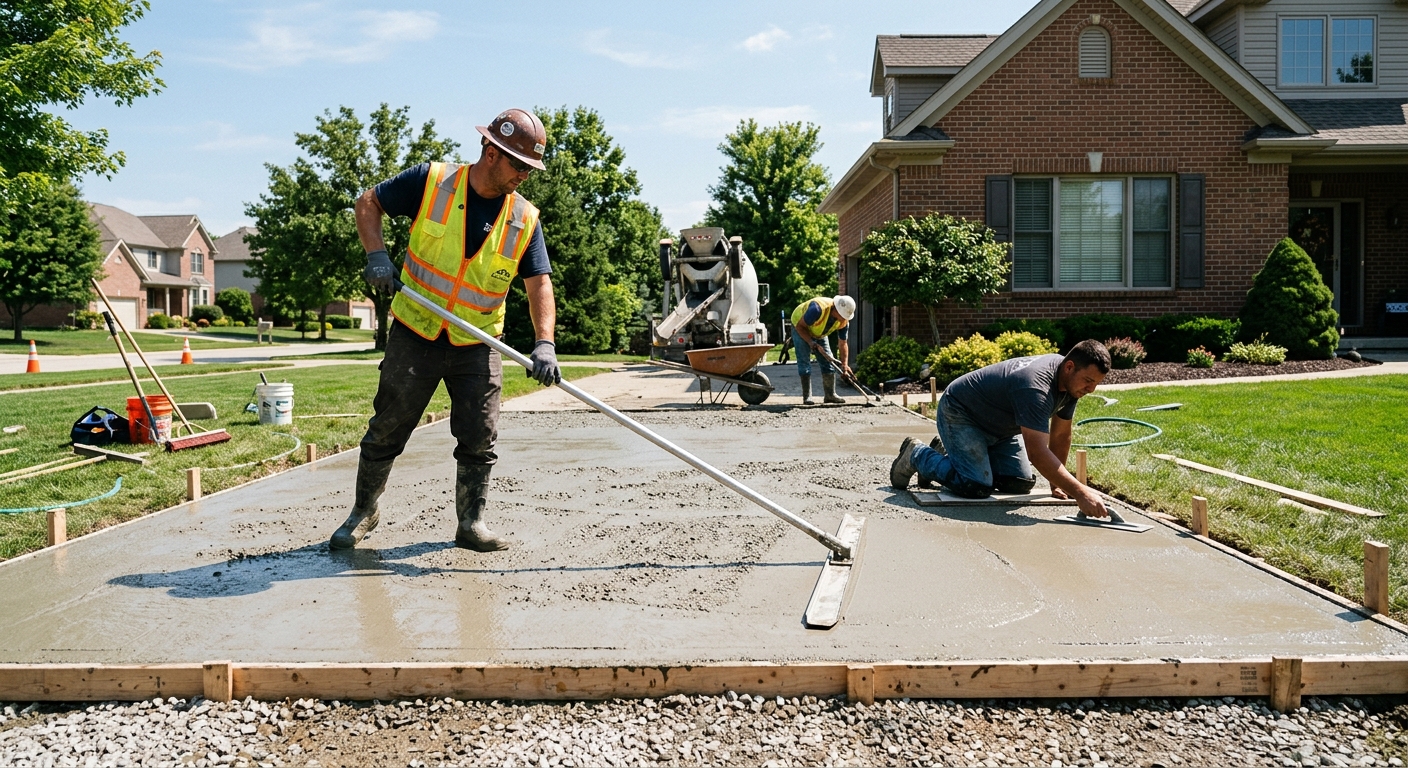
In Abbeydale, concrete work is one of the most “weather-sensitive” trades around, because the Calgary-area freeze–thaw cycle is hard on slabs and driveways. Abbeydale is a small community with a population of 5,925 (Statistics Canada, 2021 Census), and the work typically follows what homeowners are building and maintaining in the wider Calgary region. The main demand is for concrete flatwork—driveways, patios, walkways, and garage floors—because these are common on owner-occupied homes and accessory structures. In practice, the colder continental climate means jobs are engineered for frost protection and durability, not just appearance.
Local pricing reflects that engineering. Footings and foundations must bear below the design frost depth (about 1.2 m in this region), so excavation and concrete volumes rise versus milder provinces. Exterior slabs also need air-entrained mixes and the right curing plan, since rushing curing in late fall or early spring increases surface scaling and long-term cracking risk. On top of that, de-icing salt in winter accelerates spalling if the mix, finishing, and sealing aren’t done correctly.
Contractor availability can also affect cost in Abbeydale, because crews serving Calgary and nearby communities (like Rundle–style suburban build zones and the east/south Calgary truck routes commonly used from Abbeydale) may have tighter schedules during the short practical pour season. As a result, scheduling, access for the concrete truck, and the amount of demo and hauling can shift quotes noticeably. With that in mind, compare the typical applications and ranges in the table below.
| Application |
Typical Size |
Key Spec |
Finish Option |
Price Range |
| Concrete driveway (standard broom finish) |
10 m x 3 m (approx.) |
Air-entrained exterior mix; compacted base; mesh/rebar as required |
Broomed surface; control joints; optional sealer |
$12,000–$18,000 |
| Exposed aggregate driveway |
10 m x 3 m (approx.) |
Air-entrained exterior mix; proper curing to resist scaling |
Exposed aggregate finish; sealed for salt resistance |
$14,500–$22,000 |
| Stamped concrete driveway or patio |
40 m² (typical) |
Air-entrained exterior mix; engineered base; coloured/stamped system |
Stamped patterns; integral colour or colour hardener |
$15,000–$26,000 |
| Plain concrete patio or walkway |
25 m² (typical) |
Air-entrained mix; compacted base; joints |
Broom finish or smooth trowel (as suited) |
$5,000–$9,000 |
| Garage floor (interior slab) |
6 m x 7 m (approx.) |
Vapour barrier; reinforcement; mix designed for interior exposure |
Float/smooth finish; optional densifier or sealer |
$6,500–$11,500 |
| Foundation footings (structural, below frost) |
Typical house footing footprint |
Excavation to undisturbed soil; below design frost depth; engineered steel |
Structural concrete; forms as required |
$28,000–$45,000 |
Prices are estimates only and vary by project scope, site access and material selection.
What affects the price of concrete work in Abbeydale
In Abbeydale and the broader Calgary market, two quotes for the “same” concrete job can swing by 30–50% because the unseen items—excavation, engineered base prep, reinforcement, mix spec, curing plan, and access—carry the real cost. A 40 m² patio can look similar at first glance, but if one contractor needs deeper excavation for frost-protective base or more haul-off, the difference adds up quickly. Foundation scopes are even more variable because engineered drawings drive footing depth, rebar schedules, and formwork complexity.
Climate is the big driver. Calgary’s cold continental conditions mean the frost line is deeper than in milder provinces, so footings must extend below the design frost depth (about 1.2 m here) to prevent frost heave and seasonal movement. Exterior slabs also need air-entrained concrete mixes to survive freeze–thaw cycling, which affects material cost and placement requirements. In winter or shoulder seasons, the practical pour season is shorter, so cold-weather curing precautions—insulated blankets, temporary heat, and stricter monitoring—add labour and equipment. De-icing salt then becomes a durability consideration, making sealing a practical “maintenance layer” rather than an optional accessory.
Concrete examples that raise or lower cost in Abbeydale: (1) a driveway with limited access for a concrete truck (narrow lanes, tight turns) often costs more due to pump/placement time and labour; (2) a site with stable soil and good drainage typically keeps excavation and granular base prep leaner; (3) choosing stamped concrete can add major cost versus a plain broom finish, but the jump can be justified if you’re replacing a larger area and want long-term curb appeal. If your project falls into the concrete driveway tier, many homeowners end up in the $12,000–$18,000 range for a standard broom driveway, while stamped systems often land in the $15,000–$26,000 band depending on colour and pattern coverage.
Even housing age matters: older lots may have older drainage paths, uneven grading, or thicker topsoil that must be stripped before you can build the correct base—so the job cost becomes a “site correction” project as much as it is a concrete pour.
| Price Factor |
Why It Matters |
Cost Impact |
| Frost line depth — determines footing depth and form height |
Footings must bear below the design frost depth to prevent heaving and seasonal movement. |
Typically adds major excavation and concrete volume; can be the biggest swing factor. |
| Site preparation — excavation, grading, compacted granular base |
Proper sub-base supports the slab and controls settlement and cracking. |
Extra stripping/haul-off can increase labour and disposal fees substantially. |
| Reinforcement — rebar or wire mesh requirement |
Controls cracking and improves slab performance under load. |
Material and placement labour; also affects thickness and chairing. |
| Mix design — air-entrainment and compressive strength spec |
Air-entrainment helps resist freeze–thaw damage and spalling. |
Changes concrete cost and sometimes delays if cold-weather protocols are needed. |
| Finish type — broom vs. stamped vs. exposed aggregate |
Finishes require different crews, tools, and curing/colour timing. |
Stamped/exposed finishes generally cost more than plain broom finishes. |
| Pour size and concrete truck access to site |
Large pours may require multiple loads; access limits affect placement speed. |
Hard access can increase labour time, waiting, and equipment costs. |
| Cold-weather curing precautions — heating and blankets |
Maintains curing conditions so strength develops and scaling risk is reduced. |
Adds temporary materials, monitoring time, and potentially accelerators. |
| Control joint pattern and sealing cost |
Joints reduce random cracking; sealer improves resistance to de-icing salt. |
Sealing and correct jointing add cost but reduce long-term repair risk. |
Permits & regulations in Alberta
In Alberta, the rule of thumb is that structural concrete needs a permit more often than flatwork does. Concrete work that typically does require a building permit includes footings, foundation walls, grade beams, and other structural foundation elements. Those scopes generally require engineered drawings (and municipal review) because they support the building and must meet structural and frost-protection requirements for the site.
Concrete flatwork—like driveways, patios, and walkways—often does not require a permit by default. However, you may need approval if the work affects lot grading, drainage, impervious surface coverage limits, or anything in the vicinity of municipal right-of-way. The safe approach is to confirm with the local authority before breaking ground.
For contractors, don’t guess—verify. For an Abbeydale homeowner, do this step-by-step: (1) request the contractor’s liability insurance certificate and confirm it matches the legal entity name on the quote; (2) ask for clearance or proof of coverage for WSIB/WCB (coverage proof should be current); (3) confirm their licence/registration status through Alberta’s relevant online registry for contractors (use the contractor’s legal name and business number, not a nickname); and (4) check that the insured and covered work aligns with what they’re proposing (e.g., excavation, concrete placement, forming, cutting). Finally, ask for references on similar-scale projects in the Calgary area so you can judge how they handled winter scheduling and curing.
Getting concrete right in Abbeydale's freeze-thaw climate
Concrete fails in Abbeydale mostly because water finds its way into the slab/edges/base and then expands during freeze–thaw cycles, causing cracking, scaling, and (in worse cases) loss of bond at the surface. The fix isn’t “stronger concrete” alone—it’s the full system: correct base preparation, the right mix, controlled cracking, proper curing timing, and sealing against de-icing salts.
1) Base preparation: use a compacted granular sub-base to the correct depth for your local soil conditions and frost requirements. A thin or poorly compacted base is a common reason driveways and patios settle or develop uneven cracks. 2) Mix design: for exterior flatwork, specify air-entrainment (commonly 5–7% air content) and minimum 32 MPa compressive strength so the concrete can handle cycling temperatures. 3) Control joints: plan the joint pattern to limit random cracking; joints should be cut or formed on schedule so the slab relieves stress where intended. 4) Curing: plan for at least 7 days of curing under suitable conditions. In shoulder seasons, cold-weather placement may require insulated blankets and/or temporary heat—otherwise the surface may look fine but won’t reach durability potential. 5) Sealing: apply penetrating sealer after the appropriate cure window (often around 28 days) to help repel de-icing salts.
When you’re comparing options, the added cost of the “right spec” is usually justified. For example, moving from a bare-bones broom-finish approach to an air-entrained, correctly cured exterior slab may cost a few thousand dollars, but it’s cheaper than resurfacing or replacing a salt-damaged driveway later. In the driveway tier, that’s the difference between chasing minimums inside the $12,000–$18,000 band and buying durability choices that help you avoid scaling and early repairs.
| Spec |
Why It Matters in Abbeydale |
What to Ask For |
Impact if Skipped |
| Compacted granular base (depth?) |
Supports the slab and reduces settlement through freeze–thaw cycles. |
Confirm excavation depth for your site; granular layers compacted to spec. |
Uneven settlement, cracking, and premature edge failure. |
| Air-entrained concrete mix (target air %?) |
Protects against freeze–thaw damage and surface spalling. |
Ask for 5–7% air content for exterior flatwork. |
Scaling/spalling risk increases dramatically, especially with winter salt. |
| Compressive strength (MPa rating) |
Ensures the concrete develops enough strength for load and durability. |
Specify minimum 32 MPa. |
Lower strength and higher long-term deterioration risk. |
| Control joints (spacing per ACI guidelines) |
Controls where cracks form under movement and thermal cycling. |
Ask for planned spacing and how/when joints will be cut or tooled. |
Random cracking and more water ingress at stress points. |
| Minimum 7-day curing period |
Cold-weather curing issues can prevent strength and durability development. |
Confirm curing plan; blankets/heat if temperatures drop. |
Surface scaling, weaker concrete, and shortened service life. |
| Penetrating sealer (when applied after cure) |
Helps repel water and de-icing salts that drive deterioration. |
Ask for penetrating sealer application after full cure (commonly ~28 days). |
More salt intrusion leading to spalling and rough, failing surfaces. |
How to choose a concrete work contractor in Abbeydale
Choosing the right concrete contractor in Abbeydale is mostly about verification and paperwork—because concrete quality is proven at the spec, not the sales pitch. Start by confirming Alberta requirements: ask the contractor for (1) liability insurance certificate—make sure it’s current and shows appropriate coverage limits; and (2) proof of WSIB/WCB coverage (or the equivalent clearance proof if applicable). Then check their contractor licence/registration status through Alberta’s online contractor registry tools by using the contractor’s legal business name and address.
Next, get 2–3 itemised written quotes that separate labour and materials, rather than a single lump sum. You want line items that include excavation and hauling/disposal, granular base and compaction, reinforcement, concrete supply with the mix spec, forming, finishing, saw cutting/jointing, and sealing (if included). Also read the exclusions: is a permit pull included where required, and who handles it? Is topsoil/old slab removal included? Is disposal included? If they’re vague, pricing often “moves” after the pour.
Warranty matters too. Ask for: workmanship warranty length and what it covers (cracking, spalling, settlement), whether any product/manufacturer warranty applies to the concrete or admixtures, and whether warranty is transferable if you sell the home. For payment, never let a contractor demand the majority upfront—keep deposits around 10–15%, and hold back payment until completion and walkthrough are done. Finally, insist on a start date and completion estimate in writing, especially given Alberta curing and cold-weather constraints.
- Ask for their Alberta insurance certificate before signing anything; confirm dates and legal entity name.
- Verify WSIB/WCB clearance/coverage proof is current and matches the project timeframe.
- Request a written, itemised quote (labour vs materials vs disposal/haul-off).
- Confirm whether reinforcement (mesh/rebar) is included and where it will sit (chairs/spacers).
- Ask what air content and compressive strength spec will be used for exterior work.
- Ensure base preparation includes excavation depth, granular thickness, and compaction method.
- Confirm the control joint plan: spacing, placement, and timing of cuts/tooling.
- Ask how they handle cold-weather curing (blankets, heat, temperature monitoring).
- Clarify whether sealing is included; if not, price it as an add-on.
- Check the disposal/haul-off scope if there’s demo involved.
- Get schedule details in writing (start date, curing window, and handover).
- Review warranty terms in writing: coverage, exclusions, and claim process.
Concrete red flags in Abbeydale include: contractors who won’t provide insurance/WSIB/WCB documentation, quotes that don’t specify mix/air content or curing steps, “cheap” pricing that assumes minimal base prep, pressure to pay large deposits upfront, and promises that ignore cold-weather engineering (e.g., pouring late-season without blankets/heat planning).
Frequently asked questions — concrete work in Abbeydale
How long does a concrete project take in Abbeydale?
In Abbeydale, most concrete projects don’t take “months,” but the timeline is more than just the pour day. For a typical driveway or patio, you should plan for: site prep and forms/excavation (often 1–3 days depending on access and demo), the pour and finishing (usually 1 day), then curing time. Even though you can often walk on a slab sooner, the important durability window is getting proper cure development—especially in Alberta’s freeze–thaw conditions. In practice, homeowners often see full readiness after about 7 days for normal use, while sealing is commonly scheduled after a longer cure window (around 28 days). If weather is cold, extra time may be needed for insulated blankets or temporary heat to keep the curing process on track. That’s why start dates can shift in late fall and early spring.
What is a concrete overlay and is it suited to Abbeydale?
A concrete overlay is a thin topping placed over an existing concrete slab after surface preparation (often grinding/scarifying) and crack/edge assessment. In Abbeydale and the Calgary climate, overlays can work well when the existing slab is still structurally sound and drainage hasn’t caused continuous movement. However, overlaying a slab that’s settled, heaved, or delaminating at multiple spots can trap moisture and lead to faster deterioration beneath the new layer. Overlays can also be more sensitive to de-icing salt intrusion, so proper bonding and sealing are critical. If your current surface is only scaled or aesthetically tired, an overlay might be a cost-effective approach compared to full replacement. But if you’re seeing significant cracking, spalling, or uneven slopes, removal and rebuild is often the safer long-term choice—especially since footing and slab movement issues are unforgiving in freeze–thaw cycles.
How do I seal concrete to protect it in Abbeydale?
In Abbeydale, sealing is about managing water and de-icing salt exposure. The best results come from using a penetrating sealer designed to repel moisture rather than just forming a surface film. Timing matters: you typically wait until the concrete has fully cured—commonly around 28 days—before applying sealer, so you’re not trapping moisture. Before sealing, the slab must be clean and dry; contractors usually wash and let it dry sufficiently, especially after winter residue. For exterior driveways and patios, ask for a product suitable for freeze–thaw conditions and winter salt exposure. Also confirm whether the contractor will include sealing in the quote. If you’re planning a standard driveway in the $12,000–$18,000 range, sealing is often an add-on, but it can be one of the most cost-effective steps to reduce future spalling and surface scaling when Alberta temperatures swing.
What is the difference between concrete and cement?
It’s a common mix-up. Cement is one ingredient; concrete is the full material system. Cement is the binding component (a powder) that reacts during hydration. Concrete typically includes cement plus sand and gravel (fine and coarse aggregates) and water. It often also includes admixtures—like air-entrainment for exterior durability in Alberta’s freeze–thaw climate. When a contractor quotes “concrete,” they’re usually talking about the engineered mix supplied to your site, including any air-entraining admixtures and strength targets. That’s why you should ask for the concrete spec (for example, exterior air-entrainment and minimum strength) rather than focusing only on the cement brand. In Abbeydale’s winter conditions, the air-entrained concrete spec is especially important because it helps resist freeze–thaw damage and spalling caused by moisture and de-icing salt.
How much does concrete work cost in Abbeydale?
Concrete costs in Abbeydale align closely with the Calgary regional pricing bands because materials and labour are sourced through the same market. For example, a concrete driveway (standard broom finish) commonly falls in the $12,000–$18,000 range, while stamped concrete driveways or patios often land in the $15,000–$26,000 band depending on pattern area, colours, and complexity. Plain patios and walkways are frequently in the $5,000–$9,000 range for typical residential sizes. Foundation footings (structural, below frost) are often quoted in the $28,000–$45,000 range, driven by excavation depth and engineered steel requirements. Your quote can rise if access is difficult, if the base prep needs extra work, or if cold-weather curing measures are required. The best approach is an itemised quote so you can see exactly what’s included before comparing apples-to-apples.
How deep must footings be for Abbeydale's frost line?
For Abbeydale projects in the Calgary region, footings must typically extend to below the design frost depth—about 1.2 m (roughly 4 ft) in local engineering practice. The goal is to place the foundation on undisturbed soil deep enough to prevent frost heave and seasonal movement, which is one reason footing and foundation costs are higher here than in warmer regions. Exact footing depth can still vary based on geotechnical conditions, the engineered foundation design, and site-specific soil conditions. That’s why the permit drawings and engineer’s report matter. If you’re budgeting for footings, use the local band of $28,000–$45,000 as a starting point and expect excavation and concrete volume to increase if your site requires deeper frost-protective measures. Always confirm the depth on the drawings rather than relying only on general frost depth rules.