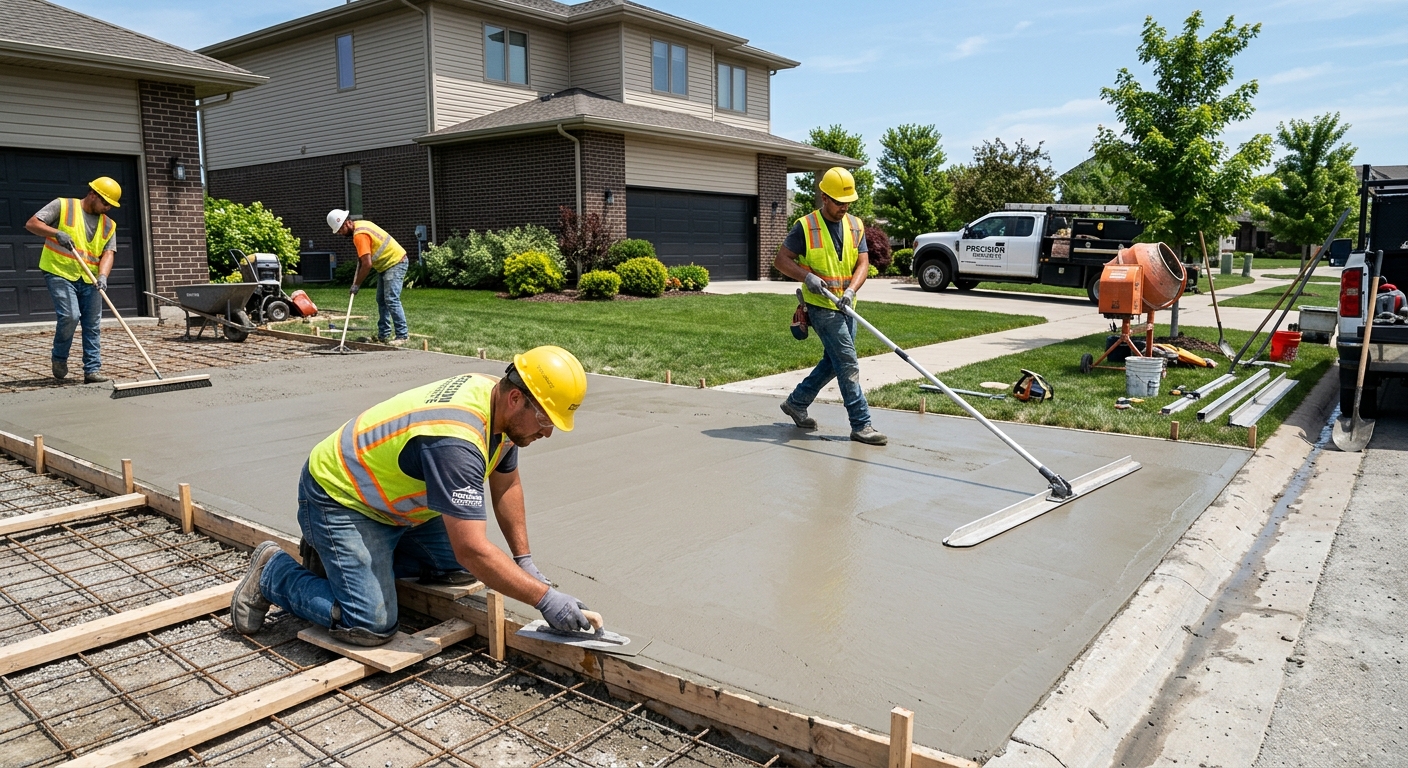
Concrete work options and costs in Southwood
In Southwood, Alberta, concrete is one of the most practical choices for driveways, patios and walkways because it can be engineered to handle Calgary’s freeze–thaw cycles and a deeper-than-you’d-expect frost depth. If you’re working around the kind of housing mix seen in a town of 6,095 people (Statistics Canada, 2021 Census), you’re typically dealing with single-family lots where homeowners invest in durable flatwork at the same time as landscaping and grading.
Southwood’s concrete demand is especially noticeable along established collector-road areas and near newer subdivisions where driveways and backyard pads get built early, then upgraded later. In Calgary’s broader market, availability and scheduling can swing with weather: exterior pours have a shorter practical season, and cold-weather curing precautions (insulated blankets, controlled heat and more careful handling of materials) affect both labour and material costs. That’s why two bids for what looks like “the same driveway” may differ: one contractor may include frost-driven excavation and proper granular base prep, while another may assume easier site conditions.
For a quick comparison, the table below shows typical scopes and the price range you can expect in Southwood for standard broom-finished concrete, exposed aggregate, stamped finishes, interior garage slabs and structural footings installed below the frost line. Use these ranges as a starting point, then tighten the scope during quoting—especially around excavation depth, reinforcement, and whether cold-weather protection is required—before you sign.
| Application |
Typical Size |
Key Spec |
Finish Option |
Price Range |
| Concrete driveway (standard broom finish) |
24 ft x 20 ft (480 sq. ft.) |
Air-entrained mix, compacted granular base, control joints |
Broom finish |
$12,000–$18,000 |
| Exposed aggregate driveway |
24 ft x 20 ft (480 sq. ft.) |
Air-entrained mix, proper retarder timing, sealed surface recommended |
Exposed aggregate |
$14,000–$21,000 |
| Stamped concrete driveway or patio |
300–450 sq. ft. |
Air-entrained mix, colour hardener/base, release and stamping |
Stamped (wood/stone pattern) |
$15,000–$26,000 |
| Plain concrete patio or walkway |
200–300 sq. ft. |
Granular base, joints as needed, air-entrained mix |
Float & broom or light broom texture |
$5,000–$9,000 |
| Garage floor (interior slab) |
22 ft x 20 ft (440 sq. ft.) |
Fibre or mesh, vapour barrier (as required), proper base compaction |
Plain finish (steel trowel/brush as requested) |
$4,500–$8,500 |
| Foundation footings (structural, below frost) |
Typical single-family: multiple trenches/walls |
Engineered sizing, below design frost depth, reinforced concrete |
Structural concrete (no decorative finish) |
$28,000–$45,000 |
Prices are estimates only and vary by project scope, site access and material selection.
What affects the price of concrete work in Southwood
In Southwood and the wider Calgary region, it’s common to see quotes for the “same” concrete work vary by 30–50%. The biggest reason is that frost and freeze–thaw forces every part of the build: excavation depth, granular base thickness, air-entrainment requirements, reinforcement choices and the curing plan. In cold continental climates, engineering practice often assumes a design frost depth of about 1.2 m (roughly 4 ft), and in Alberta that typically translates to footings bearing below frost to reduce heave and seasonal movement. That drives up foundation costs relative to milder regions.
Freeze–thaw cycles also change how crews handle exterior slabs like driveways, patios and walkways. Contractors must use air-entrained concrete mixes to survive repeated freezing and thawing. Exterior placement additionally happens over a shorter window, so cold-weather curing precautions—insulated blankets, controlled heat and scheduling to protect the pour—can add labour and equipment costs. Finally, de-icing salt accelerates surface damage; sealing and a durable mix design help reduce spalling risk.
On a typical Southwood driveway, the difference between standard broom and exposed aggregate can add cost because the surface process takes more labour time and time on-site, even though the concrete volumes are similar. Meanwhile, a plain patio at $5,000–$9,000 may cost only modestly more than a walkway, unless you’re increasing excavation for drainage or expanding reinforcement. By contrast, foundations and footings at $28,000–$45,000 swing widely based on soil conditions, footing layout, and how much excavation is needed to get to undisturbed bearing below the frost depth.
| Price Factor |
Why It Matters |
Cost Impact |
| Frost line depth — determines footing depth and form height |
Footings must extend below the design frost depth to prevent frost heave |
Higher excavation and concrete volume; often the largest driver for foundation budgets |
| Site preparation — excavation, grading, compacted granular base |
Correct base compaction reduces settlement and cracking under freeze–thaw cycles |
More granular material, machinery time and disposal can add significant cost |
| Reinforcement — rebar or wire mesh requirement |
Controls cracking and improves load capacity for driveways, slabs and footings |
Material + labour for placement and chairs; can increase cost 5–15% depending on scope |
| Mix design — air-entrainment and compressive strength spec |
Air-entrainment helps prevent freeze–thaw damage; strength affects long-term durability |
Specialty mix may cost more and may reduce substitution flexibility |
| Finish type — broom vs. stamped vs. exposed aggregate |
Decorative finishes add stamping tools, timing, and additional labour |
Stamped/exposed work commonly costs materially more per square foot |
| Pour size and concrete truck access to site |
Access affects how quickly and safely concrete can be placed |
Limited access may require pumping or extra crew time |
| Cold-weather curing precautions — heating and blankets |
Proper curing is critical to reduce scaling and surface damage in winter conditions |
Equipment and extended labour; can materially increase bids late in the season |
| Control joint pattern and sealing cost |
Joints reduce random cracking; sealing protects against de-icing salt wear |
Added line items that are small compared to the cost of premature repairs |
Permits & regulations in Alberta
In Alberta, structural concrete work—such as foundation footings, foundation walls, and grade beams—typically needs a building permit, and engineered drawings are often reviewed as part of the permit process. Concrete flatwork like patios, walkways and driveways usually does not require a permit by default, unless the work affects lot grading, drainage/servicing requirements, impervious surface coverage limits, or work within the municipal right-of-way. Because Southwood concrete projects can touch drainage slopes and access routes, the safest approach is to confirm requirements with the local authority before excavation.
Here’s how a homeowner in Southwood can verify a contractor properly:
- Ask for the contractor’s company licence (or required business registration for their contracting category) and the name you should see on paperwork.
- Request a certificate of liability insurance showing current coverage for the project type and the correct legal name/addresses.
- Confirm WSIB/WCB coverage (depending on the nature of work) and ask for proof before any site work begins.
- Verify the contractor’s references on similar-scale concrete jobs (driveways and slabs in the Calgary freeze–thaw climate).
- Get confirmation of who handles permits (if required) and whether the quote includes permit support or is strictly construction-only.
If a contractor can’t provide insurance proof, schedules without written start/end dates, or avoids discussing permit responsibility for structural work, treat it as a red flag before signing.
Getting concrete right in Southwood's freeze-thaw climate
Concrete fails in Southwood most often because the build-up layers don’t match the winter reality: inadequate base compaction, poor frost protection, insufficient air-entrainment, weak curing on cold days, or a missing seal when de-icing salt is used. In Calgary’s climate, freeze–thaw cycles expand and contract the moisture in the slab. If the concrete mix doesn’t include proper air-entrainment and the base isn’t engineered to reduce water movement, you’ll see early scaling on surfaces and random cracking that leads to spalling over time.
To spec the job correctly, start with base preparation: excavate to the required depth for undisturbed bearing and build a compacted granular sub-base to the correct thickness for the site conditions. Next, request an air-entrained mix targeting exterior performance (commonly in the 5%–7% air range) and a minimum 32 MPa compressive strength spec for typical residential flatwork. Add control joints with spacing designed to limit uncontrolled shrinkage cracking, and plan curing so the slab reaches strength under proper protection. Finally, ask for a penetrating sealer applied after the cure period—this is especially helpful for reducing de-icing salt-driven surface wear.
When comparing options, the most justified price difference is usually between standard broom and decorative finishes because labour and timing are higher. But it’s not justified to “save” money on base prep or air-entrainment. For example, a standard driveway often lands around $12,000–$18,000, while a stamped driveway may reach $15,000–$26,000—that extra cost is mainly the decorative system and labour. The performance should not be compromised; you still want the same frost-aware foundation of base prep, joints and curing.
| Spec |
Why It Matters in Southwood |
What to Ask For |
Impact if Skipped |
| Compacted granular base (depth?) |
Limits settlement and reduces water movement under freeze–thaw cycles |
Exact excavation depth and granular base thickness for your lot/subgrade |
More cracking, uneven settlement and early edge failure |
| Air-entrained concrete mix (target air %?) |
Air pockets allow expansion/contraction without destroying the concrete matrix |
Target air content (commonly 5%–7% for exterior flatwork) and mix design sheet |
Higher risk of freeze–thaw spalling and surface scaling |
| Compressive strength (MPa rating) |
Strength affects long-term durability in harsh winter conditions |
Minimum 32 MPa for typical residential exterior slabs (confirm for your scope) |
Greater wear, cracking and reduced service life |
| Control joints (spacing per ACI guidelines) |
Joints direct shrinkage cracking into planned locations |
Joint spacing plan tied to slab dimensions and thickness |
Random cracking and more water ingress at uncontrolled breaks |
| Minimum 7-day curing period |
Proper curing supports strength gain and surface durability |
Minimum curing duration under blankets/heating if cold weather applies |
Surface scaling, weak edges and premature damage |
| Penetrating sealer (when applied after cure) |
Helps repel de-icing salt impacts during winter use |
Sealer type and confirmation it’s applied after the cure window (commonly 28 days post-pour) |
Faster surface deterioration and more frequent maintenance |
How to choose a concrete work contractor in Southwood
When you hire a concrete contractor in Southwood, I treat verification as part of the job—not an admin detail. Start with licensing/registration status required for their trade activities in Alberta, then confirm liability coverage and worker coverage (WSIB/WCB as applicable). Ask for a certificate of insurance and read it: it should show the contractor’s legal name, the coverage dates and the type of work (concrete/structural flatwork) you’re hiring them for. For worker coverage, request proof before excavation begins; don’t accept “we’re covered” without documents.
Next, demand 2–3 written quotes that are itemised—labour and materials broken out rather than a single lump-sum number. In concrete, scope gaps are where money disappears. Make sure each quote states what’s included: excavation depth, granular base thickness, reinforcement type, air-entrained mix, control joints, curing/blankets for cold days, disposal, and whether the contractor will handle permits if structural work requires them.
Warranty matters, too. Look for a workmanship warranty period and ask whether any product/manufacturer warranty applies to materials (for example, sealer or admixtures if specified). Also confirm whether warranties are transferable if you sell the home. For payment, never pay more than 10–15% upfront; hold back a portion until completion and final curing/clean-up steps are done. Finally, get the start date and completion estimate in writing so winter scheduling doesn’t become an open-ended delay.
- Request proof of Alberta registration/licence status (as applicable) and confirm the contractor name matches the quote.
- Get current certificate of liability insurance before work starts.
- Confirm WSIB/WCB coverage with documentation (not verbal assurances).
- Insist on an itemised quote (excavation, base, reinforcement, concrete supply, finish, sealing, disposal).
- Confirm whether permit pulling is included for structural scope.
- Ask for mix design details (air-entrainment and strength spec) and joint/curing plan.
- Verify reinforcement type (mesh vs. rebar) and whether it’s placed at the correct cover.
- Review how control joints are planned (spacing and saw-cut timing).
- Ask how cold-weather curing is handled (blankets/heating) if work approaches freezing.
- Check whether the quote includes sealing (and when it will be applied post-pour).
- Use a staged payment schedule with a meaningful holdback until final acceptance.
- Make sure cleanup and debris removal/disposal are clearly included.
Concrete contractor red flags I see around Southwood include: skipping written specs for air-entrainment and joint spacing, vague “we’ll pour when ready” scheduling without curing protection plans, no insurance/WSIB/WCB proof, refusing to itemise scope (or excluding excavation depth/disposal), and pressure to pay large deposits upfront.
Frequently asked questions — concrete work in Southwood
How long does concrete take to cure?
In Southwood, Alberta, curing time depends on weather, slab thickness, and whether cold-weather protection is used. As a practical rule, concrete is typically workable quickly, but it isn’t “ready for normal use” until it reaches adequate strength. You should expect at least 7 days for initial curing progress, but winter conditions and exterior exposure mean you should plan to keep loads and heavy traffic off the slab during the early period. For durability against freeze–thaw, curing and temperature control matter as much as calendar days. Decorative finishes and sealing are also tied to cure timing—many penetrating sealers are applied after the cure window (often around 28 days post-pour). If you’re quoting a driveway in late fall, ask exactly what the contractor will do if temperatures drop below freezing.
Do I need a permit for concrete work in Alberta?
In Alberta, permit needs depend on what you’re building. Structural concrete like footings, foundation walls, and grade beams typically requires a building permit and often engineered drawings reviewed through the municipal process. Concrete flatwork such as patios, walkways and driveways usually does not require a permit unless it affects drainage/lot grading, impervious surface rules, or work within the municipal right-of-way. For a Southwood homeowner, the best step is to confirm with the local authority before breaking ground—especially if your driveway ties into curb/sidewalk areas or if you’re changing grades near the house. Also, ensure your contractor clearly states whether permit pulling is included in their scope for structural work (when required).
Concrete vs pavers for a patio in Southwood?
Concrete is often the better value in Southwood when you want a long-lasting patio that can be engineered for Alberta’s freeze–thaw conditions. A plain concrete patio or walkway typically falls in the $5,000–$9,000 range for many residential sizes, while pavers can cost more once you factor in excavation, base depth, edging and labour-intensive laying. The advantage of concrete is monolithic placement with a controlled joint plan, plus air-entrained mix and proper curing. Pavers can perform well too, but they rely heavily on base drainage and leveling to avoid heaving or settlement in winter. If your lot has known drainage challenges, ask both contractors to explain how they’ll build the granular base and manage water. In Calgary-area climates, the “best-looking” option isn’t as important as the engineered base and joint/sealing approach.
How long does a concrete driveway last?
A properly built concrete driveway in Southwood can last many years, often decades, but performance depends on the specs behind the finish. Freeze–thaw durability hinges on correct air-entrainment, a compacted granular base, proper control joint spacing, and curing protection if cold weather approaches the pour date. Regular use of de-icing salt can contribute to surface spalling, which is why sealing matters. If you compare quotes for a driveway in the $12,000–$18,000 range, don’t just compare the finish—make sure the quote covers the engineered base prep, the air-entrained mix requirements, and joint/curing details. A driveway that skips granular base thickness or joints tends to crack sooner. The good news: when the “hidden” items are done right, homeowners usually see much better long-term appearance and fewer repairs.
What is air-entrained concrete and why does it matter here?
Air-entrained concrete is mixed with tiny, evenly distributed air bubbles that give freezing water space to expand without destroying the concrete. In Southwood and the wider Calgary region, freeze–thaw cycles are frequent, so air-entrainment is a core durability requirement for exterior slabs like driveways, patios and walkways. Without adequate air content, the surface is more likely to scale and spall—those flaking areas that can become bigger repairs after multiple winters. This is one reason bids can vary by 30–50%: not all contractors specify the same mix design or the same curing plan for cold weather. When you request a quote, ask for the air-entrainment target (commonly 5%–7% for exterior flatwork) and confirm it’s paired with correct base prep and control joints. That combination is what helps concrete survive Alberta winters.
How do I prepare the base for a concrete slab?
Base prep is where concrete success is made or lost. In Southwood’s freeze–thaw climate, you want excavation and grading to reach stable material, then install and compact a granular sub-base to the proper thickness for your soil and frost considerations. The goal is to prevent water pooling under the slab and to reduce settlement—both of which contribute to cracking and heaving. Ask your contractor for the planned excavation depth and granular base thickness, how they’ll compact (and to what standard), and whether they’ll address drainage and subgrade conditions discovered during excavation. For exterior slabs, also ensure the concrete is air-entrained and that control joints are planned to manage shrinkage cracking. A contractor who won’t provide details on base prep and compaction is usually the one delivering the “cheapest” quote that ends up costing more in repairs.