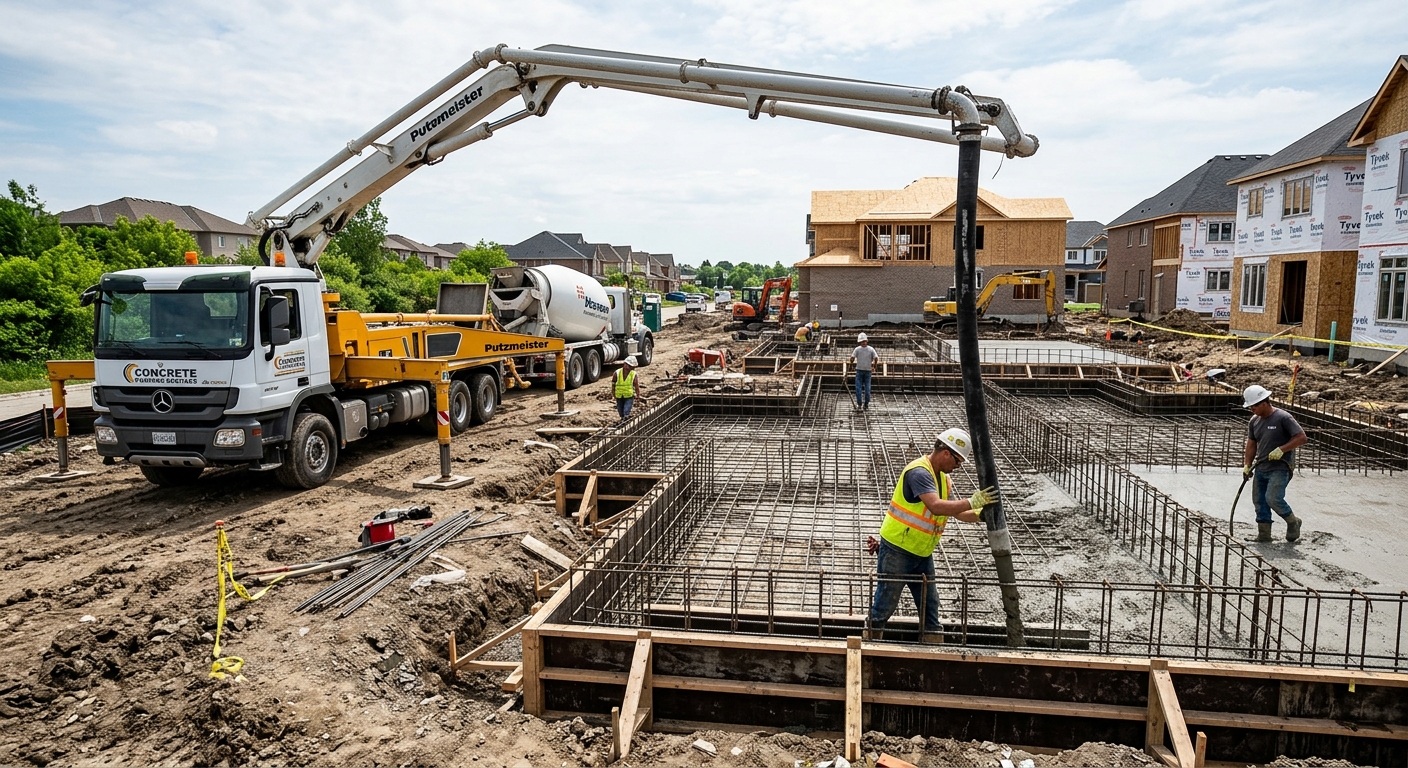
Concrete work options and costs in Marlborough Park
Marlborough Park is a mature, family-focused area in the Calgary region, and most concrete flatwork starts with the kinds of homes people move into and renovate—especially detached properties that commonly include driveways, walkways and rear patios. With a 2021 population of 8,290 in Marlborough Park (Statistics Canada, 2021 Census), the local trade is busy enough that you’ll usually get the best pricing when you’re flexible with scheduling and clear on finish details from day one. In Calgary’s broader housing stock, single-detached homes remain a key driver for exterior concrete demand, and that keeps crews focused on high-quality base prep and winter-ready specifications.
Cost in Marlborough Park is shaped by Calgary’s cold continental climate. Concrete here is engineered around freeze–thaw cycles, so exterior work typically requires air-entrained mixes and carefully planned control joints to reduce cracking and spalling. Footings are also deeper than in milder regions because local practice targets a design frost depth of about 1.2 m, meaning excavation and foundation volume are higher. That’s why foundation/footings typically land in a higher band than driveways or patios. The practical exterior pour season is also shorter, and when placements happen near the shoulder seasons, winter-grade curing measures (blankets/heat) can add cost.
If you’re in the denser pockets near 52 Street and the newer infill lanes where access can be tight, expect more time for staging and protection of landscaping—another factor that moves pricing between contractor bids. With those basics in mind, the table below gives typical Marlborough Park ranges so you can compare quotes apples-to-apples.
| Application |
Typical Size |
Key Spec |
Finish Option |
Price Range |
| Concrete driveway (standard broom finish) |
400–500 sq. ft. |
Air-entrained exterior mix, compacted granular base, control joints |
Broom finish |
$12,000–$18,000 |
| Exposed aggregate driveway |
400–500 sq. ft. |
Air-entrained exterior mix, proper curing and wash timing, jointing plan |
Exposed aggregate |
$14,500–$21,500 |
| Stamped concrete driveway or patio |
300–450 sq. ft. |
Air-entrained exterior mix, integral colour, border details and jointing |
Stamped (with stain/colour) |
$15,000–$26,000 |
| Plain concrete patio or walkway |
200–350 sq. ft. |
Air-entrained exterior mix, compacted sub-base, saw-cut joints |
Plain trowel or broomed |
$5,000–$9,000 |
| Garage floor (interior slab) |
400–600 sq. ft. |
Vapour barrier, insulated edges (if required), proper reinforcement |
Float and trowel (light broom finish if specified) |
$10,500–$17,500 |
| Foundation footings (structural, below frost) |
Typical house: 1,000–1,800 sq. ft. of footing area |
Engineered rebar, concrete poured below ~1.2 m frost depth, site excavation |
Structural finish only (not decorative) |
$28,000–$45,000 |
Prices are estimates only and vary by project scope, site access and material selection.
What affects the price of concrete work in Marlborough Park
In Marlborough Park, you can easily see quote swings of 30–50% for what looks like the same “concrete driveway” on paper. The difference usually isn’t the concrete itself—it’s the engineering and labour behind it: excavation depth, base thickness and compaction, reinforcement decisions, winter curing measures, and how much time the crew spends protecting property and controlling joints properly. Contractors that price for the real work (and the colder pour conditions) tend to be higher, but they’re also the ones that reduce callbacks.
Calgary’s frost and freeze–thaw cycle dictates every key spec. Footings and foundation elements must bear below the design frost depth (about 1.2 m) to prevent frost heave and seasonal movement. Exterior flatwork also needs air-entrained concrete to survive repeated freezing and thawing—especially when de-icing salts are involved. The colder regions around Calgary typically have a shorter pour season, so cold-weather placement often requires heating, insulated blankets, or winter-grade timing to protect curing; that adds labour and equipment costs. On top of that, inconsistent site access across neighbourhoods can force smaller pours and longer scheduling.
Two common examples in Marlborough Park: (1) a driveway on a challenging slope may require deeper excavation and more granular base, pushing a standard broom driveway closer to the $12,000–$18,000 band; (2) if you want exposed aggregate or stamped work, the added finishing steps and colouring typically move you toward the $15,000–$26,000 stamped/decorative range. For older properties, you may also encounter unexpected buried services or compacted fill—extra demo and re-grading can add thousands quickly.
| Price Factor |
Why It Matters |
Cost Impact |
| Frost line depth |
Determines footing depth and form height so concrete bears below frost |
Higher excavation and concrete volume can add significant cost, especially for foundations |
| Site preparation |
Excavation, grading and compacted granular base control settlement and cracking |
Poor soil or removal of unsuitable fill increases labour and granular material |
| Reinforcement |
Rebar or wire mesh limits curling, cracking and structural deficiencies |
Correct reinforcement is usually more expensive but reduces long-term failure risk |
| Mix design |
Air-entrainment and specified compressive strength improve freeze–thaw durability |
Exterior engineered mixes and QC testing can raise material cost |
| Finish type |
Broom vs. stamped vs. exposed aggregate affects labour time and materials |
Stamped/exposed finishes typically cost more than plain broomed slabs |
| Pour size and concrete truck access to site |
Access affects pump needs, pour scheduling and how much can be placed efficiently |
Pumps, extra labour and waiting time increase total cost |
| Cold-weather curing precautions |
Heating/blankets protect curing when temps drop and freeze–thaw risk rises |
Equipment and labour add cost near shoulder seasons |
| Control joint pattern and sealing cost |
Joints control where cracks occur; sealing helps resist de-icing salt damage |
Proper jointing and a scheduled sealer add a modest line item that prevents bigger repairs |
Permits & regulations in Alberta
In Alberta, concrete that’s part of a structure usually isn’t a “no-paperwork” project. Structural concrete work—such as footings, foundation walls, grade beams and retaining-related structural elements—typically requires a building permit, and engineered drawings are often part of the approval process. Municipal review matters because frost depth requirements and reinforcement details must match the design for your specific site and soil conditions.
Concrete flatwork (like driveways, patios and walkways) usually does not require a permit, but there are exceptions. You may need to confirm with the municipality if the project affects lot grading, impervious surface coverage limits, stormwater drainage, or if any work is within the municipal right-of-way (for example, certain boulevard conditions). When in doubt, confirm before you break ground—missteps can lead to removal or redo costs.
Before signing with a contractor in Marlborough Park, verify three things:
- Alberta licence/registration: check the contractor’s profile through the appropriate Alberta public registry listings (or ask for their business registration details if they’re structured differently).
- Liability insurance: request a current certificate of insurance (COI) naming you as a “certificate holder” where applicable.
- WCB/WSIB coverage: in Alberta this is WCB. Ask for the clearance/coverage documentation letter or confirmation number.
Then ask for references on similar-scale Calgary-area work (exterior slabs or foundations built with freeze–thaw durability in mind).
Getting concrete right in Marlborough Park's freeze-thaw climate
Concrete fails in Marlborough Park mainly through two pathways: moisture getting into the slab and freeze–thaw expanding it, and movement from poor base preparation. In a cold continental climate with a frost depth around 1.2 m, the foundation system must be engineered to bear below frost, but exterior flatwork also needs the right “survive the winter” specs. The most common homeowner-visible failure is spalling—small flakes and surface scaling—usually tied to inadequate air-entrainment, rushed curing, or insufficient base drainage.
To spec the job correctly, insist on five basics tailored to Calgary conditions. (1) Base prep: compacted granular sub-base at the correct thickness for local soil and load needs, with proper drainage and grade. (2) Mix design: air-entrained concrete for exterior flatwork with a typical target of 5–7% air content, plus minimum compressive strength of 32 MPa for standard exterior work unless engineering specifies otherwise. (3) Control joints: place joints to manage shrinkage cracking instead of letting it “randomly happen.” (4) Curing: minimum 7 days under proper conditions; in cold weather, blankets/heating are not optional if temperatures threaten early freeze. (5) Sealing: apply a penetrating sealer about 28 days post-pour to help repel de-icing salt moisture intrusion.
Is it worth paying for better options? Often yes. For example, upgrading from a plain broom driveway to a stamped concrete driveway might land you closer to the $15,000–$26,000 band. The price can be justified when the contractor is also doing the “unseen” upgrades—thicker base, correct joints, and winter-ready curing—so the decorative surface isn’t just cosmetic, it’s built to last.
| Spec |
Why It Matters in Marlborough Park |
What to Ask For |
Impact if Skipped |
| Compacted granular base (depth?) |
Prevents settlement and keeps the slab stable through freeze–thaw cycles |
Granular sub-base thickness stated in the proposal, compacted to required densities, with drainage grade |
Uneven settlement, cracking and premature spalling |
| Air-entrained concrete mix (target air %?) |
Improves freeze–thaw durability and reduces surface scaling |
Exterior mix with target 5–7% air and proof the mix is air-entrained |
Higher risk of spalling and scaling in winter |
| Compressive strength (MPa rating) |
Ensures the slab can resist loading and environmental stress |
Minimum 32 MPa (or engineering spec for foundations/engineered flatwork) |
Reduced durability, cracking under load and earlier failure |
| Control joints (spacing per ACI guidelines) |
Controls shrinkage cracking so it doesn’t turn into random wide cracks |
Joint layout spacing plan and saw-cut timing |
Random cracking, water infiltration at cracks, and faster deterioration |
| Minimum 7-day curing period |
Curing strength development matters more in colder conditions |
Plan for curing duration and temperature protection (blankets/heating if needed) |
Surface weakness, scaling and structural problems over time |
| Penetrating sealer (when applied after cure) |
Reduces moisture and salt intrusion from Calgary winters |
Sealer application at about 28 days after pour, with product type identified |
More salt-driven spalling and higher maintenance costs |
How to choose a concrete work contractor in Marlborough Park
Start with verification. For Alberta projects, make sure your contractor can legally do the work and is properly insured. Ask for their Alberta licence/registration details, then request a current certificate of liability insurance (COI) before work begins. Also confirm WCB coverage with a clearance/coverage document or confirmation number—don’t rely on verbal assurance. A reputable Calgary-area crew will provide these items without pushing back.
Next, get 2–3 itemised written quotes instead of a single lump sum. You want line items that separate excavation and disposal, granular base, forms, reinforcement, concrete supply, delivery logistics, finishing, curing measures, and (if applicable) sealing. Confirm whether permits are included for structural work, and whether disposal/hauling is part of the scope—those details commonly swing pricing by thousands.
For warranty, ask what’s covered and for how long. Separate workmanship warranty from any product/manufacturer warranty, and find out if the warranty is transferable if you sell your home. For payment, avoid large up-front payments: a typical safe approach is no more than 10–15% upfront, then hold back until substantial completion and final walk-through. Finally, demand a timeline in writing: start date, concrete pour day(s), cure/return dates for saw-cutting and sealing, and estimated completion.
- Ask for references for Marlborough Park or nearby Calgary freeze–thaw exterior work.
- Confirm air-entrained mix is included for exterior slabs and show mix specs in writing.
- Require a base prep description: excavation depth, granular thickness, compaction and drainage grade.
- Get joint spacing and saw-cut timing stated, not left “to the contractor’s discretion.”
- Verify winter curing precautions (blankets/heating) if the pour date is near cold weather.
- Clarify reinforcement (rebar vs. wire mesh), especially for garage slabs and heavier traffic areas.
- Confirm truck access plan: pump needs, staging, and protection of lawn/sidewalks.
- Ask who is responsible for debris removal and disposal.
- Ensure sealing scope is clear (who supplies sealer and when it’s applied).
- Request a detailed schedule: pour, curing period, return for joints/sealing.
- Confirm the cleanup and protection plan for driveways/patios and adjacent surfaces.
- Check insurance COI dates and that coverage is active during the project.
Concrete contractor red flags in Marlborough Park: they won’t discuss air-entrainment or joint spacing; they suggest pouring late fall without winter curing plans; they ask for most payment upfront; they provide only a lump-sum quote with no breakdown for base prep and reinforcement; or they can’t produce insurance/WCB clearance documentation when you ask.
Frequently asked questions — concrete work in Marlborough Park
How long does concrete take to cure?
In Marlborough Park, curing timelines matter because Calgary’s freeze–thaw cycles can stress a slab before it gains adequate strength. As a rule of thumb, concrete reaches much of its practical strength within about 7 days, but it should be treated more carefully in the first week, especially if night temperatures drop. If the pour is in colder weather, reputable contractors use insulating blankets and/or heat to keep curing on track. For finishing decisions like sealing, many exterior specs call for sealing about 28 days after the pour, once the concrete has fully developed and moisture levels are appropriate. For structural work, engineered cure requirements may differ, so always follow the spec for your footings or foundation elements.
Do I need a permit for concrete work in Alberta?
In Alberta, structural concrete typically needs a building permit. That includes footings, foundation walls, and grade beams. Concrete flatwork such as driveways, patios and walkways often doesn’t require a permit, but you may need confirmation if your project affects lot grading, drainage, or impervious surface coverage limits, or if it impacts municipal right-of-way. For example, a driveway that changes how runoff flows toward a ditch or neighbour’s lot can trigger extra review. Because rules can vary by how the work is scoped, the safest approach in Marlborough Park is to confirm the exact classification with the municipality before you pour, even if the contractor tells you “it’s just concrete.”
Concrete vs pavers for a patio in Marlborough Park?
Both can work well in Marlborough Park, but the choice depends on what you value most: appearance flexibility or long-term maintenance and water management. Concrete patios are usually faster to install and can be finished plain, broomed, or stamped. Typical pricing for a plain patio or walkway sits around $5,000–$9,000 for common backyard sizes, assuming good access and standard base prep. Pavers can offer easier localized repairs (you can lift and replace a section), but they still need strong base compaction and correct jointing to handle freeze–thaw. In Calgary’s winter conditions, both systems require drainage and careful installation. If de-icing salt runoff and seasonal moisture are a concern, a well-built concrete patio with air-entrained mix, joints, and proper sealer typically holds up very well.
How long does a concrete driveway last?
A properly built concrete driveway can last decades in Calgary-area winters, but “how long” depends heavily on the specs. If the contractor uses an air-entrained mix for exterior durability, compacts the granular base correctly, places control joints at the right intervals, and supports curing in cold weather, the slab is much more resistant to freeze–thaw scaling and cracking. If those pieces are cut—especially air-entrainment or curing—surface spalling and joint deterioration can start much sooner. Pricing typically reflects these factors; for driveways in Marlborough Park, a standard broom-finish driveway is often in the $12,000–$18,000 range, while decorative options can rise into higher bands. Your driveway’s lifespan is less about “concrete alone” and more about the full system (base, mix, joints, curing, and sealing).
What is air-entrained concrete and why does it matter here?
Air-entrained concrete is mixed with tiny, intentionally formed air bubbles that give freeze–thaw expansion room to relieve pressure internally. In Marlborough Park and across the Calgary region, freeze–thaw cycles are frequent, and de-icing salts can accelerate surface deterioration when water gets into the slab. That’s why for exterior flatwork like driveways and patios, you should expect an air-entrained exterior mix with a target air content commonly around 5–7%. Without air entrainment, the concrete paste can fracture during winter expansion, leading to spalling or scaling. This is one of the most important technical questions to ask before signing: a contractor should be able to confirm that the mix is air-entrained for your exposure and that it meets the needed compressive strength.
How do I prepare the base for a concrete slab?
Base prep is where durable concrete is won or lost in Marlborough Park’s climate. The contractor should excavate to the designed elevation, remove unsuitable soil, and then place and compact a granular sub-base in lifts to achieve proper density. Because the frost depth in Alberta is significant (with typical design frost depth around 1.2 m for foundational support), the project must be engineered so concrete is supported below frost movement—especially for foundations and footings. For exterior slabs, the goal is stable support plus drainage so water doesn’t sit under or within the slab. Ask how they handle grading, compacted granular depth, and whether they include reinforcement for your intended load. If you’re choosing a decorative finish (like stamped concrete), strong base prep still matters because a prettier surface won’t prevent failure if the base is weak.