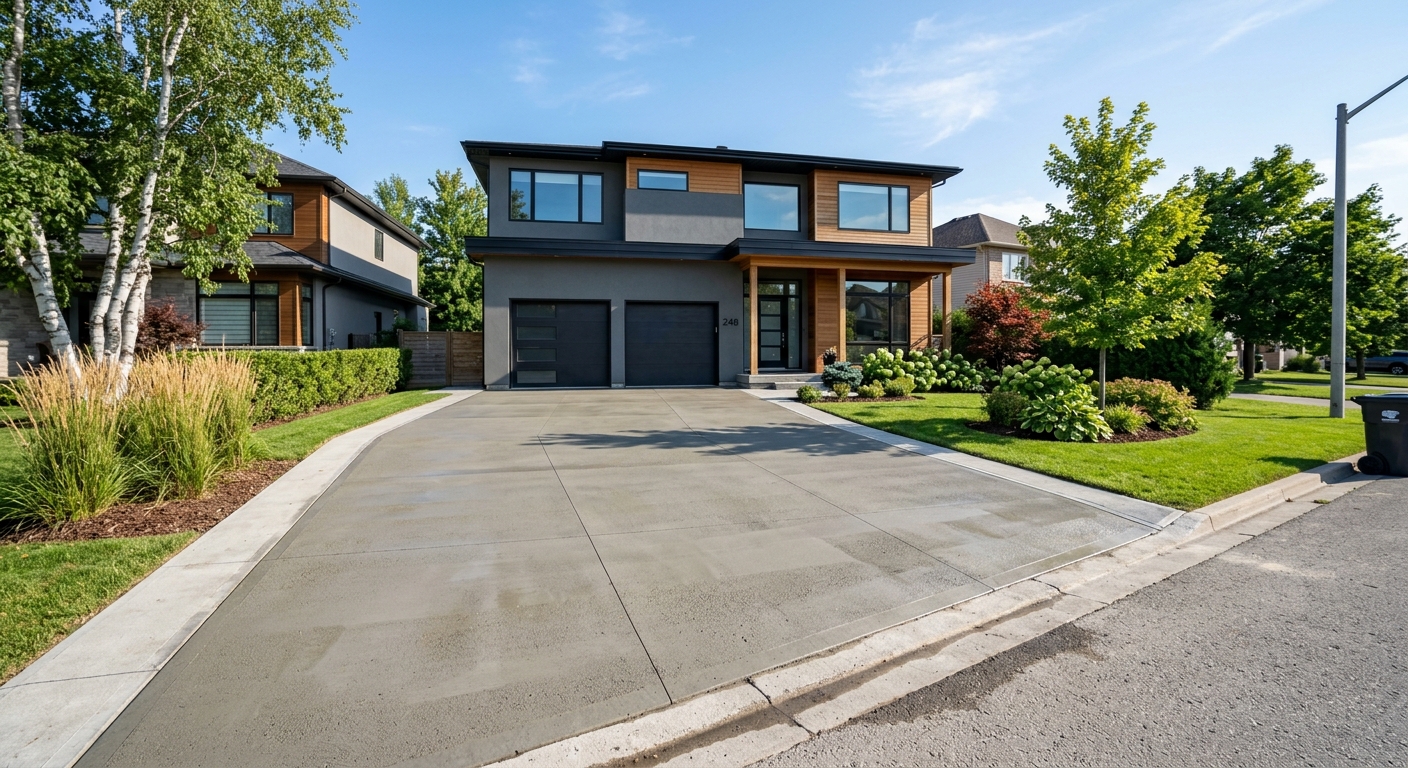
Concrete work options and costs in Rhatigan Ridge
Rhatigan Ridge is a growing Calgary-area community where most homeowners want durable, low-maintenance concrete flatwork—especially as properties mature. With a 2021 population of 3,252 (Statistics Canada, 2021 Census), local concrete demand tends to cluster around the busiest build and renovation seasons, so lead times and scheduling matter. Just as importantly, the majority of concrete “surface” work here is tied to single-detached housing and garages—flatwork like driveways, patios and walkways—so pricing is often compared year-to-year by many neighbours. In cold continental conditions, the cost to build properly is less about concrete price and more about excavation depth, base engineering, and the curing plan.
In Calgary’s freeze–thaw climate, the design frost depth is about 1.2 m (roughly 4 ft). That means footings for homes, garages, decks and retaining structures must be engineered to bear below undisturbed soil at frost depth to reduce seasonal movement. Exterior slabs also require air-entrained mixes, well-compacted granular base prep, and control joints to manage cracking and protect against scaling and spalling. Even the “pour season” is shorter in practice, and winter work can require winter-grade materials, insulated blankets and sometimes temporary heat to hit proper strength gain.
In Rhatigan Ridge, concrete trade demand is especially noticeable around newer residential pockets near the edge of Calgary’s growing southeast corridor (home builds and accessory structures), where driveways and garage slabs go in early. Below is a practical comparison of common options and what you can realistically expect to pay.
| Application |
Typical Size |
Key Spec |
Finish Option |
Price Range |
| Concrete driveway (standard broom finish) |
24 ft x 20 ft (approx. 480 sq ft) |
Air-entrained exterior mix, compacted granular base, control joints |
Broom finish + sealer (recommended) |
$12,000–$18,000 |
| Exposed aggregate driveway |
24 ft x 20 ft (approx. 480 sq ft) |
Air-entrained mix, proper curing for clean exposure, strengthened base |
Exposed aggregate with light broom texture |
$14,000–$20,500 |
| Stamped concrete driveway or patio |
24 ft x 20 ft (approx. 480 sq ft) |
Air-entrained mix, integral colour (or specified colour system), stamp layout |
Stamped pattern with seal coat |
$15,000–$26,000 |
| Plain concrete patio or walkway |
12 ft x 16 ft (approx. 192 sq ft) or 4 ft x 30 ft (120 sq ft) |
Exterior-grade air-entrained concrete, compacted base, joints |
Float + broom or broom-only finish |
$5,000–$9,000 |
| Garage floor (interior slab) |
22 ft x 22 ft (approx. 484 sq ft) |
Interior mix, vapour considerations as applicable, fibres optional |
Smooth trowel (with proper slip control) or broom-surface |
$9,500–$16,000 |
| Foundation footings (structural, below frost) |
Per engineered foundation plan (typ. varies widely) |
Reinforced concrete footings to local frost requirements, excavation to subgrade |
Structural finish (not decorative) |
$28,000–$45,000 |
Prices are estimates only and vary by project scope, site access and material selection.
What affects the price of concrete work in Rhatigan Ridge
In the Calgary region around Rhatigan Ridge, two quotes for the “same” concrete job can vary by 30–50% because the hidden work is what really drives the budget. The labour rate and crew time are only part of the story—depth of excavation, hauling, granular base quantity, reinforcing details, and cold-weather curing precautions can swing total cost quickly. Contractors also price risk differently in a short exterior pour window: getting the mix design right, protecting curing concrete, and scheduling trucks efficiently in winter all add real dollars.
The frost line depth and freeze–thaw cycles dictate almost every specification here. Footings must be engineered to extend below the design frost depth (about 1.2 m in Alberta), so excavation volumes and formwork height increase compared with milder climates. For exterior slabs, air-entrained mixes are a requirement in practice because they help concrete resist freeze–thaw damage and reduce surface deterioration. When pours happen late fall or early spring, cold-weather curing precautions—like insulated blankets and sometimes temporary heat—are often needed to reach proper strength gain. And because de-icing salt accelerates deterioration, sealing is a small cost relative to repairing spalled edges later.
In Rhatigan Ridge specifically, costs tend to rise when: the soil needs deeper removal and replacement, the site has limited concrete truck access (long carry, more crew time), or the project includes premium finishes like stamped or exposed aggregate (the labour and materials scale up). Costs can drop when the site is already graded, subgrade is stable, and you choose standard broom-finished concrete instead of decorative work. For context, a standard driveway might land in the $12,000–$18,000 band, while stamped concrete commonly shifts into $15,000–$26,000 territory once colour systems, stamps and labour time are included. Home builds that start with deeper engineered footings—often part of newer development phases—also push foundation-related budgets higher because of the frost-depth excavation requirement.
| Price Factor |
Why It Matters |
Cost Impact |
| Frost line depth |
Determines footing depth and form height for structural work; drives excavation quantity |
Often one of the biggest cost swings; can add thousands on deeper engineered footing scopes |
| Site preparation |
Excavation, grading, and compacted granular base control settlement and cracking |
Unstable or deep over-excavation increases labour, trucking and granular costs |
| Reinforcement |
Rebar or mesh improves structural capacity and controls cracking when required |
Wire mesh/fibres optional vs required rebar can materially change material costs |
| Mix design |
Air-entrainment and specified compressive strength improve freeze–thaw resistance and long-term durability |
Exterior-grade mixes are costlier but reduce spalling and scaling failures |
| Finish type |
Broom vs stamped vs exposed aggregate changes labour time, colour systems and surface curing needs |
Standard finishes cost less; decorative work often increases total price noticeably |
| Pour size and concrete truck access to site |
More volume and fewer access constraints reduce delays and re-handling |
Poor access can add labour and prolong the pour window |
| Cold-weather curing precautions |
Winter-grade materials, blankets and/or heat protect early strength gain |
Late-season work can add costs for equipment and time |
| Control joint pattern and sealing cost |
Joints manage shrinkage cracking; sealing helps repel moisture and de-icing salts |
Sealing is usually a smaller line item but helps avoid expensive surface repairs |
Permits & regulations in Alberta
In Alberta, the key distinction is whether the concrete work is structural and part of the building’s load path. In Rhatigan Ridge, concrete flatwork like driveways, patios and walkways typically does not require a building permit by default. However, permits may be triggered if the work affects lot grading, drainage, impervious surface coverage rules, or the municipal right-of-way—especially where you’re tying into a driveway approach or changing elevations near the street.
Concrete work that does require a permit generally includes structural items such as footings, foundation walls, grade beams and other reinforced structural concrete elements. Often, engineered drawings are reviewed as part of the permit process, because frost-depth support and reinforcement details must match the structural design.
For homeowners verifying a contractor in Alberta, take a step-by-step approach: (1) request the contractor’s liability insurance certificate and confirm the coverage dates and limits; (2) ask about WSIB/WCB clearance—have them provide the appropriate clearance documentation or proof of coverage status; (3) confirm their licensing/registration information through the relevant online listings used in Alberta for contractors; and (4) compare references from similar-scale projects (driveways in winter and engineered footing work where applicable). If a contractor can’t provide clear proof of insurance and coverage, that’s a red flag—especially in a freeze–thaw climate where workmanship issues can show up months later after freeze cycles begin.
Getting concrete right in Rhatigan Ridge's freeze-thaw climate
Concrete failures in Rhatigan Ridge are usually about early decisions: base prep, mix design, jointing and curing. In a Calgary-area freeze–thaw climate, the most common long-term problem homeowners notice is spalling—surface scaling and flaking caused when water enters and freezes in concrete pores. The fix is not a “better topcoat”; it’s a durable specification from day one.
Start with base preparation: you need a compacted granular sub-base to the correct depth and density for your soil conditions and local frost exposure. Next, lock in the mix design: for exterior flatwork, specify air-entrainment (commonly 5–7% air content for many exterior exposure conditions) and minimum compressive strength (commonly 32 MPa for quality residential exterior work when specified). Add control joints at a spacing that limits random cracking, and ensure proper curing. As a rule of thumb, plan for at least 7 days of curing under proper conditions; in cold weather, that often means insulating blankets or temporary heat so the concrete can gain strength. Finally, seal after the concrete has cured—typically 28 days post-pour for many penetrating sealer systems—to repel moisture and reduce the impact of de-icing salts.
Here’s a realistic cost example: if you’re choosing between a standard broom driveway and stamped concrete, the stamped option can add several thousand dollars because of colour systems, stamp timing and extra labour. That’s justified if you also ensure correct air-entrainment, jointing and curing, because decorative surfaces don’t “solve” freeze–thaw durability problems. If a contractor cuts corners on air-entrainment or base prep, you’ll pay again—often with repairs—regardless of finish.
| Spec |
Why It Matters in Rhatigan Ridge |
What to Ask For |
Impact if Skipped |
| Compacted granular base (depth?) |
Controls settlement and provides frost-resistant support under exterior slabs and footings |
Ask for target base depth and compaction method/results for your soil |
More cracking, uneven settling and potential loss of bearing over freeze–thaw cycles |
| Air-entrained concrete mix (target air %?) |
Improves freeze–thaw durability by giving water expansion room inside concrete |
Ask for air-entrainment target (commonly 5–7% for exterior flatwork) and mix delivery documentation |
Higher risk of spalling/scaling in winter, especially with de-icing salts |
| Compressive strength (MPa rating) |
Ensures the slab reaches adequate strength for loads and long-term performance |
Ask for minimum 32 MPa (or stated design strength) and curing approach in cold weather |
Surface damage, reduced durability and increased cracking likelihood |
| Control joints (spacing per ACI guidelines) |
Limits random shrinkage cracking when temperatures swing |
Ask for joint spacing plan and whether joints are saw-cut or formed as specified |
Cracks appear where they shouldn’t, and water migration accelerates damage |
| Minimum 7-day curing period |
Curing controls strength gain before freeze events begin to stress young concrete |
Ask how they maintain curing temperature/moisture; confirm curing duration on your schedule |
Weak surfaces, scaling and long-term durability problems |
| Penetrating sealer (when applied after cure) |
Repels moisture and helps protect from salt exposure during Alberta winters |
Ask for sealer type and application timing—often ~28 days after pour |
Faster moisture uptake and earlier surface deterioration |
How to choose a concrete work contractor in Rhatigan Ridge
Choosing a concrete contractor in Rhatigan Ridge is mostly about verifying documentation and controlling scope. In Alberta, confirm licensing/registration status that applies to the contractor, and then verify insurance: ask for a current certificate of liability insurance. For worker protection, ask for proof of WSIB/WCB coverage or the applicable clearance documentation. Don’t accept “we’re covered” without seeing the document—your risk is real when rebar and excavation are involved and when work is done during Alberta’s temperature swings.
Next, get 2–3 itemised written quotes rather than one lump sum. You want line items that separate labour, concrete supply, base/grading, reinforcement, formwork, finishing, saw cutting, curing/blankets (if needed), and disposal. Clear scope prevents the common Calgary-area surprise: one contractor includes proper cold-weather curing precautions while another assumes ideal temperatures. Make sure the permit pull (if required for structural work), material haul-away/disposal, and any site protection are either included or explicitly excluded.
For warranty, ask for two things: the workmanship warranty length and whether manufacturer warranties for concrete products or sealers are included. Also clarify whether warranties are transferable if you sell your home. On payment schedule, avoid paying more than 10–15% upfront; hold back a portion until the job is complete and surfaces are inspected. Finally, get a start date and completion estimate in writing—especially for exterior work where truck scheduling and curing time matter.
- Request proof of current liability insurance before signing.
- Ask for WSIB/WCB clearance or proof of coverage in Alberta.
- Confirm licensing/registration details and keep them on file.
- Get 2–3 itemised quotes (labour + materials breakdown, not just a total).
- Ask what’s included for base excavation, compacted granular depth, and disposal.
- Confirm whether rebar/mesh is included or only “as required” and how that decision is made.
- Ask for the mix spec: air-entrainment for exterior and target strength (e.g., 32 MPa).
- Ask about control joints: spacing plan and whether joints are saw-cut or pre-planned.
- Confirm curing plan for cold nights (blankets/heaters) and how curing success is ensured.
- Clarify finishing steps: broom vs stamped vs exposed aggregate and slip resistance expectations.
- Confirm sealing: type and whether application timing (often ~28 days) is included.
- Use a payment schedule that holds back until finish inspection and cleanup are done.
Concrete red flags in Rhatigan Ridge: no documentation for insurance/coverage, “cheap” quotes that omit compacted base depth or reinforcement details, no clear curing plan for cold weather, pressure for large upfront payments, and vague scope language like “finish as we see fit” (especially for joints and sealing).
Frequently asked questions — concrete work in Rhatigan Ridge
How do I maintain concrete in Rhatigan Ridge's freeze-thaw climate?
In Rhatigan Ridge and throughout Alberta’s freeze–thaw seasons, maintenance is about keeping water and salt from staying in contact with the surface. Start with regular sweeping—sand and grit act like sandpaper during temperature cycling. Use de-icing products carefully; avoid over-salting and try to remove ice promptly rather than leaving brine pools. If your driveway or walkway has been sealed, re-check the sealer condition annually and plan for re-application once water no longer beads. For exterior concrete, sealing (often applied around 28 days post-pour) helps repel moisture so freeze cycles do less damage. If you see early scaling at edges or near joints, seal and repair promptly so cracks don’t become pathways for water.
What causes concrete to spall in Rhatigan Ridge winters?
Spalling in Alberta winters is usually tied to freeze–thaw damage where water enters the concrete and freezes, expanding inside. The biggest driver is inadequate air-entrainment or an exterior mix that wasn’t engineered for cold exposure. Other causes include poor compaction/base preparation (leading to micro-movement), lack of proper control jointing (cracks open in the wrong places), and rushed curing in cold weather (weak early surface strength). De-icing salts worsen the situation by increasing the rate of surface deterioration when moisture cycles keep repeating. The practical takeaway: if you’re budgeting for something like a driveway in the $12,000–$18,000 range, insist the contractor specifies air-entrained exterior concrete and a curing plan—those are durability items, not “extras.”
What is rebar and when is it required in Alberta?
Rebar (reinforcing steel) is used to increase the structural capacity of concrete and help control cracking under load and temperature changes. In Alberta, whether rebar is required depends on the engineering design, slab type, and soil/support conditions—not just the homeowner’s preference. Structural concrete such as footings, foundation walls and grade beams typically includes reinforcement and must be detailed to the engineered drawings reviewed for permits. For flatwork like driveways, reinforcement (rebar or mesh) is sometimes specified based on thickness, span over weak soil, and expected loads (for example, heavy vehicle traffic). Always ask your contractor to show the design thickness and reinforcement plan for your scope. If you’re doing structural work, expect permits and engineered guidance; for simple patios/walkways, reinforcement may still be recommended depending on the sub-base and thickness.
How long does a concrete project take in Rhatigan Ridge?
Timelines in Rhatigan Ridge depend on whether the project is flatwork or structural, and—most importantly—weather and curing conditions. Typical concrete flatwork schedules often look like: site prep and base work in 1–3 days, formwork if needed, pour day (usually 1 day), then curing. Even if the concrete is walkable sooner, proper curing generally takes at least 7 days under suitable conditions, and many finishes and seal applications assume longer. For exterior pours near cold snaps, contractors may add time for insulated blankets or temporary heat to protect curing concrete. Structural footing schedules are longer because excavation, inspection steps, reinforcement placement, and engineered sign-offs can stretch the sequence. Plan for calendar time, not just pour day—especially if you want a durable driveway finish rather than rushed placement.
What is a concrete overlay and is it suited to Rhatigan Ridge?
A concrete overlay is a new concrete layer placed over an existing slab after surface preparation (usually grinding/removal of weak surface and proper bonding preparations). Overlays can be suited to Rhatigan Ridge when the existing concrete is sound—no major structural failure, no extensive base settlement, and manageable cracking that can be addressed. If the original slab is already heaving, pumping water, or has widespread deterioration, an overlay may hide symptoms without fixing the cause, and freeze–thaw cycles can accelerate failure again. Overlays also require attention to drainage and joint alignment so the new surface doesn’t trap moisture. Cost can be attractive compared with a full replacement, but quotes vary widely depending on thickness, prep, and whether dowels/bonding systems are included. Ask whether air-entrainment and proper sealing are included, similar to any exterior concrete project.
How do I seal concrete to protect it in Rhatigan Ridge?
Sealing helps protect against moisture and salt exposure in Alberta’s winter cycle, but timing matters. Most driveway and patio sealers are applied after the concrete cures—commonly around 28 days post-pour—so the slab can release excess moisture. Before sealing, concrete should be clean, dry, and free of dust, curing compounds (if any), and surface contaminants. Use a penetrating sealer designed for concrete (rather than a film-forming product) when the goal is moisture resistance without trapping water. For best results, follow the contractor’s surface prep steps and application conditions (temperature, wind, and dry weather window). If you’re comparing options and one quote includes sealing while another doesn’t, that’s usually a meaningful durability difference. For many homeowners budgeting around the $12,000–$18,000 driveway range, sealing is often the difference between “looks good now” and better long-term performance through freeze–thaw.