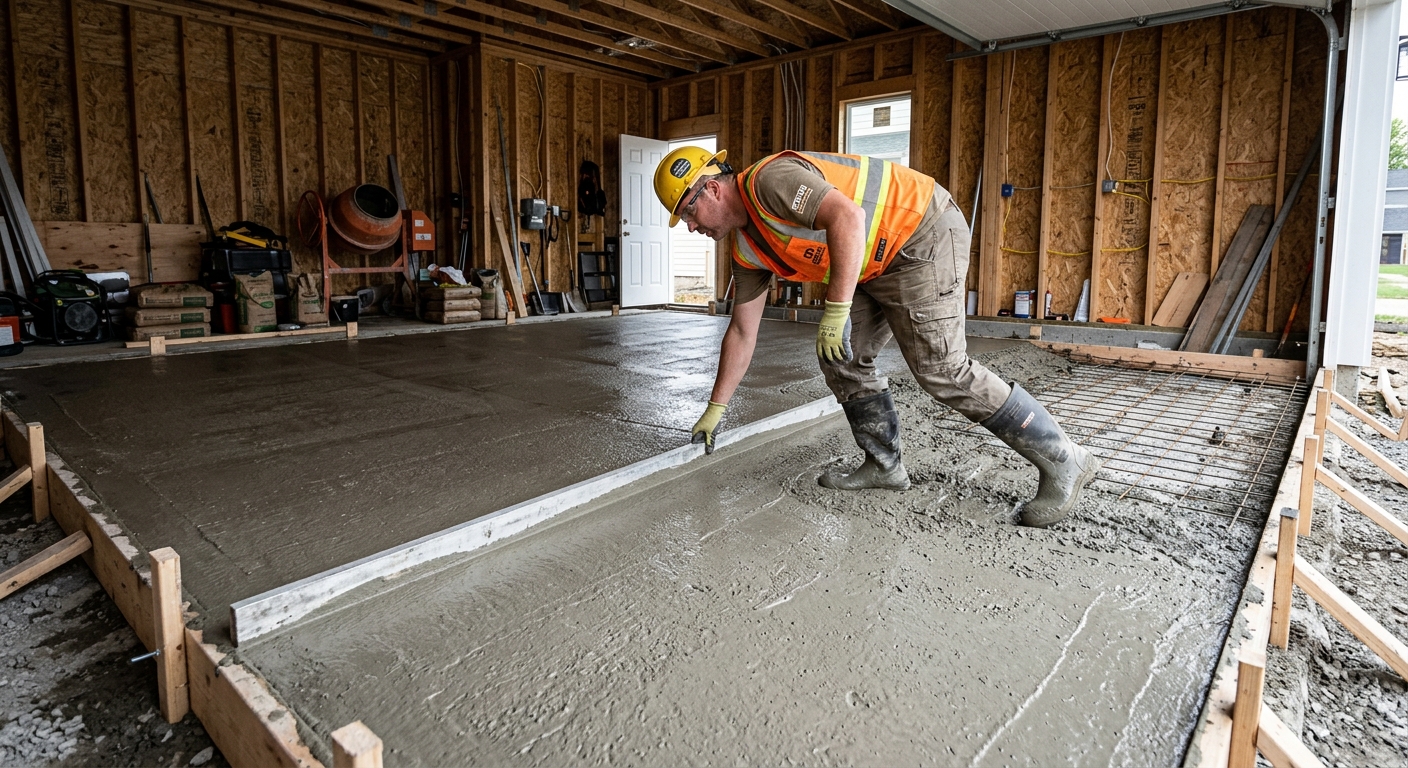
Concrete work options and costs in Braeside
Braeside, Alberta is a great place for concrete flatwork, but the cost can swing depending on how the job is engineered for winter. With a population of about 5,700 (Statistics Canada, 2021 Census), the local market is still close enough to Calgary that contractors are available—yet specialized foundation and cold-weather concrete crews book up quickly when the schedule tightens. In Braeside’s home market, single-detached houses make up the practical demand base for driveways, patios and walkways, so most concrete estimates come down to frost-protection depth, excavation volume, and how the slab is detailed for freeze–thaw cracking. (Statistics Canada, 2021 Census)
In the Calgary region, the design frost depth is about 1.2 m (roughly 4 ft). That means footing and base prep for exterior concrete is often more intensive than in warmer provinces. On top of that, freeze–thaw cycling is frequent, so exterior pours rely on air-entrained mixes, proper granular base compaction, and correctly spaced control joints. If you’re doing work late in the season, winter-grade placement and curing protection can add cost, but it’s what protects the finished surface from scaling and early-age damage. Neighbourhood areas along established residential corridors in and around Braeside are especially busy for driveway and patio upgrades as homeowners refresh curb appeal.
Below are realistic cost bands for common concrete options in Braeside, so you can compare contractor proposals before you ask for changes.
| Application |
Typical Size |
Key Spec |
Finish Option |
Price Range |
| Concrete driveway (standard broom finish) |
24 ft x 10 ft (240 sq ft) |
Air-entrained exterior mix, compacted granular base |
Broom finish + sealer |
$12,000–$18,000 |
| Exposed aggregate driveway |
24 ft x 10 ft (240 sq ft) |
Air-entrained exterior mix, proper mix design for durability |
Exposed aggregate with finish curing |
$15,000–$21,000 |
| Stamped concrete driveway or patio |
20 ft x 15 ft (300 sq ft) |
Air-entrained exterior mix, engineered base |
Stamp + integral colour + release system |
$15,000–$26,000 |
| Plain concrete patio or walkway |
12 ft x 12 ft (144 sq ft) |
Air-entrained exterior mix + control joints |
Float finish + broom edge |
$5,000–$9,000 |
| Garage floor (interior slab) |
20 ft x 22 ft (440 sq ft) |
Vapour barrier (where required), mesh/reinforcement as specified |
Steel-trowel finish or broom depending on use |
$10,000–$16,000 |
| Foundation footings (structural, below frost) |
Typical house bearing footprint |
Excavation to design frost depth, reinforcement + engineered formwork |
Structural plain concrete |
$28,000–$45,000 |
Prices are estimates only and vary by project scope, site access and material selection.
What affects the price of concrete work in Braeside
If you get two quotes for the “same” concrete job in the Calgary region, the difference can easily land in the 30–50% range. The reason isn’t just contractor overhead—it’s that concrete is a system. In Braeside, the local frost depth is about 1.2 m, so every exterior slab or foundation detail depends on excavation depth, granular base thickness, and reinforcement placement below grade. When contractors price properly, they price for frost protection; when they don’t, you often pay later for repairs.
Freeze–thaw cycles also drive mix and finishing requirements. Exterior work needs air-entrained concrete to survive repeated wetting and freezing, and driveways/patios need the right joint pattern to reduce random cracking. Costs rise further in colder placement windows: late-fall and early-spring work may require winter-grade mixes, insulated blankets, and sometimes temporary heat to achieve correct curing. Finally, de-icing salt is common on Calgary-area driveways; without sealing and the right surface curing, spalling can accelerate.
In Braeside specifically, a long or narrow access path increases labour and equipment time, while thicker slabs (for heavy vehicles or wheel loads) increase concrete volume. A larger excavated area also pushes truck counts and disposal costs. As a practical reference, a basic broom-finish driveway often fits the $12,000–$18,000 band, while stamped work in the same driveway footprint commonly shifts toward the $15,000–$26,000 range because of integral colour, release materials, extra finishing time, and labour-intensive stamping.
Housing age matters too. Older properties around Braeside sometimes require heavier removal of old base materials and subgrade rework, which can add thousands even before the new concrete is poured. On the flip side, a straightforward re-pour on compacted soil can keep costs near the lower end of the price band.
| Price Factor |
Why It Matters |
Cost Impact |
| Frost line depth — determines footing depth and form height |
Footings must bear below design frost to prevent heave |
Higher excavation and formwork; can be a major driver for foundations |
| Site preparation — excavation, grading, compacted granular base |
Good base prevents settlement and reduces cracking |
More hauling/compaction increases labour and truck costs |
| Reinforcement — rebar or wire mesh requirement |
Controls cracking and supports loads |
Material + labour to install spacers/tying; increases cost on thicker slabs |
| Mix design — air-entrainment and compressive strength spec |
Survives freeze–thaw and de-icing exposure |
Extra testing/quality requirements; necessary for exterior durability |
| Finish type — broom vs. stamped vs. exposed aggregate |
Finish systems add labour and materials |
Stamped/exposed options typically move toward the upper price bands |
| Pour size and concrete truck access to site |
Access affects pumping, labour, and schedule |
Limited access can add labour and equipment rentals |
| Cold-weather curing precautions — heating and blankets |
Protects early-age strength gain |
Winter-grade setup and labour can add a noticeable premium |
| Control joint pattern and sealing cost |
Joints manage shrinkage cracking; sealing helps resist salt scaling |
Proper jointing and sealer are cheaper than premature surface repairs |
Permits & regulations in Alberta
In Alberta, structural concrete work generally needs a building permit, especially when it affects the structural system. That typically includes footings, foundation walls, grade beams, and other load-bearing concrete elements. In many cases, engineered drawings are reviewed by the municipality before construction starts. For concrete flatwork like patios, walkways, and driveways, permits are usually not required by default—however, you must still confirm whether your project affects lot grading, drainage, or impervious surface coverage limits, or anything within the municipal right-of-way.
For a Braeside homeowner, the best approach is to verify permit requirements with the local authority before you break ground, and to ensure your contractor is properly insured. Start by confirming the contractor carries liability insurance with certificate coverage naming you and the project as required. Next, confirm worker coverage (WSIB/WCB depending on the applicable coverage structure) so you’re not exposed if labourers are injured on site. Finally, ask for references on similar-scale concrete work in the Calgary area—especially projects that required frost-depth excavation and proper exterior curing.
Step-by-step, you can verify a contractor by: (1) searching the contractor’s licensing/registration details on the appropriate Alberta registry listings, (2) requesting a current certificate of liability insurance and checking that it’s not expired and matches the job address, and (3) asking for a coverage clearance letter or proof of workers’ compensation coverage applicable to their crews. If a contractor can’t provide these documents promptly, consider it a red flag and move on.
Getting concrete right in Braeside's freeze-thaw climate
Concrete failures in Braeside usually come back to three things: base preparation, freeze–thaw durability, and early-age curing. In a Calgary-region cold continental climate, the slab experiences repeated freezing and thawing, and any water movement through cracks or around weak base areas accelerates deterioration. That’s why your specs should start with proper, compacted granular base to the right depth for your local soil and frost conditions (around a 1.2 m design frost depth). If the base is underbuilt or poorly compacted, you can get settlement and random cracking—then water finds its way into the concrete and the freeze–thaw cycle starts doing damage.
Next is mix design: exterior concrete should be air-entrained (target 5–7% air content for typical exterior flatwork) and have a minimum 32 MPa compressive strength. Without air-entrainment, freeze–thaw expands internal water pockets and can lead to spalling—flaking and scaling that homeowners notice within a few winters. Control joints also matter: they give shrinkage cracks a planned place to occur. Finally, curing is non-negotiable. Aim for at least 7 days of proper curing conditions; when temperatures drop, contractors should use insulated blankets and cold-weather precautions so the concrete reaches sufficient early strength.
Sealing helps too: apply a penetrating sealer after proper cure—commonly at 28 days post-pour—so de-icing salts are less aggressive on the surface. If you’re choosing between finishes, you can justify cost differences: for example, moving from a plain broom patio in the $5,000–$9,000 band to stamped work toward the $15,000–$26,000 band is only worth it if the contractor is also specifying the same durable base, air-entrained mix, jointing, and curing protection. Decorative work doesn’t fix an under-engineered slab.
| Spec |
Why It Matters in Braeside |
What to Ask For |
Impact if Skipped |
| Compacted granular base (depth?) |
Proper support reduces settlement and cracking under freeze–thaw |
Granular base depth and compaction plan based on your soil and frost requirements |
Uneven settling, voids, and faster cracking/spalling |
| Air-entrained concrete mix (target air %?) |
Air bubbles provide room for freeze–thaw expansion |
Air content target of about 5–7% for exterior flatwork |
Higher risk of spalling and surface scaling in winter |
| Compressive strength (MPa rating) |
Ensures structural integrity and long-term durability |
Minimum 32 MPa compressive strength spec |
Lower strength gain; increased cracking and surface damage |
| Control joints (spacing per ACI guidelines) |
Limits random cracking from shrinkage and temperature movement |
Planned joint spacing and sawcut timing schedule |
Uncontrolled cracks that allow water ingress |
| Minimum 7-day curing period |
Early-age strength gain is critical in cold snaps |
Curing method and protection plan (blankets/heating if needed) |
Reduced durability and increased scaling risk |
| Penetrating sealer (when applied after cure) |
Helps repel de-icing salt and reduces surface wear |
Penetrating sealer application after full cure, commonly around 28 days |
Faster deterioration and more visible flaking |
How to choose a concrete work contractor in Braeside
Choosing the right concrete contractor in Braeside is mostly about verifying they can deliver a durable, freeze–thaw engineered result—not just a “good-looking pour.” First, verify Alberta licensing/registration where applicable for the company and confirm they carry liability insurance. Ask for a current certificate of insurance before work starts, and make sure the coverage is active for your project dates and address. Then request proof of WSIB/WCB coverage for their workers. You’re looking for paperwork you can keep, not verbal assurances.
Next, get 2–3 written, itemised quotes rather than lump sums. The best quotes break down labour, concrete supply, excavation/grading, reinforcement, formwork, finishing, sealing, and disposal. Carefully read what’s excluded—common exclusions include hauling excess soil, cutting openings, replacing removed topsoil, surface drainage adjustments, permit handling, and patching any turf damage. If a permit is required for structural concrete, confirm who pulls it and whether it’s included.
Warranty matters too. Ask for a workmanship warranty length and whether it’s tied to surface scaling, cracking, or settlement issues. Also confirm the product/manufacturer warranty, if any, and whether you can transfer it if you sell the home. For payment, don’t pay more than about 10–15% upfront; hold back funds until key milestones are complete. Finally, insist on a start date and completion estimate in writing, especially because Calgary-area freeze–thaw cycles can compress scheduling and curing windows.
- Provide a written scope for excavation depth, base thickness, and compaction
- Confirm air-entrained mix and minimum 32 MPa strength for exterior flatwork
- Include reinforcement details (mesh vs rebar, spacing, and chair support)
- State control joint spacing and sawcut timing
- Specify cold-weather curing precautions (blankets/heaters) if temperatures drop
- List sealing type and when it will be applied (commonly after curing)
- Include disposal/hauling of excess material (or clearly state it’s excluded)
- Confirm truck access plan and whether pumping is required
- Provide proof of liability insurance and WSIB/WCB coverage
- Share references/photos from similar Braeside or Calgary-region projects
- Offer an itemised breakdown (labour + materials) rather than a single number
- State a clear warranty and exclusions in plain language
Concrete red flags in Braeside include: (1) no discussion of frost depth/base compaction and drainage, (2) promises of “no cracks” without specifying control joints, (3) vague curing—especially for winter-adjacent pours, (4) quotes that don’t mention air-entrainment for exterior work, and (5) contractors who won’t provide insurance/coverage documents or detailed scope notes.
Frequently asked questions — concrete work in Braeside
What is air-entrained concrete and why does it matter here?
Air-entrained concrete is mixed with tiny, evenly distributed air bubbles. Those bubbles give water inside the concrete room to expand when it freezes, which is exactly the mechanism that protects exterior slabs in Braeside’s Calgary-region freeze–thaw winters. Without this, freeze cycles can force water to expand against solid paste, leading to scaling and spalling—flaking at the surface that homeowners often see after a few seasons of de-icing exposure.
When you’re comparing quotes, ask whether the mix is air-entrained and what air target is being used for exterior flatwork (commonly about 5–7% air). It’s also reasonable to ask for the compressive strength spec (minimum 32 MPa). You can’t “finish” your way out of a bad mix—so even if a plain broom driveway quote seems like it’s on the lower end of the $12,000–$18,000 band, durability still depends on the mix and curing plan.
How do I prepare the base for a concrete slab?
Base prep is where most concrete performance is decided. For Braeside, contractors should excavate to the required depth for proper support and frost protection, then install compacted granular material in lifts and compact it to the spec. The goal is a uniform, well-drained base with minimal voids so the slab doesn’t settle unevenly or allow water to collect under edges.
Ask your contractor what granular type they’re using, the compacted depth, and how they’ll confirm compaction. For exterior work, proper base thickness and drainage detailing are especially important in freeze–thaw conditions. If the site is soft, has been disturbed, or has existing organics, base replacement is often needed—this is why two quotes can differ by 30–50% even when the surface dimensions are the same.
To compare properly, ensure every quote includes excavation, grading, and a compacted granular base, not just the concrete and finishing.
How do I compare concrete quotes?
Start by comparing like-for-like scope, not just the bottom-line price. In Braeside, ask for an itemised quote that separates labour and materials, including excavation/grading, granular base, reinforcement, concrete supply, finishing, disposal, and sealing (if included). Exterior flatwork should reference air-entrained concrete and proper control joint detailing because freeze–thaw cycles demand it.
Look for what’s excluded: some contractors exclude concrete sawcutting, temporary access protection, restoration of turf, or hauling away excess soil. Also confirm whether permit handling is included for any structural elements. If you’re comparing driveway options, note that a broom-finish driveway commonly falls within the $12,000–$18,000 band, while stamped work is typically higher, often closer to $15,000–$26,000 due to colour systems, stamping labour, and finishing complexity.
Finally, ask about curing protection and winter placement methods; the cheapest quote is often the one that saves money by cutting corners on curing.
Can concrete be poured in cold weather in Braeside?
Yes, concrete can be poured in cold weather in Braeside, but it must be done with the right process. Calgary-area winters can threaten early-age curing, and that’s when concrete is most vulnerable to temperature-related strength setbacks and surface scaling. A reputable contractor will specify cold-weather curing precautions: winter-grade mix design if required, insulated blankets, heaters (when appropriate), and a curing plan tied to actual temperatures.
The key is not just “pouring in the cold,” but achieving the required early strength gain before conditions deteriorate. Ask how they’ll protect the slab during placement and curing, what minimum temperatures they rely on, and whether they have procedures for wind exposure and frost on the base.
Because these precautions add labour and materials, cold-season work can push pricing toward the upper end of typical bands—for example, driveway totals often trend toward the higher side within $12,000–$18,000 when winter protection is required.
How do I maintain concrete in Braeside's freeze-thaw climate?
Maintenance in Braeside should focus on keeping water and de-icing salts from aggressively attacking the surface. The best first step is sealing after curing—often around 28 days post-pour for penetrating sealers—so the slab is more resistant to salt and moisture. If you wash the surface, use methods that don’t damage the finish or leave residues that can trap moisture.
In winter, use de-icing salts carefully. Overuse increases the risk of scaling, particularly on exterior slabs without proper air-entrainment and good curing. Remove snow in a way that avoids gouging—especially with metal shovels or aggressive scraping.
Inspect annually for cracks, joint seal wear, and areas where water stands. If a driveway edge or walkway corner is holding water, address drainage early—standing water accelerates freeze–thaw damage. Regular cleaning plus sealing touch-ups when needed typically costs less than resurfacing.
What causes concrete to spall in Braeside winters?
Spalling is usually caused by freeze–thaw distress combined with moisture and weak or incomplete durability specs. In Braeside’s cold winters, the most common root cause is inadequate air-entrainment for exterior concrete. Without proper air bubbles, water expands as it freezes, creating internal pressure that breaks down the surface paste. De-icing salts make it worse by increasing chemical stress during repeated thaw cycles.
Other contributors include insufficient base preparation (allowing settlement or water paths), inadequate curing in cold weather (reducing early-age strength development), and poor joint control (so cracks form randomly and open pathways for water). If control joints are missing, too far apart, or cut too late, shrinkage cracking can lead to freeze-thaw pumping action under the surface.
When reviewing quotes, insist on air-entrained exterior mix, minimum 32 MPa strength, a proper joint plan, and documented curing protection. It’s often the difference between staying within expected ranges like $5,000–$9,000 for a plain patio versus paying later to repair scaling and spalling.