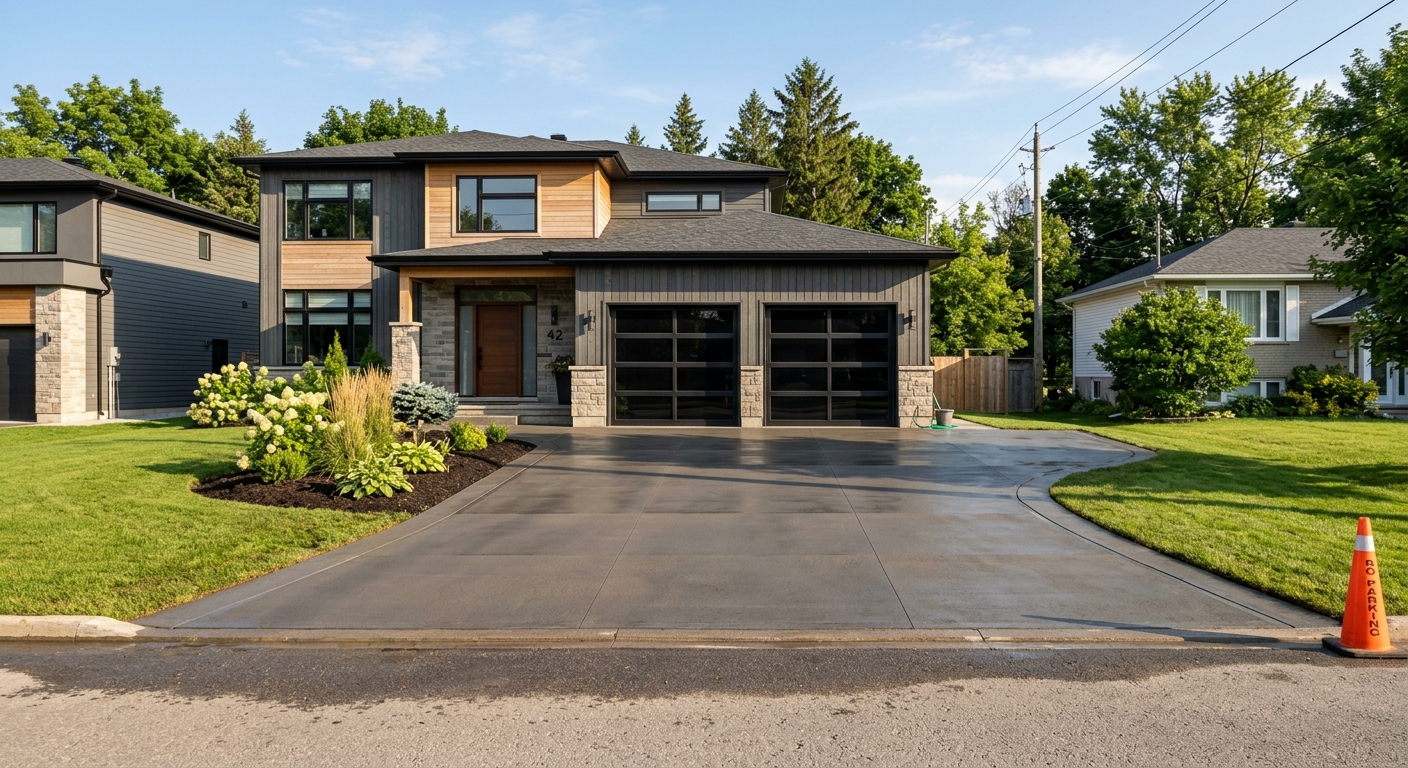
Concrete work options and costs in Willow Park
Willow Park, Alberta is a great place for durable concrete, but it’s also a place where details matter—because freeze–thaw cycles and a deeper frost line can punish shortcuts. With a population of 5,050 (Statistics Canada, 2021 Census), the market is smaller than Calgary proper, so contractor availability and site logistics can affect lead times and ultimately price. Willow Park’s housing mix is also typical of the Calgary area, where many homeowners are working with existing driveways, patios, and walkways that need replacement to match today’s grading and drainage expectations. In a cold continental climate, even a “simple” slab is engineered: footings and base prep are designed around frost protection, and exterior concrete is typically air-entrained and finished for traction and long-term durability.
In Calgary and the surrounding region, pricing bands track directly to how much excavation is needed, how much reinforcement is specified, and how the contractor protects curing concrete during colder months. A porch or garage floor inside can be a straightforward schedule job, while a driveway or walkway has to survive winter traffic, snow clearing, and de-icing salts. Areas where this trade is especially in demand include established neighbourhood pockets near local retail and main-road access, where driveways and front step replacements are common due to aging slabs and settled approaches.
Below is a practical comparison of common concrete options for Willow Park homeowners, showing typical sizes, recommended specs, and what you can reasonably expect the price to land at—then we’ll break down why quotes can vary so much across the region.
| Application |
Typical Size |
Key Spec |
Finish Option |
Price Range |
| Concrete driveway (standard broom finish) |
18' x 10' (180 sq. ft.) |
Air-entrained mix; compacted granular base |
Broom finish + control joints |
$12,000–$18,000 |
| Exposed aggregate driveway |
18' x 10' (180 sq. ft.) |
Air-entrained mix; proper retarder/process |
Exposed aggregate with sealer-ready surface |
$15,000–$21,000 |
| Stamped concrete driveway or patio |
18' x 10' (180 sq. ft.) |
Air-entrained mix; integral color + densifier (typ.) |
Stamp pattern + release powder + sealer |
$15,000–$26,000 |
| Plain concrete patio or walkway |
12' x 8' (96 sq. ft.) |
Air-entrained mix for exterior use |
Broom/smooth finish depending on design |
$5,000–$9,000 |
| Garage floor (interior slab) |
20' x 22' (440 sq. ft.) |
Vapour barrier (typ.); mesh or minimal rebar (as needed) |
Power-trowel + light broom edges |
$10,500–$16,500 |
| Foundation footings (structural, below frost) |
Varies by house plan |
Engineered reinforcement + bearing below design frost |
Formed concrete with specified rebar spacing |
$28,000–$45,000 |
Prices are estimates only and vary by project scope, site access and material selection.
What affects the price of concrete work in Willow Park
In Willow Park and across the Calgary economic region, it’s common to see two bids for the “same” concrete project that still differ by 30–50%. The biggest reason isn’t concrete itself—it’s the engineered scope around it: how deep the excavation goes, what frost protection measures are included, how reinforcement is detailed, and how the contractor manages curing during cold snaps.
First, the frost line depth dictates footing depth and form height. In Alberta, designers typically plan for a frost depth up to about 2.4 m, meaning footings, under-slab drainage strategies, and grade-beam support all require undisturbed soil below that level to reduce frost heave. Second, freeze–thaw cycles across the Calgary area drive specs like air-entrained concrete and well-spaced control joints for exterior slabs—driveways, patios and walkways. That also connects to the pour season: exterior placements often need winter-grade procedures—insulated blankets or temporary heat—to ensure proper curing, especially in late fall or early spring.
Third, de-icing salt accelerates surface wear and can cause spalling if the mix isn’t properly air-entrained or curing is rushed. That’s why sealing is often recommended after a proper cure, even if the homeowner is trying to hold the budget.
Here are two examples from local projects that explain cost swings. A driveway that only needs “surface” repairs can land near the standard driveway band of $12,000–$18,000, but a full replacement with higher excavation due to soil conditions or wider approaches can push toward the upper end. On the patio side, a basic broom-finished walk might stay around $5,000–$9,000, while stamped options—because of colour, stamping equipment, and extra finishing labor—commonly land in the $15,000–$26,000 range for decorative work.
| Price Factor |
Why It Matters |
Cost Impact |
| Frost line depth — determines footing depth and form height |
Footings must bear below design frost to prevent frost heave and seasonal movement. |
More excavation and concrete volume can add thousands. |
| Site preparation — excavation, grading, compacted granular base |
Correct base thickness and compaction control settlement and cracking. |
Unsuitable soil or over-excavation increases labour and disposal. |
| Reinforcement — rebar or wire mesh requirement |
Helps control cracking in structural slabs and exterior elements. |
Material and install labour vary by engineering/design. |
| Mix design — air-entrainment and compressive strength spec |
Air content and strength help concrete survive freeze–thaw and loads. |
Higher-spec mixes can cost more, but reduce failure risk. |
| Finish type — broom vs. stamped vs. exposed aggregate |
Decorative finishes require additional tools, colour or retarder process. |
Stamps/exposed aggregate add labour and material handling costs. |
| Pour size and concrete truck access to site |
Truck accessibility affects how quickly and how accurately concrete can be placed. |
Long carry distances or limited access increases labour time. |
| Cold-weather curing precautions — heating and blankets |
Concrete needs stable curing temperature to develop strength properly. |
Blankets/heaters/crew time can materially increase costs in winter. |
| Control joint pattern and sealing cost |
Joints manage cracking locations; sealing helps resist salt scaling. |
More joints and correct sealing add line-item costs. |
Permits & regulations in Alberta
In Alberta, structural concrete work typically needs a building permit. That includes foundation elements such as footings, foundation walls, grade beams, and other structural slabs designed as part of the building’s load path. For many homes, engineered drawings are required and reviewed as part of the permit process. Concrete flatwork—driveways, patios, walkways—often does not require a permit by default, especially when it’s replacement of like-for-like slabs. However, a permit (or at least a municipal review) may be triggered if your plan affects lot grading, drainage patterns, impervious surface coverage rules, or any work near the municipal right-of-way.
Before breaking ground in Willow Park, confirm scope with the local authority so you’re not surprised by a grading or drainage issue that could delay the pour. Also verify your contractor can legally perform the work and is properly insured: request proof of liability insurance and WSIB/WCB coverage (or the appropriate coverage depending on their setup). Ask for references from similar-size projects in the Calgary area and make sure they’ve handled winter scheduling before.
To verify properly, follow a simple checklist: (1) look for their corporate/contractor registration on relevant provincial online resources, (2) ask for a current certificate of insurance showing liability coverage for your project’s timeframe, (3) obtain their WSIB/WCB clearance letter or confirmation, and (4) ensure the scope and permit responsibility are clearly written into your contract—especially for any structural concrete or drainage-related grading changes.
Getting concrete right in Willow Park's freeze-thaw climate
Concrete in Willow Park fails most often for predictable reasons: poor base preparation, inadequate air-entrainment, rushed curing, and a lack of control joints that allow cracking to occur in the right places. In Calgary’s cold continental climate, water expands during freeze–thaw cycles, and if concrete has the wrong air-void system—or if it’s saturated before it gains adequate strength—it can scale at the surface and later spall, especially where snowmelt and de-icing salts collect.
To spec the job correctly, start with base prep: a properly compacted granular sub-base sized to support the slab for local soil conditions and frost considerations. Next, require an air-entrained mix suitable for exterior exposure—commonly 5–7% air content for exterior flatwork—plus a minimum 32 MPa compressive strength for typical residential applications. Then lock in a control joint plan so random cracking is minimized; the joint pattern should be coordinated with slab size and geometry, particularly for driveways and longer walkways. Finally, curing matters: plan for at least 7 days of curing under appropriate conditions, and when cold weather hits, use insulated blankets and—if needed—temporary heat so the concrete reaches strength safely.
Sealing is the last line of defence against salt scaling. A penetrating sealer applied after the cure (typically around 28 days post-pour) helps repel moisture and reduce surface deterioration. When comparing options, it’s helpful to use concrete dollars to separate aesthetics from durability. For example, moving from a broom-finished driveway toward a stamped driveway often adds cost because of integral colour and extra finishing labour, and that’s usually justified when you’re also committing to the same base prep and frost-resilient mix design—otherwise, decoration won’t fix structural issues.
| Spec |
Why It Matters in Willow Park |
What to Ask For |
Impact if Skipped |
| Compacted granular base (depth?) |
In Willow Park’s freeze–thaw conditions, the slab depends on a stable, well-compacted base to resist movement. |
Confirm granular base depth and compaction method for your soil and slab thickness. |
Settlement, cracking, and uneven surfaces that hold water. |
| Air-entrained concrete mix (target air %?) |
Proper air voids help concrete tolerate freeze–thaw without scaling and spalling. |
Request the target air content (commonly 5–7% for exterior flatwork) on the mix ticket. |
Increased risk of surface scaling, spalling, and premature failure. |
| Compressive strength (MPa rating) |
Strength gain is essential in cold weather and supports loading from vehicles and foot traffic. |
Confirm minimum 32 MPa (or your engineer’s specified rating) and curing plan. |
Reduced durability and higher chance of cracking or surface deterioration. |
| Control joints (spacing per ACI guidelines) |
Joint spacing controls where cracks occur during drying and temperature swings. |
Ask for joint spacing and layout tied to slab geometry and ACI principles. |
Random cracking patterns that can widen and trap moisture. |
| Minimum 7-day curing period |
Cold snaps can slow strength gain, increasing vulnerability while concrete is still young. |
Confirm curing duration and cold-weather measures (blankets/heaters if needed). |
Weak surfaces, scaling, and long-term loss of performance. |
| Penetrating sealer (when applied after cure) |
In Willow Park winters, de-icing salts and meltwater attack surfaces. |
Specify penetrating sealer and timing (often around 28 days post-pour). |
Faster salt scaling and more frequent maintenance or early replacement. |
How to choose a concrete work contractor in Willow Park
Choosing the right concrete contractor in Willow Park is mostly about verification and clarity. Start with Alberta compliance: confirm the contractor has the appropriate licence/registration for their concrete work category, carries current liability insurance, and has WSIB/WCB clearance or coverage where applicable. To check, ask for documentation: (1) their current certificate of insurance (showing liability coverage and effective dates), (2) proof/clearance letter for WSIB/WCB coverage, and (3) the contractor’s registration/standing via the relevant provincial online registry search. If they can’t provide these quickly, assume you’ll pay for it later.
Next, get 2–3 itemised written quotes, not lump-sum-only offers. The best quotes break down labour vs. materials and clearly state excavation depth, granular base, reinforcement (if any), concrete mix specs, finishing type, joints, curing methods, and whether disposal and site restoration are included. Pay close attention to exclusions: does the quote include permit pulling (for structural work), hauling/dump fees, removal of existing slabs, saw-cutting, and prep for proper drainage?
Warranty should be written and specific: workmanship warranty length, whether product/manufacturer warranties apply to any admixtures or sealers, and whether warranties are transferable if you sell the home. On payment terms, never agree to more than 10–15% upfront, and hold back a meaningful portion until the job is complete and verified. Finally, ask for a start date and completion estimate in writing—winter scheduling and curing protection in Calgary are real cost drivers, so the plan matters.
- Ask for the mix design and confirm air-entrainment for exterior concrete.
- Request documentation for liability insurance and WSIB/WCB coverage.
- Get an itemised quote showing excavation, base, reinforcement, and concrete volume.
- Confirm disposal is included if they’re removing existing concrete.
- Verify control joint layout and saw-cut timing.
- Ask how they protect curing in cold weather (blankets/heaters).
- Confirm whether sealing is included and when it’s applied after cure.
- Check references for driveways/patios done within the last 12–24 months.
- Make sure truck access/placement method is explained (no long-distance carrying surprises).
- Clarify what happens if temperatures drop mid-pour.
- Verify warranty coverage for workmanship and any surface treatments.
- Keep payment staged: small deposit, then progress payments with a holdback.
Concrete red flags in Willow Park include: vague “all-in” pricing with no base depth or joint plan stated; refusing to provide proof of insurance/WSIB/WCB; skipping air-entrainment for exterior slabs; promising pours in late cold weather without blankets/heating when required; and starting work without a written schedule, scope, and curing method.
Frequently asked questions — concrete work in Willow Park
How do I prepare the base for a concrete slab?
For Willow Park slabs, base prep is what controls most future cracking and uneven settling. Your contractor should excavate to the engineered or specified sub-grade depth, remove soft/organic material, and place a properly sized compacted granular base (often crushed stone) in lifts. Compaction testing or at least a documented compaction process is important, especially because Calgary’s freeze–thaw cycles magnify movement when the base isn’t uniform. If you’re pouring exterior flatwork, the base should also support proper drainage so water doesn’t sit on top or flow toward the house. In bid comparisons, ask for the base depth, compaction method, and how they handle unsuitable soil—those details are usually why one quote lands closer to the $5,000–$9,000 patio band while another doesn’t.
How do I compare concrete quotes?
Compare quotes line-by-line, not by total price alone, because a “driveway” can include very different scopes. Ask each contractor to itemise excavation and granular base depth, concrete mix specs (including air-entrainment for exterior), reinforcement (mesh vs. rebar vs. none), joint spacing and saw-cut timing, curing/blanket plan for cold mornings, and whether sealing is included. Confirm disposal/hauling and restoration are part of the scope if old concrete is being removed. In Willow Park, winter curing precautions can move labour costs quickly, which is one reason bids can vary substantially. If you’re pricing a standard broom driveway, look for alignment with the usual $12,000–$18,000 range and ensure the cheaper quote isn’t cutting base prep, mix design, or joint/cure requirements.
Can concrete be poured in cold weather in Willow Park?
Yes, concrete can be poured in cold weather in Willow Park, but it must be done with cold-weather procedures so strength develops properly. Calgary’s conditions mean the curing window is critical; if the temperature is too low, concrete can scale or develop weak surfaces. A reputable contractor will plan for insulated blankets and sometimes temporary heat, plus appropriate winter-grade mixes and protection from wind and frost. The key is not “pouring whenever,” but confirming the curing plan based on forecast conditions. Ask your contractor how they’ll maintain curing temperature for at least the first several days and what they’ll do if conditions change mid-pour. When someone offers a “regular pour” without blankets/heating during a cold snap, that’s where long-term spalling risk rises.
How do I maintain concrete in Willow Park's freeze-thaw climate?
Maintenance in Willow Park is mostly about reducing moisture and salt exposure at the surface. Start with sealing: a penetrating sealer applied after the cure (commonly around 28 days post-pour) helps repel water and slow down de-icing salt attack. Use de-icing practices carefully—avoid over-salting and try to remove snow promptly so salts don’t pool in texture lines and joints. Keep an eye on joints: if sealant is missing or joints are deteriorating, water can track into the slab edges and widen cracking. For exposed aggregate or stamped concrete, maintenance is more about keeping the surface sealed and clean so it doesn’t hold gritty salt residue. If you want a durable upgrade, make sure your original build included air-entrainment and proper curing; maintenance alone can’t fix concrete that was under-specified for freeze–thaw.
What causes concrete to spall in Willow Park winters?
Spalling in Willow Park is usually caused by a combination of freeze–thaw water ingress and inadequate air-void system or curing. When concrete isn’t air-entrained properly, freeze–thaw pressures build within the pores, leading to scaling and later spalling—often starting at the surface where meltwater and de-icing salts concentrate. Another common contributor is poor base preparation or uneven grade that allows water to pool, saturating the slab during shoulder seasons. Rush-cured concrete is also more vulnerable because it doesn’t reach strength development reliably. In exterior slabs, control joints and drainage matter because cracks can become pathways for water. If your slab is deteriorating, ask for the original mix specs and whether winter curing measures were used; skipping those can turn a driveway that should be in the $12,000–$18,000 durability tier into a premature repair situation.
What is rebar and when is it required in Alberta?
Rebar (reinforcing steel) is used to strengthen concrete where tensile forces and cracking control are important. In Alberta, whether you need rebar depends on the element and what the engineer or structural design requires, not just typical contractor habits. For structural work like foundation footings and foundation walls/grade beams, reinforcement is normally specified in engineered drawings to manage loads and reduce cracking. For exterior flatwork, reinforcement may be used based on slab thickness, soil conditions, and design—some garage slabs and larger driveways commonly include mesh or rebar, while smaller slabs might be handled differently if they meet design requirements. In Willow Park, the bigger question is often not “rebar or not,” but whether the entire assembly—base depth, mix design, joints, and curing—was engineered for freeze–thaw. When foundation footings are involved, that’s where permitting and engineered reinforcement requirements typically apply.