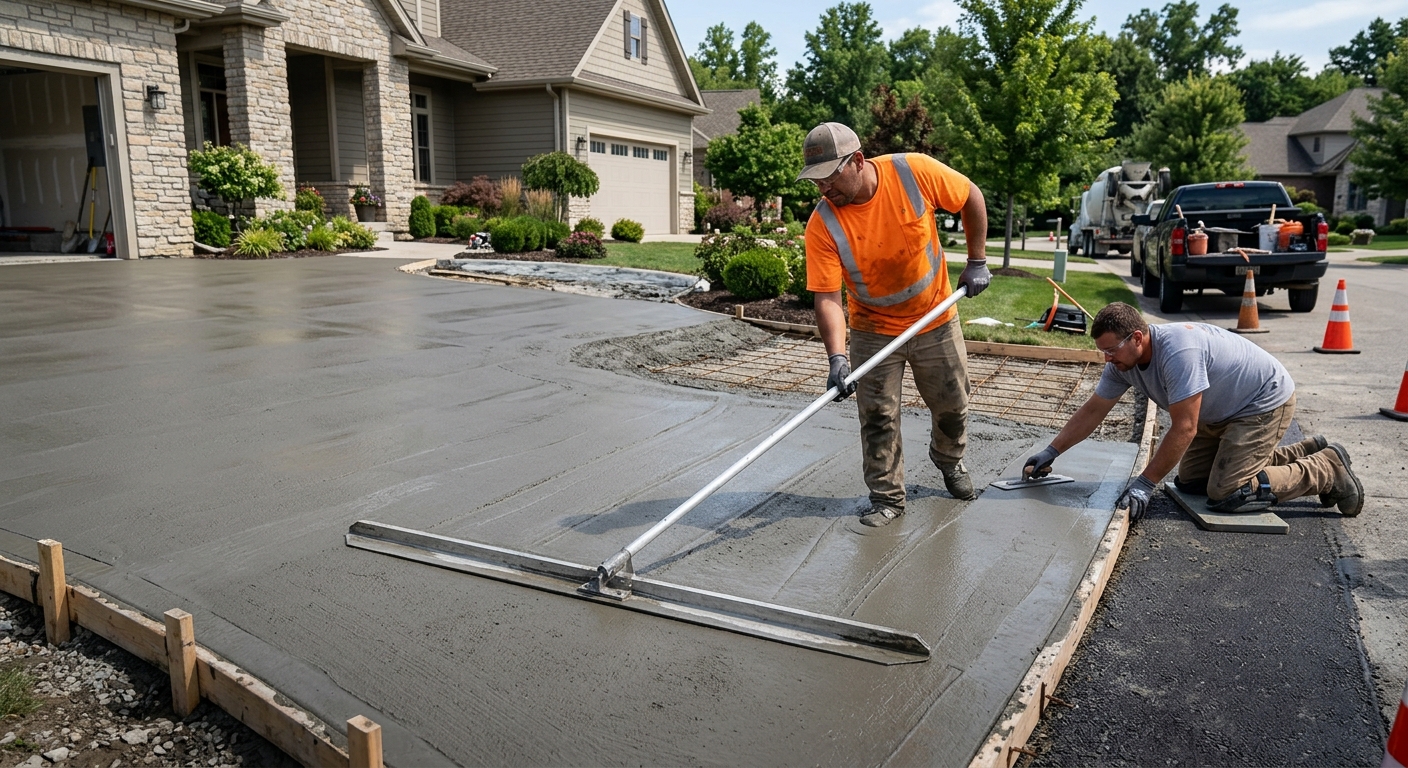
Concrete work options and costs in Wild Rose
Wild Rose, Alberta is a smaller community (population 8,031 per Statistics Canada, 2021 Census), but it still sees steady demand for concrete flatwork because most households rely on driveways, patios and walkways for everyday access. Concrete is also part of how homeowners keep older properties functional—especially when slopes, transitions, and service routes need a durable, low-maintenance surface. In practical terms, the Calgary regional market around Wild Rose—drawing customers for garages and backyard landscaping—drives contractor availability and scheduling, which is a key reason pricing can vary within the same season.
In this cold continental climate, cost is strongly tied to freeze–thaw engineering. Local designs assume a deeper frost depth (about 1.2 m, roughly 4 ft) so footings for houses, garages, decks and retaining structures must bear below undisturbed soil to reduce frost heave risk. Exterior slabs also need air-entrained concrete and a more controlled curing approach because late-fall or early-spring pours have a shorter working window. Add to that granular base prep and control joints to reduce cracking and surface damage, and you’ll see why a “simple” slab often isn’t simple in Calgary-area pricing.
Where is the demand especially noticeable? Around residential growth pockets and established neighbourhoods near the commercial corridor and service roads where driveways and garage slabs are commonly upgraded in conjunction with landscaping and drainage fixes. With that context, here’s a realistic comparison of common concrete options and typical price ranges to help you line up the right scope.
| Application |
Typical Size |
Key Spec |
Finish Option |
Price Range |
| Concrete driveway (standard broom finish) |
24 ft x 10 ft (240 sq ft) |
Air-entrained concrete, compacted granular base, control joints |
Broomed surface |
$12,000–$18,000 |
| Exposed aggregate driveway |
24 ft x 10 ft (240 sq ft) |
Air-entrained concrete, proper curing timing, refined base |
Exposed aggregate (surface wash) |
$14,000–$22,000 |
| Stamped concrete driveway or patio |
20 ft x 12 ft (240 sq ft) |
Air-entrained mix, integral colour (where specified) |
Stamp pattern + release + seal |
$15,000–$26,000 |
| Plain concrete patio or walkway |
10 ft x 12 ft (120 sq ft) |
Air-entrained concrete, compacted base, joints |
Float/smooth + broom edge (as needed) |
$5,000–$9,000 |
| Garage floor (interior slab) |
24 ft x 22 ft (528 sq ft) |
Vapour barrier (if required), reinforcement as designed |
Plain trowel finish |
$13,000–$20,000 |
| Foundation footings (structural, below frost) |
1,600 sq ft house (typical perimeter) |
Engineered reinforcing, excavation to design frost depth |
Structural formwork + placement |
$28,000–$45,000 |
Prices are estimates only and vary by project scope, site access and material selection.
What affects the price of concrete work in Wild Rose
In the Calgary region around Wild Rose, it’s common to see quotes for the “same” concrete project come in 30–50% apart. The reason is that concrete pricing isn’t just about square footage—it’s about how the job is engineered for frost, how much site excavation is required, and how carefully the contractor manages curing and finishing in cold weather. Two contractors might both state “air-entrained concrete,” but one might include thicker granular base, higher-strength mix requirements, better reinforcement detailing, and winter-grade curing measures that protect you over multiple freeze–thaw cycles. That difference is what drives the spread in cost.
Frost line depth dictates every part of exterior structural work: footings must extend below the design frost depth (about 1.2 m for local design practice). That means deeper excavation, more form height, and more concrete volume than warmer areas—pushing foundation/footings toward the $28,000–$45,000 range. Freeze–thaw cycling across Calgary and surrounding communities also dictates air-entrained mixes and a durable surface strategy, so driveways and patios often land in the $12,000–$18,000 driveway band even before upgrades like exposed aggregate or stamping.
Two local examples: (1) If your soil is tight and excavation is shallow, you might reduce base and footing quantities and come in closer to the low end of the price band. (2) If you have poor drainage, clay pockets, or a slope that needs regrading, you’ll pay more for excavation, granular import, and drainage measures to stabilize base prep. Also, as many Wild Rose homes are renovated over time, you may find older backfilled areas that require additional prep for transitions—this often adds dollars to ensure the slab isn’t sitting on compromised fill. For a homeowner, the “hidden” cost is usually the groundwork that prevents future cracking, scaling, and spalling.
| Price Factor |
Why It Matters |
Cost Impact |
| Frost line depth |
Determines footing depth and form height |
Higher excavation increases concrete and labour; can move foundation work within the $28,000–$45,000 band |
| Site preparation |
Excavation, grading, compacted granular base |
Unstable soil or extra removal/addition can add several thousand dollars to total scope |
| Reinforcement |
Rebar or wire mesh requirement |
More steel and labour for placement/chairs typically raises cost for driveways and slabs |
| Mix design |
Air-entrainment and compressive strength spec |
Exterior freeze protection adds material cost and affects durability outcomes |
| Finish type |
Broom vs. stamped vs. exposed aggregate |
Stamped/exposed finishes add labour, timing control and sealing, often pushing jobs toward the $15,000–$26,000 tier |
| Pour size and concrete truck access to site |
Shorter access routes reduce extra handling and delays |
Restricted access can increase labour and equipment time |
| Cold-weather curing precautions |
Heating and blankets |
Winter-grade placement can add costs but protects against scaling and weak surface set |
| Control joint pattern and sealing cost |
Crack control and protection from de-icing salts |
Better jointing and sealed surfaces reduce spalling risk and future patch work |
Permits & regulations in Alberta
In Alberta, many homeowners assume “concrete is concrete,” but the permitting side depends on whether the work is structural and how it affects site drainage and grade. For Wild Rose, the general rule is: structural concrete work—such as footings, foundation walls, and grade beams—typically requires a building permit, and you’ll often see engineered drawings reviewed as part of the permit process by the municipality. Concrete flatwork like patios, walkways, and standard driveway slabs usually does not require a permit by default, unless the project affects lot grading, changes how water moves across your property, or touches impervious surface coverage and municipal right-of-way considerations.
Before breaking ground, confirm the scope with the local authority and ensure your contractor has the right coverage. Step-by-step for homeowners:
- Request the contractor’s business information and licence details (where applicable) and confirm they are active and in good standing.
- Ask for proof of liability insurance (certificate of insurance showing coverage amount and project name/address if possible).
- Confirm WCB coverage (workers’ compensation) so you’re not left holding the bag if there’s a site injury.
- Get references for similar-scale concrete work locally (driveways/patios and, if relevant, foundations/footings).
- Ask whether permit application is included, and who is responsible for any municipal paperwork.
Clear documentation up front reduces delays later—especially when winter placement and engineered details are involved.
Getting concrete right in Wild Rose's freeze-thaw climate
Concrete fails in Wild Rose most often because freeze–thaw cycles punish weak surfaces and poorly prepared bases. The classic symptoms are scaling, spalling around edges, and random cracking that opens and closes as temperatures swing. To spec the job correctly in the Calgary market, you need five core elements: base preparation, mix design, control joints, curing, and sealing—done for the right weather window.
1) Base prep: Use a compacted granular sub-base engineered for local soil conditions so the slab doesn’t settle or pump during freeze–thaw. For exterior slabs, getting the base depth and compaction right is what keeps joints from telegraphing into cracks. 2) Mix design: For exterior flatwork, specify air-entrainment (typically 5–7% air content) and minimum 32 MPa compressive strength. This is what protects against freezing water expansion in the paste. 3) Control joints: Plan a joint layout that limits uncontrolled cracking—spacing matters more than homeowners realize. 4) Curing: Plan on a minimum 7-day curing period under proper conditions; cold-weather curing may require insulated blankets or temporary heating to prevent early-age freezing. 5) Sealing: Apply a penetrating sealer about 28 days post-pour to repel de-icing salts, especially on driveways.
When comparing options, understand value: upgrading from a plain broom finish driveway to exposed aggregate is not just “a look.” It adds time to control surface exposure and typically adds cost, but if the base and mix are already correct, it’s a reasonable spend. For example, if a standard broom driveway is near the low end of $12,000–$18,000, exposed aggregate might run higher—often in the mid-teens to low-20s—because the contractor has to manage curing timing precisely. Skipping air-entrainment or curing precautions to save money usually costs far more later in grinding, patching, and re-lifting.
| Spec |
Why It Matters in Wild Rose |
What to Ask For |
Impact if Skipped |
| Compacted granular base (depth?) |
Prevents pumping and settlement during freeze–thaw |
Base depth, compaction method/spec, and whether subgrade is proof-rolled |
Settling, cracking, edge breakdown |
| Air-entrained concrete mix (target air %?) |
Protects concrete from freeze–thaw expansion |
Target air content (typically 5–7% for exterior flatwork) |
Spalling and scaling within a few winters |
| Compressive strength (MPa rating) |
Ensures structural and surface durability under traffic and salt |
Minimum 32 MPa and confirmation of mix design |
Weak surface, increased wear and premature scaling |
| Control joints (spacing per ACI guidelines) |
Limits random cracking from shrinkage and thermal movement |
Proposed joint layout and spacing plan |
Random cracks that reduce service life |
| Minimum 7-day curing period |
Cold weather can stop proper early strength gain |
Curing method, temperature protection plan if nights are cold |
Low strength at surface; higher risk of cracking and scaling |
| Penetrating sealer (when applied after cure) |
Repels de-icing salts and reduces moisture uptake |
Sealer type and timing (around 28 days post-pour) |
Faster salt-driven deterioration |
How to choose a concrete work contractor in Wild Rose
Choosing a contractor in Wild Rose is mostly about confirming coverage, matching the quote to the engineered scope, and ensuring they manage cold-weather risk correctly. Start by verifying Alberta coverage items. First, ask for proof of liability insurance (so you’re protected if there’s property damage). Second, confirm workers’ compensation coverage (WCB/WSIB equivalent coverage requirements in Alberta) so injuries don’t become your expense. Then request a certificate of insurance and make sure the coverage is current. If they can’t provide it quickly and clearly, that’s a major warning sign.
Next, get 2–3 itemised written quotes—not just a lump sum. Ask for a breakdown that shows excavation and hauling, granular base and compaction, reinforcement, concrete supply/mix, finishing, joints, and sealing (where included). Confirm whether a permit is included for structural work, and whether disposal of concrete and site debris is part of the price. For warranty, ask for both: the workmanship warranty length and any product/manufacturer warranty that applies to sealer systems or admixtures.
Payment matters: never pay more than 10–15% upfront. Hold back a portion until the job is complete and deficiencies are corrected. Finally, get a start date and completion estimate in writing—especially if scheduling slips into late fall. In Calgary-area conditions, rushing curing is where you often see surface scaling later.
- Ask for references on similar driveways/patios in Calgary-area freeze–thaw conditions.
- Confirm air-entrained mix and minimum compressive strength are stated in writing.
- Request the joint layout and sealing timing (if included).
- Verify liability insurance certificate is current.
- Verify WCB/coverage is in place for site workers.
- Confirm whether permit application is included (for foundations/footings).
- Insist on an itemised quote: excavation/base/rebar/concrete/finish/joints/sealer.
- Check exclusions: what’s not included (grading, topsoil, disposal, edging, sawcut depth).
- Ask how they handle cold-weather placement (blankets/heating plan).
- Confirm curing protection responsibilities and timeline.
- Ensure warranty terms are specific about workmanship and what triggers repairs.
- Keep payment aligned with milestones; avoid large upfront deposits.
Concrete red flags for Wild Rose: crews who can’t clearly explain air-entrainment and curing plans, missing or vague joint layouts, “cheap” quotes that omit granular base prep and reinforcement, no proof of insurance/WCB, and schedules that push pours into cold nights without winter protection.
Frequently asked questions — concrete work in Wild Rose
When is the best time to pour concrete in Wild Rose?
The best time for concrete in Wild Rose is typically late spring through summer, when temperatures stay warm enough to protect early curing. In Calgary-area freeze–thaw conditions, the pour season is shorter, and late-fall or early-spring work can require extra measures (insulated blankets and sometimes heating) to keep concrete from freezing before it gains adequate early strength. That’s not just a comfort issue—it directly affects durability and reduces scaling/spalling risk later. If you’re planning a driveway or patio, aim for stable days and cool-but-not-freezing nights. If your project timing is fixed, ask your contractor to specify the winter-grade curing precautions in the written scope and whether they will monitor temperatures during the minimum curing window.
How long does concrete take to cure?
Concrete curing depends on temperature and mix design, but you should plan around a minimum 7-day period for proper early-age strength gain, and then longer for full durability. For exterior work in Alberta, especially in freeze–thaw exposure, early protection matters: if the slab is allowed to freeze too soon, you can get surface scaling and reduced long-term performance. Most contractors also plan around the 28-day mark for sealing systems—penetrating sealer is commonly applied about 28 days post-pour to repel de-icing salt. If you’re budgeting, confirm in the scope whether curing protection (and any required blankets/heating) is included, because that’s where winter pours can add cost but prevent expensive repairs.
Do I need a permit for concrete work in Alberta?
In Alberta, structural concrete work such as footings, foundation walls and grade beams typically requires a building permit and often engineered drawings for municipal review. For flatwork—patios, walkways, and standard driveways—permits are usually not required unless the project affects lot grading, drainage, impervious surface limits, or work touches right-of-way or municipal considerations. For homeowners in Wild Rose, the safe approach is to ask your contractor to confirm whether a permit is required for your exact scope before excavation starts. Also ensure the contractor carries liability insurance and WCB coverage. If you’re planning structural changes, expect more lead time for approvals compared to simple surface pours.
Concrete vs pavers for a patio in Wild Rose?
Concrete and pavers can both look good, but in Wild Rose’s freeze–thaw climate, the “best” choice is usually the one with the right base prep and drainage detailing. Concrete patios can be more cost-predictable and are often engineered with air-entrainment and control joints, which helps resist freeze–thaw damage when installed correctly. A plain concrete patio or walkway often falls in the $5,000–$9,000 range depending on size and site conditions. Pavers can offer easier localized repairs if a section fails, but they still require a well-compacted base and proper joint sand maintenance. If your patio area is exposed to de-icing salts or heavy snow buildup, ask both bidders how they handle moisture and movement at the edges.
How long does a concrete driveway last?
With the right base prep, air-entrained mix, control joints, and proper curing, a concrete driveway in Alberta can last many years—often decades—before major replacement becomes necessary. The biggest early-life risks are spalling and scaling caused by inadequate air-entrainment, rushed curing, or weak surface durability under de-icing salt exposure. Calgary-area contractors often keep bids within the typical driveway range of $12,000–$18,000 for standard broom-finished slabs, but durability comes from what’s included: granular base depth, reinforcement as specified, joint pattern, and whether the contractor applies penetrating sealer after cure (commonly around 28 days). If you want maximum lifespan, insist on those details rather than selecting the lowest price.
What is air-entrained concrete and why does it matter here?
Air-entrained concrete is a mix designed to include microscopic air bubbles that give water room to expand when it freezes. That reduces internal pressure and helps prevent surface scaling and spalling—problems that are common in Alberta’s freeze–thaw cycles. In Wild Rose and the Calgary region, exterior slabs are exposed to repeated temperature swings and de-icing salts, so air-entrainment is a key durability spec, typically targeting about 5–7% air content for exterior flatwork. If a contractor can’t clearly state the air-entrainment requirement (and curing precautions), it’s a red flag. Ask how they protect early curing in cold weather (blankets/heating where needed) and how joints and sealing are handled, because those details work together to keep the driveway looking and performing long-term.