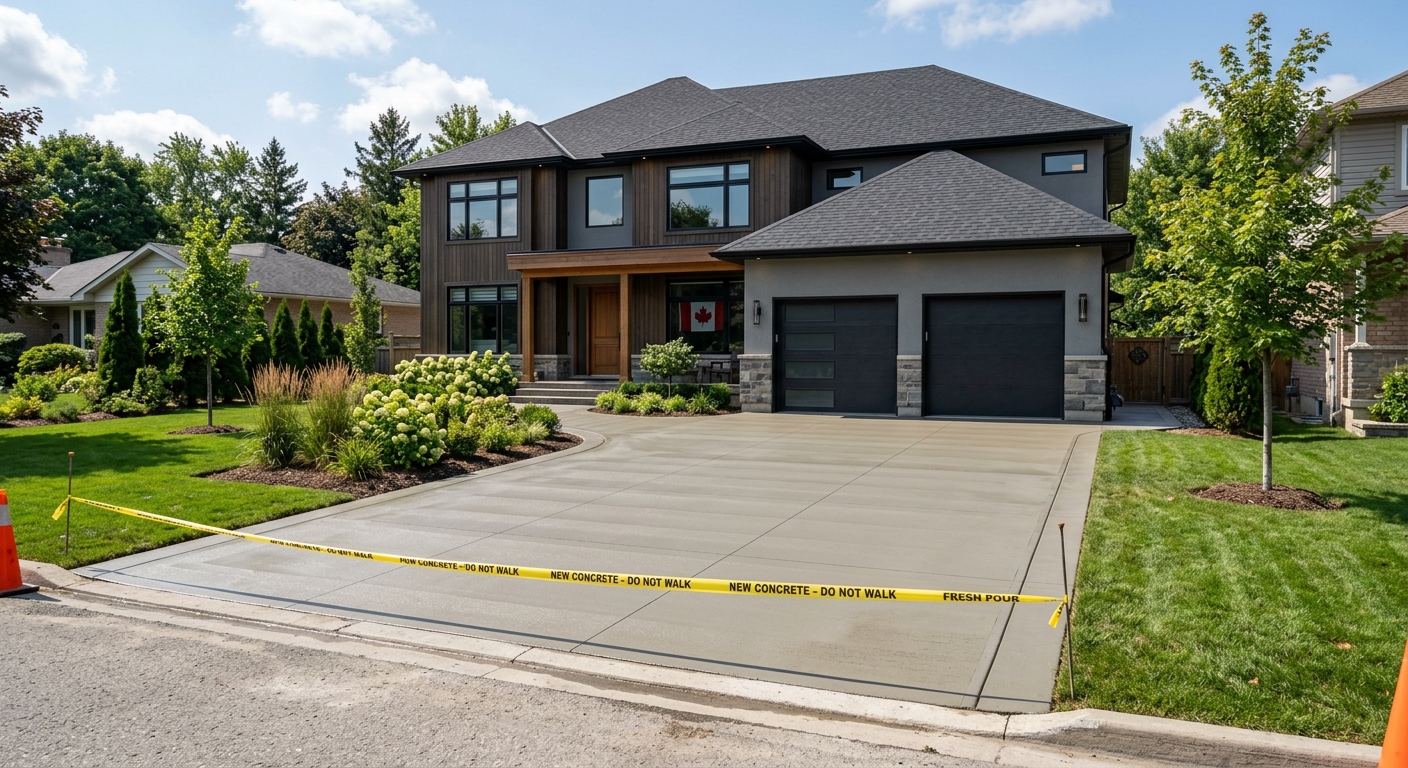
Concrete work options and costs in Legacy
Legacy, Alberta is a smaller community within the Calgary region, where most homeowners are planning concrete flatwork around a growing mix of single-detached homes and family garages. In fact, the Calgary economic region recorded a population of about 8,000 in the 2021 Census for Legacy specifically (Statistics Canada, 2021 Census). That home pattern matters because driveways, patios, walkway slabs, and garage floors are the everyday “entry point” projects that lead many neighbours into bigger concrete scopes like foundation work.
In the Calgary area, costs are shaped as much by frost and freeze–thaw as by the formwork and finish. Contractors design for a deeper design frost depth (about 1.2 m, roughly 4 ft) so footings sit on undisturbed soil below seasonal movement. Exterior slabs also need air-entrained concrete and well-timed pours so curing isn’t compromised during Alberta’s colder nights and shorter exterior placement season.
Availability can tighten around late fall and early spring because winter-grade curing precautions (insulated blankets, sometimes temporary heat) add labour and scheduling time. If your project is in a busy build-and-reno pocket such as the newer growth areas of Legacy near local school and service corridors, trades tend to be in higher demand for driveways and backyard slabs. With that in mind, the table below compares common options homeowners ask for, along with typical size assumptions and finish specs.
| Application |
Typical Size |
Key Spec |
Finish Option |
Price Range |
| Concrete driveway (standard broom finish) |
24 ft x 10 ft (240 sq ft) + 6 in thick |
Air-entrained concrete, compacted base, control joints |
Broom finish with edge control |
$12,000–$18,000 |
| Exposed aggregate driveway |
24 ft x 10 ft (240 sq ft) + 6 in thick |
Air-entrained mix, well-controlled base, proper curing timing |
Exposed aggregate with wash finish |
$14,000–$22,000 |
| Stamped concrete driveway or patio |
24 ft x 12 ft (288 sq ft) or 20 ft x 12 ft (240 sq ft) |
Air-entrained mix, integral colour, release agent, joints |
Stamp pattern + colour hardener |
$15,000–$26,000 |
| Plain concrete patio or walkway |
12 ft x 16 ft (192 sq ft) patio or 3 ft x 30 ft (90 sq ft) walkway |
Air-entrained concrete, compacted granular base |
Float/true + light broom or trowel texture |
$5,000–$9,000 |
| Garage floor (interior slab) |
22 ft x 20 ft (440 sq ft) typical |
Vapour barrier (if specified), joints, 4 in slab typical |
Plain finish or light broom |
$9,000–$15,000 |
| Foundation footings (structural, below frost) |
Typical house: perimeter + piers; engineered by design |
Concrete below design frost depth; reinforcement per engineer |
Structural concrete finish is not decorative |
$28,000–$45,000 |
Prices are estimates only and vary by project scope, site access and material selection.
What affects the price of concrete work in Legacy
Even when neighbours request “the same size” concrete, quotes in the Calgary region can swing by 30–50%. The main reason is that concrete pricing isn’t just about pouring a slab—it’s about what must be engineered and prepared to keep it stable through Alberta’s freeze–thaw cycles. In older homes, changes in grading, buried services, or frost-susceptible soils often force deeper excavation and more granular replacement than expected. In new builds, contractors still need to manage the timing of pours because cold weather can reduce early strength gain and increase curing requirements.
Frost line depth is the big driver: exterior footings and structural elements must bear on undisturbed soil below the design frost depth (about 1.2 m in the Calgary market) to prevent frost heave. That means more excavation and more concrete volume for foundations, which is why foundation/footings commonly land in the $28,000–$45,000 band. Exterior slabs also require air-entrained mixes to survive repeated freeze–thaw, and cold placement may require winter-grade mix, insulated blankets, and sometimes added heat. Those precautions can add cost on top of standard exterior work in the $12,000–$18,000 driveway band, especially if scheduling pushes the pour into late fall or early spring.
Two practical examples from Legacy: (1) a driveway over clayey or fill-heavy soil often needs thicker granular base and extra compaction time, pushing the job toward the higher end of the driveway range; (2) a small stamped patio can cost disproportionately more than a broom-finished walkway because it uses colour materials, stamp mats, and tighter crew coordination to control curing and surface texture. Housing age affects this too—retrofits in older lots often uncover drainage or slope issues that must be corrected before concrete goes down.
| Price Factor |
Why It Matters |
Cost Impact |
| Frost line depth — determines footing depth and form height |
Footings must sit below design frost to prevent frost heave and seasonal movement |
Higher excavation and rebar/formwork; can push foundation scopes toward the top of the band |
| Site preparation — excavation, grading, compacted granular base |
Undercut and replacement determines slab stability under freeze–thaw |
More truckload/disposal and compaction labour when soil is poor or access is tight |
| Reinforcement — rebar or wire mesh requirement |
Controls cracking and supports structural loads |
Material cost + additional labour for tying chairs/spacers and correct placement |
| Mix design — air-entrainment and compressive strength spec |
Exterior durability in Alberta depends on air content and strength gain |
Higher cost mix, plus possible winter-grade adjustments in cold weather |
| Finish type — broom vs. stamped vs. exposed aggregate |
Finishes require different crew steps and sometimes extra products |
Stamped/exposed work can add colour/sealer and specialized labour; plain broom is usually least expensive |
| Pour size and concrete truck access to site |
Access affects whether the crew needs pumps, extra planning, or staging |
More time on the day of pour and potential equipment charges for difficult access |
| Cold-weather curing precautions — heating and blankets |
Proper early curing prevents scaling and preserves strength development |
Insulation, heating labour, and tighter scheduling; costs rise as the pour season shortens |
| Control joint pattern and sealing cost |
Joints guide cracking and sealing helps resist de-icing salt damage |
Additional saw-cut labour and later sealer application; skipped steps can reduce service life |
Permits & regulations in Alberta
In Alberta, structural concrete work—think foundation walls, grade beams, retaining wall stems, and footings that support the building—typically requires a building permit. Many projects also need engineered drawings reviewed through the municipal process before excavation begins. Concrete flatwork such as patios, walkways, and driveways usually does not require a permit by default, but it can trigger permit or approvals if your work affects lot grading, drainage, impervious surface limits, or requires changes within municipal right-of-way conditions.
For a Legacy homeowner, the safest approach is to verify before breaking ground: ask your contractor what permits are needed for your specific scope and get it in writing. Next, verify the contractor’s Alberta eligibility and protection. Start with the contractor licence information and business registration through the appropriate provincial/online licensing listings. Then request a Certificate of Insurance showing general liability coverage and confirm it lists your property address or applies to the work. For workers on site, ask for proof of WSIB/WCB coverage—carriers and account details are typically provided as clearance documentation or current coverage certificates. Finally, ask for references on comparable-sized concrete flatwork and foundation-related projects in the Calgary region so you can gauge how they handle freeze–thaw durability specs.
Step-by-step: (1) confirm permit requirement with the municipality, (2) request insurance documents and WSIB/WCB proof, (3) review their written scope against the permit drawings (if applicable), and (4) verify references for similar winter-cure practices.
Getting concrete right in Legacy's freeze-thaw climate
In Legacy and the wider Calgary region, concrete failures usually come from three places: base problems, mix problems, and finishing/curing problems during freeze–thaw. If the base isn’t compacted to the right depth for local soil and frost conditions, the slab can “float” and crack. If the mix doesn’t have proper air entrainment, moisture can freeze inside the cement paste and cause scaling and spalling—especially where de-icing salt is used on driveways and garage-adjacent areas. If curing is rushed or done too cold, the surface may look fine at first but develop durability issues as seasons repeat.
To spec the job correctly, start with base prep: a properly compacted granular sub-base sized for frost considerations (and undisturbed bearing where structural footings are required). For exterior slabs, require air-entrained concrete—commonly about 5–7% air content for freeze–thaw-resistant exterior work—and a minimum 32 MPa compressive strength design target. Add a control joint plan: joints should be spaced to limit random cracking and relieve stresses from temperature swings. Then enforce curing: aim for minimum 7 days of curing under proper conditions, and when cold weather hits, the contractor should use cold-weather curing precautions such as insulating blankets and, when needed, temporary heat. Finally, plan sealing: a penetrating sealer should be applied after the slab is fully cured (often around 28 days) to better repel de-icing salts.
As a dollar example, a simple broom-finished patio typically sits in the $5,000–$9,000 band, but if you choose stamped decorative work in the driveway/patio range, costs can move into the $15,000–$26,000 band. That price difference is justified only if the crew also protects curing and durability—stamp mats and colour are cosmetic, but air content and curing are what keep the surface intact through Alberta winters.
| Spec |
Why It Matters in Legacy |
What to Ask For |
Impact if Skipped |
| Compacted granular base (depth?) |
Prevents slab movement under frost and freeze–thaw |
Confirm excavation depth, granular type, and compaction testing method |
Uneven settlement, wider cracks, and shortened service life |
| Air-entrained concrete mix (target air %?) |
Reduces freeze–thaw damage and spalling from trapped water |
Request air content target (commonly 5–7% for exterior flatwork) |
Surface scaling and spalling within a few seasons |
| Compressive strength (MPa rating) |
Supports durability and load capacity in a cold climate |
Ask for minimum 32 MPa design target |
Lower strength gain; increased cracking under traffic and temperature swings |
| Control joints (spacing per ACI guidelines) |
Guides cracking to predictable lines during freeze–thaw cycles |
Ask for joint spacing plan and saw-cut timing |
Random cracking and less predictable repairs |
| Minimum 7-day curing period |
Builds early strength needed to resist early-season damage |
Confirm curing method and protection during cold nights |
Dusty/weak surface, early scaling risk, reduced long-term performance |
| Penetrating sealer (when applied after cure) |
Helps repel de-icing salts that accelerate surface deterioration |
Ask for application schedule (often after ~28 days cure) and product type |
Faster deterioration, especially on driveways near garage and salted sidewalks |
How to choose a concrete work contractor in Legacy
Start with Alberta verification. Ask for the contractor’s Alberta licence/business registration details and confirm they are authorized to perform the work you’re hiring for. Next, require proof of general liability insurance—request a Certificate of Insurance showing coverage amounts and that it applies to the concrete scope on your address. Then ask for WSIB/WCB clearance or proof of coverage for their workers. If they can’t provide current documentation promptly, treat that as a red flag.
For pricing, get 2–3 itemised written quotes instead of one lump sum. You want the quote to separate labour, excavation/site prep, concrete supply/mix design, reinforcement, finishing, saw-cutting and joints, and disposal/removal of surplus material. Ask whether permits are included where needed, and what’s excluded (for example: tree removal, geotextile, additional base depth, or if they’ll handle any drainage adjustments).
Warranty matters. Confirm the workmanship warranty length and what it covers (cracks that are a workmanship issue vs normal shrinkage). Also ask about product/manufacturer warranties for sealer or admixtures and whether coverage is transferable if you sell the home. For payment scheduling, never pay more than about 10–15% upfront; use a holdback until the final surface is accepted and any sealing/joint work is complete. Finally, get a written start date and completion estimate so you can plan landscaping and accessibility.
- Request Alberta proof of licence/business registration before signing.
- Get current Certificate of Insurance (general liability) for the exact scope.
- Confirm WSIB/WCB coverage with documentation, not just verbal assurance.
- Demand an itemised quote (labour, materials, reinforcement, disposal).
- Ask for the concrete mix spec: air entrainment target and strength.
- Confirm base depth/compaction plan and whether they test compaction.
- Require a control joint layout and saw-cut timing in writing.
- Ask how they handle winter/cold-weather curing (blankets/heating).
- Clarify sealing timing and product type (penetrating sealer after cure).
- Confirm who is responsible for protecting landscaping and utilities during excavation.
- Use a payment schedule with a holdback until all finishing and cure-related items are done.
- Get a written timeline and concrete pour conditions they will/won’t accept.
Concrete red flags in Legacy: a quote that doesn’t specify air content/strength (or calls it “standard mix”); skipping details on base depth/compaction; no mention of control joints or sealing plan; crews that don’t discuss cold-weather curing precautions; and contractors who pressure you to pay most of the cost upfront or won’t provide insurance/WSIB/WCB proof.
Frequently asked questions — concrete work in Legacy
How long does concrete take to cure?
In Legacy and across Alberta’s Calgary region, timing depends on temperature and the concrete mix design. Practically, concrete reaches workable handling strength much earlier than it reaches full durability. For most exterior flatwork, you should expect at least 7 days of curing under proper conditions before treating the surface as “ready,” especially if freeze–thaw cycles are starting to ramp up. Full strength and better long-term performance typically build over several weeks—often around 28 days—when you can also apply penetrating sealer to help repel de-icing salts. If a contractor is rushing the job in late fall or early spring, curing protections like insulating blankets and correct curing steps become critical, and that’s where cheaper quotes can quietly increase future spalling risk.
Do I need a permit for concrete work in Alberta?
In Alberta, structural concrete such as footings, foundation walls, and grade beams usually requires a building permit and often engineered drawings reviewed through the municipality. Concrete flatwork—patios, walkways, and most driveways—typically doesn’t require a permit unless it affects drainage, lot grading, impervious surface coverage limits, or involves right-of-way conditions. For a Legacy property, confirm with the local authority before excavation, particularly if you’re changing how water drains away from the house or adding significant new hardscape. A reputable contractor should tell you whether permits apply for your scope and include any required approvals in the plan. When in doubt, ask the contractor to list “permit responsibility” clearly in the written quote.
Concrete vs pavers for a patio in Legacy?
Both concrete and pavers work well for patios in Legacy, but freeze–thaw and salt exposure push the decision. Pavers can offer easier section-by-section repairs, and they’re flexible where soil movement is a concern. Concrete patios can be more durable when installed correctly with proper base prep, air-entrained mix, control joints, and adequate curing. In the Calgary region, concrete patios commonly land around $5,000–$9,000 for typical scopes, while pavers often cost more once you include excavation, edge restraints, bedding layers, and labour. If you expect heavy traffic, de-icing salt, or you want lower long-term maintenance, a properly detailed concrete patio with sealing is usually a strong fit. The key is ensuring the base depth and compaction are right—materials alone won’t solve frost-related movement.
How long does a concrete driveway last?
A well-installed concrete driveway in Legacy can last decades, but lifespan depends heavily on freeze–thaw resilience, jointing, and surface protection. The two biggest durability factors are (1) air-entrained mix for exterior exposure and (2) a sealing and joint plan that resists de-icing salt and water infiltration. If your driveway is placed with correct base preparation and control joints, it can perform for a long time even with Alberta temperature swings. If the contractor uses a “standard” mix without proper air entrainment or doesn’t plan for curing in colder conditions, surface scaling and spalling can show up sooner. Typical driveway projects in this market commonly fall within $12,000–$18,000 for broom-finished scopes, and investing in the correct specs is what separates a driveway that stays solid from one that deteriorates early.
What is air-entrained concrete and why does it matter here?
Air-entrained concrete has microscopic air bubbles intentionally incorporated into the mix. In Alberta’s freeze–thaw climate, these bubbles give water a place to expand when it freezes, reducing internal pressure that would otherwise crack the surface and lead to spalling. This is why exterior flatwork in Legacy should use air-entrained concrete and why quotes that don’t mention air content deserve a second look. A typical target for exterior flatwork is about 5–7% air content, combined with proper curing so the mix develops strength before it’s exposed to early cold nights. When air entrainment is inadequate, the surface can scale and roughen, and the damage can accelerate with de-icing salts. In short: air entrainment is one of the most important specifications for keeping concrete looking good and standing up to winters.
How do I prepare the base for a concrete slab?
Base preparation is where concrete jobs are won or lost in Legacy. The goal is to excavate to the correct depth, remove unsuitable soil, and replace it with compacted granular material that can resist frost movement. Your contractor should specify the granular base depth/section, the material type, and the compaction approach (including how they verify compaction). The base also needs proper grading so water doesn’t pond near the slab edges, which is especially important in freeze–thaw conditions. For exterior slabs and driveways, drainage and base stability determine whether control joints will do their job or whether cracks open randomly. Ask your contractor how they will handle access for compaction equipment, whether they’ll correct slopes, and what they include in site prep—those details often explain why two quotes can differ substantially.