Concrete work options and costs in Wainwright
Wainwright homeowners typically reach for concrete when they’re upgrading driveways, adding patios, or fixing settlement issues—especially since the community’s housing stock is largely single-detached (66.4% of dwellings) and many homes were built before 1981 (47.3%). With 70.2% of households owning their homes, there’s steady demand for long-lived exterior flatwork that can handle Alberta winters year after year. You’ll also see a lot of projects in and around Main Street and the surrounding residential blocks, where access for trucks and forming crews is easier than on more remote acreage roads.
In the Camrose–Drumheller region, costs are shaped by cold continental winters and frequent freeze–thaw cycles. That means contractors build every exterior job around frost protection—placing footings below the design frost depth and using proper granular base drainage for slabs. Because the pour season is shorter (late spring through early fall), scheduling can be tighter, and winter-ready work often includes heating, insulated blankets, and slower, safer placement and finishing. In practice, that’s why two quotes for what looks like the “same driveway” can differ noticeably once you factor in air-entrainment, thickness, jointing, and curing protection.
Below is a realistic cost comparison for common concrete options in Wainwright, with typical specs you can use to line up apples-to-apples in your bids.
| Application |
Typical Size |
Key Spec |
Finish Option |
Price Range |
| Concrete driveway (standard broom finish) |
24 ft x 10 ft (240 sq ft) |
Air-entrained exterior mix, 4 in slab, control joints |
Broom finish + seal option |
$5,000 – $8,000 |
| Exposed aggregate driveway |
24 ft x 10 ft (240 sq ft) |
Air-entrained mix, proper base + drainage, scratch coat + wash |
Exposed aggregate |
$7,000 – $11,000 |
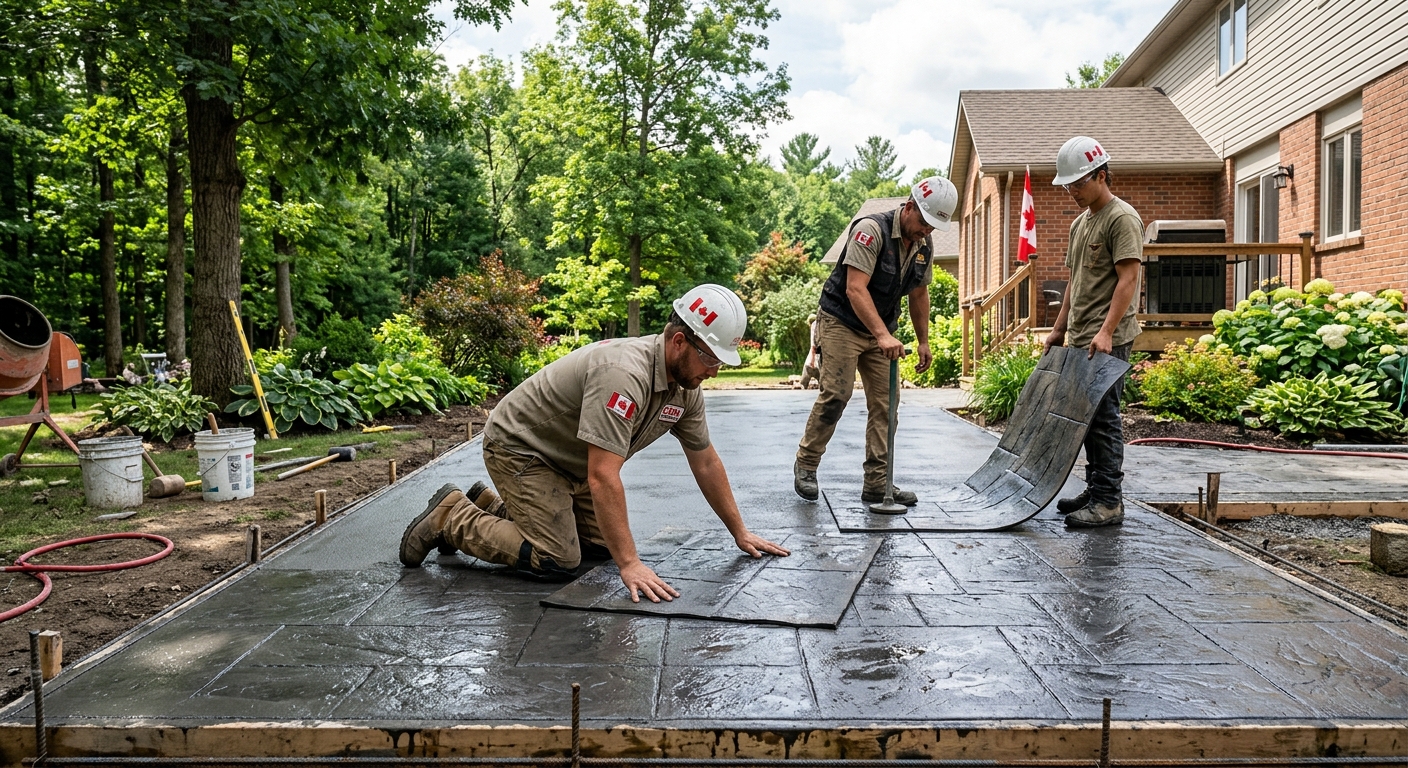
| Stamped concrete driveway or patio |
16 ft x 12 ft (192 sq ft) |
Air-entrained mix, release agent + colour integral, joints |
Stamped pattern |
$4,200 – $8,000 |
| Plain concrete patio or walkway |
12 ft x 12 ft (144 sq ft) |
Air-entrained mix, 4 in thickness, compacted base |
Float + broom edges |
$1,700 – $2,900 |
| Garage floor (interior slab) |
24 ft x 24 ft (576 sq ft) |
6 in slab, vapour considerations, wire mesh or fibre option |
Steel trowel or broom |
$9,000 – $16,000 |
| Foundation footings (structural, below frost) |
Per linear ft (typical 12 in x 18 in) |
Engineered footing size, rebar, below frost depth excavation |
Structural concrete + forming |
$180 – $260 |
Prices are estimates only and vary by project scope, site access and material selection.
What affects the price of concrete work in Wainwright
In Wainwright, you can see quote gaps of roughly 30–50% for the “same” concrete idea because bids often differ in the parts that don’t show in photos: excavation depth, base preparation, reinforcement strategy, concrete mix spec, truck access, and curing protection. In the Camrose–Drumheller economic region, those differences are amplified by cold winters and freeze–thaw cycling. Exterior work needs air-entrained concrete mixes and a drainage-ready granular base so water doesn’t sit under or within the slab and then expand as it freezes.
Frost-line depth drives a big share of foundation and heavy flatwork costs. While Ontario planning ranges around 1.5–2.4 m, Alberta designs commonly require footings and structural components to extend below local frost depth (often similar to about 2.4 m in the central corridor), which means deeper excavation, more forming, and more concrete than milder regions. That same logic carries to slabs: contractors typically require the granular base to be built to the correct depth and compacted properly so the slab doesn’t heave or crack.
Winter scheduling is another cost lever. The short pour season (late spring to early fall) can push prices up during the busy months, and if work must happen near colder shoulder dates, crews often need heating, insulated blankets, and slower finishing to meet curing requirements. Also, de-icing salts can accelerate surface spalling—so sealing becomes part of “durability math,” not an upsell.
Here are a few practical Wainwright examples: a driveway that’s 2 in thicker to reduce future maintenance usually costs more, but it can keep freeze–thaw damage from turning into edge deterioration; a broom finish driveway might land in the $14–$22 per sq ft range, while stamped upgrades can move you into the $20–$35 per sq ft bracket due to pattern materials and labour; and a tight-garage layout that forces smaller pours or extra forming can add significant labour for access and staging.
| Price Factor |
Why It Matters |
Cost Impact |
| Frost line depth |
Footing depth and form height must go below frost to prevent heave |
Higher excavation and concrete volume; can noticeably increase foundation pricing |
| Site preparation |
Grading and compacted granular base protect slabs during freeze–thaw |
Extra trucking, labour and material if base needs rebuilding |
| Reinforcement |
Rebar/wire mesh controls cracking and improves performance under loads |
Adds material + placement time; sometimes fibre is an alternative |
| Mix design |
Air-entrainment (exterior) and strength spec affect durability and scaling resistance |
Air-entrained, higher-spec mixes cost more per cubic metre |
| Finish type |
Broom is simpler; stamped/exposed aggregate require more steps and care |
Stamped/exposed typically costs more than standard flatwork |
| Pour size and concrete truck access to site |
Access affects pump vs. truck placement, staging and schedule |
Hard access can add labour time and equipment charges |
| Cold-weather curing precautions |
Low temps slow strength gain; blankets/heating protect curing |
Heating and longer protection can increase overall cost |
| Control joint pattern and sealing cost |
Joints guide cracking; sealing helps resist salt damage |
Additional cuts plus sealer material and labour |
Permits & regulations in Alberta
In Alberta, homeowners in Wainwright should expect that structural concrete work needs a building permit—typically including footings, foundation walls, and grade beams. In many cases, engineered drawings or structural details must be reviewed as part of the permit process. For concrete flatwork like driveways, patios, and walkways, a permit is often not required by default. However, there are common exceptions: if your project changes lot grading, impacts stormwater drainage, alters the amount of impervious surface, or touches areas connected to municipal right-of-way requirements, the municipality may require approvals or conditions.
Before anything starts, verify the contractor carries liability insurance and appropriate WSIB/WCB coverage (depending on their registration). Ask for references on similar-scope projects—especially exterior work designed for freeze–thaw durability (air-entrained mix, base preparation, joints, and curing protection).
How to check coverage and credentials in Alberta, step-by-step: (1) confirm the contractor’s company details and registration through official online listings; (2) request a certificate of insurance—it should show liability coverage and the project name/address if available; (3) ask for confirmation of WSIB/WCB clearance (or equivalent proof of coverage) and ensure it’s current; (4) keep copies of everything with your quote and schedule.
Getting concrete right in Wainwright's freeze-thaw climate
Concrete fails in Wainwright mainly when water gets trapped and then expands during freeze–thaw. That’s why the job must start below the surface: base preparation should be a properly compacted granular sub-base to the correct depth for local soil and frost conditions, with drainage so the slab doesn’t sit on saturated material. If base prep is rushed, even the best finishing won’t stop curling, heaving, or widening joints over time.
Next is mix design. For exterior flatwork, ask for air-entrained concrete—commonly targeting about 5–7% air—because adequate air voids improve freeze–thaw durability and reduce scaling/spalling. Pair that with a minimum 32 MPa compressive strength spec so the concrete gains strength reliably during the cold-weather shoulder conditions common in the Camrose–Drumheller area.
Then control the cracking you can’t fully prevent. Use control joints at an appropriate spacing pattern so cracks form where you want them, and seal joints correctly. Finally, curing matters: protect the slab for at least 7 days under suitable conditions, and if temperatures are borderline, contractors should use blankets/heating where required to achieve proper strength gain. After curing, plan for penetrating sealer applied about 28 days post-pour to reduce de-icing salt damage.
Ask these technical questions to avoid the biggest mistake: “What air-entrainment spec are you using, and can you show the mix delivery ticket?” Spalling is often the result of inadequate air-entrainment plus poor drainage.
Dollar example: A basic broom-finished driveway may fall around the regional $14–$22 per sq ft range, but if you choose a stamped option you might be closer to $20–$35 per sq ft. That jump is justified when both options still include proper base depth, air-entrained mix, correct joints, and proper curing—because those specs are what protect your concrete when freeze–thaw cycles keep coming.
| Spec |
Why It Matters in Wainwright |
What to Ask For |
Impact if Skipped |
| Compacted granular base (depth?) |
Controls frost movement and prevents trapped moisture under the slab |
Granular base type, target depth, and compaction method/proof |
Heaving, settlement cracks, and premature edge failure |
| Air-entrained concrete mix (target air %?) |
Freeze–thaw resistance depends on stable microscopic air voids |
Documented air content target around 5–7% for exterior flatwork |
Scaling and spalling during winter/shoulder season cycles |
| Compressive strength (MPa rating) |
Strength gain under colder conditions affects durability and wear |
Minimum 32 MPa (or higher if engineered) |
Surface damage, rough finishing, and lower long-term performance |
| Control joints (spacing per ACI guidelines) |
Directs cracking from temperature and moisture movement |
Planned joint spacing and depth, plus sealing plan |
Random cracking across flat surfaces and difficult patching |
| Minimum 7-day curing period |
Cold slows strength gain; curing protection prevents early damage |
How they protect the slab and what “curing time” means on your dates |
Reduced strength, surface scaling, and weak edges |
| Penetrating sealer (when applied after cure) |
Helps repel salts and water during Alberta winters |
Apply penetrating sealer about 28 days after pour (unless manufacturer differs) |
Faster salt/ice deterioration and higher maintenance costs |
How to choose a concrete work contractor in Wainwright
Start with verification. In Alberta, ask the contractor for a current liability insurance certificate, plus proof of WSIB/WCB coverage (or applicable equivalent clearance). In practice, you can check credibility by: (1) confirming their business details and registration through official listings; (2) ensuring the certificate of insurance is valid and includes your project address where possible; and (3) requesting a clearance letter or coverage confirmation before work begins. Don’t accept “we’ll get it later.”
Next, insist on 2–3 itemised written quotes broken into labour and materials (concrete volume, granular base, reinforcement, forming, joints, finishing, and disposal). A lump sum is harder to compare because one contractor may include base rebuild and another may not. Read the scope carefully: what’s excluded (removals, excavation to frost depth, site grading, seed/landscaping, hauling away old concrete)? Is permit handling included if your work requires it? Are line items for drainage adjustments included?
Look for warranty clarity: workmanship warranty length, who stands behind it, and whether any product/manufacturer warranties are included and transferable to you. For payment, never front-load more than about 10–15%. Use a holdback until completion and final cleanup.
Finally, get a written timeline with start and completion dates, including contingencies for cold snaps.
- Itemised quote with quantities (sq ft, linear ft, depth/thickness)
- Specified concrete mix: air-entrainment and compressive strength
- Base preparation details: depth and compaction method
- Reinforcement plan: mesh/rebar (or fibre) and placement location
- Control joint layout and whether joints are saw-cut
- Curing plan: blankets/heating if temperatures are borderline
- Sealer option included or clearly excluded (and timing)
- Permit responsibility spelled out (especially for foundations/structural work)
- Disposal and hauling charges listed separately
- Truck access plan and any coring/pumping strategy listed
- Workmanship warranty in writing
- Payment schedule with a final holdback at completion
Concrete red flags in Wainwright include: quotes that don’t mention air-entrainment, skipping granular base depth/compaction details, vague joint spacing or “we’ll cut joints later,” no curing/blanket plan for cold nights, and contractors asking for large upfront payments without a written schedule.
Frequently asked questions — concrete work in Wainwright
What is rebar and when is it required in Alberta?
Rebar is short for reinforcing steel bars, used to help concrete resist tension forces and to control cracking in structural and load-bearing applications. In Alberta, rebar is commonly required when the concrete is engineered—especially for structural elements like footings, foundation walls, grade beams, and many garage floors and slabs-on-grade that are designed to carry loads. Whether it’s required (and how much) depends on the structural design and soil/loading conditions, not just “typical practice.” If you’re doing a foundation in Wainwright, expect engineering details to call for reinforcement placed at the right cover distance from the surface. For exterior flatwork, some contractors use wire mesh or fibre-reinforced alternatives, but the specification should be explicit in your quote.
How long does a concrete project take in Wainwright?
In Wainwright, the timeline depends on the weather window, excavation/base work, and finishing complexity. For a standard exterior flatwork job, the concrete pour itself is usually one day, but the work typically spans several days for demo (if needed), forms, base grading/compaction, and finishing. Curing is where schedules get real: even though the surface may look “ready” sooner, contractors should protect the slab for at least about 7 days to support proper strength gain, especially with cold nights and freeze–thaw risk. If you’re comparing options, a broom-finished driveway may progress faster than stamped or exposed aggregate (more steps and careful curing). For a sense of cost, many homeowners budget in the $14–$22 per sq ft band for driveway flatwork, and the added labour of decorative finishes can extend the schedule.
What is a concrete overlay and is it suited to Wainwright?
A concrete overlay is a layer of new material placed over an existing concrete slab—sometimes with grinding/prep and sometimes with a bonding system—intended to improve appearance or add thickness without full removal. In Wainwright, overlays can work when the existing slab is still structurally sound: minimal spalling, no major lift/settlement, and joints/drainage are behaving. Overlays are less suited when the original slab has widespread heaving from poor base prep, failing drainage, or active freeze–thaw damage that’s already undermining the slab. If your driveway is scaling or the slab has rocking sections, the more durable fix usually involves removing the failed concrete and rebuilding base properly with air-entrained mix and correct jointing. Because Wainwright’s freeze–thaw cycles are tough on weak surfaces, a careful assessment is essential before choosing overlay vs. full replacement.
How do I seal concrete to protect it in Wainwright?
Sealing helps protect exterior concrete from water and de-icing salt exposure—important in Wainwright where winter temperatures drive freeze–thaw cycles and can accelerate spalling if water reaches the surface. The key is timing: most penetrating sealers are applied after the concrete has cured, commonly around 28 days post-pour, though you should follow the product label and contractor guidance. Before sealing, the surface should be clean and fully dry; contractors should remove dust, laitance, and any contaminants. Use a penetrating sealer designed for concrete (not just a topical coating) so it can reduce water absorption rather than trapping moisture. If you chose a decorative driveway in the $20–$35 per sq ft range, sealing is especially worth discussing because it helps maintain appearance while improving durability against salt and wet conditions.
What is the difference between concrete and cement?
Concrete is the final building material you pour: a mixture of cement, water, sand, gravel (or other aggregates), and sometimes admixtures for air entrainment, workability, and performance. Cement is only one ingredient—typically Portland cement or blended cement—acting as the binder that reacts with water to create strength. Homeowners in Wainwright often hear “cement” used casually to mean the whole concrete product, but quotes are based on the full concrete mix design: thickness, air-entrainment, compressive strength (like a minimum 32 MPa for exterior specs), and curing protection. That’s also why two “cement” prices can still lead to different durability outcomes—especially in the Camrose–Drumheller climate where freeze–thaw durability depends strongly on air-entrainment and proper base drainage.
How much does concrete work cost in Wainwright?
Concrete pricing in Wainwright typically depends on thickness, base prep, reinforcement, finish type, and access. For budgeting, many contractors use per-sq-ft pricing for flatwork: driveway slabs often land in the $14–$22 per sq ft range for standard broom-finish work, while stamped concrete can move closer to the $20–$35 per sq ft range once you factor in pattern materials and extra labour. Patios and walkways are commonly $12–$20 per sq ft. Foundations/footings are often priced differently; structural footings commonly run around $180 – $260 per linear foot depending on design and site conditions, including excavation below frost. If you’re comparing quotes, the biggest cost drivers you should verify are granular base depth and air-entrained mix spec, because those directly affect freeze–thaw performance.