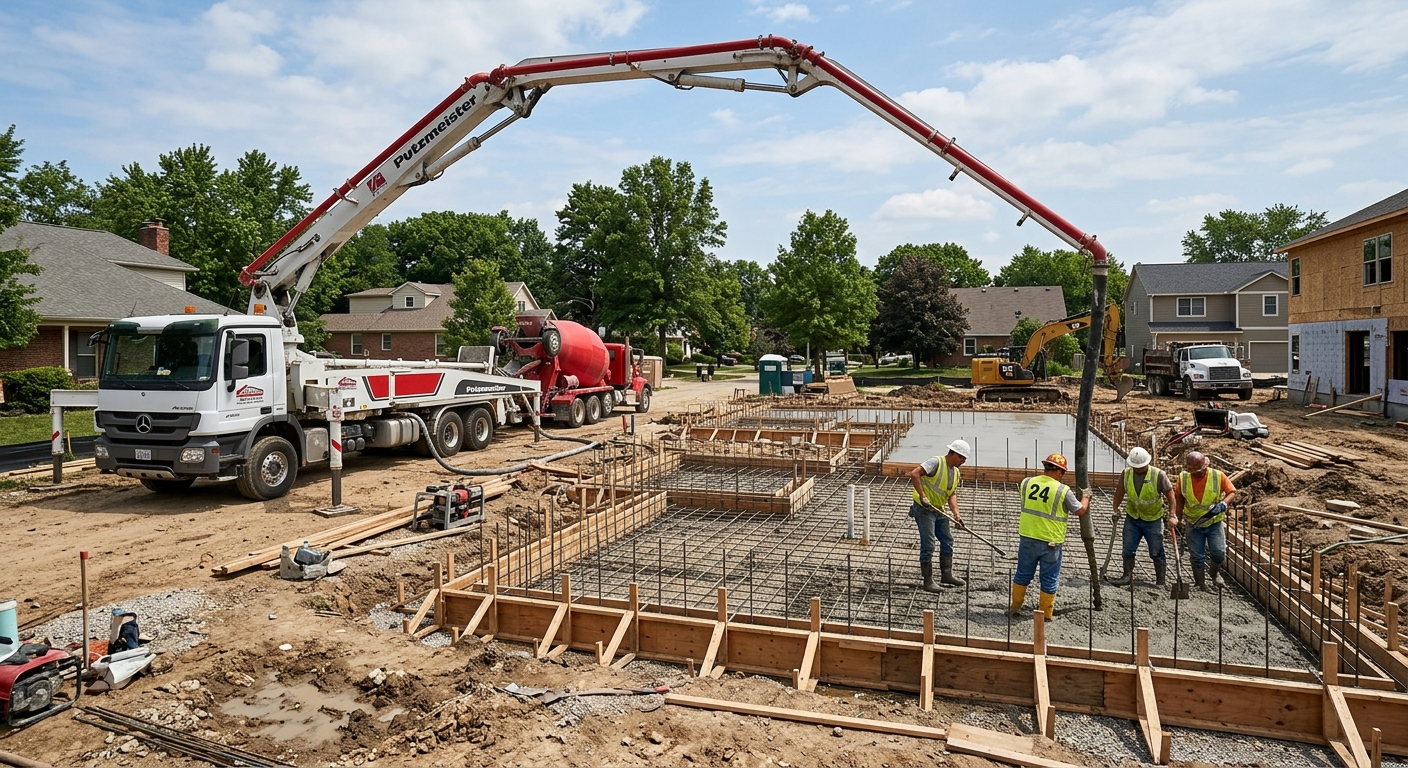
Concrete work options and costs in Royal Gardens
In Royal Gardens, Alberta, homeowners typically choose concrete for driveways, patios and walkways because it’s durable in our cold continental weather and because crews can engineer it for frost and freeze–thaw cycles. Royal Gardens has a smaller population—3,481 residents (Statistics Canada, 2021 Census)—so the local market is tighter, but the demand for concrete flatwork stays steady for the neighbourhood’s family homes. Most concrete flatwork is supporting-owner living: driveways and garage slabs are common alongside single-detached homes, which dominate the household landscape (Statistics Canada, 2021 Census). Calgary-area concrete contractors therefore price around both labour availability and the engineering details that prevent movement and cracking.
In this region, costs are shaped by a deeper design frost depth (commonly about 1.2 m, roughly 4 ft) and frequent freeze–thaw cycles. That means more excavation, deeper footings for structural work, granular base prep, and air-entrained mixes for exterior slabs. It also affects scheduling: the pour season for exterior concrete is shorter, and cold-weather placement may require heated enclosures or insulated blankets to protect curing concrete. If you’re considering work near mature landscaping or an older subdivision edge where access is tight, labour time rises and hauling costs can follow.
Concrete is especially in demand around the Royal Gardens access corridors and near busier connecting roads where driveways get widened for daily use and where homeowners update patios for winter-friendly outdoor spaces. Use the guide below to compare typical scopes, then we’ll break down what drives variation in quotes.
| Application |
Typical Size |
Key Spec |
Finish Option |
Price Range |
| Concrete driveway (standard broom finish) |
24 ft x 10 ft (240 sq. ft.) |
Air-entrained exterior mix, compacted granular base, control joints |
Broom finish |
$12,000–$18,000 |
| Exposed aggregate driveway |
24 ft x 10 ft (240 sq. ft.) |
Air-entrained exterior mix, base prep and mix control for consistent exposure |
Exposed aggregate (wash) |
$15,000–$21,000 |
| Stamped concrete driveway or patio |
20 ft x 10 ft (200 sq. ft.) or equivalent |
Air-entrained mix, integral colour or top colour, release and detailing |
Stamped patterns |
$15,000–$26,000 |
| Plain concrete patio or walkway |
12 ft x 16 ft (192 sq. ft.) |
Air-entrained mix, compacted base, expansion allowance at edges |
Float & broom or light trowel |
$5,000–$9,000 |
| Garage floor (interior slab) |
24 ft x 24 ft (576 sq. ft.) |
Interior-grade mix, vapour control (where required), broom finish |
Standard broom finish |
$10,000–$16,000 |
| Foundation footings (structural, below frost) |
Typical house footing system (scope varies) |
Engineered sizing, excavation below design frost depth, rebar as specified |
Structural concrete |
$28,000–$45,000 |
Prices are estimates only and vary by project scope, site access and material selection.
What affects the price of concrete work in Royal Gardens
It’s common to see quotes for the “same” concrete job vary by 30–50% across the Calgary market. In Royal Gardens, that spread usually comes down to engineering depth (frost and base), crew efficiency, and how much the contractor must protect curing concrete during cold snaps. When pricing is tight, you’ll notice differences in excavation volume, how the granular base is built, and whether the mix is actually specified for freeze–thaw performance (air-entrainment) rather than simply “whatever is available.”
First, the frost line depth drives foundation and edge details. Alberta practice expects footings to bear below the design frost depth (about 1.2 m, roughly 4 ft). If excavation hits more compacted soil or if there are frozen pockets, footing volumes rise and labour increases. Second, freeze–thaw cycles mean exterior slabs need air-entrained concrete mixes and carefully spaced control joints to reduce random cracking and reduce spalling risk. Third, the pour season is shorter: cold-weather placement may require winter-grade mix adjustments and curing precautions like insulated blankets or temporary heat—small delays can add real labour hours. Finally, local traffic patterns and de-icing habits matter. De-icing salt can accelerate surface wear, so sealing after cure is often recommended for driveways and patios.
Here are a few Royal Gardens examples of how costs move: a driveway with limited truck access on a narrow approach can push you toward the higher end of the $12,000–$18,000 band; a stamped job that needs extra thickness and staging often lands closer to $15,000–$26,000 because labour is higher and timing is tighter; and foundation work that requires deeper excavation to meet below-frost bearing commonly lands within the $28,000–$45,000 foundation band. Even an extra metre of excavation can translate into thousands because concrete, rebar, and formwork scale together.
| Price Factor |
Why It Matters |
Cost Impact |
| Frost line depth — determines footing depth and form height |
Footings must bear below design frost to prevent frost heave and seasonal movement |
Often the biggest driver for foundation/footing bids; deeper excavation increases concrete, rebar and labour |
| Site preparation — excavation, grading, compacted granular base |
Good base controls settlement and supports slab thickness through freeze–thaw cycles |
Unforeseen excavation or poor access can add significant time and disposal/hauling costs |
| Reinforcement — rebar or wire mesh requirement |
Helps control cracking and supports structural loads where specified |
Mesh vs rebar and schedule spacing can change material costs and labour hours |
| Mix design — air-entrainment and compressive strength spec |
Air voids improve freeze–thaw durability; strength targets support long-term performance |
Proper specs can cost more than generic mix; cutting corners leads to early surface damage |
| Finish type — broom vs. stamped vs. exposed aggregate |
Finish complexity affects labour, materials and timing constraints |
Stamped and exposed finishes often move the job toward the upper end of the price bands |
| Pour size and concrete truck access to site |
Access affects pumping, staging, and how quickly crews can place/finish |
Pumping, short-distance pumps, or multiple trips can noticeably increase total cost |
| Cold-weather curing precautions — heating and blankets |
Protects curing concrete from freezing and scaling in winter shoulder months |
Temporary heat/blankets can add labour and rental expenses, especially in late fall |
| Control joint pattern and sealing cost |
Joints help locate cracking; sealing helps repel de-icing salt and reduce surface wear |
Proper joint layout and sealing are usually worth it; skipping them often shows up as early deterioration |
Permits & regulations in Alberta
In Alberta, structural concrete work—such as foundation footings, foundation walls, and grade beams—requires a building permit. For many homes and additions, engineered drawings are also reviewed as part of the permit process. This matters because the frost-protection and rebar sizing must match the design. For concrete flatwork (patios, walkways, driveways), a permit typically is not required unless your project affects lot grading, stormwater management, impervious surface coverage limits, or impacts the municipal right-of-way. Even when a permit isn’t typically required, it’s still smart to confirm with your local authority before you excavate or change drainage.
Before hiring a contractor in Royal Gardens, verify they’re covered properly. Start by checking their Alberta credentials (the exact class depends on the work, but you want to see that they’re eligible to perform the scope they’re quoting). Next, request a certificate of liability insurance that matches the project address and confirm limits are appropriate for construction work. Finally, ask for proof of WSIB/WCB coverage (workers’ compensation coverage), especially if any trades are working on-site. A legitimate contractor should provide these documents without hesitation.
Step-by-step for homeowners: (1) ask the contractor for their insurance certificate and WCB/WSIB proof; (2) ask for the contractor’s licence/registration details and look them up using the official Alberta registry tools; (3) obtain a written scope that states whether they pull permits (for structural work) and whether any engineering sign-offs are included; and (4) keep a file of everything—scope, insurance, and permits—for your records.
Getting concrete right in Royal Gardens's freeze-thaw climate
Concrete failures in Royal Gardens usually trace back to five things: inadequate base preparation, the wrong mix, poor jointing, weak curing, and little or no protection from de-icing salts. In our climate, freeze–thaw cycles are relentless, and the design frost depth (around 1.2 m, roughly 4 ft) means slabs and footings must be built to resist seasonal movement. If the base isn’t compacted to the right depth and profile, a driveway or patio can settle and crack; if the mix lacks proper air-entrainment, you can see surface scaling and spalling within a couple winters.
To spec the job correctly in Royal Gardens, lock in these essentials: (1) base preparation with a compacted granular sub-base sized for your soil conditions and frost exposure; (2) mix design using air-entrainment—commonly 5–7% air content for exterior flatwork—paired with a minimum 32 MPa compressive strength; (3) control joints placed to limit random cracking, not just “where it looks neat”; (4) curing that protects concrete for at least 7 days under proper conditions—this is critical if you’re placing in colder shoulder months; and (5) sealing with a penetrating sealer applied after the cure window (typically at 28 days) so salts don’t aggressively attack the surface.
Ask contractors how they’ll prevent spalling: look for confirmation of air-entrainment and a plan for curing protection. For cost context, a stamped patio often costs more than a plain one; you might pay closer to $15,000–$26,000 for stamped driveway/patio work compared with a plain patio/walkway around $5,000–$9,000. That price difference is justified when finish complexity is paired with correct freeze–thaw specs—otherwise you’re paying for aesthetics on a system that’s set up to fail.
| Spec |
Why It Matters in Royal Gardens |
What to Ask For |
Impact if Skipped |
| Compacted granular base (depth?) |
Stable support reduces settlement and cracking through freeze–thaw cycles |
State granular type, lift thickness, compaction method, and base depth to suit soil and frost exposure |
Uneven settling, premature cracking, and joint failure |
| Air-entrained concrete mix (target air %?) |
Air voids provide space for ice expansion, improving durability in Alberta winters |
Confirm air content target (commonly 5–7% for exterior flatwork) and use the specified freeze–thaw rated mix |
Surface scaling and spalling, especially after de-icing cycles |
| Compressive strength (MPa rating) |
Strength supports long-term load resistance and abrasion resistance |
Minimum 32 MPa for typical exterior flatwork; confirm at pour spec level |
Higher risk of surface wear and structural problems over time |
| Control joints (spacing per ACI guidelines) |
Joints help “find” cracks in planned locations, limiting random cracking |
Ask for the joint spacing and whether they cut or form joints within the recommended timeframe |
Wider random cracks and water infiltration into joints |
| Minimum 7-day curing period |
Proper curing strength and durability depend on protecting concrete from early freezing/drying |
Confirm curing plan and protection methods when temperatures drop (blankets/heating if needed) |
Reduced surface and overall durability, higher chance of early scaling |
| Penetrating sealer (when applied after cure) |
Helps repel moisture and de-icing salt exposure at the surface |
Ask for penetrating sealer application after cure (commonly after 28 days), plus surface prep requirements |
Faster surface deterioration and more frequent maintenance |
How to choose a concrete work contractor in Royal Gardens
Choosing the right contractor in Royal Gardens starts with verifying Alberta compliance and then matching their scope to your climate needs. Ask for proof of liability insurance and workers’ compensation coverage (WSIB/WCB). A simple certificate of insurance review should show the policy is active, the limits are appropriate, and the certificate matches the project scope. For licensing, request the contractor’s Alberta registration details and confirm them using the official registry tools available to homeowners. If they can’t provide clear documentation, move on.
Next, get 2–3 itemised written quotes instead of one lump sum. You want a breakdown that distinguishes excavation, base prep, reinforcement, concrete supply, finish labour, and sealing. In Calgary-area work, the same “driveway” can include very different base depths, joint layouts, and curing precautions; without an itemised scope, bids look similar while the engineered work isn’t. Ask whether permit pulling is included where required (structural work) and whether disposal, truck access allowances, and any regrading are covered.
Warranty is another differentiator. A workmanship warranty (for labour) and a product/manufacturer warranty (for materials) should be clear: the duration, what’s covered, what’s excluded, and whether the warranty is transferable if you sell your home. For payment, keep it conservative: never pay more than 10–15% upfront, and hold a reasonable portion until completion and final curing/finish requirements are met. Get a start date and completion estimate in writing—winter shoulder-season pours need realistic timelines.
- Request proof of current liability insurance and WCB/WSIB coverage before signing.
- Confirm Alberta registration/licence details match the scope they’re quoting.
- Require itemised pricing (excavation, base, steel/rebar, concrete, finishing, sealing).
- Ask what’s included for hauling and disposal of excess soil (often overlooked).
- Verify granular base type, base depth, and compaction method.
- Confirm concrete mix is air-entrained and state target air content for exterior work.
- Ask about minimum strength (e.g., 32 MPa) and whether cold-weather precautions are planned.
- Review the control joint plan (spacing and timing of cutting).
- Ask when the sealer is applied and which penetrating product is used.
- Get curing/protection details in the contract if pouring near cold temps.
- Confirm warranty length for workmanship and whether it’s transferable.
- Use a payment schedule: 10–15% max upfront; holdback until the job is fully finished.
Concrete red flags in Royal Gardens include: “we’ll use whatever mix is cheapest” (no air-entrainment plan), no mention of curing blankets/heating in cold snaps, vague scope language like “standard base” without depth or compaction details, contractors who want large upfront payments, and quotes that don’t address joint spacing or sealing for de-icing salt exposure.
Frequently asked questions — concrete work in Royal Gardens
How do I maintain concrete in Royal Gardens's freeze-thaw climate?
In Royal Gardens and across the Calgary area, maintenance is mainly about protecting the surface from moisture and de-icing salt. Start with a good removal routine: shovel promptly and avoid piling salt at the same spots, because concentrated salt can accelerate surface wear during freeze–thaw cycles. Rinse occasionally in the spring to reduce salt residue. If your driveway or patio has been sealed, keep an eye on water beading—once water starts soaking in quickly, it’s usually time to re-seal. For plain broom-finish slabs, a penetrating sealer applied after cure (commonly around 28 days) provides better salt resistance than film-forming products. Typical flatwork pricing for a plain patio/walkway sits around $5,000–$9,000; sealing is a small add-on that often preserves that investment.
What causes concrete to spall in Royal Gardens winters?
Spalling is commonly caused by freeze–thaw damage at the concrete surface, and the biggest driver is inadequate air-entrainment. Without the correct air void system, water entering the surface freezes and expands, breaking paste near the top and leading to scaling and spalling. In Royal Gardens, de-icing salts make it worse by increasing the rate of deterioration. Other contributors include poor base prep that allows movement, inadequate curing (especially if concrete was placed in cooler weather without insulation/heating), and joints that aren’t cut or sealed correctly so water gets trapped. If a contractor didn’t specify a properly freeze–thaw rated air-entrained mix and proper curing, you’ll usually see early surface problems. This is one reason exterior concrete often aligns with the higher end of the $12,000–$18,000 driveway band when the right specs and precautions are included.
What is rebar and when is it required in Alberta?
Rebar (reinforcing steel) is used to help control cracking and provide structural capacity, particularly in foundation systems and in flatwork designed for heavier loads. In Alberta, rebar requirements are driven by engineered design and the loads your structure must carry—not just by tradition. For example, foundation footings and grade beams typically require rebar as specified on engineered drawings, and those drawings are tied to frost depth and soil conditions. For exterior slabs like driveways, rebar or welded wire mesh may be specified depending on slab thickness, soil support, and whether there’s a heavy vehicle loading scenario. The safest approach in Royal Gardens is to ask for the reinforcement plan: what’s being installed (rebar vs mesh), the placement height, spacing, and whether it matches the engineering or design assumptions. Don’t accept “we always use mesh” if the scope doesn’t explain why.
How long does a concrete project take in Royal Gardens?
Timing depends on size, access, weather, and whether cold-weather curing precautions are needed. For typical flatwork, placement day is usually only part of the timeline—what matters is curing and finish work. A driveway or patio may involve excavation and base prep the day before or in stages, followed by reinforcement setup and the concrete pour. You’ll generally see finishing and curing setup completed the same day as the pour, but concrete still needs proper curing conditions for durability. In Alberta, if temperatures drop during placement, contractors may require insulated blankets and potentially temporary heating; that can extend the “active” work window and scheduling. Even after placement, the sealer is commonly applied around 28 days after the pour, so long-term protection is a separate step. If you’re comparing budgets, remember that stamped and decorative concrete often requires more controlled timing than a plain slab, which can affect scheduling within the $15,000–$26,000 decorative band.
What is a concrete overlay and is it suited to Royal Gardens?
A concrete overlay is typically a new cement-based layer installed over an existing concrete slab to restore appearance and improve function without fully demoing the original. In Royal Gardens, an overlay can be suited to certain situations—such as when the existing slab is mostly sound, with limited cracking and no widespread settlement—because the freeze–thaw environment will stress weak areas over time. However, if the existing slab has structural failure, significant voids beneath it, or ongoing movement, an overlay can end up reflecting those problems and may not perform for as long. A contractor should assess the existing slab for delamination, spalling, and settlement, and explain whether they’ll prep and bond properly. For homeowners, it can be more affordable than replacement, but it’s not automatically the best move. If you’re already planning to budget around $12,000–$18,000 for a driveway replacement, make sure the overlay proposal includes inspection, surface prep method, and a clear durability plan for Alberta winters.
How do I seal concrete to protect it in Royal Gardens?
To protect concrete in Royal Gardens, sealing is most effective when it’s done at the right time with the right product. For exterior flatwork, a penetrating sealer is usually the best match because it helps repel moisture and reduces the rate at which de-icing salts can attack the surface. The timing matters: wait until the concrete has fully cured—commonly around 28 days—so you’re sealing a stable surface. Before sealing, the slab must be clean and dry, free of dust, curing compounds, and heavy residue. Ask your contractor how they’ll clean and whether they’ll confirm surface dryness before application. Then plan maintenance: re-seal when the surface begins to lose water repellency. If you’re comparing options, sealing is typically small compared with the overall driveway budget (often within $12,000–$18,000), but it can help preserve both plain broom-finish slabs and decorative work by slowing surface deterioration through Alberta’s freeze–thaw cycles.