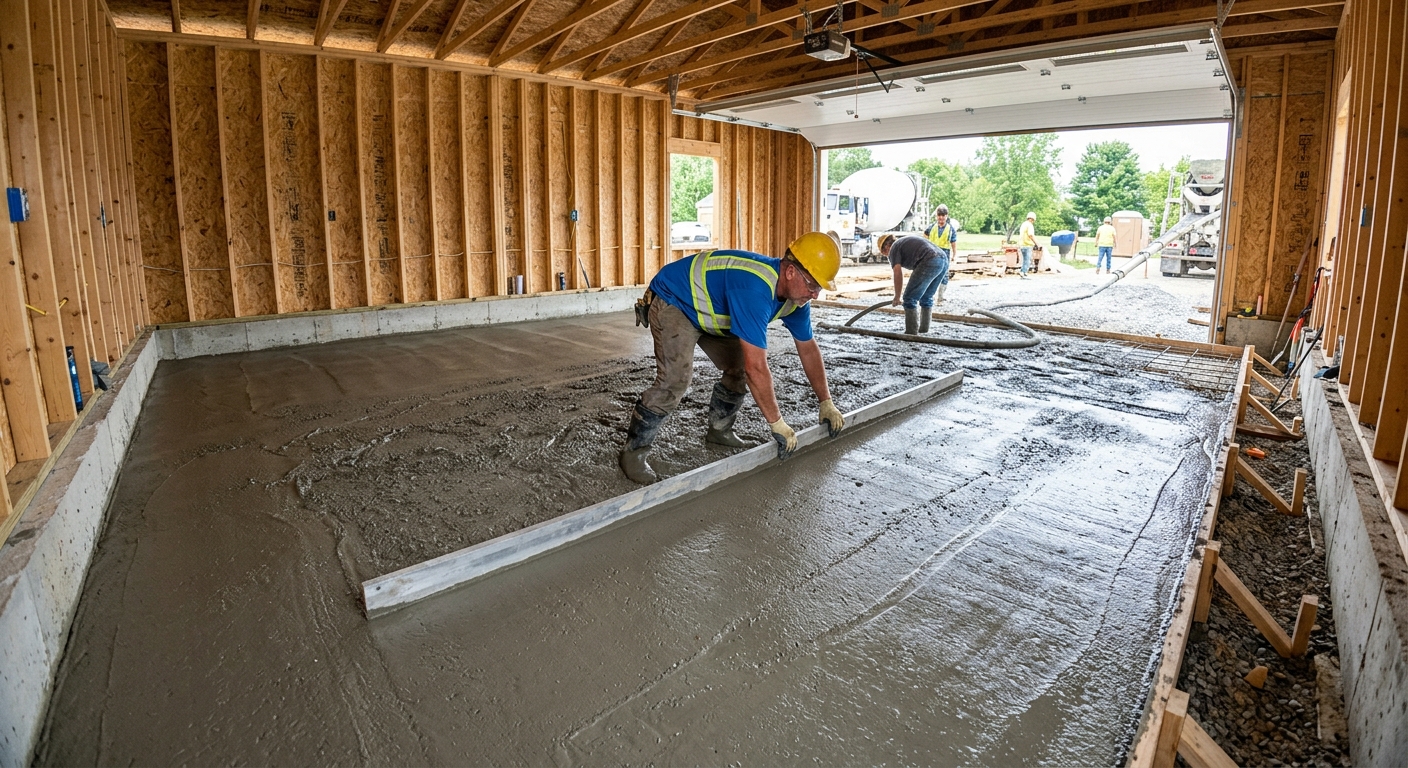
Concrete work options and costs in Westlake
Concrete work in Westlake is a smart, long-lasting choice, especially when it’s detailed for Calgary-area freeze–thaw. Westlake’s population was 1,363 in 2021 (Statistics Canada, 2021 Census), and that smaller housing market tends to concentrate demand for concrete flatwork around established neighbourhoods and growing residential pockets. In practice, the concrete work homeowners notice most—driveways, patios and walkways—is closely tied to the type of homes built and the age of upgrades in the area (many properties look for durable resurfacing as outdoor living spaces expand).
In the Calgary region, costs are shaped by engineering and logistics. With a design frost depth of about 1.2 m (roughly 4 ft) in local practice, footings for garages, decks and retaining structures must bear below frost to reduce seasonal movement and frost heave. Frequent freeze–thaw cycles also require air-entrained mixes, proper granular base prep, and well-spaced control joints—especially for exterior slabs where de-icing salt is common. On top of that, the pour season for exterior flatwork is shorter, so winter-grade placement and curing precautions (insulated blankets and sometimes temporary heat) can raise labour and equipment time.
Contractors are often especially busy in Westlake-style residential strips where homeowners are adding driveways off collector streets and expanding backyards for patios—an area where access and grading can make or break schedule and final price. Below is a practical comparison of common concrete options to help you align scope with budget before you request itemised quotes.
| Application |
Typical Size |
Key Spec |
Finish Option |
Price Range |
| Concrete driveway (standard broom finish) |
24 ft x 10 ft (240 sq. ft.) |
Air-entrained exterior mix; compacted base; control joints |
Broom finish, light saw-cut pattern |
$12,000–$18,000 |
| Exposed aggregate driveway |
24 ft x 10 ft (240 sq. ft.) |
Air-entrained mix; proper curing window; wash exposure |
Exposed aggregate with sealer |
$16,000–$22,000 |
| Stamped concrete driveway or patio |
20 ft x 12 ft (240 sq. ft.) |
Air-entrained exterior mix; integral color; base + joints |
Stamped pattern with release and seal coat |
$15,000–$26,000 |
| Plain concrete patio or walkway |
12 ft x 12 ft (144 sq. ft.) |
Air-entrained exterior mix; compacted sub-base; joints |
Broom or hand-trowelled finish |
$5,000–$9,000 |
| Garage floor (interior slab) |
22 ft x 20 ft (440 sq. ft.) |
Vapour barrier (if specified); reinforcement; proper curing |
Float finish, trowel options if requested |
$10,500–$16,500 |
| Foundation footings (structural, below frost) |
Typical house/garage footing footprint (varies) |
Engineered reinforcement; excavation to below design frost |
Structural concrete, formed where required |
$28,000–$45,000 |
Prices are estimates only and vary by project scope, site access and material selection.
What affects the price of concrete work in Westlake
Even for “the same” concrete job in Westlake, quotes can swing by 30–50% across the Calgary region because the scope is rarely identical—base depth, reinforcement, concrete mix requirements, access, and finishing complexity can all change. In cold continental conditions, engineering specs matter more than they do in milder provinces: concrete must be detailed for frost and freeze–thaw, and that drives excavation volume, formwork, and material selection.
Start with frost. Local practice uses a design frost depth of about 1.2 m (roughly 4 ft), so footings for foundations and structural elements must extend below undisturbed soil depth to reduce frost heave. Next is freeze–thaw exposure: exterior slabs should use air-entrained concrete mixes to better resist surface scaling and spalling. Then there’s the pour season. In Calgary-area schedules, winter-grade placement and cold-weather curing precautions (insulated blankets and, in some cases, temporary heating) add labour time and equipment—especially when homeowners want driveways or patios poured late in the year or early in spring.
Two practical examples that change price quickly in Westlake: (1) If your driveway requires deeper excavation and a thicker compacted granular base to stabilize subgrade, you’re not just paying for concrete—you’re paying for hauling, labour and compaction time. (2) If you choose stamped or exposed aggregate finishes, the pricing can move from the plain driveway band (often around the $12,000–$18,000 range) toward the stamped/decorative band (commonly $15,000–$26,000), because labour and finishing materials are more involved.
Housing stock also plays a role. Older properties with poor drainage or partially settled approaches often require extra base correction before any slab is poured, which can add thousands when compared with a straightforward replacement on stable grade.
| Price Factor |
Why It Matters |
Cost Impact |
| Frost line depth — determines footing depth and form height |
Footings must bear below design frost to reduce frost heave and seasonal movement |
Can raise structural costs materially when excavation depth or volume increases |
| Site preparation — excavation, grading, compacted granular base |
Proper sub-base thickness and compaction prevent settlement and cracking |
Higher when soil is variable, when access limits equipment, or when hauling is needed |
| Reinforcement — rebar or wire mesh requirement |
Controls cracking and supports slab performance under loads |
Adds material and labour; may be required for heavier use (e.g., garage/drive lanes) |
| Mix design — air-entrainment and compressive strength spec |
Air entrainment improves freeze–thaw durability for exterior slabs |
Typically modest per-yard cost, but critical to avoid early spalling and scaling |
| Finish type — broom vs. stamped vs. exposed aggregate |
Finish method changes labour time and materials (forms, mats, release, wash/expose) |
Stamped/decorative work often moves you toward higher bands than plain broom |
| Pour size and concrete truck access to site |
Long wheelbarrow runs and tight access increase labour and may reduce pour efficiency |
Access issues can add crews, time, and sometimes additional pumping/handling |
| Cold-weather curing precautions — heating and blankets |
Cold slows strength gain; curing must be protected to reach proper early strength |
Can noticeably increase labour/equipment costs in late fall/early spring |
| Control joint pattern and sealing cost |
Joints manage cracking; sealing helps repel salt and moisture at surface level |
Sealer is often a separate line item; joint sawing/layout affects labour |
Permits & regulations in Alberta
In Alberta, structural concrete work typically requires a building permit and often engineered drawings for review. That usually includes concrete footings, foundation walls, grade beams and other structural elements that carry building loads. Concrete flatwork—patios, walkways, driveways—often does not require a permit on its own, unless it changes lot grading, impacts stormwater/impervious surface limits, affects municipal right-of-way, or requires revisions to drainage. In Westlake, it’s still wise to confirm whether your specific driveway expansion, elevation changes, or drainage tie-ins trigger approvals with your local authority before excavation begins.
Step-by-step, here’s how a homeowner in Westlake can verify a contractor properly:
- Ask for the contractor’s business details and the specific scope: footings/foundation versus flatwork only.
- Check contractor licensing through the appropriate online registry for Alberta construction trades (use the contractor’s legal company name).
- Request proof of liability insurance (certificate of insurance showing coverage amount and effective dates).
- Confirm WSIB/WCB coverage status for workers—ask for a clearance letter or current account documentation.
- Verify the permit responsibility: if structural work is involved, ensure the contractor clearly states who pulls the permit and who provides stamped/engineered documentation.
- Confirm project references on similar work in the Calgary region so you’re not relying on generic experience.
If anything is missing—no insurance documents, unclear responsibility for engineered drawings, or reluctance to discuss permit requirements—treat it as a warning sign and request written clarification before signing.
Getting concrete right in Westlake's freeze-thaw climate
Concrete failures in Westlake usually come down to one thing: the slab isn’t detailed to survive Calgary-area freeze–thaw and de-icing salt. The most common homeowner-visible symptom is spalling and surface scaling—often from inadequate air-entrainment, poor base preparation, or a curing process that doesn’t allow early strength to develop. In a cold continental climate with frequent temperature swings, the “details” are not optional; they’re what you pay for when you invest in proper prep, mix design, joints and curing.
To spec the job correctly, insist on: (1) base preparation with a properly compacted granular sub-base to the required depth for local subgrade and frost considerations; (2) an exterior air-entrained mix (commonly a 5–7% target air content for outdoor flatwork) and a minimum 32 MPa compressive strength specification; (3) a control joint pattern that limits random cracking (spacing must match the slab geometry and use); (4) curing for at least 7 days under suitable conditions—cold-weather placement often requires insulated blankets or approved temporary heat to avoid surface scaling; and (5) penetrating sealing applied after the cure period (typically 28 days post-pour) so moisture and salts don’t sit at the surface.
Here’s where price comparisons make sense. A plain driveway in the $12,000–$18,000 band might be “cheaper” than a stamped option, but it still needs correct base depth, air-entrainment and joints to perform. If you choose stamping/decorative work in the $15,000–$26,000 band, the extra cost is justified by labour-intensive finishing—not by skipping the structural requirements beneath it. In other words: you can’t buy durability with looks alone; you need the engineering underneath.
Use this as your question list, too: “What air content are you targeting?” “How deep is the compacted granular base?” “How soon will you saw-cut and seal?” These are the questions that help you avoid the spalling problems that show up the second winter.
| Spec |
Why It Matters in Westlake |
What to Ask For |
Impact if Skipped |
| Compacted granular base (depth?) |
Controls settlement and supports the slab through frost-related movement |
Ask for the designed granular base depth and compaction method |
Higher risk of unevenness, cracking, and shortened service life |
| Air-entrained concrete mix (target air %?) |
Improves freeze–thaw durability for exterior slabs exposed to salt and wetting |
Ask for the target air content (commonly 5–7%) and confirmation it’s exterior-rated |
Spalling/scaling can appear early, especially after winter de-icing |
| Compressive strength (MPa rating) |
Strength gain supports structural performance and reduces surface damage |
Ask for minimum 32 MPa and when strength testing/verification is handled |
Premature wear, surface deterioration, and durability problems |
| Control joints (spacing per ACI guidelines) |
Manages where cracking occurs as the slab shrinks and expands |
Ask for joint spacing and layout based on slab dimensions and use |
Random cracking that’s harder to repair and can widen over time |
| Minimum 7-day curing period |
Ensures early strength development before exposure to cold and moisture swings |
Ask what curing method will be used if temperatures drop |
Surface scaling and reduced long-term durability |
| Penetrating sealer (when applied after cure) |
Helps repel de-icing salt and moisture that drive freeze–thaw damage |
Ask for a penetrating sealer applied around 28 days post-pour |
Faster salt penetration leading to scaling and spalling |
How to choose a concrete work contractor in Westlake
Choosing the right concrete contractor in Westlake is mostly about verification and clarity. Start by confirming Alberta compliance: ask for proof of liability insurance and proof of workers’ coverage (WSIB/WCB) for anyone working on-site. How to check each is straightforward: look for a current certificate of insurance with your address/project details or coverage period listed, and request a clearance letter or current account documentation for WSIB/WCB. Then check that the contractor’s legal business name matches the documents and the quote.
Next, require 2–3 itemised written quotes. You want a breakdown that includes labour and materials separately (concrete volume, base prep, reinforcement, joints, finishing, sealing, disposal). Avoid lump-sum quotes that don’t state what’s included. In Westlake winters and shoulder seasons, ask whether cold-weather curing precautions are included—blankets, heat management, and protection materials should be spelled out rather than implied.
Also read scope exclusions carefully: Who handles permit pulls if structural work is involved? Is disposal of excavated soil included? Are you paying extra for pumping, saw-cutting time, or additional aggregate if base depth changes after site inspection?
Warranty matters too. Ask for the workmanship warranty length and whether product/manufacturer warranty is included for things like sealers, admixtures, or decorative topping systems. Payment schedule should be conservative—never more than 10–15% upfront, and hold back until the final cleanup, joint sealing, and all finish checks are complete. Finally, get the start date and completion estimate in writing, including how weather affects the schedule.
- Use the same design/spec on every quote so you’re comparing apples to apples.
- Confirm concrete mix is air-entrained for exterior slabs and not “standard” indoor mix.
- Ask how deep the compacted granular base will be and who is responsible for compaction verification.
- Check if reinforcement is included (mesh vs rebar) for your slab type and loading.
- Verify control joint spacing and whether saw-cut timing is included.
- Confirm curing plan for cold nights (blankets/heat as needed) and who monitors it.
- Ask when sealer will be applied and whether it’s included (often 28 days post-pour).
- Ensure disposal/haul-away is included if excavation expands after inspection.
- Require a line item for trucking/pump setup if access is limited.
- Ask about liability insurance proof and WSIB/WCB coverage for all workers.
- Get a written timeline tied to weather expectations in Calgary-area conditions.
- Make sure changes are documented in writing with updated pricing—not verbal changes.
Concrete red flags I see in Westlake: contractors who can’t show insurance/WSIB documentation, quotes that omit base depth and reinforcement details, schedules that ignore cold-weather curing in late fall/early spring, “cheap” decorative work that still doesn’t include air-entrainment and proper joints, and contracts that require large upfront payments or avoid defining what’s excluded.
Frequently asked questions — concrete work in Westlake
How do I prepare the base for a concrete slab?
In Westlake and the broader Calgary area, base prep is what determines whether your slab stays level through freeze–thaw. A good contractor will excavate to the planned depth, grade to slope requirements, and then build a compacted granular sub-base (not just dirt) to the thickness needed for local subgrade and frost considerations. Ask how they verify compaction (often by process and equipment choice rather than “guessing”). For exterior slabs like driveways and patios, the base must also be stable enough to support the air-entrained mix; otherwise, even a correctly designed concrete won’t perform well. If you’re budgeting, remember driveway work often lands around the $12,000–$18,000 band, and that price assumes proper base work—not shortcuts.
How do I compare concrete quotes?
To compare quotes fairly in Westlake, request itemised breakdowns rather than just a lump sum. Make sure each proposal states: base depth and compaction approach, reinforcement (mesh vs rebar), air-entrained mix for exterior work, minimum compressive strength, control joint spacing, curing plan, and whether sealing is included. Compare finish type too—plain broom versus stamped or exposed aggregate can change labour and materials. For example, plain exterior driveway work frequently comes in around the $12,000–$18,000 range, while stamped/decorative driveways and patios commonly land closer to $15,000–$26,000 because of additional finishing steps. Finally, confirm what’s excluded: site disposal, permit handling (if structural), and cold-weather curing precautions.
Can concrete be poured in cold weather in Westlake?
Yes, concrete can be poured in cold weather in Westlake, but it must be done with winter-grade placement and curing precautions. Calgary-area freeze–thaw and overnight lows slow hydration and increase risk of surface scaling if the concrete isn’t protected. A responsible crew will plan the pour when possible and, when temperatures drop, use approved methods such as insulating blankets and controlled heating as needed to maintain curing conditions for at least the early period required to reach adequate strength. Ask your contractor what the curing plan is for your specific dates, and whether they include cold-weather protection in the quote. If you see vague answers, it’s a red flag—durable exterior concrete in Alberta depends on curing discipline as much as mix design.
How do I maintain concrete in Westlake's freeze-thaw climate?
Maintenance in Westlake is mostly about keeping water and salt off the surface and catching issues early. First, plan for sealing: a penetrating sealer is typically applied after the concrete has cured (often around 28 days post-pour) to help repel moisture and de-icing salts. Second, control water flow—keep downspouts directed away from slabs and address drainage problems before they undermine the base. Third, use de-icing products carefully: rock salt and repeated heavy salt application can accelerate scaling if the slab surface is unsealed or poorly air-entrained. Finally, inspect annually for cracks, spalling, or joint failures. Small repairs done early prevent larger patching later, especially in a climate where freeze–thaw cycles repeatedly stress the slab.
What causes concrete to spall in Westlake winters?
Concrete spalls in Westlake winters for a few repeat reasons, and the biggest one is inadequate freeze–thaw durability—most often from incorrect or missing air-entrainment for exterior exposure. When water gets into the concrete and then freezes, it can expand and damage the surface, leading to scaling and spalling. Other contributors include poor base preparation, weak or improperly cured concrete, and control joint problems that allow uncontrolled cracking. If the contractor rushed curing during a cold snap, surface damage can show up faster. That’s why Westlake exterior flatwork should use an air-entrained mix and a solid curing plan. Even if the finish is broom or decorative, durability specs matter more than appearance.
What is rebar and when is it required in Alberta?
Rebar (reinforcing bar) is steel reinforcement embedded in concrete to help manage tensile forces and limit cracking—especially in slabs that see loads, restrained shrinkage, or heavier use. In Alberta, whether rebar (or equivalent reinforcement such as mesh) is required depends on the structure and engineered design—driveways and garage slabs often need reinforcement based on slab thickness, soil support, and expected loading. For structural concrete like footings and foundation walls, reinforcement is typically engineered as part of the permit-level design. For flatwork, a proper contractor assesses your slab thickness, base condition, and use, and includes reinforcement accordingly. If you’re planning foundation work, the scope typically falls into the foundation/footings band of $28,000–$45,000, where engineering and reinforcement are standard practice rather than optional.