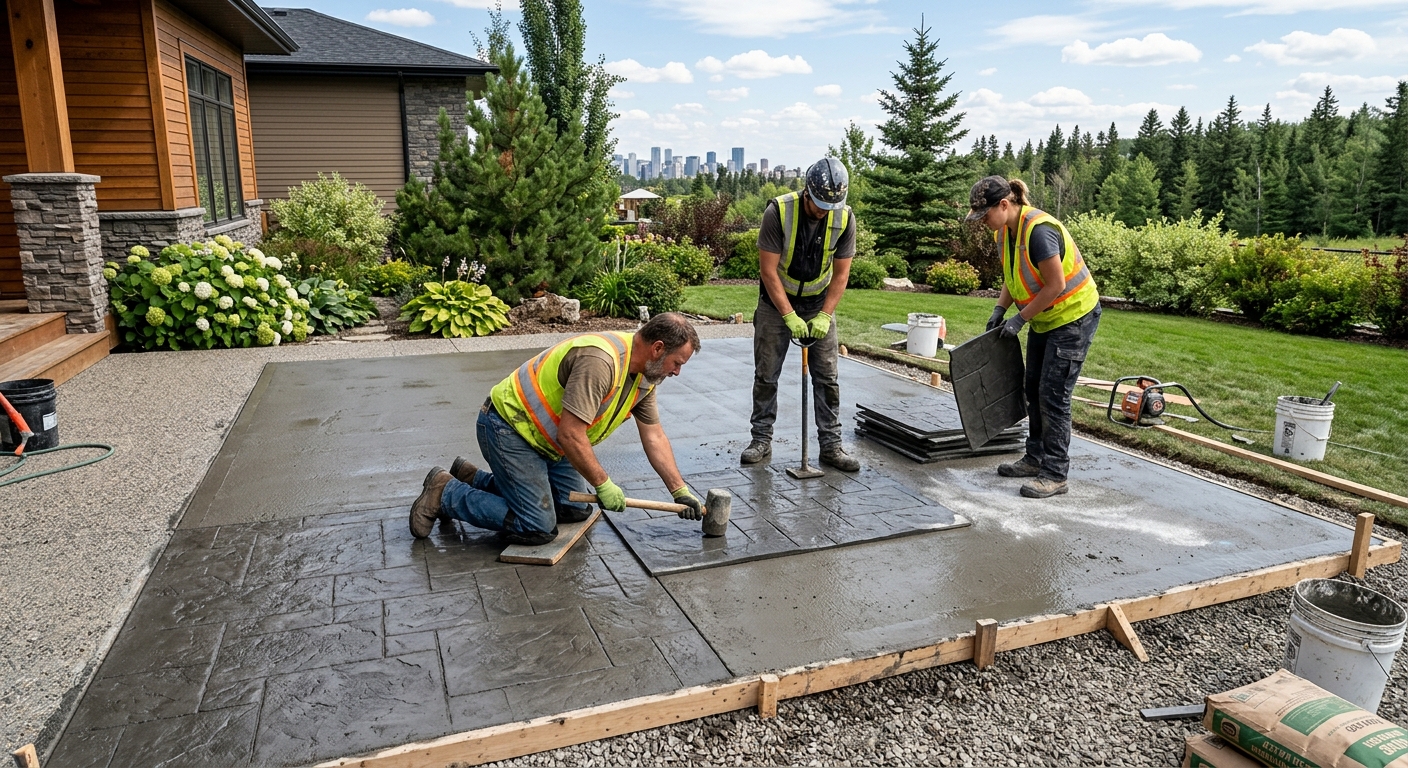
Concrete work options and costs in Currie Barracks
Concrete work in Currie Barracks, Alberta needs to be planned a little differently than in milder parts of the country because freeze–thaw cycles stress every exposed surface. With a local population of 1,275 people (Statistics Canada, 2021 Census), the community scale is small enough that contractors often consolidate scheduling—so availability and pour-day weather windows can affect timelines. It’s also a neighbourhood type that commonly relies on concrete flatwork—driveways, patios and walkways—around single-family homes, garages, and retaining features.
In Calgary’s cold continental climate, local engineering practice typically assumes a design frost depth of about 1.2 m (roughly 4 ft). That means footing excavation and concrete volume for foundations are higher than what you’d see where frost is shallower. For exterior slabs, we generally see higher specs than “minimum” because air-entrainment and control joints directly influence cracking and spalling when winter de-icing salts meet freeze–thaw. The practical pour season for exterior work is also shorter, and cold-weather curing measures (insulated blankets, heated enclosures where needed) can add cost—especially in late fall or early spring.
In Currie Barracks and nearby areas of Southwest Calgary, trades are particularly busy for driveway and patio builds where homeowners want low-maintenance surfaces that handle salt and snow removal. If you’re comparing options, the table below gives realistic local price ranges for common applications so you can line up scopes with the right specs before requesting detailed quotes.
| Application |
Typical Size |
Key Spec |
Finish Option |
Price Range |
| Concrete driveway (standard broom finish) |
24’ x 12’ (288 sq ft) |
Air-entrained mix for exterior, control joints |
Broom finish |
$12,000–$18,000 |
| Exposed aggregate driveway |
24’ x 12’ (288 sq ft) |
Air-entrained mix, polished exposure plan |
Exposed aggregate |
$14,500–$21,500 |
| Stamped concrete driveway or patio |
24’ x 12’ (288 sq ft) |
Air-entrained mix, colour hardeners/sealers |
Stamped + colour |
$15,000–$26,000 |
| Plain concrete patio or walkway |
12’ x 16’ (192 sq ft) typical |
Air-entrained mix, proper base and grade |
Broom or light float |
$5,000–$9,000 |
| Garage floor (interior slab) |
22’ x 20’ (440 sq ft) |
Vapour management as needed, proper curing |
Broom finish, steel trowel optional |
$7,500–$13,000 |
| Foundation footings (structural, below frost) |
Typical single-detached footprint |
Engineered rebar cage, poured below design frost |
Structural concrete only (no surface finish) |
$28,000–$45,000 |
Prices are estimates only and vary by project scope, site access and material selection.
What affects the price of concrete work in Currie Barracks
In Currie Barracks (Calgary region), quotes for the “same” concrete project can swing by 30–50% because the underlying specs are rarely identical. Two contractors may both quote a driveway, but one might be allowing for a deeper frost-resistant excavation, better granular base prep, and air-entrainment to survive Calgary’s freeze–thaw cycles—while another uses less robust assumptions to hit a lower number. Labour rates, truck access, rebar detailing, and how they plan curing in cold weather also change the labour and material hours, which quickly adds up.
Why is frost so central here? The design frost depth is about 1.2 m in this region (roughly 4 ft), so footings for houses, garages, decks and retaining structures must bear on undisturbed soil below that depth to prevent frost heave. For exterior flatwork—driveways, patios and walkways—air-entrained concrete is essential so the paste can handle freeze–thaw without surface scaling or spalling. Calgary’s colder pour window is tighter, and if you’re placing concrete late in the season, winter-grade placement may require insulated blankets and sometimes temporary heat to achieve proper curing. Separately, de-icing salt accelerates surface wear, so sealing becomes a cost-effective durability step.
In practical terms, you’ll often see cost increases when (1) excavation reaches deeper undisturbed soils, (2) the base requires additional granular layers and compaction, and (3) control joints and reinforcement are detailed to reduce cracking. Conversely, costs can lower slightly when site access is easy and the geometry is simple—fewer edges, no tight crane moves, and straightforward truck placement. If your driveway budget is near the standard backbone range of $12,000–$18,000, upgrading to exposed aggregate or stamps can be justified, but only if the extra prep and curing are included—not just the surface treatment. Likewise, foundation work in the $28,000–$45,000 band can rise quickly when engineering calls for additional reinforcement or deeper excavation due to site conditions.
| Price Factor |
Why It Matters |
Cost Impact |
| Frost line depth — determines footing depth and form height |
Concrete must extend below design frost to prevent heave and seasonal movement |
Higher excavation and formwork can add major labour and volume |
| Site preparation — excavation, grading, compacted granular base |
Loose soil and poor compaction lead to settlement and cracking in freeze–thaw |
Extra granular layers and compaction time increase the bill |
| Reinforcement — rebar or wire mesh requirement |
Controls cracking and improves durability, especially on driveways and footings |
Material cost plus labour for placement/ties |
| Mix design — air-entrainment and compressive strength spec |
Air-entrainment helps concrete survive repeated freeze–thaw cycles |
Specialty mix increases material cost and may require QC steps |
| Finish type — broom vs. stamped vs. exposed aggregate |
Surface texture affects appearance and long-term wear under snow-clearing |
Stamped/exposed adds labour time, tooling, and materials |
| Pour size and concrete truck access to site |
Long linework and difficult access can extend pour time and labour |
Delays, extra handling, or smaller pours raise costs |
| Cold-weather curing precautions — heating and blankets |
Proper curing reduces scaling and surface deterioration in cold temps |
Insulation/heating adds rental and labour hours |
| Control joint pattern and sealing cost |
Joints manage shrinkage cracks; sealing improves salt resistance |
May increase scope, but reduces future repair risk |
Permits & regulations in Alberta
In Alberta, the first thing to separate is what’s structural versus what’s cosmetic or flatwork. Structural concrete work—such as footings, foundation walls, grade beams, and other parts of a foundation system—typically requires a building permit and, in many cases, engineered drawings reviewed as part of the permitting process. For concrete flatwork like patios, walkways, driveways and garage floors, a permit is often not required by default, but it can be required if the work affects lot grading, drainage, impervious surface coverage considerations, or municipal right-of-way conditions. Always confirm with the local authority before breaking ground, especially if you’re changing swales, adding retaining features, or altering how surface water moves.
For contractor qualification in Currie Barracks, verify three things step-by-step: (1) licensing/registration (as applicable), (2) liability insurance, and (3) workplace coverage (WSIB/WCB coverage depending on how the contractor is set up). Start by asking the contractor for a current certificate of insurance showing the policy term and coverage limits, and ensure the certificate lists the correct business name and address. Next, request proof of clearance/coverage status so you’re not assuming risk as the homeowner. If a contractor uses subcontractors, ask who holds the insurance and coverage for the concrete crew. Finally, confirm they can provide references from similar-scale jobs in the Calgary area—driveways and slabs in winter conditions—so you know they’ve managed air-entrainment specs and cold-weather curing.
Getting concrete right in Currie Barracks's freeze-thaw climate
Concrete can fail in Currie Barracks when it’s not engineered for Alberta’s freeze–thaw rhythm and de-icing salts. The most common field problems I see are surface scaling and spalling from inadequate air-entrainment, cracking from weak or inconsistent base support, and random cracking when control joints aren’t planned. To spec the job correctly, start with base preparation: compacted granular sub-base to the correct depth and grade so water drains and the slab stays supported through winter. For mix design, specify air-entrainment (target 5–7% air content for exterior flatwork) and a minimum 32 MPa compressive strength so the concrete meets durability expectations in cold cycles.
Next, control joints. They need to be cut and spaced to limit random shrinkage cracking, and the jointing plan should match the slab geometry and expected loads (snow storage, vehicle traffic, plough lines). Curing is also critical: aim for at least 7 days of proper curing under suitable temperature conditions. In cold weather, that often means insulated blankets or heated enclosures so the surface develops strength instead of scaling. After cure (typically around 28 days post-pour), sealing with a penetrating sealer helps repel meltwater and reduce salt-driven deterioration.
To see where price differences are justified: a standard broom-finished driveway may land around $12,000–$18,000, while a stamped driveway can range up to $15,000–$26,000. That extra cost is only worth it if the contractor still includes the same frost-focused base prep, correct air-entrained mix, proper curing measures, and an appropriate joint pattern. If the job is “cheap” by skipping those, the surface look won’t last through the Calgary winter—especially once de-icing starts coming down.
| Spec |
Why It Matters in Currie Barracks |
What to Ask For |
Impact if Skipped |
| Compacted granular base (depth?) |
Reduces settlement and keeps the slab stable during freeze–thaw |
Confirm excavation depth and granular lift thickness + compaction standard |
Settlement cracking and uneven slab heave |
| Air-entrained concrete mix (target air %?) |
Improves resistance to freeze–thaw scaling and spalling |
Ask for target air content (5–7% for exterior flatwork) and mix design spec |
Surface deterioration within a few winters |
| Compressive strength (MPa rating) |
Ensures sufficient strength and durability under winter stress |
Minimum 32 MPa for exterior flatwork (or as engineered) |
Higher risk of chipping, scaling, and early repairs |
| Control joints (spacing per ACI guidelines) |
Limits random shrinkage cracking in cold-season curing |
Joint spacing plan based on slab dimensions and tooling/cutting schedule |
Random cracking that’s harder to fix aesthetically |
| Minimum 7-day curing period |
Strength gain protects against early freeze damage |
Confirm curing method and cold-weather allowances (blankets/heating if needed) |
Reduced strength and surface scaling risk |
| Penetrating sealer (when applied after cure) |
Helps repel meltwater and de-icing salts |
Apply after cure (commonly about 28 days) with surface-prep requirements |
Faster salt-related deterioration and staining |
How to choose a concrete work contractor in Currie Barracks
When you’re hiring a concrete contractor in Currie Barracks, verify Alberta coverage before you sign anything. First, ask for proof of liability insurance (certificate of insurance with coverage limits and the policy effective dates). Second, confirm workplace coverage—WSIB/WCB—so you’re not exposed if a worker is injured on your property. Where to look: request the documents directly, and check that the business name on the certificate matches the contractor applying for the job. If they can’t provide current paperwork quickly, that’s a red flag.
Next, request 2–3 itemised written quotes, not one lump number. A good quote breaks labour and materials clearly: excavation and haul/disposal, granular base, reinforcement and placement labour, concrete supply/mix spec (including air-entrainment), finishing, jointing, and curing/sealing if included. Confirm whether a permit is included for any structural scope. Clarify what’s excluded (for example: removal of existing footings, tree roots, or disposal costs) so your project doesn’t inflate later.
For warranties, ask for workmanship warranty length in writing and whether it applies to cracking due to curing/base issues—not just “cosmetic” surface defects. If they provide a product/manufacturer warranty (such as for sealers), confirm whether it’s transferable to you as the homeowner. For payments, I recommend a schedule that never exceeds 10–15% upfront; hold back money until the job is complete, inspected, and you’ve received documentation. Finally, get the start date and completion estimate in writing, including how weather triggers schedule changes in Calgary’s cold season.
- Request certificates: liability insurance + WSIB/WCB clearance/coverage proof
- Confirm the contractor’s business name matches the insurance certificate
- Get itemised quotes (labour, concrete mix, reinforcement, base prep, finishing, disposal)
- Ask what concrete mix is being used and whether it’s air-entrained for exterior durability
- Confirm how control joints will be cut (timing and spacing)
- Ask about curing plan for cold weather (blankets/heating if temperatures drop)
- Verify base prep depth and compaction method/standard
- Ask whether sealer is included and when it’s applied (after cure)
- Confirm who does rebar/mats placement and how it’s supported for correct cover
- Clarify disposal/hauling—what is removed, where it goes, and any tipping fees
- Review warranty terms: workmanship, who covers it, and what defects qualify
- Agree on a payment schedule with a holdback until final cleanup and inspection
Concrete contractor red flags in Currie Barracks include: refusing to provide insurance/WSIB/WCB paperwork, quoting without mix or air-entrainment details, skipping base preparation specifics, proposing a late-season pour without a cold-weather curing plan, or not discussing control joints and sealing at all.
Frequently asked questions — concrete work in Currie Barracks
What is rebar and when is it required in Alberta?
Rebar is steel reinforcement placed inside concrete to help control cracking and carry tensile forces that plain concrete can’t handle well. In Alberta, rebar requirements depend on the engineered design and the structural role of the concrete—so it’s common in foundation footings, foundation walls, grade beams, and many reinforced slabs. For exterior flatwork like driveways and patios, rebar or wire mesh may be specified based on slab thickness, soil conditions, and load expectations (such as vehicle traffic and snow storage), but it’s not “one-size-fits-all.” In Currie Barracks and across the Calgary region, reinforcement decisions are also tied to durability under freeze–thaw, because cracked or poorly supported slabs deteriorate faster with salt. If you’re getting a foundation quote in the $28,000–$45,000 band, expect engineered rebar work; for driveways in the $12,000–$18,000 range, ask how and where reinforcement will be installed.
How long does a concrete project take in Currie Barracks?
Timelines in Currie Barracks depend mainly on site prep and weather, not just the pour day. For a driveway or patio, excavation and forming can take a few days, then finishing and jointing happen after the pour. The concrete itself is placed quickly, but the project isn’t “done” until the slab has cured properly and the surface has reached a safe strength level for traffic and maintenance. In Calgary’s cold continental climate, crews may need cold-weather curing precautions—insulated blankets and sometimes heat—which can extend the calendar time even if the labour-day count is similar. A typical driveway job might take roughly 1 to 3 weeks from start to final finishing, while foundation footings can take longer due to excavation depth, inspection/engineering steps, rebar placement, and cure time. If you’re planning around late fall or early spring, ask your contractor for a weather-based plan, because rushing curing increases scaling and long-term structural risk.
What is a concrete overlay and is it suited to Currie Barracks?
A concrete overlay is a new concrete layer poured over an existing concrete slab after surface preparation—sometimes with grinding, patching, and often installing bonding methods or dowels depending on conditions. In Currie Barracks, overlays can be a good option when the existing slab is generally sound but worn (for example, staining, minor surface scaling, or small surface defects). However, freeze–thaw and de-icing salt can worsen underlying issues, so an overlay is not suitable if the original slab has major structural cracking, significant settlement, poor drainage, or heaving that indicates the base is failing. Cost-wise, overlays can sometimes be cheaper than full removal and replacement, but if prep reveals deeper problems, replacement may be the better long-term value. Since exterior work relies on air-entrained mixes and proper curing to resist Calgary winters, ask how the contractor will ensure bond strength and a durable mix design—not just “pour something on top.”
How do I seal concrete to protect it in Currie Barracks?
Sealing is about reducing how meltwater and de-icing salts interact with your concrete surface. In Alberta’s freeze–thaw climate (and particularly around Calgary where salt is used heavily), a penetrating sealer helps repel moisture and can slow deterioration like spalling and surface scaling. The key timing is after proper cure—commonly about 28 days post-pour—so the concrete has developed enough strength and is dry enough for the sealer to penetrate. Before sealing, the surface must be clean and dry, with any required surface preparation completed to ensure adhesion. For homeowners, ask your contractor: which sealer product is used, whether it’s penetrating or film-forming, and whether they include the correct application schedule and coverage rate. Sealing won’t fix structural issues from weak base prep or inadequate air-entrainment, but when those fundamentals are right, it’s one of the best protective steps for exterior slabs during Calgary winters.
What is the difference between concrete and cement?
Concrete and cement are related, but they’re not the same. Cement is the binder—an ingredient (made from limestone and other materials) that reacts chemically with water. Concrete is the final building material you see and drive on: cement plus water, sand, gravel (or other aggregates), and often admixtures. In Currie Barracks and across the Calgary region, admixtures matter a lot for durability—especially air-entrainment for exterior slabs. That’s the difference between “it hardens” and “it survives freeze–thaw.” When contractors talk about a spec like 5–7% air content and a minimum 32 MPa strength, they’re talking about the concrete mix design (cement plus aggregates plus admixtures). That’s why two jobs can land in different price ranges: the materials and engineering behind the concrete—not just the labour—can push a driveway closer to the $12,000–$18,000 band or higher when you add upgrades like stamps or exposed aggregate.
How much does concrete work cost in Currie Barracks?
Concrete pricing in Currie Barracks is driven by scope, site conditions, and how the work is engineered for Calgary’s cold-season durability requirements. For context, local backbone ranges for this tier are commonly around $12,000–$18,000 for a concrete driveway or slab, $5,000–$9,000 for a patio or walkway, and $28,000–$45,000 for foundation/footings (structural, below frost). Stamped and decorative concrete often sits higher—around $15,000–$26,000—because it includes extra labour for forms, finishing, and colouring. Actual quotes can move up or down based on excavation depth, reinforcement needs, granular base prep, control joint pattern, truck access, and cold-weather curing measures like insulating blankets. Also, remember the community scale—Currie Barracks has a smaller population (Statistics Canada, 2021 Census)—so scheduling can be tighter during peak exterior seasons. For the best comparison, ask for itemised quotes with mix specs and curing plans, not just a single total.