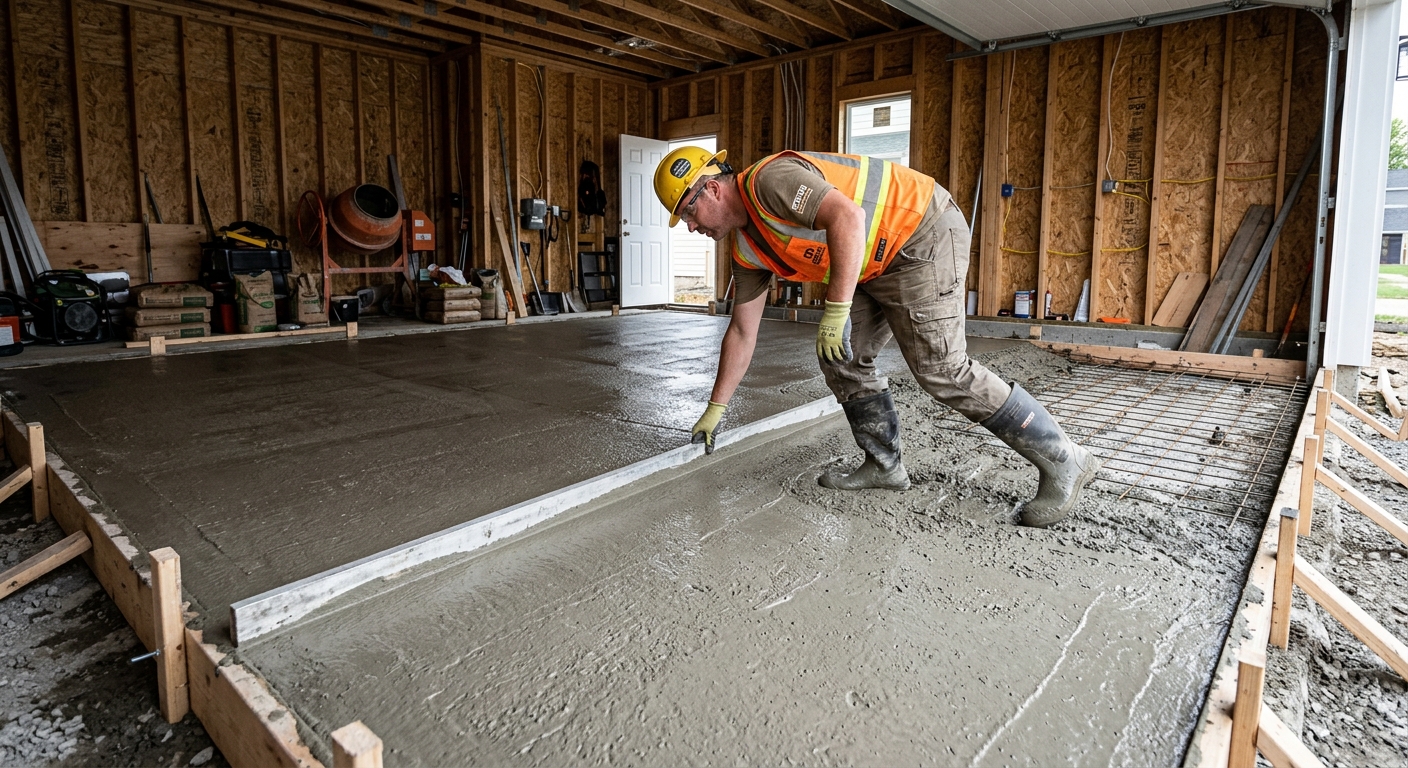
Concrete work options and costs in Spirit River
Concrete work in Spirit River is a practical upgrade for driveways, patios, and walkways, but the final price is shaped by our long freeze–thaw seasons and deep frost. With single-detached houses making up 81.6% of dwellings in the community and homeowners representing 84.4% of households (Statistics Canada, 2021 Census), most concrete flatwork demand comes from older residential lots where repairs and expansions are common. In Spirit River, many homes were built before 1981 (63.6%), so you’ll often see re-slabbing, new walkways, and driveway widening tied to aging foundations, settled approaches, and upgraded drainage.
In the Athabasca–Grande Prairie–Peace River region, frost lines typically run deep, which means footings and any exterior slab work must sit below frost to reduce heave. That drives excavation, forming height, and concrete volume. Freeze–thaw cycling also demands air-entrained concrete and careful jointing so the surface doesn’t scale. Finally, we work within a shorter reliable pour season for flatwork, and crews may be stretched with travel between Peace-region sites, so labour and equipment can be tighter during peak weeks. If you’re near the core residential areas (like the downtown/central service area), access and grading planning tend to be straightforward, which can keep pricing closer to the lower end of the band.
Below is a comparison of the typical options we price for Spirit River projects, using the local tier ranges for your decision-making.
| Application |
Typical Size |
Key Spec |
Finish Option |
Price Range |
| Concrete driveway (standard broom finish) |
400 sq. ft. (about 20 ft x 20 ft) |
Air-entrained concrete, compacted granular base, control joints |
Broom finish, edged/thickened apron where needed |
$5,600 – $8,000 |
| Exposed aggregate driveway |
400 sq. ft. |
Air-entrained concrete, consistent mix, curing/curtailment plan for wash |
Exposed aggregate finish with sealer-ready surface |
$7,200 – $11,000 |
| Stamped concrete driveway or patio |
250 sq. ft. (about 15 ft x 16-17 ft) |
Air-entrained concrete, integral color, reinforced slab |
Stamped pattern + release agent |
$6,000 – $10,000 |
| Plain concrete patio or walkway |
200 sq. ft. (about 10 ft x 20 ft) |
Proper drainage slope, compacted base, control joints |
Broom or smooth trowel edge finish |
$2,400 – $3,600 |
| Garage floor (interior slab) |
500 sq. ft. (about 20 ft x 25 ft) |
Vapour retarder (as spec’d), reinforced interior slab |
Broom finish, densifier optional |
$7,500 – $11,000 |
| Foundation footings (structural, below frost) |
Varies by house plan (example 120 lineal ft) |
Below frost depth, reinforced concrete, forms and excavation |
Structural finish (no decorative finish) |
$5,400 – $8,400 |
Prices are estimates only and vary by project scope, site access and material selection.
What affects the price of concrete work in Spirit River
In Spirit River and across the Athabasca–Grande Prairie–Peace River region, quotes for the “same” concrete job can vary by 30–50% because the biggest cost drivers are often site conditions, excavation depth, and schedule—not just the concrete itself. For example, a driveway that needs more granular base, deeper snow/ice removal for access, or extra truck mobilization can move quickly from a standard build into a higher-production, higher-cost scenario. When you compare builders across Alberta, those differences in planning and curing handling can also show up as larger labour line items.
Frost line depth and freeze–thaw cycles dictate every spec: exterior footings must extend below the design frost depth (in Alberta it’s commonly up to about 2.4 m) to prevent frost heave, and slabs require air-entrained concrete to survive repeated freeze–thaw. The cold-weather curing precautions we use in winter—insulating blankets, heating, and extended cure protection—add time and handling cost, especially when the pour window is short. De-icing salt accelerates surface spalling when the mix and finish aren’t matched to exposure; a proper sealer plan helps protect the surface.
Two common Spirit River examples: (1) If your driveway ties into an older approach with poor drainage, we may need extra base and subdrain adjustments, pushing you toward the higher end of the $14–$20 per sq. ft. driveway band. (2) If you’re choosing stamped work, like stamped patterns priced in the $22–$35 per sq. ft. range, the real cost difference is labour-intensive finishing and integral colour control—not the basic material. With many homes built before 1981 (Statistics Canada, 2021 Census), retrofits and drainage corrections frequently account for the added dollars.
| Price Factor |
Why It Matters |
Cost Impact |
| Frost line depth — determines footing depth and form height |
Deeper footings require more excavation and taller forming |
Often one of the biggest drivers for structural work |
| Site preparation — excavation, grading, compacted granular base |
Undercut and rebuild reduces settlement and cracking risk |
Can add substantial labour and hauling time |
| Reinforcement — rebar or wire mesh requirement |
Controls cracking and improves load performance |
Material + placement time, especially for larger slabs |
| Mix design — air-entrainment and compressive strength spec |
Exterior freeze–thaw protection depends on correct air content |
Higher-spec mix adds cost but prevents early scaling |
| Finish type — broom vs. stamped vs. exposed aggregate |
Finishes require different labour intensity and curing care |
Stamped/exposed typically run higher per sq. ft. |
| Pour size and concrete truck access to site |
Limited access can require pump use or extra staging |
Mobilization and production rate affect overall price |
| Cold-weather curing precautions — heating and blankets |
Ensures strength gain despite cold temps |
Adds equipment time and crew monitoring |
| Control joint pattern and sealing cost |
Joints reduce random cracking; sealing helps repel salts |
Small cost relative to repair avoidance |
Permits & regulations in Alberta
In Alberta, structural concrete work—typically including footings, foundation walls, and grade beams—usually requires a building permit, and engineered drawings are commonly part of the process so the municipality can review the structural design. For concrete flatwork like patios, walkways, and driveways, a permit is often not required unless the work affects lot grading, ties into municipal requirements, or changes impervious surface coverage in a way that triggers review. That said, before you break ground in Spirit River, it’s smart to confirm with the local authority—especially if you’re raising elevations near eaves, relocating drainage, or altering slopes near the right-of-way.
Step-by-step, here’s how you verify a contractor in Alberta: (1) Ask for their valid business licence/registration details and confirm they operate as a concrete contractor with proper trade credentials if applicable in your situation. (2) Request a Certificate of Insurance naming you as a certificate holder where possible—review general liability limits and ensure it’s active for the dates of your project. (3) Verify workers’ compensation coverage (WSIB/WCB). In Alberta, don’t accept “we’re covered” without documentation; ask for a clearance letter or confirmation. (4) Get references on similar-scale work—driveways with freeze–thaw performance, or foundations with below-frost excavation—then visit or request photos that match your soil and exposure conditions.
Doing these checks up front protects you from schedule delays and reduces the risk of subpar curing and workmanship on critical exterior exposures.
Getting concrete right in Spirit River's freeze-thaw climate
Concrete failure in Spirit River winters usually starts with water management and durability. The freeze–thaw cycle expands and contracts moisture in the slab, and if the base isn’t compacted to the right depth or if the mix doesn’t include proper air entrainment, you can get scaling and spalling. The fix isn’t “stronger concrete only”—it’s correct specification: (1) base prep with a compacted granular sub-base sized for local soil and frost conditions, including proper drainage slope; (2) mix design with air entrainment suited for exterior flatwork (commonly 5–7% air content) and a minimum 32 MPa compressive strength; (3) control joints placed at spacing that limits random cracking; (4) curing that realistically targets at least 7 days under proper conditions; and (5) sealing with a penetrating sealer after cure (typically 28 days post-pour) to help repel de-icing salts.
Ask technical questions so you don’t end up paying for premature repairs. For example, if two contractors quote similar driveway totals but one refuses to discuss air entrainment and joint spacing, that’s a red flag. Sealing is another question: a small upcharge on finishing is often cheaper than grinding and patching scaled edges next spring.
Dollar perspective: if you’re deciding between plain broom-finished concrete (often closer to the $14–$20 per sq. ft. driveway band) and an exposed aggregate finish (typically higher), the extra cost is justified when the contractor commits to correct mix control and curing. In our climate, the “best-looking” finish can still fail if the air content, base thickness, and curing plan aren’t right.
| Spec |
Why It Matters in Spirit River |
What to Ask For |
Impact if Skipped |
| Compacted granular base (depth?) |
Prevents settlement and reduces frost-related movement at slab edges |
Granular type, target compacted thickness, and compaction test approach |
Cracking, uneven surface, and early edge failure |
| Air-entrained concrete mix (target air %?) |
Protects against freeze–thaw scaling and improves durability with salt exposure |
Confirmed air content target (commonly 5–7% for exterior flatwork) |
Spalling/scaling within 1–3 winters in severe conditions |
| Compressive strength (MPa rating) |
Ensures strength gain for the slab’s structural and wear needs |
Minimum 32 MPa and curing temperature plan |
Surface weakness, increased cracking risk |
| Control joints (spacing per ACI guidelines) |
Controls where cracking occurs so it doesn’t become random |
Joint spacing and whether saw-cut timing is planned |
Random cracks and moisture ingress at cold joints |
| Minimum 7-day curing period |
Cold snaps can delay strength gain without insulation/heating |
Curing method (blankets/heating) and protection timeline |
Reduced strength and higher scaling risk |
| Penetrating sealer (when applied after cure) |
Helps reduce damage from de-icing salt and moisture cycling |
Sealer type and timing—typically after 28 days post-pour cure |
Faster surface wear and more frequent patching |
How to choose a concrete work contractor in Spirit River
To choose a concrete contractor in Spirit River, verify three things every time: Alberta credentials (where applicable), liability insurance, and workers’ compensation coverage. Start by requesting proof—don’t rely on a verbal assurance. For liability, ask for a Certificate of Insurance and review that it’s active for your project dates. For workers’ comp, ask for confirmation/clearance documentation (WSIB/WCB equivalent proof in Alberta) so you know the site is covered if someone is injured. If a contractor won’t provide paperwork promptly, treat it as a scheduling risk and a potential liability risk.
Next, get 2–3 itemised written quotes that separate labour and materials. You want line items for excavation/base preparation, reinforcement, concrete supply, forming, finish type, curing blankets/heating (if needed), saw cutting/control joints, and sealing. Avoid comparing only totals—scope gaps are where most “cheap quotes” go sideways.
Read the scope carefully: what’s excluded (removals, hauling, disposal of concrete, relocating services), is the permit pulling responsibility spelled out, and does the quote include compaction and protection? Warranty matters too: confirm workmanship warranty length, what it covers (cracking within reason vs. spalling from incorrect mix/air), whether product warranties apply to materials, and if anything is transferable. For payment schedule, never pay more than 10–15% upfront; keep a holdback until the finish and curing requirements are met. Finally, insist on a start date and completion estimate in writing so the short pour season doesn’t become an open-ended wait.
- Ask whether they design for below-frost placement and proper drainage details on exterior work.
- Request mix information (air entrainment target for exterior) and compressive strength spec.
- Confirm reinforcement plan: rebar size, spacing, and where mesh is (and isn’t) used.
- Check if they include compaction and granular base thickness in writing.
- Verify curing plan for cold weather (blankets/heating and minimum curing duration).
- Make sure control joint spacing and saw-cut timing are specified.
- Confirm sealing if you want salt protection (and when sealer is applied).
- Review insurance paperwork before scheduling—ask for certificate and worker coverage proof.
- Get a disposal/hauling line item clarified (removal of old concrete, if any).
- Ensure the quote includes site protection (property protection, track mats where required).
- Check warranty terms in plain language, including exclusions for improper de-icing use.
- Pay progressively with a clear holdback tied to completion and cleanup.
Concrete red flags in Spirit River: crews that won’t discuss air entrainment for exterior freeze–thaw exposure, “cheap” quotes that omit base thickness and compaction, no written curing protection plan for cold weather, vague joint spacing/saw-cut timing, and contractors who can’t show insurance/WSIB/WCB coverage documentation.
Frequently asked questions — concrete work in Spirit River
What is air-entrained concrete and why does it matter here?
Air-entrained concrete is mixed with tiny, evenly distributed air bubbles that give freezing water room to expand. In Spirit River, that matters because repeated freeze–thaw cycles and winter de-icing salt can pull moisture into the surface. If air content is too low or not controlled, the slab can scale and spall, especially at edges and at joints where water collects. That’s one reason Spirit River exterior flatwork typically costs more when it’s done correctly—the contractor is selecting the right air-entrained mix and curing plan, not just pouring regular concrete. In practical terms, a well-built driveway in the $14–$20 per sq. ft. band depends on correct air content, control joints, and proper base prep, not only on the broom finish you see on top (Statistics Canada, 2021 Census).
How do I prepare the base for a concrete slab?
Base prep is where most long-term performance is won or lost in Alberta’s cold climate. For Spirit River slabs, the contractor should excavate to the required depth, remove organics, then place and compact a granular base in lifts. The goal is a stable, uniform support under the concrete so you don’t get differential settlement that cracks the slab. You should also expect proper grading and drainage so meltwater doesn’t pond near the slab edges. A good quote will list granular thickness and compaction expectations, along with whether reinforcement is included. If your home is older (many built before 1981, Statistics Canada, 2021 Census), it’s common to find drainage issues or soft spots that need undercutting—those changes increase scope but improve durability. If base prep is missing from the quote, ask directly before work begins.
How do I compare concrete quotes?
Compare quotes like a scope audit, not like a “lowest number wins” contest. Ask for itemised pricing that breaks down excavation/site prep, granular base, reinforcement, concrete supply, forming, finish type, curing protection, saw-cut control joints, and sealing (if included). The same driveway can vary by 30–50% across the Athabasca–Grande Prairie–Peace River region because one contractor may include deeper base work, better truck access planning, or cold-weather curing blankets. Also compare finish details: a stamped driveway or patio typically sits in the $22–$35 per sq. ft. range (or higher depending on site), and that premium should reflect labour-intensive finishing and colour consistency. For a plain broom-finished driveway, the $14–$20 per sq. ft. band assumes correct air entrainment and joints. If one quote is much lower without listing those specs, that’s usually where risk is hidden.
Can concrete be poured in cold weather in Spirit River?
It can, but only with the right cold-weather procedures. In Spirit River, crews often work around temperature swings and the shorter reliable pour season, so timing matters. If conditions are cold or the weather is wet, the contractor should use insulated curing blankets and, when needed, heating strategies to keep the concrete protected until it reaches safe strength. A quality contractor will spell out their plan: curing duration, blanket/heating approach, and how they protect newly placed edges and joints. Pouring without protection can delay strength gain and increase scaling or cracking later. Because freeze–thaw cycling is brutal here, you should treat “we’ll pour whenever” as a risk statement. Even a well-priced driveway in the $14–$20 per sq. ft. band can fail early if curing precautions aren’t included in the scope.
How do I maintain concrete in Spirit River's freeze-thaw climate?
Maintenance in Spirit River is about reducing moisture and salt exposure. First, keep snowmelt from ponding near the slab by following the intended slope and clearing debris from edges and joints. Use de-icing methods carefully: choose salt options sparingly when possible and avoid aggressive scraping that damages the surface during freeze cycles. If you had exterior flatwork sealed, plan for re-sealing according to the product’s life span; penetrating sealers work best when applied after full cure (commonly after 28 days). For joints, don’t ignore small gaps—water intrusion accelerates deterioration. If you see early scaling, patch promptly with products matched to freeze–thaw conditions. For many homeowners—where single-detached homes are a dominant type (Statistics Canada, 2021 Census)—maintenance is the difference between a driveway that lasts decades and one that needs grinding and rework within a few winters.
What causes concrete to spall in Spirit River winters?
Spalling in Spirit River winters is usually caused by freeze–thaw damage plus moisture and salt getting into the surface. The most common technical causes are inadequate air entrainment and poor curing, which leave the concrete unable to handle internal freezing pressure. Poor base prep or weak drainage can also trap water against the slab and edges, making the problem worse. Jointing problems—like wider-than-planned spacing or missed saw-cut timing—allow random cracking, and those cracks become pathways for moisture. Finally, aggressive de-icing early in the slab’s life can accelerate surface deterioration. A driveway that looks good initially may still spall if the mix design and curing plan were rushed. That’s why the “right spec” option inside the $14–$20 per sq. ft. driveway band or the higher-range decorative options should always include air-entrainment, correct joints, and a realistic cure plan.