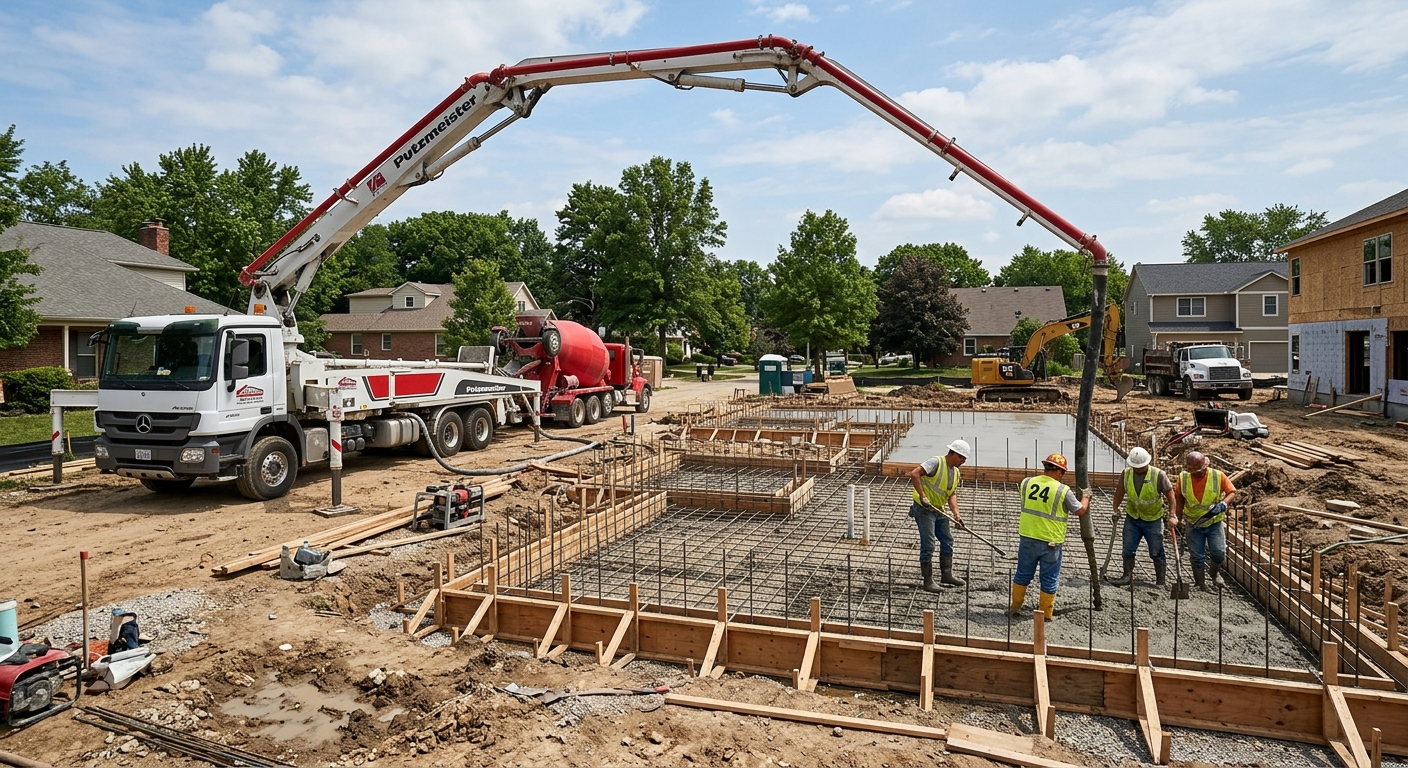
Concrete work options and costs in St. Paul
Concrete work is a major part of home improvement in St. Paul, Alberta—especially for homeowners with driveways, patios and walkways that need to survive deep frost and rapid freeze–thaw cycles. In a town with 5,863 people (Statistics Canada, 2021 Census), the housing mix matters: 71.6% of dwellings are single-detached homes, and about 68.3% of households own their homes (Statistics Canada, 2021 Census). That combination typically drives steady demand for exterior concrete flatwork, along with garage slabs and structural foundation work.
In the Wood Buffalo–Cold Lake region, concrete costs generally run higher than in milder parts of Alberta because contractors must build for frost heave resistance: footings are set well below the design frost depth, and exterior slabs typically use air-entrained mixes. The shorter warm season also means projects get squeezed into fewer workable weeks, so scheduling can be tight and contractors may need cold-weather measures (blankets, heaters, or accelerators) to protect the pour. You’ll see this reflected in typical quote ranges for driveways, patios and garage floors, and it’s one reason two quotes for “the same size slab” can still land far apart.
Local demand is especially noticeable around the core residential areas where lot servicing and re-grading are common, such as the downtown and church-adjacent neighborhoods, where older homes often need driveway and walkway replacements to improve drainage and safety. From there, the best way to compare options is to look at typical sizes, specs and finish choices side-by-side in the table below.
| Application |
Typical Size |
Key Spec |
Finish Option |
Price Range |
| Concrete driveway (standard broom finish) |
12 ft x 24 ft (288 sq ft) |
Air-entrained mix; compacted granular base; control joints |
Broom finish |
$4,900–$7,700 |
| Exposed aggregate driveway |
12 ft x 24 ft (288 sq ft) |
Air-entrained mix; base prep; tighter jointing |
Exposed aggregate |
$6,700–$10,200 |
| Stamped concrete driveway or patio |
10 ft x 20 ft (200 sq ft) |
Air-entrained mix; integral colour; reinforcement as required |
Stamped pattern |
$5,100–$7,000 |
| Plain concrete patio or walkway |
8 ft x 12 ft (96 sq ft) |
Air-entrained mix; compacted base; edge forms |
Float & broom/steel trowel |
$1,450–$2,400 |
| Garage floor (interior slab) |
22 ft x 24 ft (528 sq ft) |
Reinforcement typical (wire mesh or rebar); vapour barrier as needed |
Smooth/steel trowel or broom finish |
$8,200–$13,500 |
| Foundation footings (structural, below frost) |
Varies by plan (commonly per-linear-foot allowance) |
Excavation to frost depth; rebar; inspected placement |
Structural concrete with proper formwork |
$10,000–$18,000 |
Prices are estimates only and vary by project scope, site access and material selection.
What affects the price of concrete work in St. Paul
In St. Paul and across the Wood Buffalo–Cold Lake region, it’s common to see quote differences of 30–50% for what sounds like the “same” concrete job. The main drivers are deeper frost protection, more forming and reinforcement, and the logistics of scheduling in a shorter pour season. Contractors are also protecting brand-new concrete from freeze–thaw damage, so they specify air-entrained mixes for exterior slabs, tighter control joint patterns, and cold-weather curing precautions when temperatures drop.
Here’s how the climate translates into specs and dollars: exterior concrete needs to endure repeated thawing and freezing, which is why mix design usually includes air-entrainment and a minimum compressive strength spec. Frost line depth dictates how deep you excavate for footings and how tall forms need to be; in Alberta, frost can extend up to roughly 2.4 m, meaning more excavation and haul time than in milder areas. The short warm season also compresses the pour window—meaning a contractor may have to mobilize quicker, manage limited truck availability, and use heaters, insulating blankets, or accelerators to reach adequate curing conditions. Finally, de-icing salt can accelerate surface spalling if the concrete isn’t proportioned and sealed correctly; sealing is often the difference between a slab that looks good and one that chips off early.
Concrete examples that often move the price up or down in St. Paul: switching from a broom finish driveway to exposed aggregate typically adds finishing time and materials, while keeping a patio simple and rectangular usually reduces forming complexity (and can keep you closer to the $15–$25 per sq ft band for patios/walkways). If you’re replacing an older, poorly drained driveway, excavation and drainage corrections can push the project toward the higher end of the $18–$28 driveway band—yet that work is often what prevents recurring settlement and cracking around the first winter.
| Price Factor |
Why It Matters |
Cost Impact |
| Frost line depth — determines footing depth and form height |
Deeper frost protection requires more excavation, rebar, and concrete volume |
Higher material and labour; excavation can dominate foundation budgets |
| Site preparation — excavation, grading, compacted granular base |
Proper base reduces slab movement and cracking under freeze–thaw |
Unexpected removal/haul can add significant dollars |
| Reinforcement — rebar or wire mesh requirement |
Supports loads and limits cracking patterns |
Rebar jobs cost more than thin, lightly reinforced slabs |
| Mix design — air-entrainment and compressive strength spec |
Air bubbles help resist freeze–thaw deterioration |
Specialty mix may raise concrete supply cost and scheduling |
| Finish type — broom vs. stamped vs. exposed aggregate |
Finishes require extra labour, products, and finishing steps |
Stamped/exposed typically land at the high end of quote ranges |
| Pour size and concrete truck access to site |
Limited access increases labour for pumping/hand placing and risk |
Short access roads or tight turns can add mobilization charges |
| Cold-weather curing precautions — heating and blankets |
Maintains strength gain during short warm windows |
Heaters/blankets/accelerators can add a meaningful premium |
| Control joint pattern and sealing cost |
Manages cracking and reduces salt-driven surface damage |
More joints and sealing steps increase total line-item cost |
Permits & regulations in Alberta
In Alberta, structural concrete work generally needs a building permit, and in many cases engineered drawings reviewed through the municipal process. That means foundation components such as footings, foundation walls, and grade beams typically require approval before you pour. Concrete flatwork—like patios, walkways and most standard driveways—often does not require a permit by itself unless it changes grading in a way that impacts lot drainage, triggers impervious-surface or right-of-way concerns, or affects municipal requirements near sidewalks/approaches. Because rules can vary by site conditions, confirm with your local authority before excavation starts.
For homeowner due diligence in St. Paul, treat contractor verification like you would for any structural trade: ask for evidence, then check it. Start by requesting the contractor’s proof of Alberta business licensing (if applicable to their structure) and a Certificate of Liability Insurance showing the policy is current and adequate for your project. Next, verify their WSIB/WCB coverage—ask for the clearance letter or employer coverage document provided by their workers’ compensation provider. Finally, request references tied to the same scope (for example, a driveway replacement with air-entrained exterior concrete in cold conditions). A contractor who can’t provide clean documentation or won’t walk you through their site protection and curing plan is a red flag.
Quick rule of thumb: if the concrete supports the structure (footings/walls/grade beams), expect a permit and engineering involvement; if it’s mostly exterior flatwork with normal grading, it often doesn’t need a permit—unless drainage, lot grading, or right-of-way rules are affected.
Getting concrete right in St. Paul's freeze-thaw climate
Concrete failure in St. Paul usually comes down to three things: water movement through the slab/base, incorrect mix design for freeze–thaw, and curing that’s rushed by cold temperatures. In the Wood Buffalo–Cold Lake market, the base must be built correctly and the exterior mix must be air-entrained so the concrete can tolerate repeated freezing and thawing without scaling or spalling. For homeowners, “getting the spec right” means insisting on the right base depth and compaction, a verified air content target, correct control joint spacing, and proper curing and protection during cold weather pours.
Spec-wise, start with (1) base preparation: a compacted granular sub-base to the right depth for your subgrade and local frost considerations, with drainage that prevents standing water. (2) Mix design: for exterior flatwork, air-entrainment is typically in the 5–7% range, and contractors should meet at least a 32 MPa compressive strength specification (as minimums commonly used for durable exterior work). (3) Control joints: set them to limit random cracking—especially important where seasonal movement and moisture cycling are aggressive. (4) Curing: plan for a minimum 7 days of curing under appropriate conditions; if you pour near shoulder season temperatures, the contractor should add blankets/heating so strength gain isn’t compromised. (5) Sealing: penetrating sealer applied after the cure period—often around 28 days—helps repel de-icing salts and reduces surface breakdown.
Here’s a practical dollar example: a broom-finished driveway might land closer to the $18–$28 per sq ft band (for the overall project cost), but if you upgrade to an exposed aggregate finish you’re often paying for more finishing steps and product. The extra cost can be worth it if you also confirm the air-entrained mix, jointing, and sealing plan—because those choices are what protect the concrete through St. Paul winters, not just how it looks on day one.
| Spec |
Why It Matters in St. Paul |
What to Ask For |
Impact if Skipped |
| Compacted granular base (depth?) |
Limits frost-driven movement and reduces water pumping from beneath the slab |
Documented subgrade prep plan and granular base thickness/compaction method |
Settlement and cracking that reappears after the first winter cycle |
| Air-entrained concrete mix (target air %?) |
Provides freeze–thaw resistance in Alberta’s harsh winter conditions |
Confirm air content target (typically 5–7% for exterior flatwork) and mix design sheet |
Spalling/scaling and early surface deterioration from freeze–thaw |
| Compressive strength (MPa rating) |
Ensures the slab reaches durability performance, especially with cold-weather curing |
Minimum 32 MPa spec and curing/protection plan to achieve it |
Lower strength gain leads to faster wear, chipping, and joint failure |
| Control joints (spacing per ACI guidelines) |
Directs cracking to predictable lines as moisture and temperature move the slab |
Planned joint layout and spacing tailored to slab dimensions |
Random cracking and difficult, unsightly repairs |
| Minimum 7-day curing period |
Cold nights and freeze–thaw can interrupt strength development |
Curing method and how blankets/heaters will be handled if needed |
Weak concrete at the surface and reduced long-term durability |
| Penetrating sealer (when applied after cure) |
Helps resist de-icing salts and reduces water absorption |
Sealer type and application timing (commonly around 28 days post-pour) |
Higher risk of salt-related surface scaling and faster deterioration |
How to choose a concrete work contractor in St. Paul
Choosing the right concrete contractor in St. Paul is mostly about verification and clear scope—because in a frost-heavy region, small spec mistakes become big failures. Start by confirming Alberta coverage and documentation. Ask for (1) liability insurance and verify the certificate is current and the coverage limits are appropriate for your project, (2) workers’ compensation coverage (WSIB/WCB) and request the clearance letter or proof of employer account, and (3) a written contract/scope that matches the work you actually need (especially air-entrained exterior concrete, base preparation, reinforcement and curing measures).
Then get 2–3 itemised written quotes. Don’t accept a single “lump sum” without breakdowns. You want to see labour and materials lines that include excavation/grading, granular base, reinforcement, formwork, concrete supply, finishing, curing protection, and sealing (if requested). Read exclusions carefully: is disposal included? Is the permit included where required? Who handles hauling excess soil or unsuitable material?
Warranty matters too. Ask for the workmanship warranty length (often tied to cracking or surface defects under normal conditions), whether any product manufacturer warranty applies to coatings/sealers, and whether warranties are transferable if you sell the home. Finally, be cautious with payment schedules—never pay more than 10–15% upfront, and hold back a meaningful portion until punch-list items are complete. Get the start date and estimated completion window in writing, since weather can affect cure protection in Alberta.
- Confirm they specify air-entrained concrete for exterior flatwork.
- Ask what happens if temperatures drop mid-pour (blankets, heaters, accelerators).
- Request their plan for compacted granular base and drainage.
- Verify reinforcement assumptions (mesh vs rebar) for your slab thickness and use.
- Make sure control joint layout is included in the scope.
- Ask who supplies and places the concrete, and whether mix tickets are documented.
- Get details on curing method and the minimum curing period.
- Confirm whether penetrating sealer is included and when it will be applied.
- Check disposal/hauling is stated (over-excavation can add cost quickly).
- Request a clear timeline: start date, pour day, and curing/protection duration.
- Review warranty terms in writing—what’s covered, what’s excluded, and duration.
- Verify insurance and WSIB/WCB documents before signing.
Concrete red flags in St. Paul include: no written mix/design confirmation for freeze–thaw durability, vague curing plans (“we’ll be fine” without blankets/heating strategy), missing joint layout details, failure to document base compaction and drainage, and demanding large upfront payments without clear progress milestones.
Frequently asked questions — concrete work in St. Paul
Stamped vs broom-finish concrete — cost difference?
In St. Paul, stamped concrete costs more than broom-finished concrete because it requires extra materials (integral colour systems and release agents) and additional labour for stamping, texturing and finishing. For many driveways, broom-finish projects tend to sit closer to the $18–$28 driveway band, while stamped driveway or patio work usually moves toward the mid-to-upper ranges—often around $22–$35 for stamped & decorative concrete depending on size and pattern complexity. If you’re considering stamped concrete, make sure the contractor still meets the essentials for Wood Buffalo–Cold Lake conditions: air-entrained exterior mix, correct base prep, appropriate control joints and a realistic curing plan for the shorter pour season. That’s what protects the surface through Alberta winters, not just the finish.
When is the best time to pour concrete in St. Paul?
The best time in St. Paul is typically mid-to-late spring through summer, when daytime temperatures are reliably above freezing and nights are less likely to threaten curing. In the Wood Buffalo–Cold Lake region, the warm season is short, so contractors often have a compressed window and may need cold-weather measures if you’re near shoulder season. If you pour late, you should expect the contractor to plan for blankets, heaters, and/or accelerators to protect strength gain and reduce surface damage. The earlier you book, the more likely you are to avoid rush schedules and premium cold-weather services. For best results, ask for the exact pour date, temperature targets, and curing/protection steps in writing before you approve the schedule.
How long does concrete take to cure?
Concrete curing has two time concepts: initial setting and strength development. For homeowner planning in St. Paul, the key benchmark is that exterior concrete should receive at least 7 days of proper curing under appropriate conditions, especially where freeze–thaw cycles can stress young concrete. Even after the slab is “walkable,” the deeper durability performance continues to develop over time. For sealing, a common expectation is to apply penetrating sealer around 28 days post-pour (once the concrete has cured sufficiently), which is important because de-icing salts can accelerate surface spalling in winter. If temperatures dip during the early days, a good contractor will use protection measures to maintain curing conditions rather than relying on luck.
Do I need a permit for concrete work in Alberta?
In Alberta, structural concrete like footings, foundation walls, and grade beams typically requires a building permit and often engineered drawings reviewed through the municipal process. For concrete flatwork such as patios, walkways and many standard driveways, permits are commonly not required by default—unless the project affects lot grading, drainage, impervious surface rules, or municipal right-of-way requirements. In St. Paul, the safest approach is to confirm with the local authority before breaking ground, especially if you’re changing drainage patterns or modifying an approach area near the street. Regardless of permit needs, you should also verify the contractor carries current liability insurance and WSIB/WCB coverage and that their proposed work matches your lot conditions.
Concrete vs pavers for a patio in St. Paul?
Both concrete and pavers can work well in St. Paul, but they fail differently in freeze–thaw climates. A concrete patio built with air-entrained mix, a well-compacted base and proper control joints can be a durable, lower-maintenance option—especially for homeowners who want a uniform surface. Pavers can be attractive for design and easier spot repairs, but they still rely on proper base prep and jointing, and settlement can show up if drainage isn’t managed well. In cost terms, concrete patios typically fall around the $15–$25 band for plain work, while stamped/decorative options move higher. If your priority is predictability and a single monolithic surface, concrete is often the better fit—provided the contractor follows the right exterior specs for Alberta winters.
How long does a concrete driveway last?
A concrete driveway lifespan in St. Paul can be many years—often 15 to 30+—when it’s built with durable exterior specs for freeze–thaw: air-entrained concrete, compacted granular base, correct jointing and an appropriate curing/protection plan. The biggest threats are water management issues (poor drainage or weak base) and surface scaling from de-icing salt, which is why sealing matters in our region. You can also extend life by using sand rather than only salt when temperatures allow, and by addressing small cracks early rather than waiting for freeze-driven expansion. If your current driveway is showing spalling or repeated settlement, that can be a sign the base prep or mix design wasn’t built for Wood Buffalo–Cold Lake conditions. In those cases, budget for a proper replacement—often in the $18–$28 overall driveway band for standard work, with decorative options costing more.