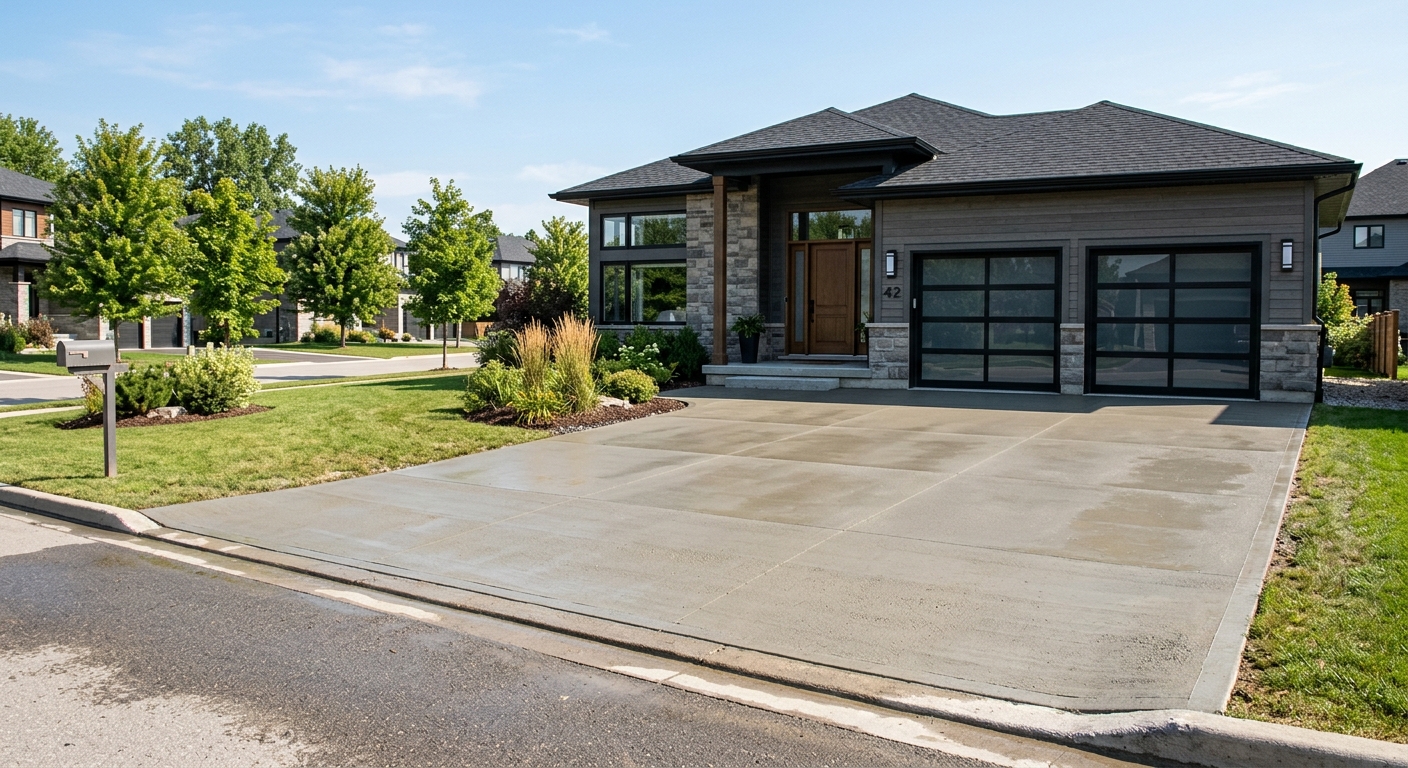
Concrete work options and costs in Sifton Park
Sifton Park, Alberta is a neighbourhood where homeowners expect concrete to look sharp and last through deep winters. With a total population of 2,289 residents (Statistics Canada, 2021 Census), demand is steady for driveways, patios, walkways, and foundation work—especially around the growing inventory of single-detached homes that typically require new flatwork and periodic repairs. In this Calgary region, concrete pricing is strongly shaped by the cold continental climate: frost penetration drives deeper footings, while frequent freeze–thaw cycles require air-entrained mixes, granular base prep, and careful control-joint spacing to manage cracking and surface scaling. The practical pour season for exterior slabs is shorter than in milder parts of Canada, so contractors often schedule ahead, and cold-weather protection (insulated blankets, heating, and winter-grade admixtures) can add cost if you’re pouring late in the year or early in spring.
In Sifton Park, trades are particularly busy on the east-side and around the newer infill areas where driveways and garages are often added after the main build is complete. If you’ve gotten two quotes for the same project, it’s common to see meaningful differences because depth, reinforcement, finish type, and cold-weather allowances vary from one proposal to the next. Use the ranges below as a realistic starting point before you request a fully itemised estimate.
| Application |
Typical Size |
Key Spec |
Finish Option |
Price Range |
| Concrete driveway (standard broom finish) |
18 ft x 20 ft (360 sq. ft.) |
Air-entrained mix, compacted granular base, control joints |
Broom finish |
$12,000–$18,000 |
| Exposed aggregate driveway |
18 ft x 20 ft (360 sq. ft.) |
Air-entrained mix, higher material and finishing time |
Exposed aggregate (washed/stamped-style texture not included unless specified) |
$15,000–$22,000 |
| Stamped concrete driveway or patio |
18 ft x 20 ft driveway (360 sq. ft.) or 12 ft x 20 ft patio (240 sq. ft.) |
Reinforced slab, air-entrained mix, colour hardener + release |
Stamped pattern + integral colour (or overlays, if specified) |
$15,000–$26,000 |
| Plain concrete patio or walkway |
12 ft x 20 ft (240 sq. ft.) |
Air-entrained mix, compacted base, light broom texture |
Broom finish or smooth-trowel lite (slip resistance varies) |
$5,000–$9,000 |
| Garage floor (interior slab) |
24 ft x 22 ft (528 sq. ft.) |
Interior slab spec, vapour considerations for some builds |
Plain trowel finish |
$8,500–$14,500 |
| Foundation footings (structural, below frost) |
Typical house/garage footing package varies by plan |
Engineered reinforcement, concrete placed below design frost depth |
Structural concrete (no decorative finish) |
$28,000–$45,000 |
Prices are estimates only and vary by project scope, site access and material selection.
What affects the price of concrete work in Sifton Park
In Sifton Park and the wider Calgary market, it’s not unusual for the same concrete scope to land 30–50% apart once you compare excavation, base prep, reinforcement, and finish details. Concrete isn’t just “pour and go” here—engineered specifications drive cost because Calgary sits in a cold continental climate with frequent freeze–thaw cycles. Practically, the design frost depth is about 1.2 m (roughly 4 ft), so footings and formwork often require more excavation than homeowners expect. Exterior slabs also need air-entrained concrete to survive repeated expansion and contraction, and cold-weather placement may require heated enclosures, insulated blankets, and winter-grade curing steps to reduce scaling and long-term deterioration.
Market availability also matters. When multiple crews are booked for late-season driveway and patio work, some contractors price higher due to scheduling constraints and the extra labour time needed to protect curing concrete. De-icing salt is another local reality: it can accelerate spalling if the slab mix, air content, and sealing plan aren’t right—so sealing and correct mix design aren’t “extras,” they’re risk controls.
Here are a few Sifton Park examples that typically move price up or down: (1) A driveway replacement that requires removing old asphalt and over-excavating for a thicker granular base tends to push you toward the higher end of the concrete driveway band of $12,000–$18,000. (2) If your patio is a small, straightforward rectangle on stable soil, plain concrete often fits the $5,000–$9,000 band; if it needs regrading, steps, or complex edges, cost rises quickly. (3) Foundations are most sensitive to excavation depth and engineered rebar spacing—expect foundation / footings to align with $28,000–$45,000 depending on footing geometry and accessibility.
| Price Factor |
Why It Matters |
Cost Impact |
| Frost line depth — determines footing depth and form height |
Footings must bear below design frost depth to avoid frost heave |
Higher excavation and more concrete = higher foundation pricing |
| Site preparation — excavation, grading, compacted granular base |
Correct base thickness and compaction prevent settlement and cracking |
Unclear grading or weak base can add hours of labour and material |
| Reinforcement — rebar or wire mesh requirement |
Controls cracking and improves load capacity for driveways and slabs |
May increase material cost and placement labour |
| Mix design — air-entrainment and compressive strength spec |
Freeze–thaw survival depends on air content and adequate strength |
“Standard” mixes may cost less but raise long-term repair risk |
| Finish type — broom vs. stamped vs. exposed aggregate |
Labour time and materials (colour hardeners, release agents) vary |
Stamped and exposed finishes typically cost more per sq. ft. |
| Pour size and concrete truck access to site |
Smaller pours or tight access can require more batches and handling |
Extra trucking trips, waiting time, and labour can increase cost |
| Cold-weather curing precautions — heating and blankets |
Proper curing reduces scaling and surface damage in Calgary’s shoulder seasons |
Can add a noticeable line item if the schedule lands in cold snaps |
| Control joint pattern and sealing cost |
Joints limit uncontrolled cracking; sealing helps protect against de-icing salt |
Sealing is an extra step but reduces spalling and early deterioration |
Permits & regulations in Alberta
In Alberta, many homeowners are surprised by how often permits are tied to structural scope rather than just “concrete is concrete.” Structural concrete work—such as footings, foundation walls, and grade beams—typically requires a building permit and often engineered drawings that the municipality reviews. For concrete flatwork (like driveways, patios, walkways), a permit is usually not required unless the work affects lot grading, impervious surface coverage, or the municipal right-of-way (for example, work that impacts boulevard drainage or access). Before you break ground in Sifton Park, confirm the requirements with the local authority based on your specific site conditions.
Contractor compliance is just as important as permits. Ask for proof of liability insurance and confirm they have appropriate WSIB/WCB coverage for their workers. Then verify licensing where applicable: in Alberta, check the contractor’s credentials through provincial registries and business listings that correspond to the trade. For a practical homeowner checklist, follow this sequence: (1) request the insurance certificate (and confirm dates), (2) request evidence of WSIB/WCB clearance or coverage letter, (3) ask for project references similar in size and complexity to your driveway or footing scope, (4) confirm permit responsibility in the written proposal (who pulls permits, who schedules inspections), and (5) get everything in writing before payment begins.
Getting concrete right in Sifton Park's freeze-thaw climate
Concrete failures in Sifton Park usually trace back to one of five problems: poor base preparation, inadequate frost protection, weak or incorrectly designed mix, missing/incorrect control joints, or rushed curing. In Calgary’s freeze–thaw climate, the biggest long-term risk for exterior slabs is spalling—surface flaking caused by water getting in and expanding when temperatures swing below freezing. The way you prevent that is through correct specification: (1) build a compacted granular base to the right depth for local soil conditions and engineered frost considerations; (2) use an air-entrained concrete mix—commonly 5–7% air content for exterior flatwork—to give freeze–thaw resistance; (3) install control joints at an appropriate spacing to force cracking in the right places; (4) cure properly—plan for at least 7 days under suitable conditions; and (5) seal after curing (typically around 28 days post-pour) so de-icing salts have less direct access to the surface.
If you’re comparing bids, be cautious of any proposal that under-specifies air content or suggests you can “pour anytime” without cold-weather curing precautions. The price difference between options is sometimes justified: for example, a stamped driveway can land in the $15,000–$26,000 band because the process requires additional materials and finishing time. But if a cheaper broom-finish quote ($12,000–$18,000) cuts corners on base compaction, air-entrainment, or joint layout, you may pay later through repairs and resealing.
The goal isn’t just to pour concrete—it’s to spec it so the slab survives Calgary’s winters year after year.
| Spec |
Why It Matters in Sifton Park |
What to Ask For |
Impact if Skipped |
| Compacted granular base (depth?) |
Prevents settlement and helps manage frost-related movement |
State target base depth and compaction standard (and soil assumptions) |
Cracking, uneven slab, and premature failure |
| Air-entrained concrete mix (target air %?) |
Freeze–thaw resistance depends on controlled air content |
Confirm air content target (commonly 5–7% for exterior flatwork) |
Higher risk of spalling and surface scaling |
| Compressive strength (MPa rating) |
Adequate strength reduces long-term surface and structural issues |
Minimum compressive strength (commonly 32 MPa for many flatwork specs) |
Weaker slab can wear faster and crack sooner |
| Control joints (spacing per ACI guidelines) |
Controls where shrinkage cracking occurs |
Ask for joint spacing and saw-cut timing plan |
Random cracking and water infiltration |
| Minimum 7-day curing period |
Proper hydration creates durable concrete |
How they’ll protect the slab during cold weather (blankets/heating if needed) |
Surface scaling and reduced long-term performance |
| Penetrating sealer (when applied after cure) |
Helps repel de-icing salt and moisture-driven damage |
Schedule: apply around 28 days after pour (after achieving cure) |
Faster deterioration from salt exposure |
How to choose a concrete work contractor in Sifton Park
Choosing the right contractor in Sifton Park is mostly about verifying three things: compliance, scope clarity, and construction quality control. Start with Alberta compliance. Ask for their liability insurance certificate (confirm the coverage is active for the project dates), and request evidence of WSIB/WCB coverage for their workers (a clearance letter or coverage confirmation). For licensing/qualification, verify the contractor’s credentials through the appropriate provincial registries and business listings that match their trade activities—then cross-check that their company name is consistent across the quote, insurance certificate, and invoice. If a contractor hesitates to provide documentation up front, treat that as a red flag.
Next, insist on 2–3 itemised written quotes rather than lump sums. You want labour and materials clearly separated (excavation and disposal, granular base, reinforcement, concrete mix spec, finishing, joints, and sealing). Carefully read what’s excluded: disposal of old materials, saw-cutting, base depth assumptions, permit handling (if applicable), and protection for curing time are common “gotchas.”
On warranty, ask for: workmanship warranty length, what product/manufacturer warranties apply (if any), and whether warranty is transferable if you sell your home. For payment, a good practice is never paying more than 10–15% upfront; use a holdback until completion and any stated curing/finish milestones are met. Finally, require a written timeline with a start date, estimated pour date (or pour window), and completion date.
- Request insurance certificate and WSIB/WCB proof before signing anything
- Confirm whether they include permit pulling for structural work (footings/foundation walls)
- Get a site access plan (truck access route, staging area, and spoil removal method)
- Insist on air-entrainment and minimum compressive strength in writing for exterior work
- Ask what granular base thickness they plan to excavate to and how it will be compacted
- Confirm reinforcement type (rebar spacing or mesh) where required
- Require a control joint plan (spacing and when joints will be cut)
- Ask how they handle cold-weather curing (blankets/heating) if temperatures drop
- Clarify whether sealing is included and the exact schedule (typically after full cure)
- Ensure disposal and site cleanup are itemised, not assumed
- Use payment milestones tied to completion and cure/finish requirements
- Verify the contractor provides references for similar-size projects in the Calgary area
Concrete red flags I commonly see in Sifton Park include: quotes that don’t specify air content or strength, “standard” mixes for exterior slabs, promises to pour through cold snaps without winter curing measures, vague base-depth assumptions, and payment schedules that ask for large deposits long before the first pour.
Frequently asked questions — concrete work in Sifton Park
Why does concrete crack in Sifton Park and how is it prevented?
Cracking in Sifton Park usually isn’t “because concrete is bad”—it’s because Calgary’s freeze–thaw cycles and shrinkage stress meet real-world conditions. The two most common causes are uncontrolled shrinkage (leading to random cracks) and water movement through hairline openings (which can worsen spalling after freeze–thaw). Prevention comes from proper base preparation, air-entrained exterior mixes, and a controlled joint plan. A contractor should specify compacted granular base depth, confirm the mix design (including air content), and include control joints at a practical spacing with timely saw-cutting. Sealing after cure also helps protect against de-icing salt attack. If you’re budgeting, remember that driveways often land around $12,000–$18,000, and the middle or high end typically reflects the right base, reinforcement, and joint execution rather than decorative extras.
Stamped vs broom-finish concrete — cost difference?
Stamped concrete costs more because the process needs additional materials and extra labour time: colour hardener or integral colouring, release agent, stamping mats, and more careful finishing. In the Calgary region, you should also expect the same cold-weather and durability requirements as broom-finish work—air-entrainment, correct curing, and proper jointing—because appearance doesn’t replace freeze–thaw protection. Broom-finish driveways usually align with $12,000–$18,000 for typical sizes, while stamped driveway or patio scopes are commonly in the $15,000–$26,000 band depending on area, pattern complexity, and whether colouring is integral or applied as a surface system. If a quote shows a big price gap, ask what’s included: colour type, reinforcement, base depth, joint pattern, and sealing schedule.
When is the best time to pour concrete in Sifton Park?
For Sifton Park homeowners, the best time is generally late spring through early fall, when temperatures are steadier and curing is less complicated. Calgary’s cold snaps can start quickly, and winter placement requires heating, insulated blankets, and strict curing controls to keep the slab hydrated and protected. Even if the contractor can pour, rushing curing increases the chance of scaling or reduced durability—especially for exterior slabs exposed to freeze–thaw and de-icing salts. If you’re planning a driveway, walkway, or patio, aim for a schedule window where the contractor can maintain proper curing conditions for at least 7 days. If your project timing falls into early spring or late fall, ask whether they’re using winter-grade measures and what their cold-weather protection plan includes. Foundation work has different scheduling constraints, but the same “cure properly” principle still applies.
How long does concrete take to cure?
Concrete curing is often misunderstood. In Alberta, you should plan for two timelines: initial curing to reach sufficient durability for finishing and construction activity, and full cure for maximum performance. A common standard target is at least a 7-day curing period under proper conditions before you assume the slab has gained meaningful strength. The concrete continues to develop strength beyond that, and many durability steps—especially sealing—are typically scheduled after full cure. For example, penetrating sealers are usually applied around 28 days post-pour so the surface is properly cured and ready to accept sealer for moisture and de-icing salt resistance. If your contractor pressures you to traffic the slab early or skip curing protections during cold weather, that’s when cracking and surface damage risks rise. Ask for their curing and protection plan in writing.
Do I need a permit for concrete work in Alberta?
In Alberta, permits depend on what the concrete work is supporting. Structural concrete like footings, foundation walls, and grade beams typically requires a building permit and often engineered drawings reviewed by the municipality. For concrete flatwork—such as driveways, patios, and walkways—a permit is usually not required unless your work affects lot grading, impervious surface limits, or the municipal right-of-way/drainage conditions. Before you start in Sifton Park, confirm the requirement with the local authority because sites vary (especially where grading and drainage tie into existing swales). Regardless of permit needs, verify the contractor’s liability insurance and WSIB/WCB coverage, and ask whether they will handle permit paperwork for structural scope. If you’re doing a driveway within the typical $12,000–$18,000 band, it’s often not a permit-triggering job unless drainage grading is impacted.
Concrete vs pavers for a patio in Sifton Park?
Concrete and pavers can both look great, but they behave differently in Calgary’s freeze–thaw climate. Concrete patios—especially with air-entrained mix, correct base prep, control joints, and proper curing—often provide a more uniform surface and simpler maintenance once cured and sealed. Concrete patio/walkway projects commonly fall in the $5,000–$9,000 range for typical sizes, depending on site prep and finish. Pavers can offer easier partial repairs if you ever need to replace a section, but they rely heavily on drainage and a well-constructed granular base; if the base shifts, you can get uneven settling over time. If you use de-icing salts, sealing and correct concrete spec matter for long-term durability. Ask each contractor to explain their base depth/compaction approach, drainage plan, and how they control cracking or movement—those details usually determine which option performs better in Sifton Park.