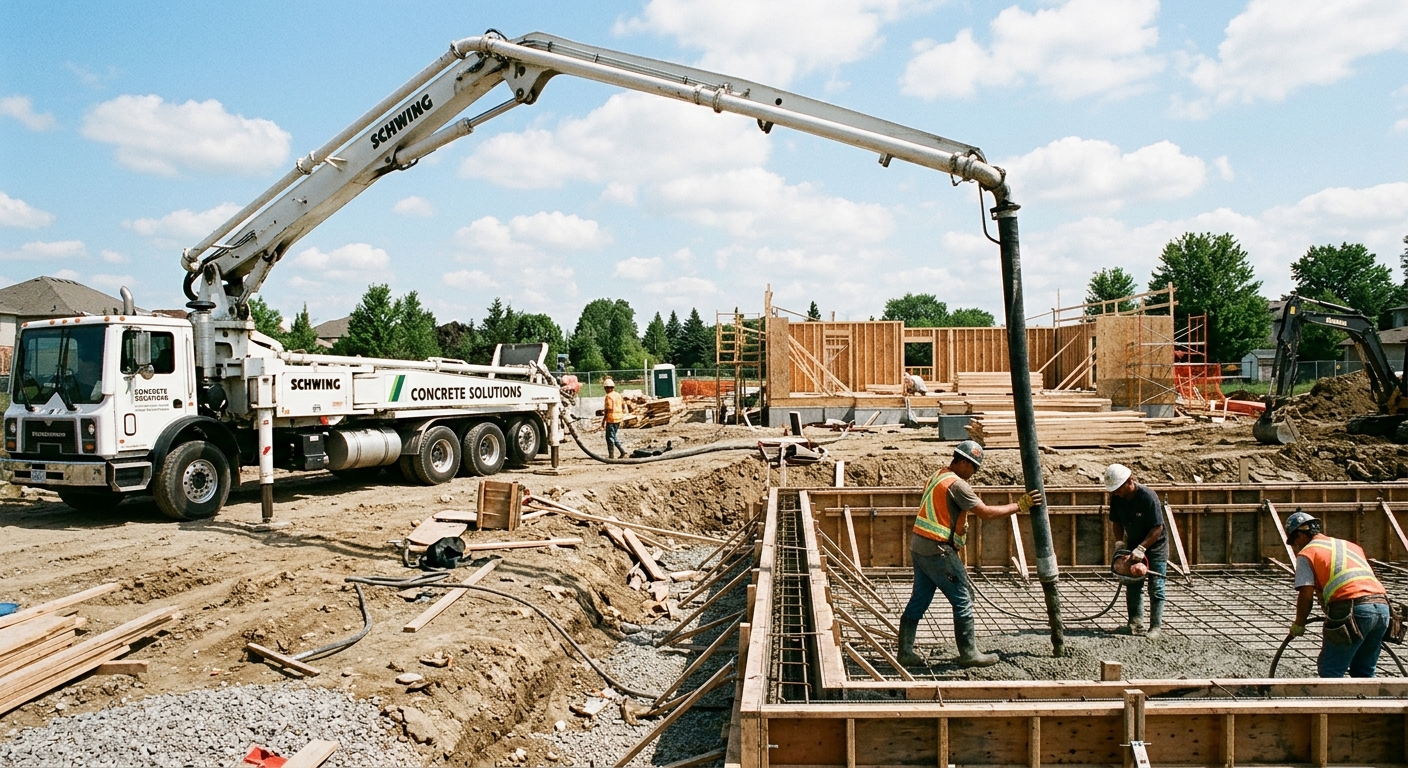
Concrete work options and costs in Hudson
Hudson, Alberta is a small community near Calgary, and that local scale matters when you’re budgeting for driveways, patios and walkways. In Hudson (2021), the population is 2,012 (Statistics Canada, 2021 Census), and the housing mix here is dominated by single-detached dwellings—exactly the type of property that typically needs concrete flatwork around the garage, along the front entry, and on backyard patios. Because Calgary’s labour market is tied to the broader region, demand spikes can tighten scheduling, but availability usually improves when local foundation and exterior crews cycle back in spring.
Pricing in this part of Alberta is also shaped by the cold continental climate. Our design frost depth is about 1.2 m (roughly 4 ft), so exterior projects can’t “cheat” on excavation and footing support—foundation costs rise when the engineer specifies deeper bearing or more robust reinforcement. For slabs like driveways and patios, Calgary’s frequent freeze–thaw cycles push contractors to use air-entrained concrete, granular base prep, and a control-joint pattern that limits cracking and spalling. The pour season is shorter, and cold-weather curing precautions (insulating blankets, sometimes temporary heat) can add labour and materials when you’re placing concrete in late fall or early spring.
In Hudson, we often see steady demand in the newer fringe areas where lots are being developed and homes are adding garages, walkways, and retaining steps to manage grade. With that in mind, the table below compares common options and typical ranges you’ll see in Calgary-area quotes for similar scopes.
| Application |
Typical Size |
Key Spec |
Finish Option |
Price Range |
| Concrete driveway (standard broom finish) |
20 ft x 10 ft (200 sq. ft.) |
Air-entrained exterior mix, compacted base, control joints |
Broom finish |
$12,000–$18,000 |
| Exposed aggregate driveway |
20 ft x 10 ft (200 sq. ft.) |
Air-entrained mix, retarder/wash process, sealed after cure |
Exposed aggregate |
$14,000–$20,500 |
| Stamped concrete driveway or patio |
18 ft x 12 ft (216 sq. ft.) |
Air-entrained mix, reinforced edges, pattern layout |
Stamped (texture + integral or stain colour) |
$15,000–$26,000 |
| Plain concrete patio or walkway |
12 ft x 12 ft (144 sq. ft.) |
Air-entrained exterior mix, compacted base, joints |
Float + light broom or trowel edge |
$5,000–$9,000 |
| Garage floor (interior slab) |
22 ft x 20 ft (440 sq. ft.) |
Vapour barrier, fibre or mesh, decent thickness for loading |
Plain finish (broom/steel trowel edges) |
$7,500–$14,000 |
| Foundation footings (structural, below frost) |
Typical house perimeter + piers |
Engineered spec, excavation to undisturbed soil below frost depth |
Structural concrete with rebar per design |
$28,000–$45,000 |
Prices are estimates only and vary by project scope, site access and material selection.
What affects the price of concrete work in Hudson
In Hudson, you’ll often see quotes for the “same” concrete work swing by 30–50% once excavation, reinforcement, mix requirements, and finishing labour are properly defined. The big driver is that Calgary-area concrete isn’t just poured—it’s engineered for freeze–thaw. Footings and structural elements must bear on undisturbed soil below the design frost depth (about 1.2 m here), and that means deeper excavation and larger concrete volumes than you’d see in milder climates. Even for driveways and patios, the mix spec changes: exterior slabs are typically air-entrained so they can tolerate repeated freezing and thawing without scaling and spalling. Those material and labour choices show up directly in contractor pricing.
Cold-weather placement also compresses the usable pour season. When temperatures drop, crews may need winter-grade mixes, insulated blankets, and controlled curing measures to protect the slab while it reaches adequate strength. That’s one reason a straightforward broom-finished driveway (often in the $12,000–$18,000 band) can climb toward the upper end if you’re scheduling around late fall conditions. Similarly, decorative work like stamped concrete (commonly $15,000–$26,000) costs more because it adds labour for pattern alignment, finishing steps, and colour application—then still has to meet the same exterior durability specs.
Two or three Hudson-specific examples I see often: (1) sites with harder digging or buried services require more excavation time and hauling; (2) sloped lots increase base preparation and may require thicker edges or more reinforcement; (3) older infill properties sometimes have poor drainage, so we’ll design better base grading to prevent water from pooling under the slab, which changes the scope before concrete gets placed. If you’re building new or refreshing a driveway on a developing lot—where grades and underground utilities are still being adjusted—budget time for prep, not just the pour.
| Price Factor |
Why It Matters |
Cost Impact |
| Frost line depth — determines footing depth and form height |
Footings must extend below the design frost depth to prevent heave and seasonal movement |
More excavation and concrete volume; higher labour for forms/placement |
| Site preparation — excavation, grading, compacted granular base |
Compacted base and proper grading reduce settlement and prevent water-related failure |
Hard dig/limited access can add hauling, equipment time, and truck count |
| Reinforcement — rebar or wire mesh requirement |
Controls cracking and improves load capacity for exterior slabs and foundations |
Material cost plus tying/chairs and extra labour to meet spec |
| Mix design — air-entrainment and compressive strength spec |
Freeze–thaw resistance depends on air content; strength supports durability |
Higher-performance mix and tighter placing/curing procedures |
| Finish type — broom vs. stamped vs. exposed aggregate |
Finish affects labour time and curing/handling requirements |
Decorative processes add steps; plain broom is faster and typically cheaper |
| Pour size and concrete truck access to site |
Smaller pours with limited access increase labour for distribution and placement |
Additional labour, smaller batches, and potential equipment/placement charges |
| Cold-weather curing precautions — heating and blankets |
Proper curing prevents scaling and surface/structural issues in cold snaps |
Heaters, blankets, monitoring time, and sometimes schedule changes |
| Control joint pattern and sealing cost |
Joints manage shrinkage cracking; sealing reduces chloride/ice exposure damage |
Saw-cut labour plus sealer material and application time after cure |
Permits & regulations in Alberta
In Alberta, structural concrete work—footings, foundation walls, and grade beams—typically requires a building permit and is often tied to engineered drawings that the municipality reviews as part of the overall foundation or structural package. For concrete flatwork (driveways, patios, walkways), permits are usually not required unless the work affects lot grading, impervious surface coverage limits, or intersects with municipal right-of-way concerns (for example, certain tie-ins or drainage changes). Because requirements can vary based on your lot and how the work impacts drainage and surfaces, confirm with the local authority before breaking ground.
No matter what, a good Hudson homeowner checklist starts with contractor compliance. Ask for a current certificate of insurance (liability) and proof of Workers’ Compensation coverage (WCB/WSIB). Then request references on similar-scale projects in the Calgary area and verify who pulls the permit (if required) and whether it’s included in the quote.
Step-by-step, here’s how to verify before signing:
- Licensing: look up the contractor in the Alberta registry/credential information available online (use the business name exactly as on the quote/contract).
- Certificate of insurance: request a COI showing liability limits and that it names you (where required by the contract).
- WCB coverage: ask for the clearance letter or proof showing the employer account is active.
- Cross-check the quote: ensure concrete removal/disposal, forms, and engineering/inspection needs (if structural) are clearly addressed.
- Confirm jobsite responsibility: who covers site protection, barricades, and traffic/drive access during construction.
Getting concrete right in Hudson's freeze-thaw climate
Concrete failures in Hudson most often come from the freeze–thaw cycle attacking a weak interface: water gets into the slab or base, freezes, and pushes outward—leading to scaling, spalling, and in worse cases settlement-related cracking. In this Calgary region, the design frost depth (about 1.2 m) means the sub-base and, for structural pours, the bearing depth must be engineered and constructed to reduce seasonal movement. For exterior slabs, the mix must be air-entrained so it can tolerate freeze–thaw without losing surface integrity. Next comes control joints: they’re not optional aesthetic details; they’re how you manage where cracks will form so they don’t become random and wide.
To spec the job correctly, focus on five things: (1) base preparation—compact granular sub-base to the required depth and ensure good drainage away from the slab; (2) mix design—typically 5–7% air content for exterior flatwork with minimum 32 MPa compressive strength; (3) control joints—placed to limit random cracking; (4) curing—minimum 7 days under proper conditions, and in cold weather, curing protection like insulating blankets or approved heat; (5) sealing—use a penetrating sealer after the slab cures (often around 28 days) so de-icing salts don’t accelerate breakdown.
Where price differences are justified: if you’re choosing between a basic broom-finished patio and a decorative stamped surface, the stamped option (often within the $15,000–$26,000 band for driveways/patios of typical sizes) costs more because it adds finishing steps and time. But the technical backbone should still be the same exterior durability specs. If a quote offers a “cheap” mix or skips air-entrainment and proper curing, you may save upfront and pay later in surface deterioration—especially in late winter with frequent thawing.
| Spec |
Why It Matters in Hudson |
What to Ask For |
Impact if Skipped |
| Compacted granular base (depth?) |
Proper base depth and compaction help prevent settlement and water infiltration |
Base depth for your slab type and soil, plus compaction method/testing if applicable |
Early cracking, uneven slab movement, and pooling water leading to freeze damage |
| Air-entrained concrete mix (target air %?) |
Freeze–thaw resistance depends on entrained air in exterior concrete |
Air content specification (commonly 5–7% for exterior flatwork) on the delivery ticket |
Surface scaling and spalling, especially in Hudson winters with salt and thaw cycles |
| Compressive strength (MPa rating) |
Strength supports the slab’s long-term durability under load and weather stress |
Minimum 32 MPa (or higher per engineer/design) stated in the quote |
Reduced structural performance and faster degradation under traffic and freeze action |
| Control joints (spacing per ACI guidelines) |
Joints control where shrinkage cracks occur so they stay narrow |
Joint spacing plan and saw-cut timing |
Random cracking across the slab and higher chance of water entering cracks |
| Minimum 7-day curing period |
Concrete needs time and suitable conditions to reach adequate strength before exposure |
How they cure in cold weather (blankets/heating if needed) and what temperature targets they follow |
Surface weakness, increased scaling risk, and long-term durability issues |
| Penetrating sealer (when applied after cure) |
Sealer reduces salt/chloride penetration and helps protect the surface |
Confirm timing (often after full cure, around 28 days) and which penetrating product is used |
Faster breakdown of the surface, more scaling in salted driveways |
How to choose a concrete work contractor in Hudson
Choosing the right concrete contractor in Hudson comes down to verification and clarity. Start with Alberta licensing/credentials relevant to the type of work, then confirm liability insurance and WCB/WCB coverage. To check liability, request a certificate of insurance (COI) with limits that match the project risk; for WCB, ask for a clearance letter or proof the account is active. Don’t accept a “we’re covered” statement—ask to see documents before work starts.
Next, get 2–3 itemised written quotes. Insist on a breakdown that separates labour, excavation/site prep, formwork, concrete supply, reinforcement, finishing, saw-cutting, and disposal/hauling. A lump-sum quote with no detail is where misunderstandings happen—especially on flood-prone or sloped sites where base thickness and drainage scope can change.
Read the scope for exclusions: Is permit handling included where required (for structural work), is disposal of old concrete included, and is any heat/blinds/curing protection for cold weather part of the plan? Also ask about warranty. A workmanship warranty should be in writing with a clear duration, and you should confirm whether it covers the specific issues you’re worried about (cracking, joint performance, surface scaling). Product/manufacturer warranty is separate.
For payment schedule, don’t pay more than 10–15% upfront. Use a holdback until the job is complete and you’ve had a chance to review finishing, joint layout, and cleanup. Finally, ask for a written start date and completion estimate—if they won’t commit, you can’t hold them to schedule.
- Ask for proof of liability insurance (COI) before any equipment arrives.
- Request WCB/WCB clearance (active coverage) for the companies doing the work.
- Verify contractor credentials in Alberta using the business name exactly as listed.
- Require the delivery tickets or mix spec for air-entrainment on exterior work.
- Get slab thickness and reinforcement details in writing (not “as needed”).
- Confirm base prep depth and compaction method.
- Check whether they include saw-cut timing and the joint spacing plan.
- Ask how they’ll protect curing in cold weather (blankets/heaters if necessary).
- Confirm sealing scope for driveways/patios (penetrating sealer timing after cure).
- Ensure old concrete removal and disposal are included if demolition is required.
- Clarify truck access/distribution plan if your driveway is narrow or sloped.
- Require a written schedule: start date, key milestones, and completion window.
Concrete red flags I see in Hudson-area projects: (1) no clear air-entrainment/mix spec for exterior slabs; (2) skipped or poorly planned control joints; (3) curing shortcuts in cool spells (no blankets/heating when needed); (4) vague quotes that lump demo, base prep, and finishing together; (5) reluctance to provide insurance/WCB paperwork and references on similar Calgary-scope jobs.
Frequently asked questions — concrete work in Hudson
What causes concrete to spall in Hudson winters?
In Hudson and across southern Alberta, spalling usually comes from freeze–thaw combined with water and salts. If a driveway or walkway uses the wrong mix (for example, not enough entrained air) or if the base isn’t properly compacted and graded to shed water, moisture can get into the surface and within micro-cracks. When temperatures drop, that trapped water freezes, expands, and flakes the surface—especially where de-icing salt is used. Another common contributor is rushing curing after a cold snap; concrete needs adequate time to build strength before it’s exposed. A properly built exterior slab should also include a good joint pattern and a penetrating sealer applied after cure (often around 28 days). In pricing terms, skipping these specs can undercut a typical exterior budget that might otherwise land in the $12,000–$18,000 driveway band.
What is rebar and when is it required in Alberta?
Rebar (reinforcing steel) is steel bars placed inside concrete to control cracking and add structural capacity. In Alberta, whether rebar is required depends on the concrete element and the design. Structural concrete like foundation walls, grade beams, and engineered footings typically requires reinforcement sized and located per engineered drawings. For flatwork, many contractors use wire mesh or fibre reinforcement to help control shrinkage cracking, and rebar can be required in higher-stress locations like thickened edges, heavy vehicle traffic areas, or where the engineer calls for it. Even when rebar isn’t mandated for a simple patio, reinforcement still matters for durability in Alberta’s freeze–thaw climate. The practical point for homeowners in Hudson: ask your contractor to state reinforcement type and spacing, and confirm it aligns with the project’s design (especially for anything structural).
How long does a concrete project take in Hudson?
Timelines in Hudson generally depend on access, excavation, curing conditions, and whether the work is decorative. For basic flatwork, the “active” construction day may be short, but the full readiness timeline isn’t just the pour day. Contractors usually need time for demo (if needed), excavation and compacted base prep, reinforcement placement, form setup, and finishing. After the pour, concrete needs at least 7 days of proper curing before you treat it like a finished surface for normal use, and weather can extend effective curing time. Cold weather can also limit when finishing and curing protection can safely be applied. Decorative stamped work takes longer for patterning and finishing—so it may feel like more than “just one extra day.” Budget-wise, if your scope is in the $5,000–$9,000 patio/walkway band, expect a faster turnaround than a foundation scope like $28,000–$45,000.
What is a concrete overlay and is it suited to Hudson?
A concrete overlay is a new concrete layer placed over an existing slab—often used to restore appearance or fix minor surface problems without full removal. In Hudson’s freeze–thaw climate, overlays can work when the original slab is still structurally sound, properly prepared, and the bond conditions are right. If the existing concrete is already failing (wide cracks, significant spalling, or drainage problems causing water to collect), an overlay may hide symptoms temporarily while the underlying movement continues. Overlay success depends on thorough surface prep (profiling, cleaning), correct materials, and ensuring that water can’t keep intruding beneath the new layer. Also consider de-icing salt exposure; the overlay should be designed for exterior conditions and sealed appropriately. If you’re seeing active surface deterioration in your current slab, a full replacement is often more durable long-term than relying on overlay thickness.
How do I seal concrete to protect it in Hudson?
For driveways and patios in Hudson, sealing is mainly about reducing chloride and salt penetration and slowing surface breakdown. The usual approach is a penetrating sealer applied after the concrete has cured—commonly around 28 days—so you’re not trapping moisture. Before sealing, the surface should be cleaned of dust and any contaminants, and joints should be in place and properly finished. Choose a product intended for exterior concrete and de-icer exposure, and follow application conditions (temperature and surface dryness). Sealing is especially important when you’re dealing with frequent freeze–thaw cycles and salted meltwater, which is when scaling and spalling can show up. If you’re budgeting, sealing may be an add-on or included in the final-stage scope; it’s often justified to protect a driveway in the $12,000–$18,000 range from early deterioration.
What is the difference between concrete and cement?
Concrete and cement are related but not the same. Cement is one ingredient—typically Portland cement—that acts as the binder. Concrete is the full manufactured material: cement plus aggregates (sand and gravel or crushed stone), water, and sometimes admixtures like air-entrainers for exterior durability. In Hudson and across Alberta’s cold winters, the concrete mix design is what matters for performance. Contractors specify air content and strength (for example, exterior flatwork typically targets air-entrainment and minimum compressive strength) and add admixtures to manage curing and freeze–thaw resistance. So when you compare quotes, don’t just look at “cement cost”—ask for the delivered concrete mix specification and how it achieves air-entrainment and strength for your specific application (driveway, patio, walkway, or structural footings). That’s the difference between buying ingredients and getting a slab engineered for Alberta conditions.