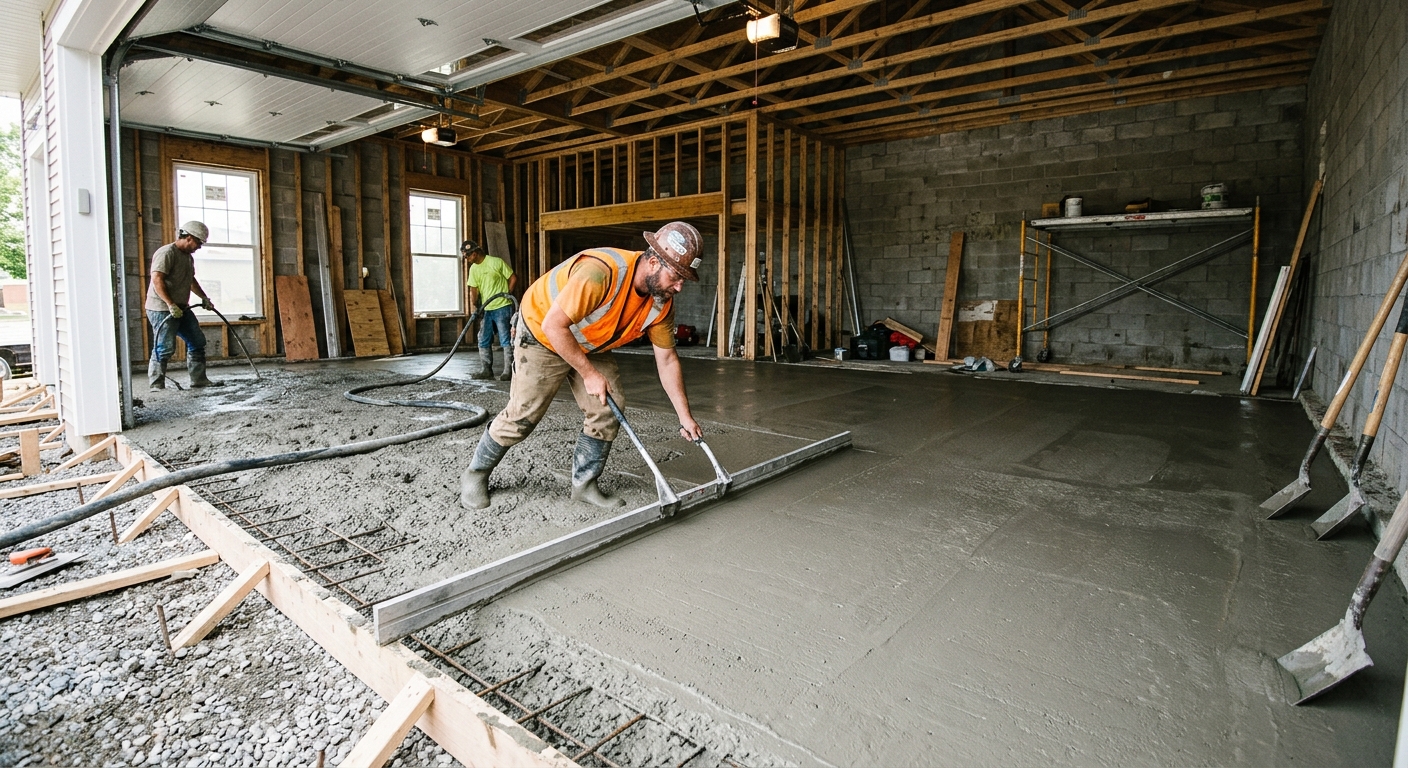
Concrete work options and costs in Patricia Heights
In Patricia Heights, Alberta, homeowners typically choose concrete for driveways, patios and walkways because it holds up well against winter traffic and Calgary-area freeze–thaw cycles. With a population of 1,749 (Statistics Canada, 2021 Census), the neighbourhood market is tight, so dependable crews who schedule exterior pours early tend to be in demand—especially where single-detached homes dominate lot-level flatwork needs. In the Calgary economic region, that demand is paired with a colder continental climate, where engineering is designed around a deep design frost depth (roughly 1.2 m) to help prevent frost heave. Practically, that means more excavation, more granular base prep, and deeper footings for foundations and some retaining-style elements—costs that can be higher than in milder provinces.
Local crews also plan around frequent freeze–thaw cycles. Exterior slabs typically use air-entrained concrete and tighter control-joint planning to reduce surface cracking and spalling. Pour-season timing matters too: placing concrete too late in the fall or early in spring can force contractors to use winter-grade mixes, insulated curing blankets and sometimes temporary heat to hit proper curing targets. If your project is near heavy-use routes or requires detailed traffic control, labour and equipment time increase as well.
Because of those realities, quotes in Patricia Heights can vary by finish and structural requirements—from a broom-finished driveway to a decorative stamped pour. Below is a practical comparison of the most common options and the budget range many local homeowners plan for.
| Application |
Typical Size |
Key Spec |
Finish Option |
Price Range |
| Concrete driveway (standard broom finish) |
24 m² (about 12 ft x 20 ft) |
Air-entrained for exterior, compacted granular base, control joints |
Broom finish + saw-cut joints |
$12,000–$18,000 |
| Exposed aggregate driveway |
24 m² (about 12 ft x 20 ft) |
Air-entrained exterior mix, base prep engineered for frost |
Exposed aggregate (surface retarder) |
$15,000–$22,000 |
| Stamped concrete driveway or patio |
30 m² (about 320 ft²) |
Air-entrained, integral colour (or densifier), joint pattern planned |
Stamped pattern + sealed finish |
$15,000–$26,000 |
| Plain concrete patio or walkway |
18 m² (about 200 ft²) |
Exterior mix, proper base thickness and drainage |
Broom or light trowel + control joints |
$5,000–$9,000 |
| Garage floor (interior slab) |
24 m² (about 12 ft x 20 ft) |
Vapour barrier (if required), fibre or mesh, cured properly |
Float finish + hardener or light broom |
$11,000–$16,000 |
| Foundation footings (structural, below frost) |
Per project (typical 1–2 storey home) |
Engineered rebar cage, concrete mix spec, excavation below design frost |
Structural (utility and formwork-driven) |
$28,000–$45,000 |
Prices are estimates only and vary by project scope, site access and material selection.
What affects the price of concrete work in Patricia Heights
In Patricia Heights, Alberta, two quotes for what looks like the same concrete job can differ by 30–50% because Calgary-area concrete pricing is driven less by “concrete volume” and more by engineering choices, site conditions and how winter placement is managed. The design frost depth used in the region (about 1.2 m) is deeper than in many warmer markets, so excavation and footing/form height go up. Meanwhile, freeze–thaw cycles are frequent, so exterior pours typically need air-entrained mixes and a deliberate control-joint layout to reduce cracking and spalling. If a contractor can’t get proper curing conditions—especially in cold snaps—the labour cost can effectively rise because the job may need rework or additional protection measures.
Local conditions also influence base preparation. In frost-prone areas, granular base thickness and compaction are not optional; they’re what protect the slab from seasonal movement. De-icing salt can accelerate surface wear and spalling if the mix air content and finishing/sealing are not done correctly—so homeowners sometimes need to budget for penetrating sealer as part of long-term durability. As a planning baseline, many driveway budgets in the region land in the $12,000–$18,000 band for standard broom-finished work. If you upgrade to stamped or decorative finishes, the cost commonly shifts toward the $15,000–$26,000 band because of labour-intensive patterning, colour work and sealing.
Two practical Patricia Heights examples: a driveway with limited truck access (narrow gate, soft landscaping, or overhead lines) often increases labour and equipment time; and a patio on a slope or with poor drainage typically requires extra grading and thicker base, which can push the job toward the upper end of the $5,000–$9,000 patio/walkway band. On foundation work, the deeper frost-driven excavation and formwork can add significant dollars—especially where underpinning or complex utility coordination is required.
| Price Factor |
Why It Matters |
Cost Impact |
| Frost line depth — determines footing depth and form height |
Footings must bear on undisturbed soil below design frost to prevent heave |
Higher excavation and concrete volume; often the biggest driver on foundations |
| Site preparation — excavation, grading, compacted granular base |
Proper sub-base prevents settlement and reduces cracking |
Additional truckloads, labour and compaction testing can add significant cost |
| Reinforcement — rebar or wire mesh requirement |
Controls cracking and supports structural durability |
Material + tying/placing time; cost rises when engineered rebar cages are specified |
| Mix design — air-entrainment and compressive strength spec |
Air entrainment helps resist freeze–thaw; strength spec protects structural capacity |
Higher-quality mix and tighter batching/placement oversight increase costs |
| Finish type — broom vs. stamped vs. exposed aggregate |
Complex finishes require more labour steps and careful timing |
Stamped/exposed options can add thousands versus standard broom finishes |
| Pour size and concrete truck access to site |
Access affects how quickly crews can place and finish before set |
Long pump runs or multiple mobilizations raise labour and equipment time |
| Cold-weather curing precautions — heating and blankets |
Protects early-age strength development during temperature swings |
Winter-grade materials and insulation/temporary heat add cost, especially late season |
| Control joint pattern and sealing cost |
Joints manage cracking; sealing reduces salt-driven surface damage |
More saw-cut lines and sealer application add line-item expense |
Permits & regulations in Alberta
In Alberta, structural concrete work typically needs municipal review. For Patricia Heights, anything involving foundations and engineered structural elements—such as footing excavation and pour, foundation walls, and grade beams—usually requires a building permit, and engineered drawings are often needed before construction proceeds. Concrete flatwork like patios, walkways and driveways often does not require a permit by itself, but it can trigger requirements if it affects lot grading, changes surface drainage, or impacts impervious surface coverage limits. The safest approach is to confirm with your local authority before breaking ground, especially if you’re tying into a foundation, changing runoff patterns, or working in or near a municipal right-of-way.
Before you hire a contractor in Patricia Heights, verify these basics step-by-step:
- Alberta licence/registration (as applicable): Ask for their business credentials and confirm the status through the appropriate online registry, using the company legal name you plan to contract.
- Liability insurance: Request a current Certificate of Insurance showing limits that match their work scope and that lists you (or your project address) where required.
- WSIB/WCB coverage: Ask for proof of coverage (or clearance), and confirm it’s active for the period the crew will be on site.
- References: Request recent photos and references for similar scale projects in the Calgary area, ideally exterior work that survived winter weather.
- Permit responsibilities: In writing, clarify whether the contractor pulls any permits if needed and who pays.
If the contractor can’t provide proof of insurance/coverage or won’t clearly explain what requires a permit for your specific job, that’s a red flag in any Alberta community.
Getting concrete right in Patricia Heights's freeze-thaw climate
Concrete failures in Patricia Heights usually come from a predictable set of problems: insufficient base preparation, the wrong mix for freeze–thaw, poor joint detailing, and rushed curing. In our Calgary-region winter conditions, the freeze–thaw cycle can pump moisture in and out of the slab surface. If the concrete isn’t air-entrained for exterior exposure, water expands during freezing and can drive spalling and scaling, even when the slab “looks fine” at first. The design frost depth around this area (roughly 1.2 m) also means footings and some slab-on-grade conditions must be built on properly prepared soil and granular layers to avoid seasonal movement.
To spec the job correctly, focus on five areas. (1) Base prep: specify compacted granular sub-base to the engineered depth for your soil and frost conditions. (2) Mix design: request air-entrainment and a minimum compressive strength commonly used for exterior flatwork (often at least 32 MPa). (3) Control joints: ask for a joint layout that limits random cracking; joints must be placed and timed to control where shrinkage cracks form. (4) Curing: insist on proper protection so the slab achieves early strength—minimum 7 days in typical practice, with added precautions in cold weather. (5) Sealing: for de-icing salt protection, plan for penetrating sealer applied after cure (often around 28 days) to help repel moisture.
Budget reality check: upgrading from a plain patio/walkway into a stamped finish may add cost, commonly shifting toward the decorative band of $15,000–$26,000 for driveway/patio-scale stamped work. That difference is justified when the goal is long-term curb appeal plus correct joint/sealer detailing—but it’s not justified if the base and curing are treated casually. In Patricia Heights winters, a properly built standard broom slab with sealing often outlasts a rushed “fancy” pour.
| Spec |
Why It Matters in Patricia Heights |
What to Ask For |
Impact if Skipped |
| Compacted granular base (depth?) |
Reduces settlement and limits frost-driven movement |
Engineered granular thickness and proof of compaction testing/verification |
Cracking, uneven slab, and accelerated surface damage after freeze–thaw |
| Air-entrained concrete mix (target air %?) |
Helps manage freezing expansion cycles |
Exterior air-entrainment target (typically 5–7% air for exterior flatwork) and mix ticket confirmation |
High risk of spalling/scaling in winter, especially with salt |
| Compressive strength (MPa rating) |
Ensures durability and load capacity for traffic and temperature cycles |
Minimum 32 MPa (or as engineered) and documented batch/manufacturer mix design |
Surface wear, premature scaling, and reduced long-term performance |
| Control joints (spacing per ACI guidelines) |
Directs shrinkage cracking and reduces random cracking |
Joint spacing and timing plan, including saw-cut schedule after initial set |
Random cracking, wider cracks, water intrusion and faster deterioration |
| Minimum 7-day curing period |
Early-age strength development supports freeze resistance |
Curing method and protection during cold snaps (blankets/heating if needed) |
Weaker surface, cracking and scaling risk increases |
| Penetrating sealer (when applied after cure) |
Improves resistance to moisture and salt exposure |
Confirm application after cure (often 28 days) and surface readiness |
Salt-driven surface deterioration and faster spalling |
How to choose a concrete work contractor in Patricia Heights
Choosing a contractor in Patricia Heights is mainly about proof: proof they understand Calgary-area freeze–thaw engineering, proof they’re properly insured for Alberta work, and proof they price your project transparently. Start by verifying Alberta licensing/registration (as applicable), then request their liability insurance and proof of WSIB/WCB coverage. How to check: look at the Certificate of Insurance for the policy period and limits, and ask for current clearance/proof for workers’ coverage so you know the crew is compliant before they arrive.
Next, get 2–3 itemised written quotes instead of one lump-sum. Ask for a breakdown separating labour and materials (concrete supply, base material, reinforcement, finishing labour, saw-cutting, disposal, and sealing if included). Carefully read what’s excluded: removed sod, trucking/hauling, sub-drainage tie-ins, permit fees, and finishing touch-ups. On the permit front, for structural work (footings and foundations) confirm who pulls permits and who is responsible if engineering review is required. For flatwork, clarify whether grade/drainage modifications trigger additional review.
Warranty matters in Alberta because winter damage can show up later. Ask for a workmanship warranty length, whether it covers labour for repairs, and whether any manufacturer product warranty is transferable. For payment, a healthy schedule is typically no more than 10–15% upfront; hold back the final portion until forms, cleanup and finishing/sealing are completed to spec. Finally, insist on a start date and completion estimate in writing—cold-weather curing protection can shift timelines, but good contractors plan for that.
- Provide proof of insurance and WSIB/WCB coverage before signing.
- Use itemised quotes with base prep, reinforcement, and finishing line items.
- Explain how they will meet air-entrainment and curing requirements in winter.
- Show past projects in Calgary with freeze–thaw exposure (driveways/patios).
- Confirm whether disposal and site clean-up are included.
- Clarify concrete truck access, staging, and any pump requirements.
- Confirm joint spacing and whether saw-cut timing is planned.
- Ask who supplies and installs reinforcement (mesh/rebar) and why.
- Ask for curing method details (blankets/heating if cold).
- Confirm sealing is included or priced separately (and when it’s applied).
- Request their warranty terms in plain language (what’s covered/for how long).
- Verify the schedule accounts for minimum curing time, not just the pour day.
Concrete red flags in Patricia Heights include: promising “instant cure” timelines without curing protection, skipping granular base thickness or compaction proof, offering low-cost decorative work that can’t explain mix air content, leaving out control joints or sealing plans, and demanding large upfront payments (more than about 10–15%) without a defined scope and schedule.
Frequently asked questions — concrete work in Patricia Heights
What causes concrete to spall in Patricia Heights winters?
In Patricia Heights and across the Calgary region, spalling is usually driven by moisture entering the slab and freeze–thaw expanding within the concrete. If the exterior mix doesn’t have the right air entrainment (and there isn’t enough spacing to manage surface stress), the freeze cycle can pop off the surface layer over time. De-icing salt accelerates the process by driving moisture and salts into micro-cracks, which then expand. Poor base prep can also cause slight slab movement; even small movement can widen cracks and let water in. The good news is that contractors can prevent most spalling by using an exterior-rated mix, building the base to the frost conditions, installing control joints properly, and sealing after cure (often around 28 days). For reference, homeowners budgeting standard driveway work often start in the $12,000–$18,000 band where base and exterior mix specs are typically included—skipping those specs is where spalling risk rises.
What is rebar and when is it required in Alberta?
Rebar is steel reinforcement bars placed inside concrete to help control cracking and carry tension loads. In Alberta, whether rebar is “required” depends on the design and loading: engineered foundation elements (footings, foundation walls, grade beams) are commonly reinforced based on structural drawings. For slabs and flatwork, some projects use wire mesh or fibre reinforcement, while others require rebar, especially for heavier loads (like thicker garage floors) or where the engineer/contract spec calls for it. The key is that reinforcement isn’t a one-size-fits-all decision; it’s tied to slab thickness, soil conditions, and the structural requirements. If you’re building new or doing structural work in Patricia Heights, ask to see the engineered drawings or the reinforcement specification. A reputable contractor will explain why they’re using rebar/mesh, not just whether they’re using it.
How long does a concrete project take in Patricia Heights?
The timeline in Patricia Heights usually has two parts: the construction day(s) and the curing/protection window. A standard exterior flatwork pour (like a broom-finished driveway) can often be completed in a single main day—excavation and forming are separate from the pour. However, preparation (demo, base grading, compacting granular base, setting forms and reinforcement) can add days depending on site access. After the pour, crews need proper curing conditions; in Calgary-area winter conditions, curing can require additional insulation blankets or heating. That’s why exterior work often can’t be treated like “pour and go.” As a benchmark, homeowners often see patios/sidewalk-type work finish faster than driveways because the forms and base prep are smaller, but the cure time is still essential. If your contractor is pushing for early traffic on the slab without meeting curing and cold-weather precautions, that’s a quality concern in Alberta.
What is a concrete overlay and is it suited to Patricia Heights?
A concrete overlay is a new concrete layer poured over an existing slab, typically after surface preparation and repair of underlying issues. In Patricia Heights, overlays can be suited when the existing slab is structurally sound (not extensively cracked, heaving, or failing due to moisture intrusion). The challenge is that freeze–thaw cycles can keep exposing weak spots if the original drainage/base is wrong; an overlay may hide the surface problems temporarily while the root cause continues. A proper assessment is critical: the contractor should inspect cracking pattern, settlement, drainage slope and delamination risk. If the base is stable and the slab is prepared correctly, overlays can extend service life—often cheaper and faster than full removal. If the existing slab has major movement tied to frost and poor base support, a full replacement typically performs better long-term, even if the upfront cost is higher. Always ask what mix and bond/prep method they use, and whether sealing is included.
How do I seal concrete to protect it in Patricia Heights?
Sealing in Patricia Heights is mainly about moisture and salt protection. First, don’t seal too early: you generally want the concrete to cure fully before applying a penetrating sealer—commonly around 28 days for exterior work. The surface must be clean and dry enough for the sealer to penetrate; otherwise, you risk poor adhesion. A contractor should explain the exact product type (penetrating vs film-forming), the application conditions (temperature and wind), and the coverage rate. After sealing, your slab is better able to repel de-icing salts and limit moisture movement, which helps reduce the cycle that causes spalling. Sealing is especially important for driveways and patios exposed to Alberta winter traffic and salting. If you’re comparing quotes, ask whether sealing is included or priced separately—decorative stamped work often includes sealing as part of the finish plan, and that can influence the overall budget within the $15,000–$26,000 range for stamped driveway/patio-scale projects.
What is the difference between concrete and cement?
In everyday conversation, many people say “cement” and mean “concrete,” but they’re not the same. Cement is one ingredient—a binding powder—used to make concrete. Concrete is the full engineered mixture: cement plus water plus aggregates (sand and gravel, sometimes crushed stone), and in exterior work often air-entrainment admixtures to improve freeze–thaw durability. In Alberta’s cold climate, that mix design is what protects performance: the air content, strength target and finishing timing matter more than the word people use. A contractor may talk about “cement” when discussing batching, but the real performance comes from the concrete specification (for example, air-entrained exterior concrete and typical exterior strength targets). When you request a quote in Patricia Heights, ask for the exterior mix requirements and how they’ll handle curing in cold weather—those answers reflect whether the job will stand up to winter, not whether someone used the “right brand of cement.”