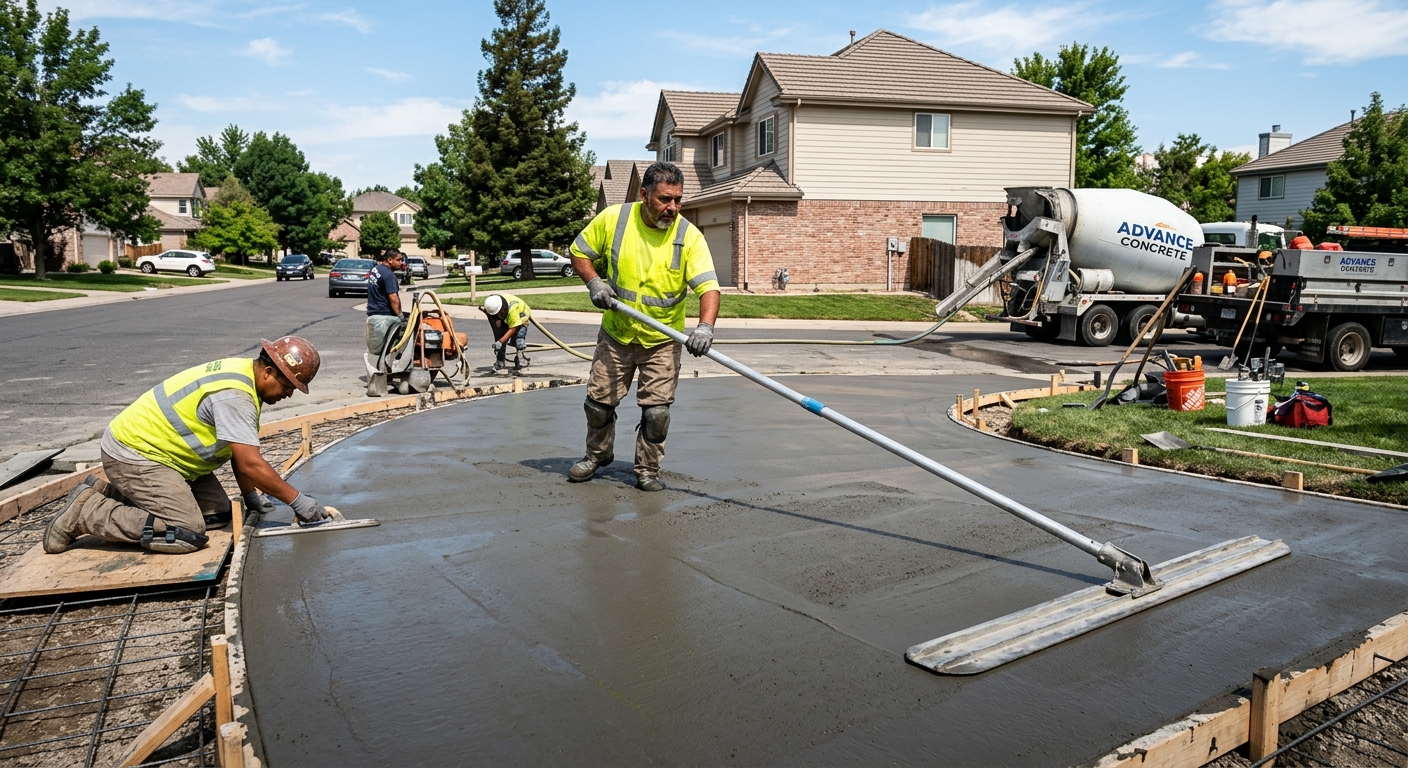
Concrete work options and costs in Parkhill
Parkhill, Alberta is a small community (population 1,770 according to the Statistics Canada, 2021 Census), and it shows in the concrete market: you’ll often see the same crews booked for multiple neighbours’ flatwork in the same pour window. Most concrete projects here support the typical residential pattern—Parkhill is dominated by single-detached homes, which drives steady demand for driveways, patios, walkways, and garage slabs.
In the Calgary economic region, cost and scheduling are strongly shaped by the cold continental climate. Concrete has to be engineered around frost and freeze–thaw, with excavation and footing depth designed to bear below the design frost depth (about 1.2 m, roughly 4 ft). For exterior slabs, contractors generally use air-entrained mixes and plan control joints carefully to reduce cracking and surface scaling. The local pour season is also shorter in late fall and early spring, so cold-weather placement may require insulating blankets or temporary heat to protect curing—this adds labour and equipment costs.
Concrete work is especially in demand around residential pockets like the established areas near Parkhill’s main built-up neighbourhood core, where homeowners often refresh aging driveways and front steps before winter arrives. Because foundation and exterior flatwork are both “frost-driven,” you’ll see more consistent pricing per square foot for standard work, but wider variation when site access, excavation depth, or decorative finishes change the spec.
Below is a practical comparison table you can use to benchmark contractor quotes before you ask for an itemised breakdown.
| Application |
Typical Size |
Key Spec |
Finish Option |
Price Range |
| Concrete driveway (standard broom finish) |
600 sq. ft. |
Air-entrained, 4 in. slab, control joints, granular base |
Broom finish |
$12,000–$18,000 |
| Exposed aggregate driveway |
600 sq. ft. |
Air-entrained, mid-depth aggregate mix, improved curing |
Exposed aggregate (wash) |
$15,000–$23,000 |
| Stamped concrete driveway or patio |
300–450 sq. ft. |
Air-entrained, integral colour, hardener, sealer |
Stamped pattern |
$15,000–$26,000 |
| Plain concrete patio or walkway |
200–300 sq. ft. |
4 in. slab (typical), proper drainage, control joints |
Broom/float finish |
$5,000–$9,000 |
| Garage floor (interior slab) |
400–600 sq. ft. |
6 mil vapour barrier (typical), mesh or rebar as required, 4 in. slab |
Broom or trowel finish (varies) |
$10,000–$16,000 |
| Foundation footings (structural, below frost) |
Typical house/garage footing system |
Engineered section, excavation to design frost depth, rebar, waterproofing details as specified |
Structural concrete (no decorative finish) |
$28,000–$45,000 |
Prices are estimates only and vary by project scope, site access and material selection.
What affects the price of concrete work in Parkhill
Even when two contractors quote what sounds like the “same” job in Parkhill, prices can vary by 30–50% across the Calgary region and Alberta because concrete is engineered around site conditions. The big drivers are the frost line depth, freeze–thaw exposure, and how much preparation the contractor has to do before the first truck shows up. In this region, local engineering practice assumes a design frost depth of about 1.2 m (roughly 4 ft), which means deeper excavation and higher footing volumes than many homeowners expect from online examples. For exterior slabs—driveways, patios and walkways—air-entrained mixes are not optional in practice; they help concrete survive repeated freeze–thaw cycles without scaling and spalling.
Cold-weather placement also compresses the effective pour season. When temperatures drop, crews may need winter-grade admixtures, insulated blankets, and sometimes temporary heat to achieve proper curing. That curing window is critical: rushing it (especially in late fall or early spring) increases long-term surface damage risk, so reputable contractors build that protection into the price.
De-icing salts are another real cost factor. If a contractor skips or reduces sealing and doesn’t plan for snow/ice maintenance, you may see earlier deterioration on broom-finished driveways. You’ll also notice cost swings depending on finish choice: a standard broom driveway tends to land in the $12,000–$18,000 range, while stamped work is frequently priced higher within $15,000–$26,000 because of colour/hardener, mats, and labour time.
In Parkhill, two common examples that push costs up or down are the amount of granular base needed (clay soils often require more correction and compaction) and truck access (narrow approaches mean more handwork). If a homeowner’s project involves older foundations—common in the area—site constraints can also increase excavation time and disposal costs, which adds dollars quickly to both footing and exterior slab scopes.
| Price Factor |
Why It Matters |
Cost Impact |
| Frost line depth |
Determines footing depth and form height |
Deeper excavation/formwork can add thousands to foundation-related scopes |
| Site preparation |
Excavation, grading, compacted granular base |
Soft subgrade or poor drainage correction increases labour, haul, and base material |
| Reinforcement |
Rebar or wire mesh requirement |
Higher reinforcement spec and better tying/placement increases labour but improves longevity |
| Mix design |
Air-entrainment and compressive strength spec |
Exterior air-entrained mixes and specified strength raise material cost and control costs for cold pours |
| Finish type |
Broom vs. stamped vs. exposed aggregate |
Stamped/exposed options add materials, crews, and extra cure/sealer steps |
| Pour size and concrete truck access to site |
Scheduling and placement efficiency |
Long carries or crane/boom placement can add significant labour and equipment time |
| Cold-weather curing precautions |
Heating and blankets |
Winter prep can increase total job cost, especially for exterior slabs in shoulder seasons |
| Control joint pattern and sealing cost |
Crack control and durability vs salts |
More joints and proper sealing add line items but reduce premature spalling and scaling |
Permits & regulations in Alberta
In Alberta, structural concrete work—anything that forms part of the building’s load-bearing system—typically requires a building permit. That usually includes footings, foundation walls, and grade beams, particularly when they’re engineered and tied into the foundation plan. For concrete flatwork (patios, walkways, driveways), a permit often isn’t required by default; however, you may still need to coordinate permits if the work affects lot grading, changes drainage patterns, or intersects municipal right-of-way rules. The right approach for Parkhill homeowners is simple: confirm with the local authority before breaking ground, especially if you’re altering slopes, adding retaining support, or tying into existing foundations.
Before you hire a contractor, verify they’re properly insured and compliant. Step-by-step: (1) Ask for their proof of liability insurance—request a current certificate of insurance showing your project as an interested party if possible. (2) Ask about workers’ compensation coverage; in Alberta you’ll want to confirm WCB coverage and clearance information if applicable to their scope and crew. (3) Request their business documentation and references for similar-scale concrete jobs (ideally in cold-weather conditions). (4) Ensure they can provide a job-specific plan for frost-depth excavation and curing—this is a practical “competence check” in our climate.
Where to look: check their business details and standing online through Alberta’s business/contractor resources, and verify the insurance certificate is current (the expiry date matters). If a contractor won’t share these documents upfront, treat that as a red flag and move on.
Getting concrete right in Parkhill's freeze-thaw climate
In Parkhill’s freeze–thaw environment, concrete failures usually come down to three things: inadequate base prep, poor mix/spec for exterior exposure, and rushed curing. When sub-base isn’t compacted to the correct depth, water can collect and freeze under the slab. That’s when you get lifting, uneven settlement, and eventually cracking. For exterior work, you need air-entrained concrete so the paste has the ability to relieve freezing pressure. Another common failure is spalling from de-icing salts attacking weaker surface paste—sealing and correct curing help reduce that damage.
To spec the job correctly, start with base preparation: use a compacted granular sub-base designed for local soil and frost conditions, and confirm the excavation depth aligns with engineered requirements for footings and with slab support needs for flatwork. Next, mix design: for exterior flatwork, air-entrainment typically targets about 5–7% air content, with a minimum compressive strength around 32 MPa. Then control joints: plan joint spacing to limit random cracking, and make sure joints are installed consistently. Finally, curing and sealing matter. Aim for at least 7 days of proper curing under appropriate conditions, and apply a penetrating sealer after the cure period (commonly at 28 days) to help repel de-icing salts.
Ask the right questions so you don’t buy “cheap concrete” that fails early. For example, if you’re choosing between a standard broom driveway and a stamped option: the stamped driveway often costs within the $15,000–$26,000 range, but it’s justified when the contractor includes the full spec—air-entrainment, integral colour/hardener, proper curing, and sealer. If the cheaper quote cuts corners on base prep or curing, the price difference won’t matter; you’ll pay again later with patching and re-lifting.
| Spec |
Why It Matters in Parkhill |
What to Ask For |
Impact if Skipped |
| Compacted granular base (depth?) |
Supports the slab and controls water movement during freeze–thaw |
Specify granular base depth and compaction method; confirm drainage plan |
Settlement, cracking, and premature lifting from trapped moisture |
| Air-entrained concrete mix (target air %?) |
Prevents freeze pressure damage and reduces scaling/spalling |
Confirm air-entrainment target (about 5–7% for exterior flatwork) |
Surface deterioration and scaling within a few winters |
| Compressive strength (MPa rating) |
Ensures structural durability for loads and weather exposure |
Minimum 32 MPa (or higher if engineered) stated in the scope |
Weaker paste leads to faster wear and cracking |
| Control joints (spacing per ACI guidelines) |
Controls where cracks form as concrete shrinks |
Ask for the joint spacing layout and saw-cut timing |
Random cracking, water intrusion, and freeze pumping |
| Minimum 7-day curing period |
Develops strength before the slab faces cold nights and freeze–thaw cycles |
Confirm curing plan; ask how they handle cold-weather pours |
Reduced strength gain and higher risk of scaling |
| Penetrating sealer (when applied after cure) |
Helps repel de-icing salts and reduces surface paste attack |
Confirm sealer type and timing (commonly after 28 days cure) |
Earlier spalling and colour/finish fade on exterior slabs |
How to choose a concrete work contractor in Parkhill
Start with verification. In Alberta, ask every contractor to provide (1) proof of liability insurance with a current certificate; (2) workers’ compensation coverage information (WCB/WCB clearance where relevant to their operations); and (3) business legitimacy and references for similar concrete scopes—especially cold-weather exterior flatwork. If they can’t produce documents quickly, or if the insurance is near expiry, that’s a sign to pause. For your peace of mind, you should also ask if their crews are familiar with frost-driven excavation and winter curing practices, because those details directly affect whether your driveway or patio survives Calgary-area winters.
Next, collect 2–3 itemised quotes. Don’t accept a single lump-sum without line items. You want labour and materials broken out—excavation/haul, compacted granular base, reinforcement (if required), concrete mix spec (including air-entrainment), forming, finishing, control joints, curing protection, and sealing. Confirm what’s included vs excluded: disposal of excess material, protection of landscaping, permit pulling (if needed), and whether they handle cold-weather measures like blankets or heaters.
Warranty matters too. Ask for workmanship warranty length, whether product/manufacturer warranties apply (and what they cover), and whether any warranty is transferable if you sell the home. For payment, avoid heavy upfront deposits—never more than 10–15%—and hold back a portion until the full scope is complete and cleaned up. Finally, insist on a timeline: request a start date and estimated completion window in writing so there’s no misunderstanding around the short pour season.
- Ask for a written, itemised quote with line items (base, reinforcement, mix, finishing, curing, sealing).
- Verify liability insurance certificate is current and request project-specific details.
- Confirm WCB coverage/clearance as applicable to the contractor and their crew.
- Check references for similar-size work in freeze–thaw conditions (driveways/patios/footings).
- Confirm frost-depth/engineered requirements are discussed for structural work.
- Require the concrete mix spec: air-entrainment and minimum strength stated in the scope.
- Ask how control joints will be laid out and when they’ll be cut.
- Ask about cold-weather curing measures if the pour is near shoulder season.
- Confirm who handles excavation, hauling, and disposal of excess material.
- Verify sealing plan for exterior slabs (when applied after cure).
- Use a staged payment schedule with 10–15% max upfront and a holdback until completion.
- Get a written start/completion timeline and weather contingency plan.
Concrete red flags in Parkhill include quotes that don’t mention air-entrainment for exterior slabs, a “flat” price with no breakdown for base prep/compaction, crews that won’t discuss curing or cold-weather blankets when temps are dropping, missing or outdated insurance/WCB documents, and vague language like “we’ll pour what we think is right” instead of specifying mix/strength and joint layout.
Frequently asked questions — concrete work in Parkhill
Do I need a permit for concrete work in Alberta?
In Alberta, structural concrete like footings, foundation walls, and grade beams typically requires a building permit and often engineered drawings that the municipality reviews. For concrete flatwork—patios, walkways, and most driveways—permits are commonly not required unless your work affects lot grading, changes drainage, or touches municipal right-of-way requirements. Because local conditions and project details matter, Parkhill homeowners should confirm with the local authority before excavation, especially if you’re adding a retaining element or altering slopes near the house. Also make sure your contractor can explain whether engineering or permit steps apply to your specific scope, and insist on proof of liability insurance and WCB coverage before work starts.
Concrete vs pavers for a patio in Parkhill?
Concrete and pavers can both work in Parkhill’s freeze–thaw climate, but concrete usually wins on long-term stability when it’s built with proper base prep, air-entrainment, and control joints. A basic plain patio is often in the $5,000–$9,000 range depending on size and site conditions. Pavers can be attractive for aesthetics and smaller “spot repair,” but they still need correct drainage and a properly compacted base—otherwise you’ll see shifting or settlement around edges and in freeze-heavy winters. If you want a premium look and accept higher cost, stamped concrete in the $15,000–$26,000 band can mimic stone or tile with a seamless finish, as long as curing and sealing are done right.
How long does a concrete driveway last?
With correct design and installation in the Calgary region, many concrete driveways can last 20–30 years or more. The timeline depends on whether the contractor used air-entrained concrete for exterior exposure, installed control joints with a sound pattern, and prepared a compacted granular base that prevents water trapping. In Parkhill, de-icing salt is a major durability factor: sealing helps repel salts after curing (often after 28 days). Driveways that are poured late in cold weather without proper insulation/blankets often show early surface scaling and can deteriorate faster—so curing practices matter as much as thickness. If your quote sounds too cheap but skips these specs, expect a shorter lifespan.
What is air-entrained concrete and why does it matter here?
Air-entrained concrete is a mix designed with tiny, evenly distributed air bubbles that give freezing water a place to expand. That’s essential in Alberta’s freeze–thaw cycles—Parkhill gets repeated winter temperature swings, and exterior slabs face months of moisture and salts. Without the correct air content, surface paste can scale and spall when water freezes in the concrete pores, leading to pitting and rough driving surfaces. A properly designed exterior mix typically targets about 5–7% air content for flatwork and includes a minimum compressive strength (often around 32 MPa) so the slab can handle loads. When you request quotes, ask directly for the air-entrainment target and curing plan, especially for shoulder-season pours.
How do I prepare the base for a concrete slab?
Base prep is the foundation—literally—for slab performance in Parkhill. A contractor should excavate to the required depth, remove unsuitable material, and then place a compacted granular sub-base to the correct thickness for the local soil conditions and drainage. The granular layers must be compacted in lifts to reduce settlement and stop water from pooling under the slab. From there, the slab gets reinforcement where required and is poured on a stable, level profile. For exterior work, proper base prep is what prevents frost heave and freeze pumping. When comparing quotes, ask for the base depth, compaction method, and how they address drainage at the house edge. If the quote doesn’t explain base prep clearly, it’s incomplete.
How do I compare concrete quotes?
To compare concrete quotes fairly in Parkhill, insist on itemised pricing rather than just a lump sum. Look for line items for excavation/haul-away, granular base and compaction, reinforcement (rebar or mesh as specified), concrete mix details (including air-entrainment and minimum strength), finishing, control joints, curing protection for cold weather, and sealing (for exterior slabs). Confirm project size and thickness assumptions match across bids—one contractor’s “standard” can mean different slab thicknesses. As a quick benchmark, standard broom driveways are often in the $12,000–$18,000 range, while stamped work commonly lands in the $15,000–$26,000 band. Finally, verify they include disposal and any permit-related steps if your scope is structural.