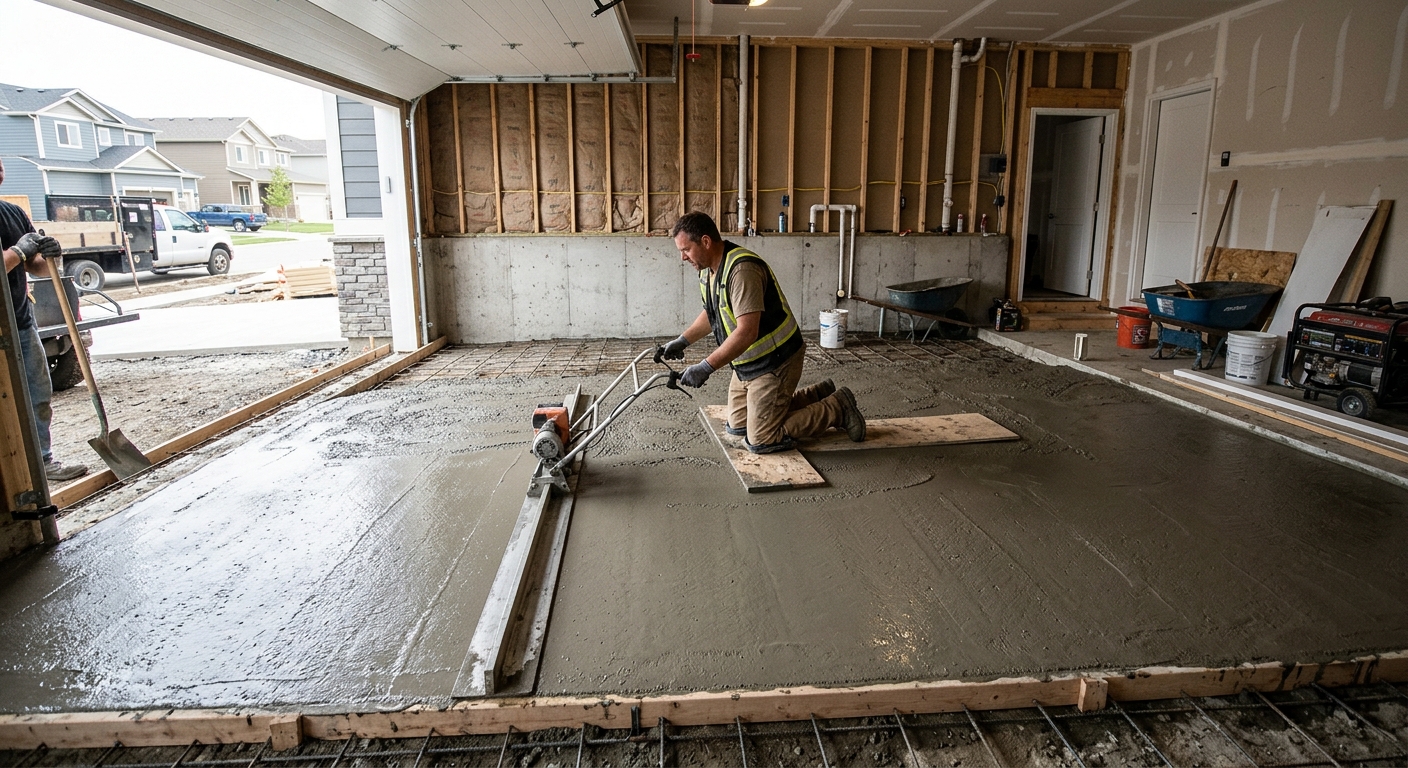
Concrete work options and costs in Chestermere
Concrete work in Chestermere is a little different than in milder parts of Alberta because exterior slabs here must be engineered for deep frost and repeated freeze–thaw. With about 80.2% of local dwellings being single-detached homes, most of the demand is for driveways, patios, walkways, garage floors, and foundation footings. There are also plenty of homeowners who have been maintaining or renovating older homes; only 3.3% of Chestermere homes were built before 1981, so many foundation systems in the area are relatively newer—but resurfacing and re-labelling of exterior flatwork is still common as driveways settle over time.
In the Calgary region, pricing reflects that the design frost depth is roughly 1.2 m, meaning excavation for footings and structural foundation work is deeper and more expensive than you’d see in regions with shallower frost. Freeze–thaw cycles also push contractors toward air-entrained mixes, stronger control-joint planning, and careful cold-weather curing. Availability can tighten in peak pour months, and late-season placement often costs more because heating, insulated blankets, and extra supervision may be required to keep curing on track.
In Chestermere, trades are especially busy around newer growth areas and ongoing infill activity along established residential corridors—where residents are frequently adding new driveways, pads, and slab extensions to keep up with expanding household needs. Below is a practical comparison of common options and typical pricing bands so you can align expectations before you request a quote.
| Application |
Typical Size |
Key Spec |
Finish Option |
Price Range |
| Concrete driveway (standard broom finish) |
400–500 sq. ft. |
Air-entrained, reinforced as required, control joints |
Broom finish, basic edging |
$12,000–$16,000 |
| Exposed aggregate driveway |
400–500 sq. ft. |
Air-entrained, stone exposure, higher material handling |
Exposed aggregate with even texture |
$15,000–$18,000 |
| Stamped concrete driveway or patio |
350–450 sq. ft. |
Air-entrained, release agent system, color hardener |
Stamp pattern + integral or surface color |
$15,000–$26,000 |
| Plain concrete patio or walkway |
200–300 sq. ft. |
Air-entrained, compacted base, joints as needed |
Float + broom or light broom |
$5,000–$9,000 |
| Garage floor (interior slab) |
500–700 sq. ft. |
Interior mix spec, shrinkage control, sealed or not |
Standard trowel/finish |
$12,000–$18,000 |
| Foundation footings (structural, below frost) |
Typical house/garage perimeter + pads |
Excavation to frost depth, rebar as engineered |
Structural concrete formwork + finish to spec |
$28,000–$45,000 |
Prices are estimates only and vary by project scope, site access and material selection.
What affects the price of concrete work in Chestermere
In Calgary’s concrete market, it’s common to see quotes for the “same” job vary by 30–50%. The difference usually comes down to how the contractor designs for frost and durability, how much excavation and base prep is needed on your lot, and how well they plan for cold-weather curing. In a cold continental climate, local code and engineering practice typically targets a design frost depth of about 1.2 m, so footings for houses, garages, decks and retaining structures must bear on undisturbed soil below that depth. When that soil depth changes (or you hit poor fill or seasonal moisture), excavation volume and haul/disposal costs change quickly.
Exterior slabs also need air-entrained concrete mixes to survive freeze–thaw cycles and reduce scaling and spalling. Add in a shorter exterior pour season, and cold-weather precautions (insulated blankets and sometimes temporary heating) become part of the true cost. De-icing salt accelerates surface wear, so sealing becomes less of an optional “nice-to-have” and more of a sensible protection step.
For Chestermere homeowners, two things often move the number: (1) how hard it is to excavate and prep—rock, soft spots, or drainage issues can push costs into higher brackets; and (2) finish choice. For example, a standard broom driveway can land around $12,000–$18,000, while upgrading to stamped or exposed aggregate can justify extra labour and materials because installation is more detail-dependent. Likewise, foundation footings tend to follow the $28,000–$45,000 band, but the moment excavation needs deeper correction or extra reinforcement, that band shifts toward the top.
| Price Factor |
Why It Matters |
Cost Impact |
| Frost line depth |
Determines footing depth and form height |
Higher excavation and concrete volume; deeper trench = more labour and hauling |
| Site preparation |
Excavation, grading, compacted granular base |
Poor subgrade or extra removal/haul increases cost; correct base reduces long-term failures |
| Reinforcement |
Rebar or wire mesh requirement |
Material + placement time; may be required to meet structural and crack-control expectations |
| Mix design |
Air-entrainment and compressive strength spec |
More robust exterior mix costs slightly more but lowers scaling and spalling risk |
| Finish type |
Broom vs. stamped vs. exposed aggregate |
Stamped/exposed requires more labour steps (staging, stamping, texture control) |
| Pour size and concrete truck access to site |
Placement speed and logistics |
Hard access can require extra equipment or smaller loads; delays can add labour hours |
| Cold-weather curing precautions |
Heating and blankets |
Protecting curing quality can add line items, especially in late fall/early spring |
| Control joint pattern and sealing cost |
Crack control and surface protection |
More joints correctly located reduces random cracking; sealing adds materials and scheduling |
Permits & regulations in Alberta
In Alberta, it helps to separate structural concrete from flatwork. Structural concrete work—commonly including footings, foundation walls, and grade beams—requires a building permit and often depends on engineered drawings that the municipality reviews. Concrete flatwork such as driveways, patios, and walkways typically does not require a permit unless the work affects lot grading, changes impervious surface calculations, or ties into municipal right-of-way requirements. Because edge cases happen (swales, drainage direction, or municipal boulevard ties), confirm with the local authority before you break ground.
Also verify your contractor is properly covered. For Chestermere projects, ask for proof of liability insurance and WCB/WSIB coverage (the exact program name depends on the employer’s registration, but you should receive clearance/coverage documentation). Check that the contractor’s references match your scale and exposure level—flatwork in a freeze–thaw climate should use air-entrained mixes and proper jointing.
Step-by-step homeowner checks: (1) search the Alberta contractor/licence registry online using the company name; (2) request a certificate of insurance and confirm it is current; (3) ask for the WCB/WSIB clearance letter or coverage proof; (4) confirm the quote includes site protection, disposal, and curing steps. If the contractor can’t provide documentation quickly, that’s usually your first red flag.
Getting concrete right in Chestermere's freeze-thaw climate
Concrete fails in Chestermere mainly when freeze–thaw exposure isn’t addressed in the design and finishing steps. The big culprits are inadequate base preparation, missing or incorrect air-entrainment, poor curing in cold conditions, and weak or poorly planned control joints. To spec the job correctly, start with base prep: the contractor should build a compacted granular sub-base to the frost-informed depth and properly grade for drainage so water doesn’t sit under the slab. Next, lock in the mix design: for exterior flatwork, ask for air-entrainment (typically 5–7% air content) and a minimum target of 32 MPa compressive strength so the concrete can resist freeze–thaw stresses.
Control joints matter because they guide cracking to predictable locations. Ask for the joint pattern and timing so joints are cut/installed so the slab doesn’t crack randomly. Curing is the make-or-break step in Calgary-area weather: plan for at least 7 days of proper curing conditions, and if you’re close to freezing temperatures, confirm cold-weather curing (insulated blankets, temperature control, and scheduling) so the surface doesn’t scale. Finally, sealing is important here because de-icing salt accelerates surface wear; request a penetrating sealer applied after the proper cure window (often around 28 days post-pour) to help repel chloride-contaminated meltwater.
Why spec choices change price: a plain patio might be around $5,000–$9,000, but adding a higher-spec air-entrained exterior mix, better base prep, and sealing can reduce future patching. If a contractor tries to cut corners, spalling and surface scaling can show up within a few winters—costing you far more than the difference between a basic and a properly engineered exterior job.
| Spec |
Why It Matters in Chestermere |
What to Ask For |
Impact if Skipped |
| Compacted granular base (depth?) |
Supports slab and limits frost-related movement |
Granular base depth + compaction method/proof (test or documentation) |
Settlement or heaving; cracking and uneven surface |
| Air-entrained concrete mix (target air %?) |
Protects against freeze–thaw damage and spalling |
Target air content for exterior flatwork (commonly 5–7%); specified mix design |
Surface scaling/spalling, especially under de-icing salt exposure |
| Compressive strength (MPa rating) |
Improves durability and long-term performance |
Minimum 32 MPa (or higher as specified by engineer/contract) |
Higher risk of wear, cracking, and reduced service life |
| Control joints (spacing per ACI guidelines) |
Controls where cracks form during shrinkage and temperature changes |
Joint spacing plan + timing (when joints are cut/formed) |
Random cracking across finished surfaces |
| Minimum 7-day curing period |
Lets concrete gain strength before freeze risk |
Curing method; confirm cold-weather plan if temps drop |
Weak surface, scaling, and long-term durability issues |
| Penetrating sealer (when applied after cure) |
Repels chloride-laden meltwater from de-icing salts |
Specify sealer type and timing (often after cure, commonly around 28 days) |
Faster surface wear and potential spalling at edges |
How to choose a concrete work contractor in Chestermere
Choosing the right concrete contractor in Chestermere comes down to three things: technical competence for freeze–thaw durability, documented insurance/coverage, and clear scope. In Alberta, you should verify the company’s licence/registration status through the online registry, then request a current certificate of liability insurance naming you properly as required by contract terms. Next, confirm WCB/WSIB coverage by asking for a clearance letter or proof of coverage—this is non-negotiable because it protects you if there’s an on-site injury.
Then, compare quotes correctly. Get 2–3 itemised written quotes where labour and materials are broken out (concrete volume, base prep, rebar/wire mesh, forms, finishing labour, curing measures, jointing, sealing, and disposal). Avoid “all-in” numbers that don’t state what’s included—especially excavation depth to reach undisturbed soil, granular base thickness, and whether control joints and sealing are part of the plan. Confirm whether permits are included (for structural work that needs them) and whether hauling and disposal are covered.
For warranties, ask for both the workmanship warranty and the product/manufacturer warranty (and whether it’s transferable to you). Payment should protect you: never pay more than 10–15% upfront; use a holdback until the job is complete and cleaned up. Finally, insist on a timeline: request a start date and completion estimate in writing, including what happens if weather forces a delay.
- Provide your exact scope: dimensions, thickness (if known), and finish type.
- Ask how they will meet frost-related depth requirements for your footing/structural elements.
- Require an air-entrained exterior mix specification for driveways/patios in freeze–thaw areas.
- Confirm rebar/wire mesh type and placement method (not just “reinforced”).
- Request base prep details: granular depth, grading, and compaction approach.
- Ask when control joints will be installed/cut and what spacing plan they use.
- Confirm cold-weather curing steps (blankets/heating) if temps are near freezing.
- Clarify sealing: product type and when it will be applied after cure.
- Make sure disposal/haul-off and protection (fencing, silt control) are included.
- Get a payment schedule with milestones and retainage/holdback.
- Ask for references on similar Chestermere exterior flatwork (not only interiors).
- Ensure insurance and WCB/WSIB coverage documentation is current and provided before work starts.
Concrete red flags in Chestermere: contractors who won’t show mix specs (especially air-entrainment), vague joint spacing plans, ignoring cold-weather curing and trying to “push through” freezing temperatures, skipping proper granular base prep, or quoting without confirming excavation/haul and disposal scope.
Frequently asked questions — concrete work in Chestermere
What causes concrete to spall in Chestermere winters?
In Chestermere’s Alberta winters, spalling is usually tied to freeze–thaw action combined with de-icing salt and water getting into the concrete surface or around edges. If the contractor uses a non-air-entrained or incorrectly air-entrained exterior mix, the freeze–thaw pressure increases and the surface can scale and break off over time. Another driver is water movement: if base drainage and compacted granular sub-base are weak, water can collect and expand when temperatures drop. Finally, cold-weather curing shortcuts can leave the near-surface layer weaker than it should be, making it more vulnerable. If you’re budgeting for a driveway in the $12,000–$18,000 range, insist on air-entrainment specs and curing plans; they’re what keep you from paying again after a couple seasons.
What is rebar and when is it required in Alberta?
Rebar is steel reinforcement bars placed inside concrete to help it handle tensile forces that concrete alone can’t resist well. In Alberta, whether rebar is required depends on the engineered design, the structural purpose of the slab (foundation vs. flatwork), the thickness, and the soil conditions. For structural concrete like footings, foundation walls, and grade beams, rebar is often specified by an engineer and tied to loads and frost considerations. For driveways and patios, reinforcement may be recommended or required based on thickness, slab size, and crack-control plan (often combined with proper base prep and control joints). Ask your contractor to state what reinforcement they’re using (rebar size/spacing or wire mesh) and where it will sit within the slab depth—not just “we’ll reinforce it.”
How long does a concrete project take in Chestermere?
Timelines in Chestermere are shaped by freeze–thaw risk and how the contractor manages curing. A small interior slab (like a garage floor) is often poured quickly in a day, but preparation, forming (if needed), and finishing still take time—so “in and out” can be several days. Exterior flatwork is more dependent on temperature and curing conditions; if cold weather requires insulated blankets or temporary heating, the schedule expands to protect strength gain. Even after placement, concrete needs time to cure: you’ll typically see strength progress over days, with more reliable protection after at least a week under proper conditions. If your project is near the practical pour window, ask for a written plan that includes weather contingencies. For example, a standard broom-finish driveway in the $12,000–$18,000 band often takes longer than homeowners expect once base prep, jointing, and curing steps are done correctly.
What is a concrete overlay and is it suited to Chestermere?
A concrete overlay is a new layer of concrete placed on top of an existing slab to restore surface quality or change the look. It can be suited to Chestermere when the original base is still sound (no major settlement, widespread debonding, or deep structural cracking). The overlay needs proper surface preparation—typically grinding, patching, and ensuring good bonding—plus a mix/design suited to exterior freeze–thaw and drainage. If the existing slab has failed due to poor base compaction or frost movement, overlaying can hide the symptoms temporarily while the movement continues underneath, which can lead to future cracking or delamination. For many homeowners, sealing and joint maintenance on intact slabs can be a better first step. If you’re considering upgrading the look, you might compare overlay to starting fresh with a new driveway or patio, where pricing commonly sits in the $12,000–$18,000 driveway range and $5,000–$9,000 for smaller patio/walkway work.
How do I seal concrete to protect it in Chestermere?
In Chestermere, sealing is mainly about repelling meltwater and salt—both of which can speed up surface wear and contribute to spalling when combined with freeze–thaw. The key is timing and product choice. You generally want to seal after the concrete has cured properly; many penetrating sealers are applied after a full cure period (often around 28 days), when moisture levels are suitable. Use a penetrating sealer rather than a film-forming product for exterior slabs because it helps reduce chloride penetration while still allowing the slab to breathe. Prep matters: the slab should be clean and dry, with cracks assessed and repaired before sealing. Ask your contractor what sealer they use and how they’ll schedule the application around Alberta weather. If you’re planning exterior flatwork in the $5,000–$9,000 patio/walkway range, sealing should be treated as part of the durability plan, not a last-minute add-on.
What is the difference between concrete and cement?
Cement and concrete are related, but they’re not the same thing. Cement is one ingredient—essentially the binder—that reacts chemically when mixed with water to form a paste. Concrete is the full engineered material made from cement plus water, aggregates (sand and gravel/stone), and often admixtures (like air-entrainment for freeze–thaw durability). In Alberta’s concrete work, contractors specify the concrete mix design because that’s what controls performance: for exterior slabs in Chestermere, air-entrained concrete is a must to help manage freeze–thaw stresses, and the mix design targets compressive strength (often a 32 MPa class or higher, depending on application). So when a quote talks about “concrete” rather than “cement,” it usually means the full mix and curing approach—not just the cement type.