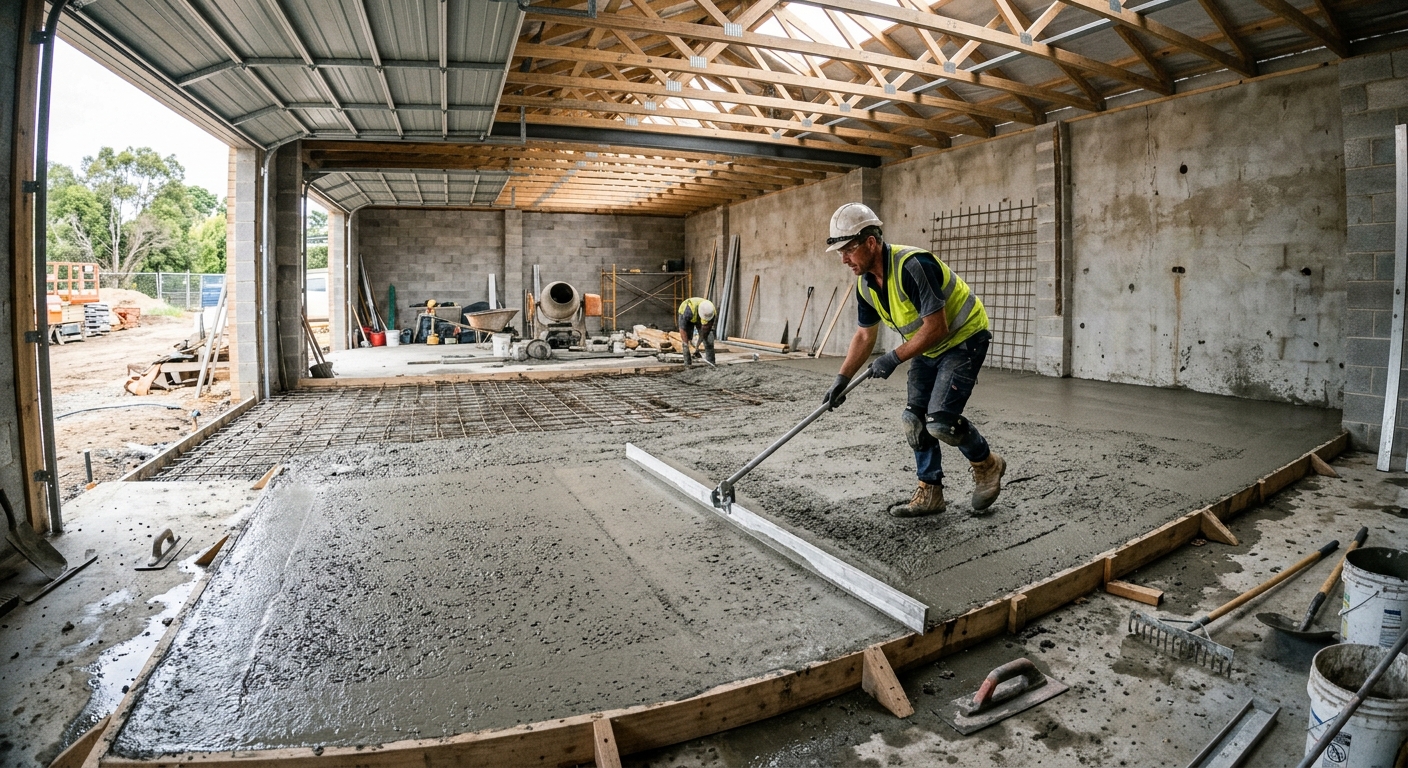
Concrete work options and costs in Irricana
Irricana is a small but active community south of Calgary, and concrete flatwork is one of the most common home improvements homeowners tackle—especially in neighbourhoods around Main Street and the broader service area where driveways, walkways, and patios are replaced as properties age. With single-detached houses making up 76.3% of local dwellings and 415 homeowner households representing 89.2% of households (Statistics Canada, 2021 Census), you’ll typically see projects sized for family homes: driveway widening, new garage floors, patio rebuilds, and occasional repairs to older slabs.
In the Calgary region, pricing is engineered around cold continental conditions. The design frost depth is about 1.2 m (roughly 4 ft), so footings and structural concrete must bear on undisturbed soil below that depth. Freeze–thaw cycles across the area also push contractors to use air-entrained mixes, granular base prep, and properly spaced control joints—details that directly affect material and labour time. Exterior pours also have a shorter practical season, and cold-weather curing precautions (insulated blankets and sometimes temporary heat) can raise costs if you’re scheduling late in fall or early spring.
Because of those climate realities, two contractors can price the “same” concrete job differently by 30–50%—usually due to how they handle excavation depth, reinforcement, mix design, and curing requirements. Use the following table as a realistic budget guide before you compare quotes for your Irricana project.
| Application |
Typical Size |
Key Spec |
Finish Option |
Price Range |
| Concrete driveway (standard broom finish) |
24 ft x 10 ft (240 sq. ft.) |
Air-entrained exterior mix, compacted base, control joints |
Broom finish |
$12,000–$18,000 |
| Exposed aggregate driveway |
24 ft x 10 ft (240 sq. ft.) |
Air-entrained exterior mix, surface retard/bonding plan |
Exposed aggregate |
$15,000–$22,000 |
| Stamped concrete driveway or patio |
20 ft x 12 ft (240 sq. ft.) |
Air-entrained exterior mix, stamped texture + release workflow |
Stamped (decorative pattern) |
$15,000–$26,000 |
| Plain concrete patio or walkway |
10 ft x 12 ft (120 sq. ft.) |
Compacted granular base, mesh/wire as required |
Broomed or lightly finished surface |
$5,000–$9,000 |
| Garage floor (interior slab) |
22 ft x 20 ft (440 sq. ft.) |
Vapour control as applicable, reinforced slab, proper curing |
Float finish |
$10,500–$16,500 |
| Foundation footings (structural, below frost) |
Typical detached/garage footprint |
Excavate to undisturbed soil, engineered rebar, below design frost |
Structural concrete forming and placement |
$28,000–$45,000 |
Prices are estimates only and vary by project scope, site access and material selection.
What affects the price of concrete work in Irricana
In Calgary and the surrounding region, it’s common to see quotes for the same concrete “type” vary by 30–50%. The biggest drivers are the parts homeowners don’t always see: how deep they excavate, the thickness and compaction of the granular base, whether reinforcement is included as needed, and whether the mix design is actually suitable for Alberta freeze–thaw conditions. When a contractor prices to a colder-spec mix and builds the base correctly, the job costs more upfront but holds up far better over the years.
Frost depth is the hard constraint. Footings must extend below the design frost depth (about 1.2 m in this region) so winter heave doesn’t lift the structure or crack slabs at weak points. The freeze–thaw cycle also means exterior concrete should be air-entrained to improve freeze resistance. At the same time, cold weather placement shortens the effective pour season, and curing may need winter-grade precautions such as insulated blankets and controlled temperature so the concrete reaches strength properly. De-icing salt used on driveways can accelerate surface scaling if the mix, curing and sealing weren’t done right—so sealing is a practical add-on that affects life-cycle cost.
In Irricana, local site conditions can swing budgets. For example, a driveway rebuild where excavation must go deeper for a uniform base can push a standard broom driveway toward the higher end of the $12,000–$18,000 band. Conversely, a stamped driveway or patio often looks like a “simple upgrade,” but if the contractor includes reinforced sub-base and proper curing, it’s typically justified within the $15,000–$26,000 decorative range. Housing-stock age also matters: with 30.1% of homes built before 1981 (Statistics Canada, 2021 Census), older lots often need more demo, subgrade correction, and joint rework.
| Price Factor |
Why It Matters |
Cost Impact |
| Frost line depth |
Determines footing depth and required form height |
Higher excavation volume increases labour and concrete |
| Site preparation |
Excavation, grading, and compacted granular base stability |
Bad base prep causes early cracking and costly rework |
| Reinforcement |
Rebar or wire mesh helps control cracking and adds load capacity |
Adds materials and labour for placement and chairs/ties |
| Mix design |
Air-entrainment and specified compressive strength for freeze resistance |
Winter-grade mixes can cost more per cubic metre |
| Finish type |
Broom vs stamped vs exposed aggregate affects crew time and labour |
Decorative finishes typically add curing/finish labour steps |
| Pour size and concrete truck access to site |
Smaller pours can mean more trips; limited access increases handling time |
Additional labour for pumping/line placement or added truck costs |
| Cold-weather curing precautions |
Heating and insulated blankets protect early strength development |
Can add equipment, fuel, and extended time on site |
| Control joint pattern and sealing cost |
Joints manage shrinkage cracking; sealing reduces salt penetration |
Proper jointing and sealer are usually small cost vs big payoff |
Permits & regulations in Alberta
In Alberta, structural concrete work generally requires a building permit, and many projects also require engineered drawings reviewed by the municipality. That includes foundation-related components such as footings, foundation walls, and grade beams—because they affect the structural system and frost-bearing performance. For concrete flatwork (patios, walkways, driveways), permits are typically not required if the work is like-for-like and doesn’t materially change lot grading, alter municipal right-of-way, or push you past local impervious surface and drainage requirements. Still, it’s smart to confirm in advance, especially if you’re changing slopes for drainage, adding new drainage swales, or building near a property line.
For Irricana homeowners, here’s a practical step-by-step way to verify a contractor in Alberta before signing:
- Ask the contractor for their certificate of insurance (liability) and confirm the effective dates cover the project period.
- Request proof of WSIB/WCB coverage (or the appropriate exemption documentation if they’re structured differently).
- Check whether the contractor’s registrations and business details are active using the relevant online registry listings available to Alberta consumers.
- Get the permit responsibility confirmed in writing: who applies, what drawings/engineering are included, and when approvals are required.
- Ask for 2–3 similar-scale references and photos from comparable cold-weather concrete placements.
Doing this upfront helps prevent schedule delays—especially important in the Calgary area where exterior pours depend on curing conditions.
Getting concrete right in Irricana's freeze-thaw climate
Concrete failures in Irricana usually come from one of five issues: weak or poorly prepared base, incorrect mix design, insufficient reinforcement for the use case, inadequate control jointing, or rushed curing. In a freeze–thaw environment, the concrete has to be engineered to resist early freeze damage. The spec starts at the ground: compacted granular sub-base at the correct depth for local soil conditions and frost considerations is what prevents voids and settlement. From there, the concrete mix should include air-entrainment (commonly 5–7% air content for exterior flatwork) and a minimum compressive strength target (often 32 MPa) so the paste can tolerate freezing.
Next, control joints are what limit random cracking. Spacing isn’t just a cosmetic decision; it’s part of the performance system that keeps shrinkage cracks from opening up and letting moisture reach the sub-base. Curing also matters: aim for at least 7 days of curing under proper conditions. In cold snaps, cold-weather placement needs insulation blankets and—if required by conditions—temporary heat so the slab doesn’t scale or lose strength at the surface. Finally, sealing should be planned after the concrete has cured: a penetrating sealer applied after 28 days helps repel de-icing salts and reduces surface deterioration.
When comparing options, know what’s worth paying for. For example, moving from a plain broom patio to stamped concrete might cost more (often within the $15,000–$26,000 decorative band for driveway/patio scopes), but if the contractor includes the right air-entrainment, base compaction, joints and proper curing, that premium is justified. If they skip base prep or curing precautions, the cheaper option can fail faster and cost more later.
| Spec |
Why It Matters in Irricana |
What to Ask For |
Impact if Skipped |
| Compacted granular base (depth?) |
Prevents voids and frost-related movement under the slab |
State sub-base thickness (to design) and compaction testing method |
Settlement and cracking; uneven surface and premature failure |
| Air-entrained concrete mix (target air %?) |
Improves freeze resistance during repeated freeze–thaw cycles |
Ask for air content target and that the mix is appropriate for exterior use |
Spalling, scaling and surface flaking—common on salted driveways |
| Compressive strength (MPa rating) |
Ensures durability and adequate strength gain in cold placement conditions |
Confirm minimum compressive strength requirement (e.g., 32 MPa) |
Weaker surface, higher risk of damage during early freezes |
| Control joints (spacing per ACI guidelines) |
Controls where shrinkage cracks form and reduces random cracking |
Request joint spacing and saw-cut/formed joint timing |
Wider cracks, moisture ingress and freeze-driven expansion damage |
| Minimum 7-day curing period |
Builds strength before exposing concrete to freezing conditions |
Ask how curing is protected during cold weather (blankets/heat if needed) |
Surface scaling, reduced strength and shortened service life |
| Penetrating sealer (when applied after cure) |
Reduces salt and water penetration that accelerates spalling |
Confirm sealer type and that it’s applied after cure (often after 28 days) |
Higher salt/ice damage risk; faster deterioration of surface quality |
How to choose a concrete work contractor in Irricana
Choosing a concrete contractor in Irricana is less about flashy ads and more about proof: Alberta compliance, a realistic scope, and workmanship you can verify. Start by confirming they carry liability insurance and WSIB/WCB coverage (or the correct exemption paperwork). Ask for certificates of insurance, then confirm the coverage period matches your pour dates. Next, verify their contractor identity and registration status through available Alberta consumer-facing registry information. If they can’t provide documents quickly, that’s a warning sign on a project where cold-weather scheduling and proper curing are critical.
Then, get 2–3 itemised written quotes—not just one lump-sum number. A good quote breaks down excavation and base prep, concrete volume, reinforcement, forms, finish labour, truck access logistics, and any cold-weather curing items. Confirm whether permits are included (for structural work) and whether disposal of excess material is included. Make sure warranty terms are specific: workmanship warranty length, product/manufacturer warranty coverage, and whether any warranty is transferable if you sell your home.
For payment, keep it controlled: never pay more than 10–15% upfront, and hold back until completion and cleanup. Finally, insist on a timeline in writing: proposed start date, concrete delivery/pour day, curing protection steps, and estimated completion. In this region, delays can affect curing performance, so clarity matters.
- Ask what air content target and mix strength they use for exterior work.
- Confirm frost-related excavation depth and sub-base compaction approach.
- Require reinforcement details: mesh/rebar type, placement height, and chairs/ties.
- Check that control joints are included (spacing and timing).
- Ask how they handle cold-weather curing (blankets/heating plan).
- Make sure sealing is specified if you want salt protection.
- Demand itemised pricing for concrete, labour, and site prep—no “allowances” without detail.
- Confirm whether cutting, patching, edging, and cleanup are included.
- Verify who pulls the permit for structural concrete (if applicable) and who pays fees.
- Check disposal/recycling is included if demo is part of the scope.
- Review warranty coverage and what counts as “defect” versus “normal wear.”
- Get start/completion dates and a contingency plan for weather delays.
Concrete red flags in Irricana: contractors who promise “quick pours” in late season without cold-weather curing plans; quotes that skip air-entrainment and only mention “regular concrete”; no clear joint plan or joint spacing; vague scopes like “prep as needed” without stating depth/compaction; and refusing to provide insurance/WSIB/WCB documentation before signing.
Frequently asked questions — concrete work in Irricana
Do I need a permit for concrete work in Alberta?
In Alberta, structural concrete typically requires a building permit and often engineered drawings—so footings, foundation walls, and grade beams usually fall into the “permit required” category. Concrete flatwork like patios, walkways and driveways often does not require a permit if it’s like-for-like and doesn’t meaningfully change lot grading, drainage, or impervious surface rules. In Irricana, the key is the impact on grading and drainage: if you’re changing slopes, affecting how water leaves your property, or working near lot drainage concerns, confirm with the municipality before you break ground. Also verify your contractor carries liability insurance and has WSIB/WCB coverage so you’re protected during excavation and concrete placement.
Concrete vs pavers for a patio in Irricana?
Concrete and pavers can both work well in Alberta, but they fail differently in freeze–thaw conditions. A properly built concrete patio with air-entrained mix, good compacted granular base, and correctly spaced control joints tends to crack in a controlled way and can be sealed to resist de-icing salt exposure. Pavers can shift if base prep is weak or if edging isn’t stable, but they’re also easier to replace one section at a time. In practice, concrete patios often land in the $5,000–$9,000 range depending on size and site access, while pavers vary widely based on stone type and excavation. If you use salt frequently, a sealed concrete surface usually holds up well, but any approach requires excellent base prep and drainage detailing.
How long does a concrete driveway last?
A well-built concrete driveway in Irricana commonly lasts 20–30 years (sometimes longer) when the design accounts for frost, freeze–thaw cycles, and proper curing. The biggest long-term risks are inadequate air-entrainment, rushed curing, and weak or uneven base—those lead to spalling, scaling and cracking. Control joints and correct finishing also matter: in this Calgary-region climate, the surface needs durability against cycles and salt. If the driveway is older (and many homes here were built before 1981), you may see issues like settling or joint deterioration sooner, which can shorten lifespan. Budget-wise, a new driveway is often in the $12,000–$18,000 band for standard broom finishes. Decorative options cost more, but longevity depends far more on base and curing than on colour alone.
What is air-entrained concrete and why does it matter here?
Air-entrained concrete is mixed with tiny, evenly distributed air bubbles that give freezing water a place to expand without damaging the cement paste. In Irricana’s Alberta freeze–thaw climate, that matters because water from thaw cycles can enter at the surface or through small cracks—then freeze again, expanding and breaking up the concrete. Without proper air-entrainment, you can see surface scaling and spalling, even if the driveway “looks fine” at first. For exterior flatwork in Calgary-area conditions, contractors typically target about 5–7% air content and use air-entrained exterior mixes plus good curing. When you compare quotes, ask the contractor to confirm the mix design is air-entrained for exterior exposure, not a generic interior mix.
How do I prepare the base for a concrete slab?
Base preparation is where quality is won or lost. For a concrete slab in Irricana, the contractor should excavate to a depth that supports frost performance and then place a compacted granular sub-base in lifts, achieving the correct compaction for stability. The goal is a uniform, well-graded base that won’t settle and won’t hold excess water. After grading, they should add proper bedding where needed and ensure forms are set to grade so the slab drains correctly. Ask whether they include granular base thickness, compaction methods, reinforcement placement (chairs/ties), and control joint design. If this is a driveway or walkway, good base prep is a major reason pricing can differ across quotes—because “scrimping” here often shows up later as cracking and spalling.
How do I compare concrete quotes?
Start by comparing itemised quotes, not just totals. You want a breakdown of excavation and granular base prep, concrete volume, reinforcement (mesh or rebar type/placement), finishing labour (broom vs stamped vs exposed aggregate), and whether cold-weather curing is included for your dates. Confirm whether disposal of debris and site protection are included, and whether sealing is planned where de-icing salt exposure is expected. For Irricana projects, make sure the contractor is pricing to Alberta conditions—air-entrained exterior mix and proper curing—because that’s a common reason prices swing. As a reference point, many standard broom driveway projects land in the $12,000–$18,000 range, while stamped driveway/patio scopes often sit higher, around $15,000–$26,000. The best quote is usually the one that clearly includes frost-aware base prep, jointing and curing—not the lowest number.