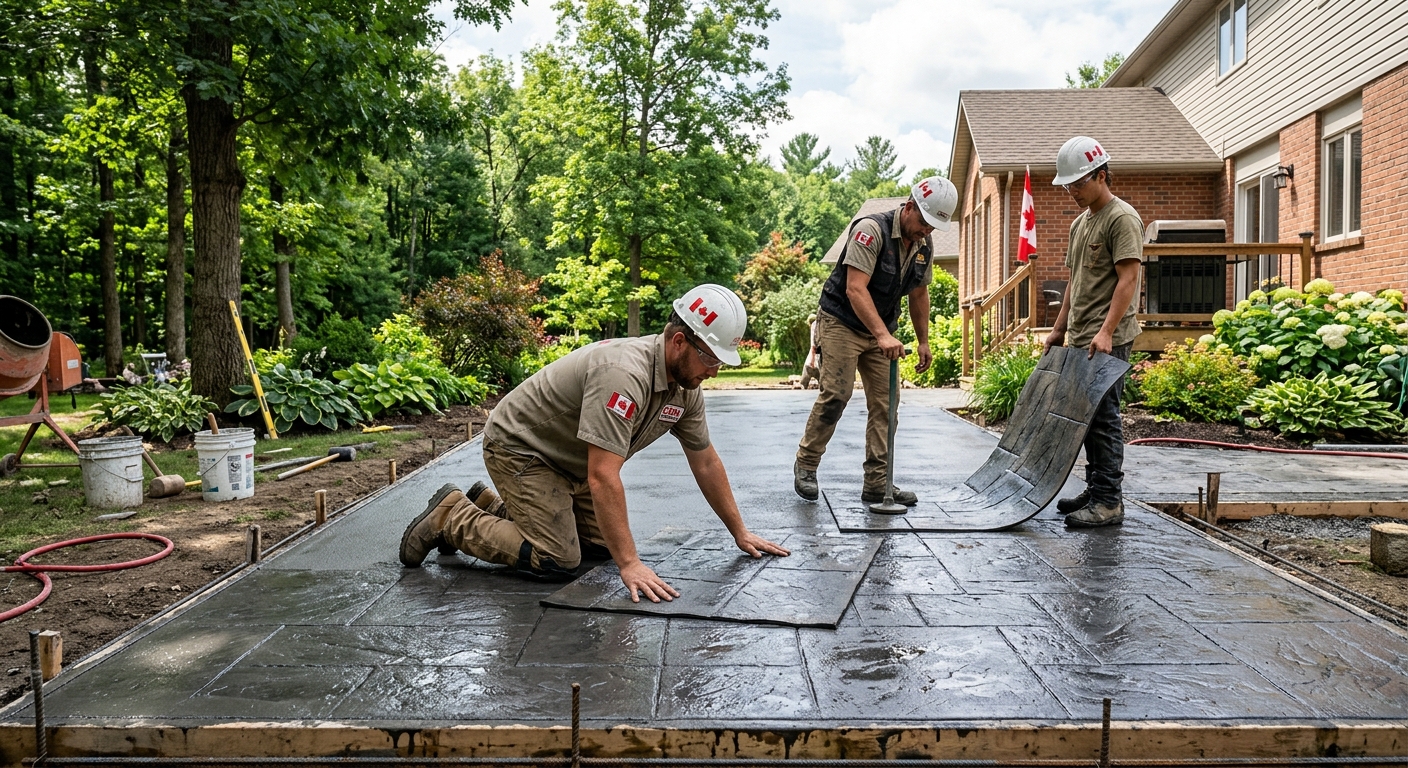
Concrete work options and costs in Granville
Concrete work in Granville, Alberta typically comes down to a few repeatable project types: driveway flatwork, patios and walkways, garage floors, and the structural foundation work that supports the home. With Granville’s population at 2,772 people (Statistics Canada, 2021 Census), the market is smaller than Calgary proper, so availability can depend on contractor schedules and how busy the freeze–thaw season is at the time you call. Granville also mirrors the broader Calgary-area housing profile where single-detached homes are a major share of the market—exactly the kind of housing that drives demand for driveways, steps, and backyard slabs.
Because Calgary sits in a cold continental climate, pricing reflects frost depth and freeze–thaw cycling rather than just square footage. Local engineering practice commonly uses a design frost depth of about 1.2 m (roughly 4 ft) for home foundations, so footings and below-grade work require more excavation and higher concrete volumes than in milder regions. Exterior slabs also need air-entrained concrete, better granular base preparation, and a realistic pour-and-cure plan. In practice, that means contractors plan around colder placement windows and may use winter-grade mixes, insulated blankets, and sometimes temporary heat—especially for exterior flatwork scheduled late in the year.
In Granville, demand is especially strong in the newer infill pockets close to the main residential corridors, where homeowners often update driveways and rear patios at the same time as grading and landscaping. Below is a practical side-by-side comparison of typical sizes, specs, and budget ranges so you can compare quotes apples-to-apples.
| Application |
Typical Size |
Key Spec |
Finish Option |
Price Range |
| Concrete driveway (standard broom finish) |
20 ft x 10 ft (200 sq. ft.) |
Air-entrained exterior mix, compacted granular base, control joints |
Broom finish |
$12,000–$18,000 |
| Exposed aggregate driveway |
20 ft x 10 ft (200 sq. ft.) |
Air-entrained exterior mix, properly graded base, mix design for durability |
Exposed aggregate |
$14,000–$20,000 |
| Stamped concrete driveway or patio |
20 ft x 10 ft driveway or 12 ft x 20 ft patio (200–240 sq. ft.) |
Air-entrained mix, integral color, release system, proper curing |
Stamped pattern |
$15,000–$26,000 |
| Plain concrete patio or walkway |
10 ft x 16 ft (160 sq. ft.) walkway/patio |
Air-entrained mix, compacted base, jointing plan |
Smooth/float finish |
$5,000–$9,000 |
| Garage floor (interior slab) |
24 ft x 24 ft (576 sq. ft.) |
Vapour barrier (as specified), fibre or mesh reinforcement, proper curing |
Standard broom/steel trowel (as specified) |
$13,000–$22,000 |
| Foundation footings (structural, below frost) |
House/garage system footprint varies (typically per plan) |
Below design frost depth, reinforced footings, engineered bearing conditions |
Structural concrete (no decorative finish) |
$28,000–$45,000 |
Prices are estimates only and vary by project scope, site access and material selection.
What affects the price of concrete work in Granville
In Granville and the wider Calgary area, quotes for the “same” concrete job can swing by 30–50% because contractors price for risk: soil conditions, excavation depth, reinforcement detailing, access for trucks, and the realistic schedule needed to cure concrete properly in a cold continental climate. Even within the Calgary region, the mix of clients building new infill versus renovating older properties changes the complexity of the base work—grading, removal, disposal, and tie-ins.
Two climate-driven items affect almost every bid. First is frost line depth. In Alberta, exterior structural systems commonly require footings to extend below the design frost depth (about 1.2 m), which means deeper excavations and higher concrete volumes than in milder climates. Second is freeze–thaw cycling: exterior slabs and driveways need air-entrained concrete and well-spaced control joints to reduce cracking and spalling. Calgary’s shorter pour season can also force winter-grade placement precautions (insulated blankets and sometimes temporary heat), and de-icing salt accelerates surface deterioration if sealing and mix design aren’t done right.
Here are a few local examples of how cost rises or falls in Granville. A driveway on clayey subgrade often costs more because excavation expands to reach stable granular base and proper compaction. A stamped driveway costs more than a broom-finished slab, and in our local pricing it usually lands near the stamped/decorative band (for many projects, that’s roughly $15,000–$26,000) because labour is concentrated in finishing time and pattern setup. Conversely, a simple 10 ft x 16 ft patio that stays within the same material and access constraints may fit closer to the plain patio/walkway band (often $5,000–$9,000), especially when no excavation surprises occur.
Finally, note that older housing lots can have service conflicts (weeping tiles, footing drains, older asphalt) that add labour and disposal. When foundation work needs to hit below frost depth, you can quickly see why foundation/footings budgets typically sit in the $28,000–$45,000 range.
| Price Factor |
Why It Matters |
Cost Impact |
| Frost line depth — determines footing depth and form height |
Footings must bear below the design frost depth to limit frost heave and seasonal movement |
Higher excavation and concrete volume; can swing budgets on foundation work significantly |
| Site preparation — excavation, grading, compacted granular base |
Concrete longevity depends on stable, compacted base and proper drainage |
More removal/grading/disposal raises labour and equipment time |
| Reinforcement — rebar or wire mesh requirement |
Reduces cracking and helps slabs carry loads as designed |
Material and labour for tying/chairing increases cost, especially on driveways |
| Mix design — air-entrainment and compressive strength spec |
Air-entrainment improves freeze–thaw durability in exterior Calgary exposure |
Cold-weather capable mixes and engineered specs increase material cost |
| Finish type — broom vs. stamped vs. exposed aggregate |
Finishing complexity affects labour time and scheduling; exterior durability matters |
Stamped/exposed aggregate typically costs more than broom or float finishes |
| Pour size and concrete truck access to site |
Truck access limits how much can be poured per visit; pumping adds cost |
Tighter sites can add labour, hose/pump costs, and staging time |
| Cold-weather curing precautions — heating and blankets |
Proper curing prevents scaling and surface/strength issues in short pour windows |
Blankets/heaters can add daily set-up and labour to protect the pour |
| Control joint pattern and sealing cost |
Jointing controls cracking locations; sealing helps resist de-icing salt spalling |
Sealer and joint detailing add steps but reduce long-term repair risk |
Permits & regulations in Alberta
In Alberta, concrete work isn’t one-size-fits-all when it comes to permits. Structural concrete—things like foundation walls, grade beams, footings, and other load-bearing elements—typically requires a building permit and, in many cases, engineered drawings reviewed through the municipal permitting process. Decorative flatwork (patios, walkways, and most standard driveways) often does not require a permit unless the work changes lot grading, impacts drainage, or triggers impervious surface or right-of-way considerations. In Granville, the practical takeaway is: if the concrete is supporting the building structure, treat it as permit-required; if it’s purely exterior flatwork, it’s usually permit-exempt, but you still must confirm with the local authority before you break ground.
Step-by-step, here’s how a homeowner can verify an Alberta concrete contractor. First, ask for their proof of liability insurance (certificate of insurance showing your project’s named coverage and effective dates). Second, confirm coverage for worker protection (WSIB/WCB clearance) by requesting documentation—don’t rely on a verbal promise. Third, ask for their business information and check that the contractor is properly set up to work in Alberta (many homeowners start with public business records and contractor websites, then follow up directly). Fourth, request references on projects with similar scope and winter scheduling.
Always get the scope and responsibility for permitting clarified in writing—who pulls the permit (if applicable), who coordinates engineered requirements, and what is excluded from disposal, traffic control, or excavation. That paper trail protects you when schedules tighten due to cold-weather curing needs.
Getting concrete right in Granville's freeze-thaw climate
Concrete failure in Granville usually isn’t about “bad concrete”—it’s about the system not being engineered for our freeze–thaw reality. In a cold continental climate with frequent temperature swings, the weakest links are often insufficient base preparation, inadequate air-entrainment, missing or poorly planned control joints, and curing that’s rushed when temperatures drop. If any of those are off, you can see surface scaling, hairline cracking that turns into spalling, and premature wear where de-icing salts sit.
To spec the job correctly, start with base prep. Use compacted granular sub-base to the right depth for the soil conditions and frost considerations so the slab doesn’t heave seasonally. Next, demand a mix design with air-entrainment suitable for exterior exposure—typically 5–7% air content for exterior flatwork—and a minimum 32 MPa compressive strength (as specified for the application). Then control cracking by designing control joint locations and spacing appropriate for the slab dimensions. For curing, plan for a minimum 7-day cure under proper conditions; cold-weather placement may require insulating blankets and/or heat to protect the early-age concrete. Finally, add sealing: a penetrating sealer applied after the cure period (often 28 days post-pour) helps repel de-icing salts and reduces surface degradation.
Here’s where the price difference makes sense. If two bids differ by roughly $3,000–$6,000 on a driveway around the typical $12,000–$18,000 range, it’s often because one contractor includes the granular base depth, proper jointing layout, and winter curing protection. That added cost is usually justified—especially on driveways—because repairs after failure are more expensive than doing it right at pour time.
| Spec |
Why It Matters in Granville |
What to Ask For |
Impact if Skipped |
| Compacted granular base (depth?) |
Prevents settlement and helps manage moisture so frost effects don’t translate into movement |
Base depth and compaction method matched to site conditions and slab thickness |
Uneven settling, cracking, and premature edge deterioration |
| Air-entrained concrete mix (target air %?) |
Improves freeze–thaw durability against scaling and spalling in Alberta winters |
Target exterior air content (commonly 5–7%) and confirmation of air-entrainment |
Higher risk of surface scaling and spalling within seasons |
| Compressive strength (MPa rating) |
Ensures slab reaches required strength for loads and long-term durability |
Minimum 32 MPa (or higher if specified for the use) |
Lower strength can lead to faster wear and cracking under traffic |
| Control joints (spacing per ACI guidelines) |
Limits random cracking and creates predictable weak points |
Joint spacing and layout tied to slab geometry and reinforcement plan |
Random cracks that can open and allow moisture intrusion |
| Minimum 7-day curing period |
Cold mornings/nights can slow curing and affect early-age performance |
Minimum 7-day cure under proper conditions (including protection if cold) |
Surface damage, reduced strength, and shortened service life |
| Penetrating sealer (when applied after cure) |
De-icing salt exposure accelerates surface breakdown without protection |
Penetrating sealer applied after cure (often around 28 days post-pour) |
Faster scaling/spalling on driveways and exterior walkways |
How to choose a concrete work contractor in Granville
Choosing a concrete contractor in Granville (and the Calgary region) is mostly about verifying coverage, tightening your scope, and protecting your schedule during cold-weather curing. Start with Alberta requirements and the basics that actually matter on-site. Ask for proof of liability insurance—your contractor should be able to provide a current certificate of insurance on request. Next, verify WSIB/WCB clearance for worker protection by requesting the appropriate documentation (and confirm effective dates). Don’t accept “we’re covered” without seeing the paperwork.
Then get 2–3 itemised written quotes. You want labour and materials broken out—excavation and disposal, granular base, reinforcement, concrete supply and mix type, finishing labour, and any winter curing protection. Look for what’s excluded: is permit work included (if required), is saw-cutting included, and is sealing included or an add-on? Pay attention to the timeline and ask for a start date and completion estimate in writing, especially because the pour window for exterior slabs can tighten when overnight temperatures drop.
Warranty also matters. Ask for the workmanship warranty length and whether it’s tied to proper curing/sealing. Confirm whether product/manufacturer warranties apply and if they’re transferable in case you sell the home. Finally, use a sensible payment schedule: never pay more than 10–15% upfront, and hold back money until the job is complete and accepted.
- Ask for a site plan and pour sequencing so you can judge truck access and staging.
- Confirm granular base thickness and compaction requirements in writing.
- Request the air-entrainment and compressive strength spec for exterior work.
- Verify reinforcement type and placement (rebar vs mesh, chairs/spacers).
- Confirm control joint layout and saw-cut timing.
- Ask how they handle cold weather: blankets, heating, and daily temperature checks.
- Ensure sealing scope is clear (included? if so, when applied).
- Check that disposal/removal of old concrete and excess soil is itemised.
- Ask whether elevations and grading for drainage are included.
- Use an itemised quote (not a lump sum) so comparisons are fair.
- Confirm the warranty terms, exclusions, and what “completion” means.
- Agree on schedule expectations and call-outs if weather delays occur.
Concrete red flags in Granville include: promises to pour exterior slabs in late fall without winter curing protection, quotes that omit air-entrainment and joint/saw-cut timing, not providing insurance/WSIB/WCB documentation, vague scope wording like “concrete and finishing” without base/reinforcement details, and requests for large deposits (well over 10–15%) before any work begins.
Frequently asked questions — concrete work in Granville
How long does concrete take to cure?
In Granville, curing time depends on temperature and whether the contractor uses cold-weather protection. As a baseline for exterior slabs and driveways in the Calgary area, plan for at least a 7-day curing period for the concrete to reach early durability, and longer if temperatures stay cold. Full strength typically develops over 28 days, which is why sealing schedules often reference that 28-day mark. If you’re pouring during colder shoulder seasons, the contractor should include insulated blankets and/or heat so the curing doesn’t stall during overnight drops. A common issue we see is homeowners who want to wrap up quickly—rushing the curing window increases the risk of surface scaling and future spalling, especially where de-icing salt hits edges and high-traffic areas.
Do I need a permit for concrete work in Alberta?
In Alberta, structural concrete typically requires a building permit and often engineered drawings review—so footings, foundation walls, and grade beams are the “permit-required” category. For concrete flatwork like patios, walkways, and many driveways, permits often aren’t required unless the work affects lot grading, drainage, impervious surface rules, or the municipal right-of-way. In Granville, the best practice is to confirm with the local authority before breaking ground, especially if you’re changing elevations or tying into existing drainage systems. Before hiring, also ask whether the contractor handles permit paperwork (when applicable) and request their documentation and coverage. A qualified contractor should clearly state what requires a permit and what does not in their scope.
Concrete vs pavers for a patio in Granville?
Concrete and pavers can both perform well in Granville’s freeze–thaw climate, but the details are different. Concrete patios benefit from a monolithic slab approach with control joints and proper base preparation; with air-entrained concrete and correct jointing, they resist salt and freeze damage better than poorly built alternatives. Pavers can offer easier repair of individual sections, but the overall system still depends on a well-compacted base and correct drainage. Price-wise, a plain concrete patio/walkway commonly lands around $5,000–$9,000 for many typical sizes, while paver systems often cost similarly or more once you include excavation depth, edging, and labour-intensive setting. If you want a smooth, low-maintenance finish and you’re confident the contractor specs joints and curing properly, concrete is often a straightforward choice.
How long does a concrete driveway last?
When properly designed for Calgary-area conditions, a concrete driveway can last decades. The biggest determinants are base preparation, air-entrainment, joint spacing, curing, and maintenance like sealing. In freeze–thaw climates, inadequate air-entrainment and poor jointing are what typically lead to early scaling and spalling. Also, driveways that see heavy de-icing salt need protection—penetrating sealing applied after cure (often around 28 days) helps repel salt and reduces surface breakdown. If you’re comparing bids that land in the typical driveway range (often $12,000–$18,000), the contractor’s details matter more than the sticker price: a bid that includes proper granular base depth, reinforcement as required, and winter-curing precautions usually outperforms a cheaper option that skips those steps.
What is air-entrained concrete and why does it matter here?
Air-entrained concrete is mixed with microscopic air bubbles designed to give freeze–thaw water pressure somewhere to go. In Alberta—like in Granville—freeze–thaw cycles repeatedly expand and contract moisture in the concrete. Without air-entrainment, water can damage the surface, causing scaling and eventual spalling, especially on exterior slabs and driveways where de-icing salt adds chemical stress. For exterior flatwork, contractors typically target about 5–7% air content and specify adequate compressive strength (often at least 32 MPa, as required by the project). When you request a quote, ask how they confirm air-entrainment on the job and whether winter-grade placement and curing protection will be used if temperatures dip.
How do I prepare the base for a concrete slab?
Base prep is the foundation of concrete performance. For a slab in Granville, the process starts with excavation to remove unsuitable material, then grading so water won’t pool under the slab. Contractors typically place a compacted granular sub-base to the right depth for local soil conditions and the frost considerations that govern movement risk. After placement, compaction is critical—loose or poorly compacted base leads to settlement and cracking. From there, the slab system is built with reinforcement as specified (rebar or mesh positioned correctly using chairs/spacers) and proper joint planning. Finally, curing must be protected so the concrete reaches strength before it’s exposed to freeze–thaw stress. If a contractor won’t clearly describe base depth, compaction method, and joint layout, treat it as a major quote risk.