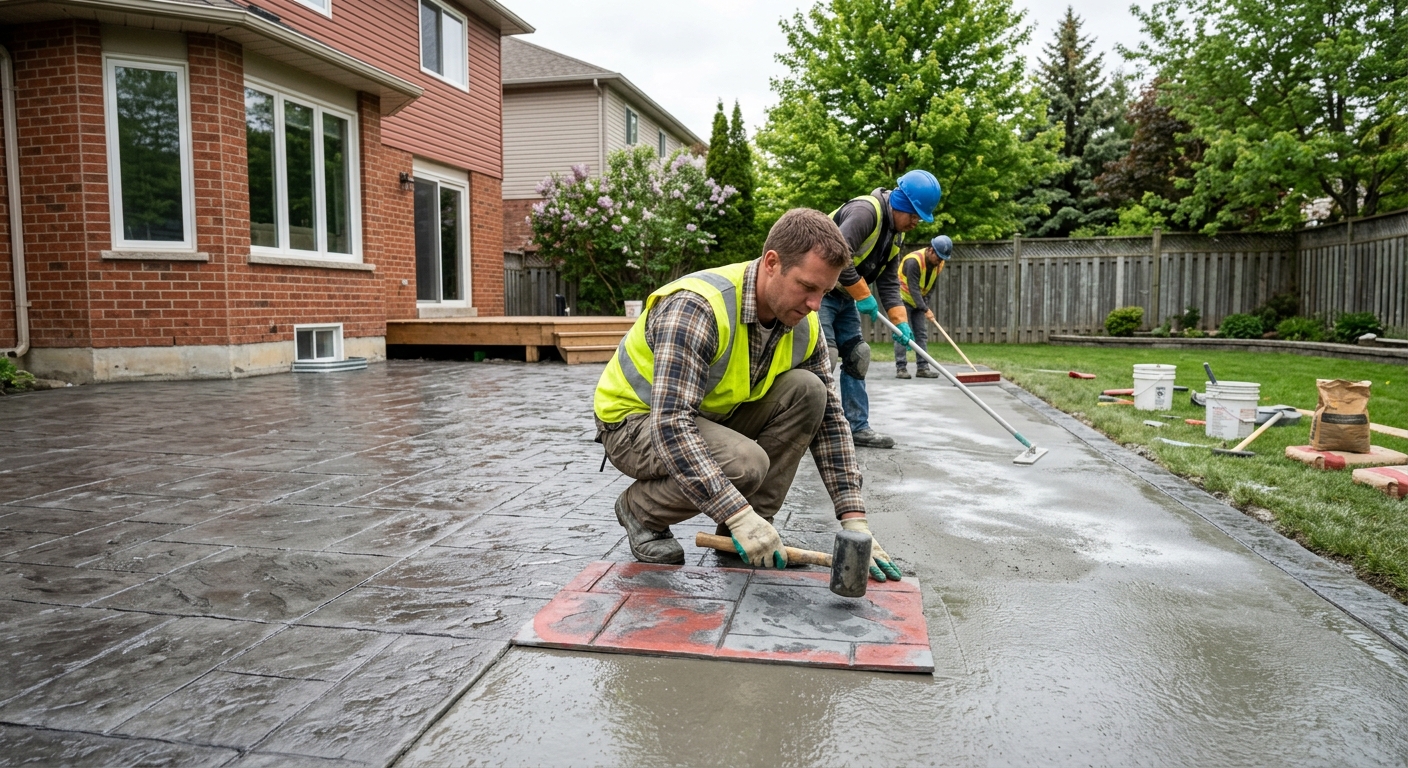
Concrete work options and costs in Harvest Hills
Harvest Hills concrete work is mostly driven by the needs of local homeowners and builders in a market where the majority of housing is single-detached. In the 2021 Census, Harvest Hills had a population of 7,805, which translates to steady demand for driveways, patios, walkways and foundation work as properties get renovated and new builds are completed (Statistics Canada, 2021 Census). In this kind of neighbourhood build-out, contractors tend to be busiest in the spring and early summer, then tighten scheduling as the cold sets in.
In Calgary’s cold continental climate, concrete pricing reflects more than just forming and finishing. The design frost depth is engineered around about 1.2 m (roughly 4 ft) in this region, so footings and structural concrete often require deeper excavation and more base preparation than you’d see in milder parts of Canada. Freeze–thaw cycles also push specifications toward air-entrained concrete for exterior flatwork, plus a well-thought-out control joint plan to reduce cracking and spalling. On top of that, the exterior pour season is shorter, and winter placement may require winter-grade materials, insulated blankets and sometimes temporary heat to protect curing.
Because of these climate-driven requirements, you’ll often see quotes differ meaningfully even for the same “standard” footprint. For example, a driveway in the Harvest Hills area near local school and pathway corridors typically needs careful access planning for trucks and finishing, which can increase labour time but improves long-term performance. With that context, here’s a realistic comparison of common options and budgets to help you line up like-for-like scopes.
| Application |
Typical Size |
Key Spec |
Finish Option |
Price Range |
| Concrete driveway (standard broom finish) |
24 ft x 10 ft (240 sq. ft.) |
Air-entrained mix for exterior, compacted granular base |
Broom finish + saw-cut joints |
$12,000–$18,000 |
| Exposed aggregate driveway |
24 ft x 10 ft (240 sq. ft.) |
Air-entrained mix, proper curing control |
Exposed aggregate (wash or retarder method) + seal |
$15,000–$22,000 |
| Stamped concrete driveway or patio |
24 ft x 10 ft driveway OR 300 sq. ft. patio |
Air-entrained mix, integral color, full bond prep |
Stamp patterns + release + seal |
$15,000–$26,000 |
| Plain concrete patio or walkway |
300 sq. ft. patio / 100 sq. ft. walkway |
Exterior air-entrained mix, compacted base |
Float/finish + saw-cut joints |
$5,000–$9,000 |
| Garage floor (interior slab) |
22 ft x 20 ft (440 sq. ft.) |
Interior mix + vapour barrier + insulation if specified |
Steel trowel + light broom texture at doorways |
$8,000–$15,000 |
| Foundation footings (structural, below frost) |
Typical single home + garage/porch impact |
Reinforced concrete designed below ~1.2 m frost depth |
Structural formwork + rebar + engineered detail |
$28,000–$45,000 |
Prices are estimates only and vary by project scope, site access and material selection.
What affects the price of concrete work in Harvest Hills
In Harvest Hills and across the Calgary region, you can see 30–50% price swings for the same “type” of concrete work because the quote depends on what’s truly required to make the slab or foundation perform in a freeze–thaw environment. The biggest drivers are how deep you must excavate (frost depth), how much base preparation is needed, what mix design is specified, and how long the contractor must protect curing to hit the strength and durability targets. Even small differences in truck access, subgrade conditions, and reinforcement detailing can add up quickly.
For exterior work, Calgary practice generally assumes footings and structural members must extend below the local design frost depth (about 1.2 m here) to prevent frost heave and seasonal movement. Freeze–thaw cycles also dictate air-entrained concrete for driveways, patios and walkways; without that, the surface can spall over time. Cold-weather placement further affects cost: the pour season is shorter, and curing often needs heating, insulating blankets or winter-grade admixtures to reach proper strength. Finally, de-icing salt in winter accelerates surface wear, so sealing is commonly recommended—especially on broom-finished or exposed aggregate surfaces.
In practice, a driveway that lands at the lower end of the typical $12,000–$18,000 band is usually on firm soil with straightforward access and a standard reinforcement plan. Push it toward the higher range when excavation is deeper, when mesh/rebar needs upgrading, or when the homeowner wants an exposed aggregate finish with extra labour and tighter curing control. For patios and walkways, the typical $5,000–$9,000 range tightens when the base is stable and the footprint is uncomplicated; it expands when there’s slope correction, utility adjustments, or decorative finishing.
| Price Factor |
Why It Matters |
Cost Impact |
| Frost line depth — determines footing depth and form height |
Footings must bear on undisturbed soil below frost to prevent movement |
Higher excavation and concrete volume; can shift foundations into the $28,000–$45,000 range |
| Site preparation — excavation, grading, compacted granular base |
Proper base prevents settlement and reduces cracking under freeze–thaw |
Extra trucking/haul-off and more granular material; often a major quote driver |
| Reinforcement — rebar or wire mesh requirement |
Improves load capacity and reduces width of cracks in exterior slabs |
Additional steel and labour to place accurately; can add several thousand dollars |
| Mix design — air-entrainment and compressive strength spec |
Air void system helps concrete survive freeze–thaw without spalling |
Winter-grade or engineered mixes can increase material cost |
| Finish type — broom vs. stamped vs. exposed aggregate |
Decorative finishes need labour-intensive preparation and curing control |
Stamped/exposed typically pushes flatwork toward the upper bands |
| Pour size and concrete truck access to site |
Long pulls or tight access slow placement and can require more crews/plans |
Extra labour time, coordination and sometimes smaller loads |
| Cold-weather curing precautions — heating and blankets |
Cold temperatures can prevent adequate curing and early strength gain |
Heaters, blankets and labour time can raise costs noticeably in shoulder season |
| Control joint pattern and sealing cost |
Joints reduce random cracking; sealing helps with de-icing salt wear |
Added saw cutting and materials; often worth it for exterior longevity |
Permits & regulations in Alberta
In Alberta, structural concrete work usually needs a building permit. That typically includes foundations such as footings, foundation walls, and grade beams—especially when the municipality requires engineered drawings and inspections for the structural elements. For example, a homeowner planning new or replacement structural foundation elements in Harvest Hills should expect permit requirements and inspections as part of the foundation stage.
Concrete flatwork (patios, walkways and driveways) often does not require a permit on its own. However, permits can become necessary when the work affects lot grading, drainage, or impervious surface coverage rules, or when you’re changing how runoff is directed near the property boundary. The safe approach is to confirm with the local authority before breaking ground, particularly if you’re altering drainage, raising the grade, or working close to a right-of-way.
To protect yourself, verify your contractor before scheduling: (1) confirm they carry general liability insurance and provide a current certificate of insurance; (2) ask for WSIB/WCB clearance (or the applicable Alberta coverage information) and verify it’s current; and (3) request references for similar-scale structural and flatwork projects in Calgary-area conditions. Step-by-step, you can also check for contractor registration/clearances through online registries used in Alberta and review the certificate details for coverage limits and dates. Clearance letters and certificates should match the exact legal business name on the quote and invoice.
Getting concrete right in Harvest Hills's freeze-thaw climate
Concrete failures in Harvest Hills typically come down to three things: inadequate base prep, the wrong mix for freeze–thaw, and curing that’s rushed or under-protected. In a cold continental climate with frequent freeze–thaw cycles, exterior slabs need the right granular sub-base thickness and compaction so the slab doesn’t settle or heave. The mix must be air-entrained to create freeze–thaw protection; that’s what reduces surface spalling when de-icing salts and winter moisture meet the slab. Then comes the “invisible” part homeowners don’t always see: curing. Minimum curing time and protecting the slab during cold snaps determine whether you get the strength and durability you paid for.
For a properly engineered exterior flatwork spec in Harvest Hills, plan for: (1) compacted granular base to the correct depth for your soil and frost considerations; (2) air-entrained concrete with an exterior target of about 5–7% air content; (3) a minimum 32 MPa compressive strength; (4) control joints cut and spaced to encourage cracking in the right locations; (5) at least 7 days of curing under proper conditions, with winter precautions like blankets/heating when temperatures require; and (6) penetrating sealer applied 28 days after the pour to repel de-icing salts.
When homeowners compare options, the price difference is often justified when it protects the slab. For instance, if a standard broom-finish driveway sits near the $12,000–$18,000 band, moving to an exposed aggregate finish with a more demanding curing and surface preparation plan may bring you closer to the upper end (or beyond) because it requires extra steps—not just decorative form work. The goal is to ask: “What air content, what strength, how deep is the base, and how will you protect curing?”
| Spec |
Why It Matters in Harvest Hills |
What to Ask For |
Impact if Skipped |
| Compacted granular base (depth?) |
Improves load support and resists frost-related movement |
State granular base depth and compaction method for your soil |
Settlement, early cracking and uneven surface wear |
| Air-entrained concrete mix (target air %?) |
Protects concrete during freeze–thaw and reduces spalling risk |
Ask for exterior air target of 5–7% and mix design documentation |
Surface scaling/spalling over winter cycles |
| Compressive strength (MPa rating) |
Ensures durability and load capacity in a harsh climate |
Confirm minimum 32 MPa and curing conditions |
Lower strength gain, higher cracking probability |
| Control joints (spacing per ACI guidelines) |
Limits random cracking patterns from shrinkage and temperature swings |
Ask for planned joint layout and saw-cut timing |
Random wide cracks that admit water and accelerate deterioration |
| Minimum 7-day curing period |
Cold weather slows curing, impacting strength and surface durability |
Confirm curing plan; if temps drop, ask about blankets/heating |
Reduced strength and increased scaling risk |
| Penetrating sealer (when applied after cure) |
Helps repel moisture and de-icing salts that drive surface breakdown |
Ask for penetrating sealer at 28 days post-pour (typical) |
Faster surface wear and more frequent maintenance |
How to choose a concrete work contractor in Harvest Hills
Choosing the right contractor in Harvest Hills is mostly about verifying capability and accountability for winter-ready concrete work. Start with Alberta coverage checks: request a current certificate of general liability insurance (including liability limits) and ask for WSIB/WCB coverage confirmation for workers. Next, verify the contractor’s registration/clearance status through Alberta’s online resources used for contractor verification, and make sure the name on the insurance and clearance matches the legal business name on the quote.
Then get 2–3 itemised written quotes rather than lump sums. The quote should break out labour and materials—like excavation and disposal, granular base, reinforcement, formwork, concrete supply (including air-entrainment and strength spec), finishing, joints, and sealing. Read the scope for exclusions: what’s not included (for example, site regrading, utility locates, snow removal during cure, additional saw cuts, or decorative extras)? Ask whether permit pulling (when required) is included in the price and confirm who is responsible for inspections.
Warranty also matters. Look for a workmanship warranty length (not just a product statement), plus how repairs are handled. Ask whether any manufacturer warranty applies to the specific materials used and whether it’s transferable. For payment, plan a schedule where you don’t pay more than 10–15% upfront; use a holdback until the job is complete and surfaces are cleaned and sealed as agreed. Finally, get start date and completion estimate in writing, tied to weather contingencies.
- Ask for the proposed air-entrained mix spec (target air % and strength rating)
- Confirm base depth and compaction method for your soil conditions
- Request reinforcement details (mesh vs. rebar, placement method, cover)
- Verify joint spacing and saw-cut timing plan
- Ask about cold-weather curing provisions (blankets/heating when needed)
- Get disposal and haul-away included (or clearly excluded) in the quote
- Confirm sealing type and timing (typically 28 days post-pour for penetrating sealer)
- Ensure truck access plan is included (no “we’ll figure it out day-of”)
- Check that quotes specify finishes exactly (broom vs. stamped vs. exposed aggregate)
- Request insurance certificate and WSIB/WCB clearance before signing
- Use a payment schedule with a holdback until final cleanup and walkthrough
- Get proof of similar completed projects in Calgary-area freeze–thaw conditions
Concrete red flags in Harvest Hills include: promises of “cheap concrete” without specifying air-entrainment; skipping base-depth details and compaction requirements; vague curing plans for cold mornings/evenings; no clear joint layout or joint-cut timing; and a warranty that’s only a short “material” statement with no workmanship coverage.
Frequently asked questions — concrete work in Harvest Hills
When is the best time to pour concrete in Harvest Hills?
For Harvest Hills and the Calgary area, the best window is typically late spring through summer when daytime temperatures are stable and nights stay manageable. This matters because freeze–thaw cycles are hard on fresh concrete if curing is interrupted. Contractors also plan around frost risk (with the local design frost depth guiding foundation work) and the practical exterior pour season. If you’re scheduling for driveways, patios or walkways, aim for weather that allows at least 7 days of proper curing. If you must pour in a shoulder season, ask specifically about winter-grade mixes, insulated blankets and any temporary heating plan. If you’re comparing quotes, those curing precautions can be a reason one contractor ends up closer to the higher end of the typical flatwork bands (Statistics Canada, 2021 Census).
How long does concrete take to cure?
Concrete cure time has two layers: early strength and longer durability development. In Alberta freeze–thaw conditions, you should plan for at least 7 days of curing under proper conditions for typical residential exterior slabs, including driveways and patios. That doesn’t mean it’s “done”—concrete continues to gain strength and durability beyond that. In cold conditions, the curing process can slow dramatically, which is why reputable Harvest Hills contractors use blankets or heat when needed to keep temperatures stable. If sealing is part of your scope, penetrating sealer is commonly applied after the pour has had time to cure—often around 28 days—to repel de-icing salts. When you’re comparing options like plain broom-finish vs. stamped concrete, ask whether curing and protection steps are included, because skipping them is where most premature surface problems start.
Do I need a permit for concrete work in Alberta?
In Alberta, structural concrete generally requires a building permit, including footings, foundation walls, and grade beams. Concrete flatwork—like patios, walkways and driveways—often does not require a permit by itself, but it can if the work affects lot grading, drainage, impervious surface coverage limits, or the municipal right-of-way. For a homeowner in Harvest Hills, the practical approach is to confirm with the local authority before excavation, especially if you’re changing slopes, directing runoff, or replacing sections near the property line. Also verify that your contractor is properly insured and can provide required documentation. If engineered drawings are needed for foundation work, that will usually be part of the permit process. When quotes differ, “permit handling included” can be one of the hidden cost drivers.
Concrete vs pavers for a patio in Harvest Hills?
Both can work well, but the right choice depends on maintenance expectations and how your base is built. Concrete patio slabs are typically smoother to clean and can be finished broom-smooth for traction; they also work well when engineered with air-entrainment, good base compaction, and a proper joint layout to manage temperature movement. Pavers can offer easier spot repairs and a more “modular” look, but you still need a strong base and correct drainage to avoid heaving. In Harvest Hills’ freeze–thaw climate, what often drives performance is not the material name—it’s whether the contractor specs correct granular base preparation and protects the installation. Pricing for a plain concrete patio or walkway commonly fits the typical $5,000–$9,000 band; stamped concrete can move higher (often closer to $15,000–$26,000 depending on footprint and finish). Ask both bidders for base depth, joint/drainage details, and the repair strategy after winter cycles.
How long does a concrete driveway last?
A well-installed concrete driveway in the Calgary region can last decades, but performance depends on the details that are easy to miss: frost-resistant base prep, air-entrained concrete for freeze–thaw, correct reinforcement, control joints, and curing protection. Without those, spalling and cracking can appear much earlier—sometimes within a few winters—because de-icing salt and moisture accelerate surface wear. In Harvest Hills, sealing helps repel salt and can extend the life of the surface, particularly on broom-finished and exposed aggregate finishes. Your total driveway budget also influences how much reinforcement and finishing time is possible; a standard driveway often lands in the $12,000–$18,000 range, while decorative finishes and tighter curing requirements can push costs higher. If you want a durability-focused estimate, compare contractors on what they’re doing before and during the pour—not just the final finish.
What is air-entrained concrete and why does it matter here?
Air-entrained concrete is mixed with tiny, controlled air bubbles that give water room to expand when it freezes. In Harvest Hills and the broader Calgary region, freeze–thaw cycles and winter moisture are constant stressors, and air-entrainment is one of the key defences against surface damage like scaling and spalling. Exterior flatwork—driveways, patios and walkways—should generally be specified with air-entrainment and a suitable strength rating (commonly aiming for around 5–7% air content for exterior flatwork and minimum 32 MPa). This spec is one reason quotes can vary even when footprints are similar; it also ties directly to curing and finish quality. When comparing bids, ask the contractor to confirm the air-entrained mix design and how they’ll protect curing during colder weather. If it’s not clearly stated, treat it as a major missing piece in the scope.