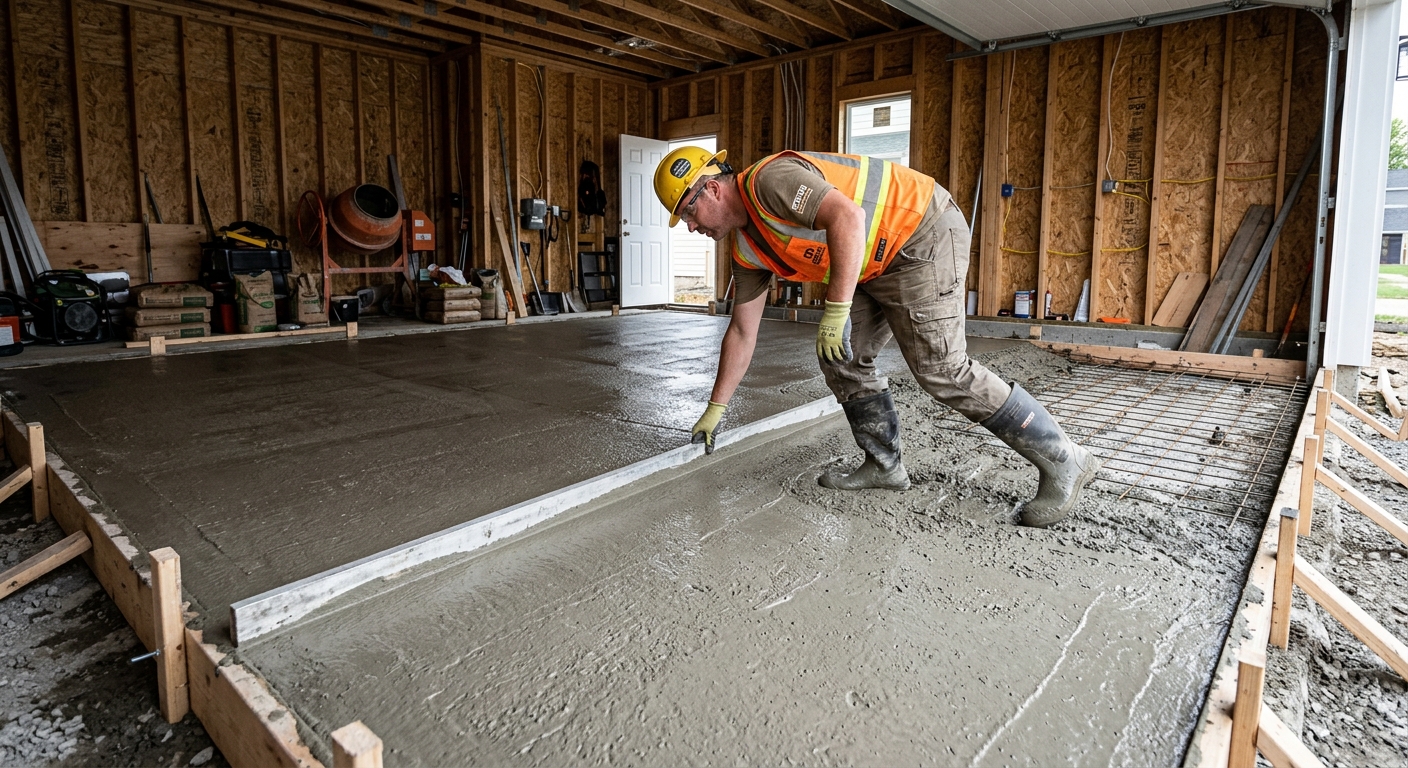
Concrete work options and costs in Swan Hills
Concrete work in Swan Hills is all about getting the right specs for the ground conditions, not just picking a colour. With about 82.5% of local dwellings being single-detached homes (Statistics Canada, 2021 Census), most driveway, patio and walkway projects are tied to routine homeowner upgrades—often at properties built long before newer standards. About 64.3% of homes in Swan Hills were built before 1981 (Statistics Canada, 2021 Census), so we frequently see older drainage patterns, compacted soil that needs reworking, and replacement flatwork that has to perform through deep seasonal frost.
In the Athabasca–Grande Prairie–Peace River region, costs are shaped heavily by climate and logistics. Frost typically runs deep, meaning exterior footings and slab edges must sit well below frost to reduce heave, and that drives excavation and forming costs. Freeze–thaw cycles also make air-entrained concrete and tight control-joint planning non-negotiable, especially for slabs exposed to winter meltwater. Crews in the Peace region also tend to work in a shorter, higher-demand pour season, and cold-weather curing precautions (heating and insulated blankets) can add time and labour—particularly when crews and equipment are booked.
Concrete is especially in demand around town core and residential areas off Highway 2 where homeowners plan practical upgrades before winter. Below is a straightforward comparison of common options and what drives the budget.
| Application |
Typical Size |
Key Spec |
Finish Option |
Price Range |
| Concrete driveway (standard broom finish) |
24 ft x 10 ft (240 sq ft) |
Frost-depth edge prep, air-entrained exterior mix |
Broom finish, simple control joints |
$14,000–$20,000 |
| Exposed aggregate driveway |
24 ft x 10 ft (240 sq ft) |
Proper curing schedule, air-entrained mix |
Exposed aggregate with sealer |
$18,000–$26,000 |
| Stamped concrete driveway or patio |
18 ft x 12 ft (216 sq ft) |
Reinforcement as required, air-entrained mix |
Stamp + release + colour hardener |
$22,000–$35,000 |
| Plain concrete patio or walkway |
10 ft x 12 ft (120 sq ft) |
Compacted base, air-entrained exterior mix |
Screed + light broom finish |
$12,000–$18,000 |
| Garage floor (interior slab) |
24 ft x 22 ft (528 sq ft) |
Vapour control considerations, proper curing |
Power-trowel or steel trowel + sealer |
$18,000–$30,000 |
| Foundation footings (structural, below frost) |
Varies by house plan (example: 400 sq ft footing area) |
Engineered rebar, excavation below frost, drainage |
Structural concrete, formwork as required |
$45,000–$70,000 |
Prices are estimates only and vary by project scope, site access and material selection.
What affects the price of concrete work in Swan Hills
The same concrete job can come in 30–50% apart across the Athabasca–Grande Prairie–Peace River region because the real cost is in the groundwork and labour planning, not the cement. In Swan Hills, you’ll often see one contractor quote closer to the driveway backbone range (about $14–$20 for typical concrete driveway work), while another ends up higher once they include deeper frost protection, more granular base, reinforcement, and cold-weather curing precautions that protect the slab against scaling. Transport and scheduling also matter here—when crews are in peak demand and equipment has to move from a wider service area, productivity changes.
Frost line depth and freeze–thaw cycles dictate every spec in this region. Exterior footings must extend below the design frost depth (Alberta can reach up to about 2.4 m depending on conditions), which increases excavation and forming. Freeze–thaw cycles then require air-entrained mixes for exterior slabs so you don’t get early surface scaling. Cold weather also shortens the reliable pour season for flatwork, and if you need heated curing or insulated blankets, that adds time and handling cost. Finally, de-icing salt accelerates spalling on inadequately mixed or unsealed concrete—so sealing is often treated as part of the “durability package,” not an optional add-on.
Here are a few real examples of how local conditions move the price up or down in Swan Hills: replacing a failed driveway typically costs more if the old base is pumping or contaminated and must be fully rebuilt (higher excavation and disposal). A simple broom-finish walkway can stay nearer the $12–$18 band when access is easy and weather conditions allow proper curing. Stamped work is more sensitive to timing and finishing crew availability; it’s often justified when you want curb appeal and are selecting a finish like that $22–$35 decorative range, but it still needs the same frost and air-entrainment basics to last.
| Price Factor |
Why It Matters |
Cost Impact |
| Frost line depth |
Determines footing depth and form height |
More digging, more concrete volume, higher forming and labour |
| Site preparation |
Excavation, grading, compacted granular base |
New base and proper compaction can add significant labour and granular material |
| Reinforcement |
Rebar or wire mesh requirement |
Material + placement time; increases cost but reduces cracking risk |
| Mix design |
Air-entrainment and compressive strength spec |
Exterior air-entrained mix can raise material cost, but is critical for freeze–thaw |
| Finish type |
Broom vs. stamped vs. exposed aggregate |
Decorative work adds finish time, tools, and sometimes colour hardener |
| Pour size and concrete truck access |
How much can be placed per trip and how close trucks can park |
Long carries and tight access increase labour and may require scheduling changes |
| Cold-weather curing precautions |
Heating and blankets |
Higher labour, fuel, and material costs to protect early strength gain |
| Control joint pattern and sealing cost |
Crack control + surface protection from de-icing salts |
More planning and labour; sealing adds a separate materials line item |
Permits & regulations in Alberta
In Alberta, structural concrete work typically requires a building permit, and it’s common to need engineered drawings that the municipality reviews. That usually includes footings, foundation walls, and grade beams—any concrete that forms part of the structural system or supports the building loads. For Swan Hills homeowners, that’s the work that must be permitted because it affects structural safety and requires inspection.
Concrete flatwork such as patios, walkways and driveways usually does not require a permit, unless it impacts lot grading, drainage, or impervious surface coverage limits, or if it affects municipal right-of-way areas. Even when a permit is not required for the slab itself, you should confirm requirements with the local authority before breaking ground, especially if you’re changing the slope toward a ditch or sidewalk.
Step-by-step, verify a contractor properly in Alberta:
- Confirm the company is licensed/registered to do the work (ask them for their Alberta documentation and verify it through the applicable online registry).
- Ask for a Certificate of Insurance showing liability coverage; ensure it matches the job site address.
- Request proof of WSIB/WCB coverage for the crews doing the concrete and site work.
- Look for a clearance letter or current status confirmation on their documentation—don’t rely on a verbal claim.
- Ask for 2–3 references on similar-scale projects in Alberta climates (flatwork and/or below-frost work).
If a contractor won’t provide insurance and coverage details up front, that’s a red flag—especially in a place where freeze–thaw durability and below-frost excavation make rework expensive.
Getting concrete right in Swan Hills's freeze-thaw climate
Concrete failures in Swan Hills usually come down to one theme: the slab or footing didn’t get the right base, the right air content, and the right curing time for freeze–thaw cycles. In the Athabasca–Grande Prairie–Peace River region, the freeze–thaw pattern can be brutal on inadequately prepared slabs—so the “spec” matters as much as the finish. Here’s how to spec the job so it performs.
First, base preparation: compacted granular sub-base to the correct depth for local soils and frost requirements, with proper grading and drainage so meltwater doesn’t saturate the base. Second, mix design: exterior flatwork typically needs air-entrainment (commonly targeted at 5–7% air content) and a minimum 32 MPa compressive strength. Third, control joints: plan them to limit random cracking, then keep spacing consistent so joints do the cracking instead of the slab. Fourth, curing: minimum 7-day curing under proper conditions. In cold or wet weather, cold-weather curing measures (heating/insulated blankets) protect strength gain and reduce early surface damage. Fifth, sealing: for durability against de-icing salts, use a penetrating sealer applied after the slab cures—commonly at around 28 days post-pour.
When you’re comparing quotes, ask for air-entrainment documentation and joint layout, not just “broom finish.” A specific example: a plain broom-finish driveway might land near the $14–$20 estimate band if base prep and air-entrainment are included. The cheapest quote tends to cut corners—like thinner base or skipping curing precautions—which can lead to scaling. Spending within that band is usually justified because repairs after freeze–thaw can cost far more than the difference between a well-prepped standard mix and a basic “value” spec.
| Spec |
Why It Matters in Swan Hills |
What to Ask For |
Impact if Skipped |
| Compacted granular base (depth?) |
Stabilizes soil and reduces heave under repeated freeze–thaw |
Base depth, compaction method, granular type and moisture conditions |
Settlement, cracking, and premature edge failure |
| Air-entrained concrete mix (target air %?) |
Prevents freeze–thaw damage and scaling/spalling on exterior slabs |
Air content target (typically 5–7%) and confirmation of air entrainment |
Spalling, scaling, and surface deterioration in winter |
| Compressive strength (MPa rating) |
Ensures concrete gains design strength despite cold/short season |
Minimum 32 MPa (or project-specific spec) and curing plan |
Lower strength, increased cracking and surface defects |
| Control joints (spacing per ACI guidelines) |
Controls where cracks happen during shrinkage and temperature swings |
Planned joint layout, timing of cutting, and sealing approach |
Random cracking across the slab and more water intrusion |
| Minimum 7-day curing period |
Strength and durability depend on protected curing through temperature swings |
How curing will be maintained in cold weather (blankets/heating if needed) |
Weak surface layer, scaling, and reduced long-term performance |
| Penetrating sealer (when applied after cure) |
Reduces salt and moisture penetration that drives spalling |
Sealer type and target application timing (commonly ~28 days post-pour) |
More rapid deterioration from de-icing salts and moisture |
How to choose a concrete work contractor in Swan Hills
Choosing a concrete contractor in Swan Hills should start with verifying Alberta coverage and accountability, then move to how clearly they scope the work. Start with licensing/registration: ask the contractor which trade authorization applies to their work and verify it through the appropriate Alberta online registry. Next, verify liability insurance—request a Certificate of Insurance naming you/your property as appropriate, and confirm the policy is current for the job dates. Then ask for WSIB/WCB coverage documentation for the workers who will be on site; in Alberta, trades commonly carry this for worker protection, and you should be able to view current status or clearance letters. If they can’t provide these documents quickly, don’t sign.
For pricing, get 2–3 itemised written quotes that separate labour and materials. You want line items for excavation, granular base, reinforcement, formwork, concrete supply, finishing, saw-cut control joints, curing measures, and disposal. Avoid one-line “lump sum” quotes unless the scope is extremely detailed. Carefully read what’s excluded: is permit work included (if required for structural work), is site protection included, and is haul-off/disposal included for unsuitable soil? Confirm the number of truck loads and how access constraints are handled.
Ask about warranty in plain terms: workmanship warranty length, who honours it, and whether product/manufacturer warranty applies to admixtures/sealers. Clarify whether warranties are transferable if you sell the home.
Payment schedule matters in a short northern pour season: never pay more than 10–15% upfront. Hold back a portion until the final walk-through and finish/cure/sealer items are complete. Also request a start date and completion estimate in writing, tied to weather readiness.
- Provide proof of insurance and WSIB/WCB status before work starts.
- Give references for Swan Hills-area flatwork or similar frost conditions.
- Itemise scope: excavation, base, rebar/mesh, concrete, finishing, joints, curing, sealing.
- Specify concrete mix: air-entrainment and minimum 32 MPa strength.
- Show joint layout and when joints will be cut.
- Confirm curing method for cold days (blankets/heating if needed).
- Confirm disposal/haul-off for excess soil and forms.
- Clarify protection of landscaping, fences, and grading drainage paths.
- Confirm truck access plan and whether pumps are required.
- Include workmanship warranty length and what’s covered.
- Ask for product specs for sealers and decorative systems (if applicable).
- Verify schedule and weather contingency plan.
Concrete contractor red flags in Swan Hills: promises of “no need for air-entrainment,” quotes that omit curing blankets/heating in cold snaps, no mention of control joints or sealing, vague excavation/base specs, and requests for large upfront payments without a detailed scope or dates.
Frequently asked questions — concrete work in Swan Hills
What is rebar and when is it required in Alberta?
Rebar is steel reinforcement placed in concrete to control cracking and add strength where tension forces occur. In Alberta, rebar is commonly required for structural concrete such as foundation footings, foundation walls, and grade beams, and those projects are typically permitted and engineered. For exterior flatwork like driveways and garage slabs, rebar is often recommended or required depending on slab thickness, soil conditions, and loading (for example, heavy vehicles and turning stress). In Swan Hills’ freeze–thaw climate, reinforcement doesn’t replace correct air-entrainment or base prep—it complements them. When you get a quote in the Athabasca–Grande Prairie–Peace River region, ask what reinforcement is included (rebar size, spacing, and placement level) and whether it matches the design for your application. If the quote is near the standard driveway band (about $14,000–$20,000), the reinforcement and base should still be clearly specified—not assumed.
How long does a concrete project take in Swan Hills?
In Swan Hills, timelines depend on access, excavation volume, weather, and how much protection curing needs. For typical flatwork, you’ll often see: one or two days for site prep (base excavation, grading, compacting), one day for formwork and pouring, and then additional time for curing protection and finish work. The slab won’t be “fully ready” right away—minimum curing periods apply, and cold-weather conditions can extend the timeline. Even though decorative finishes may be placed in a day, staging for stamping, texturing, and curing protection matters. Structural concrete like footings and below-frost work can take longer because excavation and inspection coordination are involved, and engineered layouts usually require more planning. If the job needs extended curing blankets, that can shift completion by several days. Planning around Swan Hills’ shorter reliable pour season helps keep the schedule realistic and protects the investment.
What is a concrete overlay and is it suited to Swan Hills?
A concrete overlay is a new concrete layer placed over an existing slab, usually after preparation like crack repair, cleaning, and sometimes grinding or partial removal. Overlays can work when the existing concrete is stable and the base isn’t failing (no major settlement or pumping), and when moisture conditions can be controlled. In Swan Hills’ freeze–thaw environment, overlays are sometimes attempted to save cost, but they only perform if the prep is thorough and the old slab is sound. If the original slab is already scaling, curling, or losing support, an overlay can trap problems underneath and lead to faster deterioration. Overlays can also complicate drainage at the edges unless the slope is carefully maintained. For many homeowners, a full replacement may be closer to the $14,000–$20,000 driveway backbone range, while an overlay quote may look lower initially. The key is to ask the contractor how they will assess base integrity and moisture issues before deciding overlay versus removal.
How do I seal concrete to protect it in Swan Hills?
Sealing helps reduce moisture and de-icing salt penetration, which is important in Alberta’s freeze–thaw cycles and in Swan Hills where winter maintenance is common. Typically, sealing is done after the concrete has cured properly; a common practice is applying a penetrating sealer around 28 days post-pour so the slab has developed strength and moisture levels are suitable for bonding. The surface should be clean, dry, and free of dust, curing compounds, and contaminants. For driveways, sealing is especially valuable because salt and meltwater can drive spalling when the concrete is not well protected. When you’re comparing quotes, don’t just ask “will it be sealed?”—ask what sealer type is used, the expected application timing, and whether it’s included in the scope. If your project is within the standard or decorative bands (for example, $22,000–$35,000 for stamped work), sealing should be detailed as part of that durability package, not treated as an afterthought.
What is the difference between concrete and cement?
In everyday conversation, people use “cement” and “concrete” interchangeably, but they’re not the same. Cement is the binder—one of the ingredients that reacts chemically to form strength. Concrete is the final composite made from cement plus aggregates (sand and gravel), water, and often admixtures such as air-entrainment for exterior durability. In Swan Hills, that admixture choice is a big deal because freeze–thaw cycles demand air-entrained concrete for exterior flatwork. When a contractor quotes your driveway or patio, what matters isn’t whether they mention “cement”—it’s the mix design requirements: target air content, minimum compressive strength (commonly at least 32 MPa for flatwork specs), and curing plan for cold weather. A quote that’s accurate should describe the concrete performance spec even if you never hear the word “cement.”
How much does concrete work cost in Swan Hills?
Concrete costs in Swan Hills typically follow regional climate and logistics, so budgeting based on local bands is the safest approach. For example, a standard broom-finish concrete driveway often lands in the $14,000–$20,000 range, depending on excavation, base rebuild needs, reinforcement, and whether cold-weather curing is required. Plain patios and walkways commonly fall around $12,000–$18,000, while stamped concrete is usually higher—roughly $22,000–$35,000—because decorative finishing is labour-intensive and timing-sensitive. Foundation footings (structural, below frost) are typically quoted in a broader band of about $45,000–$70,000 because excavation and reinforcement are substantial. Your exact total will depend on site access, truck placement, disposal, and how much the base needs correction, especially on older homes (many built before 1981 in Swan Hills). Get an itemised quote so you can see what’s included rather than relying on a single number.