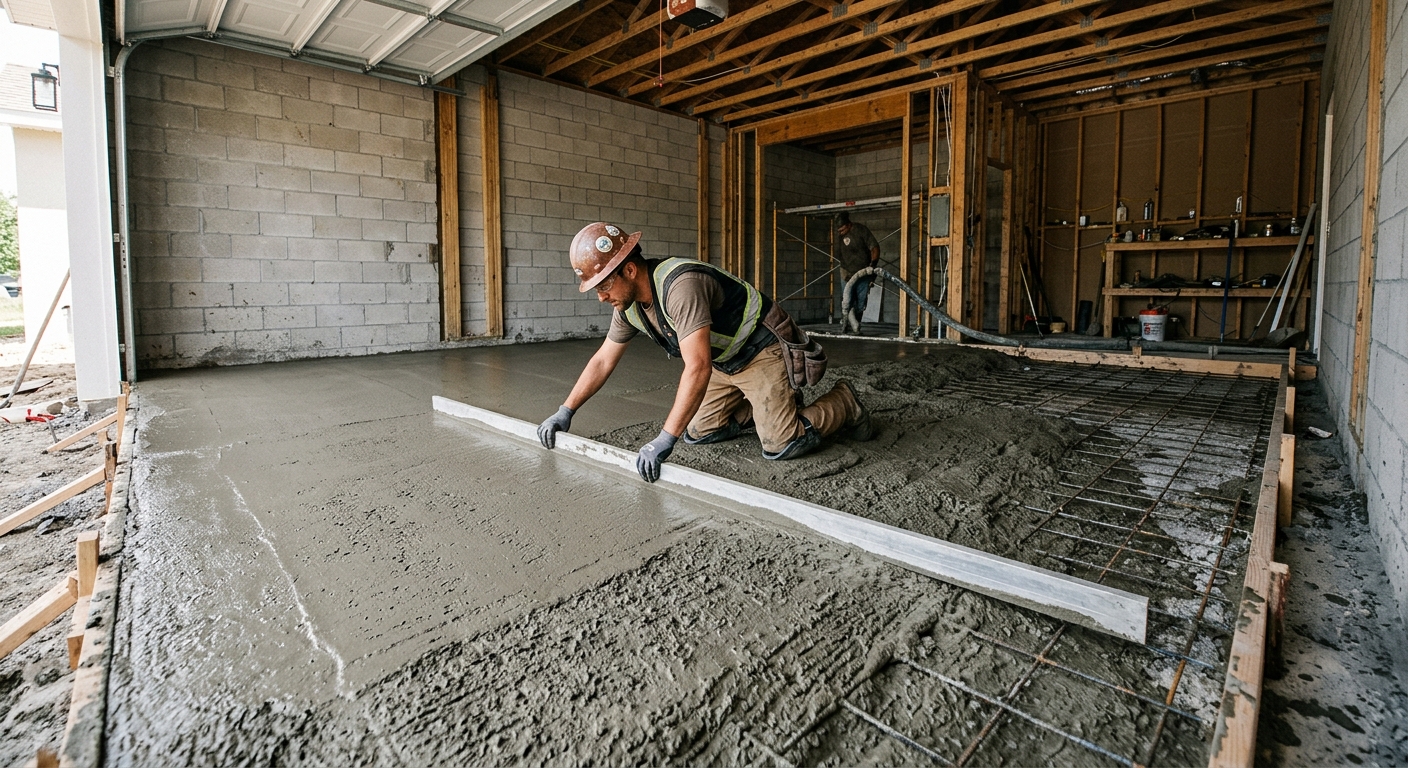
Concrete work options and costs in Falconer Heights
Concrete work in Falconer Heights is shaped by a short exterior pour season and a deep frost depth, so your driveway, patio, walkways and foundations are priced like engineered systems—not just “wet cement.” Falconer Heights has a population of 2,079 (Statistics Canada, 2021 Census), and the surrounding Calgary region is dominated by family neighbourhood growth where homeowners commonly add or upgrade concrete flatwork around single-detached homes, which makes local scheduling and crew availability especially important. In practice, most concrete flatwork demand tends to cluster in established residential pockets near newer infill streets, where properties are updating driveways and adding rear patios to match the way families use outdoor space.
In Calgary’s cold continental climate, freeze–thaw cycles and de-icing salt drive the specs: air-entrained concrete, properly compacted granular base, and a crack-control plan. The frost depth used for design is roughly 1.2 m (about 4 ft) in this region, so footings and exterior supports often require more excavation than in milder provinces. That excavation, plus winter-grade placement and curing precautions (insulated blankets, sometimes heat), is a big reason why concrete quotes can swing depending on when the pour happens and how accessible your site is.
Below are typical contractor pricing ranges for common Falconer Heights projects, using current local backbone bands for this tier. Use this table to sanity-check your quote before you compare contractor line items.
| Application |
Typical Size |
Key Spec |
Finish Option |
Price Range |
| Concrete driveway (standard broom finish) |
24 ft x 10 ft (240 sq ft) |
Air-entrained, 4 in thick typical; granular base & reinforcement as required |
Broom finish with expansion/control joints |
$12,000–$18,000 |
| Exposed aggregate driveway |
24 ft x 10 ft (240 sq ft) |
Air-entrained mix; proper curing to achieve exposure |
Exposed aggregate finish |
$15,000–$21,500 |
| Stamped concrete driveway or patio |
200 sq ft driveway or 240 sq ft patio |
Air-entrained; higher material and labour for stamping system |
Stamped pattern with release agent |
$15,000–$26,000 |
| Plain concrete patio or walkway |
12 ft x 16 ft (192 sq ft) or 4 ft x 20 ft (80 sq ft) |
Air-entrained; compacted base and drainage slope |
Smooth/steel finish with light broom edges |
$5,000–$9,000 |
| Garage floor (interior slab) |
22 ft x 20 ft (440 sq ft) |
Vapour barrier & reinforcement as required; typically 4 in slab |
Smooth trowel or light broom |
$10,500–$16,500 |
| Foundation footings (structural, below frost) |
Varies by plan; typical single-detached footprint |
Below design frost depth (~1.2 m in this region); engineered rebar & concrete |
Structural concrete only (no surface decorative finish) |
$28,000–$45,000 |
Prices are estimates only and vary by project scope, site access and material selection.
What affects the price of concrete work in Falconer Heights
In Falconer Heights and the Calgary market, the same “driveway” or “patio” can quote 30–50% differently from one contractor to the next because the real cost drivers are underground and in the curing process: excavation and granular base depth, reinforcement design, concrete mix requirements, and winter placement controls. Two bids may both call for “4 inches,” but one plan may include deeper base prep, engineered reinforcement, proper air-entrainment, and a control joint layout that actually matches the panel sizes—those details directly affect longevity and crack patterns.
Frost depth and freeze–thaw cycles dictate every exterior spec in this region. Here, footings and exterior supports are designed around roughly 1.2 m of frost depth (about 4 ft), so excavation is more intensive and footing volumes are higher than in warmer areas. Exterior slabs also need air-entrained concrete to survive repeated freezing and thawing, especially where de-icing salt is used. Calgary’s colder seasons mean a shorter pour window, so contractors may schedule earlier placements or use cold-weather curing precautions (insulated blankets, heating methods, and mix adjustments). Rushing curing can lead to scaling and surface deterioration, which eventually increases repair costs.
Local conditions that raise cost in Falconer Heights often include narrow driveways that limit truck access, poorly draining soil requiring additional base work, and older lots where regrading is more extensive. Costs can be lower when you have a straightforward rectangle footprint with easy access and existing drainage that’s already correct. For a ballpark comparison, standard broom driveway pricing typically sits in the $12,000–$18,000 band, while stamped systems often land in the $15,000–$26,000 range because of labour-heavy finishing and system materials.
| Price Factor |
Why It Matters |
Cost Impact |
| Frost line depth |
Determines footing depth and form height |
More excavation and concrete volume; can add major cost on foundations and structural supports |
| Site preparation |
Excavation, grading, compacted granular base |
Unstable or wet subgrade increases base tonnage, rework, and equipment time |
| Reinforcement |
Rebar or wire mesh requirement |
Labour to install steel + material cost; engineered designs often raise cost but reduce failure risk |
| Mix design |
Air-entrainment and compressive strength spec |
Higher spec mixes can cost more, but are critical for freeze–thaw durability |
| Finish type |
Broom vs. stamped vs. exposed aggregate |
Decorative finishes typically add labour and materials versus standard broom |
| Pour size and concrete truck access to site |
Logistics affect placement speed and quality |
Long carries or tight staging can require extra manpower and more planning |
| Cold-weather curing precautions |
Heating and blankets |
Insulation/heat adds cost but helps prevent surface scaling and weak early strength |
| Control joint pattern and sealing cost |
Controls cracking and reduces moisture ingress |
More joints and proper sealants increase line items but protect the surface over time |
Permits & regulations in Alberta
In Alberta, structural concrete work generally requires a building permit and, in many cases, engineered drawings reviewed by the municipality. This typically includes foundation-related items like footings, foundation walls, grade beams, and other below-grade structural elements. For concrete flatwork—like patios, walkways, and driveways—permits often are not required unless the work affects lot grading, impacts impervious surface coverage limits, or ties into the municipal right-of-way (for example, drainage changes near a curb/sidewalk area). Because requirements can depend on site conditions and local interpretation, the practical step is to confirm with the local authority before you break ground.
For your protection in Falconer Heights, verify the contractor carries liability insurance and the required workplace coverage (WSIB/WCB coverage). Then ask for references on similar-scale projects—ideally recent Calgary-area exterior pours—so you can see how they manage freeze–thaw curing and crack control. If a contractor is vague about documentation, that’s a warning sign.
Step-by-step verification for Alberta:
- Licence/registration: check the contractor’s business details on the provincial/online registry where applicable and confirm the name matches the quote and invoice.
- Liability insurance: request a current certificate of insurance and verify active coverage before the first pour day.
- WSIB/WCB clearance: ask for confirmation/clearance of required workplace coverage (or the applicable proof).
- References: request 2–3 recent local projects and ask specifically about winter placements and sealing timelines.
Getting concrete right in Falconer Heights's freeze-thaw climate
Concrete failures in Falconer Heights are usually about water and temperature management. Freeze–thaw cycles can push moisture through small cracks; if the concrete isn’t air-entrained correctly or the base isn’t compacted and sloped properly, you’ll see scaling, spalling, and widening cracks over time. To spec the job correctly, start with base preparation: a compacted granular sub-base sized to suit your soil and frost considerations, placed in lifts and compacted to reduce settlement and pumping. Next, lock in mix design: exterior flatwork should use air-entrained concrete (typically 5–7% air content for durability) and a minimum compressive strength around 32 MPa, suited to cold exposure.
Then address control joints. Joints are your “planned crack” system, so you need a spacing approach that limits random cracking while still allowing for thermal movement. Finally, curing matters most in Calgary’s shoulder seasons. Plan for at least 7 days of proper curing conditions; in cold weather, crews often use insulating blankets and controlled heat to protect early strength gain. After cure, seal with a penetrating sealer applied about 28 days post-pour to repel de-icing salts and reduce moisture intrusion.
When asking questions, focus on the most common failure mechanism: spalling from inadequate air-entrainment. If a quote is cheaper but doesn’t clearly state air content and curing precautions, it’s often false savings. For example, upgrading from a standard broom finish to a stamped patio can move you into the $15,000–$26,000 decorative band, but that price is justified only if the base, mix, joints, and curing specs are equally strict—not just if the surface pattern changes.
| Spec |
Why It Matters in Falconer Heights |
What to Ask For |
Impact if Skipped |
| Compacted granular base (depth?) |
Reduces frost-related movement and settlement under repeated freeze–thaw |
Confirm excavation depth, base thickness, and compaction method to suit your soil |
Settlement, cracking, and early edge deterioration |
| Air-entrained concrete mix (target air %?) |
Protects against freeze–thaw damage and surface scaling |
Ask for the target air content (typically 5–7%) and verify it’s included in the mix design |
Spalling and scaling can appear within a few winters |
| Compressive strength (MPa rating) |
Ensures strength gain for cold exposure and durability |
Confirm minimum 32 MPa (or higher if engineered) and test/traceability practices |
Lower long-term strength and increased cracking risk |
| Control joints (spacing per ACI guidelines) |
Controls where cracks happen instead of random cracking |
Ask for joint spacing, saw-cut timing, and sealing plan |
Random cracking and moisture pathways |
| Minimum 7-day curing period |
Cold slows strength gain; curing supports proper durability development |
Confirm curing duration and cold-weather protections (blankets/heating) if needed |
Weak surface scaling and reduced resistance to freeze–thaw |
| Penetrating sealer (when applied after cure) |
Helps repel de-icing salt and reduces moisture ingress |
Ask for application timing (about 28 days post-pour) and sealer type |
Faster salt damage and spalling near edges and joints |
How to choose a concrete work contractor in Falconer Heights
Choosing the right contractor in Alberta comes down to proof and process. Start by verifying licensing/registration details for the business, then confirm current liability insurance and workplace coverage (WSIB/WCB). In practice, you can check these by: (1) requesting a certificate of insurance from the contractor and confirming it’s active for the exact project period; (2) asking for WSIB/WCB clearance/proof applicable to their workforce; and (3) cross-checking that the company name on the insurance and coverage documents matches the quote and invoice. If they can’t provide documentation quickly, don’t assume it’s “no big deal”—concrete issues are expensive, and you want coverage in place.
Next, demand 2–3 itemised written quotes. Ask for a breakdown that separates excavation, granular base, reinforcement, concrete supply, forming, finishing, joints, sealing, and disposal/disposal haul. Avoid pure lump sums where key items are missing.
Read exclusions carefully: is permit pull included (when required for structural work)? Is disposal of excess material included? Are snow/ice removal and cold-weather curing blankets part of the plan if temperatures drop? Also ask about warranty terms. A workmanship warranty should be in writing, and you should know the length and what it covers. Product/manufacturer warranties may apply to sealers or decorative systems—ask if they’re transferable to you.
Payment schedule matters. Never pay more than about 10–15% upfront; hold a reasonable portion back until forms are removed, finishing is complete, joints are sealed (where included), and the site is cleaned. Get a start date and completion estimate in writing—especially because Calgary’s freeze–thaw cycle can compress the pour window.
- Provide proof of liability insurance (certificate of insurance) before signing
- Provide WSIB/WCB proof/clearance for their workforce
- Share at least 2–3 recent Calgary-area similar pours (driveways/patios/foundations)
- Quote includes granular base depth, compaction method, and drainage slope
- Concrete mix spec includes air-entrainment for exterior flatwork
- Reinforcement requirements are explained (not just “we’ll decide later”)
- Control joint layout and sealing plan are listed as separate line items
- Cold-weather curing approach is described (blankets/heating if needed)
- Confirm disposal/hauling for excess material and waste
- Stated timeline includes curing and when sealing (if included) will occur
- Warranty length and exclusions are written clearly
- Payment schedule caps upfront and includes a completion holdback
In Falconer Heights, red flags include: quotes that don’t mention air-entrained concrete for exterior slabs, no plan for joints or sealing, vague curing timelines (especially for late-season pours), “too-good-to-be-true” decorative pricing without detailed base prep specs, and contractors who won’t show insurance/WSIB/WCB documentation or recent references.
Frequently asked questions — concrete work in Falconer Heights
What is rebar and when is it required in Alberta?
Rebar (reinforcing steel) is used to help concrete resist tension and control cracking, which is especially important for slabs and foundations exposed to movement from freeze–thaw cycles in Alberta. In Falconer Heights, rebar is typically required for structural elements like footings, foundation walls, and grade beams, and may be required for exterior flatwork depending on design load (driveways vs. light pathways), slab thickness, and engineering requirements. Some slabs use wire mesh or welded wire fabric in lieu of rebar, but reinforcement should follow the spec rather than guesswork. If your project is structural, the permit package and engineered drawings usually spell out placement and size, and the contractor should build to that. If you’re comparing quotes, ask what reinforcement they’re installing and why—then confirm it’s included in the price rather than treated as an “allowance.”
How long does a concrete project take in Falconer Heights?
In Falconer Heights, the schedule depends more on prep, weather, and curing than on the pour day itself. Typical driveway or patio work often runs 3–7 working days including excavation, base compaction, forms, finishing, and joint cutting. Actual “wet concrete” time is usually measured in hours, but curing requirements and Calgary temperature swings can stretch the timeline. For cold-weather placements, crews may need additional time for insulating blankets/heating to protect strength gain. Also, sealing (when included) is commonly applied about 28 days after the pour, so the final “fully protected” phase may be later even after the forms are stripped. If your quote references a standard flatwork budget like $5,000–$9,000 for a basic patio/walkway, confirm whether the timeline includes joint work and curing protections, not just the pour. Good contractors plan around the shortened exterior season.
What is a concrete overlay and is it suited to Falconer Heights?
A concrete overlay is a new layer placed on top of an existing concrete surface to restore appearance and extend service life. In Falconer Heights, overlays can be suitable when the original slab is structurally sound—meaning minimal spalling, no major settlement, and cracks that can be stabilized. If the existing base is failing or the slab has ongoing movement, an overlay can still crack and fail because freeze–thaw movement continues below. Overlay success depends on surface preparation: grinding, cleaning, sometimes bonding agents, and proper thickness and curing. Overlays also have different performance from full replacement when de-icing salt and water have already penetrated old concrete. Before paying for an overlay, ask for inspection findings and a documented plan for joint treatment and drainage. In many cases, if the driveway is already in the $12,000–$18,000 replacement territory, contractors will recommend replacement when movement is present.
How do I seal concrete to protect it in Falconer Heights?
Sealing in Falconer Heights is about repelling moisture and reducing de-icing salt impact, not “making concrete waterproof forever.” The key is timing and product selection. After a new exterior pour, don’t seal immediately—most penetrating sealers are applied after the concrete has cured, often around 28 days post-pour, provided the surface is dry and ready. Prior to sealing, the slab should be clean and free of curing compounds, dust, and salts. For freeze–thaw areas, the best approach is pairing sealing with proper joints, drainage slope, and air-entrained mix design. If a contractor includes sealing, ask what type of sealer they’ll use, coverage rate, and whether joints are prepared/treated correctly. Sealing is commonly part of higher-quality exterior maintenance, and it’s especially relevant if you regularly use de-icing products. When comparing bids in the $12,000–$18,000 driveway band, look for whether sealing is included or listed as a separate line item.
What is the difference between concrete and cement?
Cement is one ingredient—basically the powder binder—that reacts with water to create the paste that holds everything together. Concrete is the finished composite: cement plus water, plus aggregates (sand and gravel), often with additives like air-entrainment admixtures for exterior durability in Alberta’s freeze–thaw conditions. So when a contractor says “air-entrained concrete,” they’re talking about the overall concrete mix design, not just the cement. This distinction matters because durability issues (like spalling) often come from mix design and curing practices—especially failure to include correct air content for exterior flatwork. When you get quotes in Falconer Heights, ask for the mix design specs: air-entrainment target, minimum compressive strength (commonly around 32 MPa for exterior slabs), and cold-weather curing plan. A lower quote that ignores those details usually under-specs performance, even if it uses the same “cement” label.
How much does concrete work cost in Falconer Heights?
Concrete pricing in Falconer Heights is driven by frost-depth excavation, granular base prep, reinforcement, finish labour, and whether cold-weather curing precautions are required. For quick comparison: concrete patios and walkways commonly land in the $5,000–$9,000 range depending on size and site access. Standard broom-finished driveways are often in the $12,000–$18,000 band. Stamped/decorative options typically cost more because of labour and system materials, often in the $15,000–$26,000 range. For structural foundation footings (below frost), pricing often sits in the $28,000–$45,000 range depending on excavation volume and engineered requirements. If you’re comparing quotes, insist on itemised line items—base prep depth, reinforcement type, mix spec, joint and sealing scope—so you’re not paying for a finish while missing the durability work that matters most in Alberta’s freeze–thaw climate.