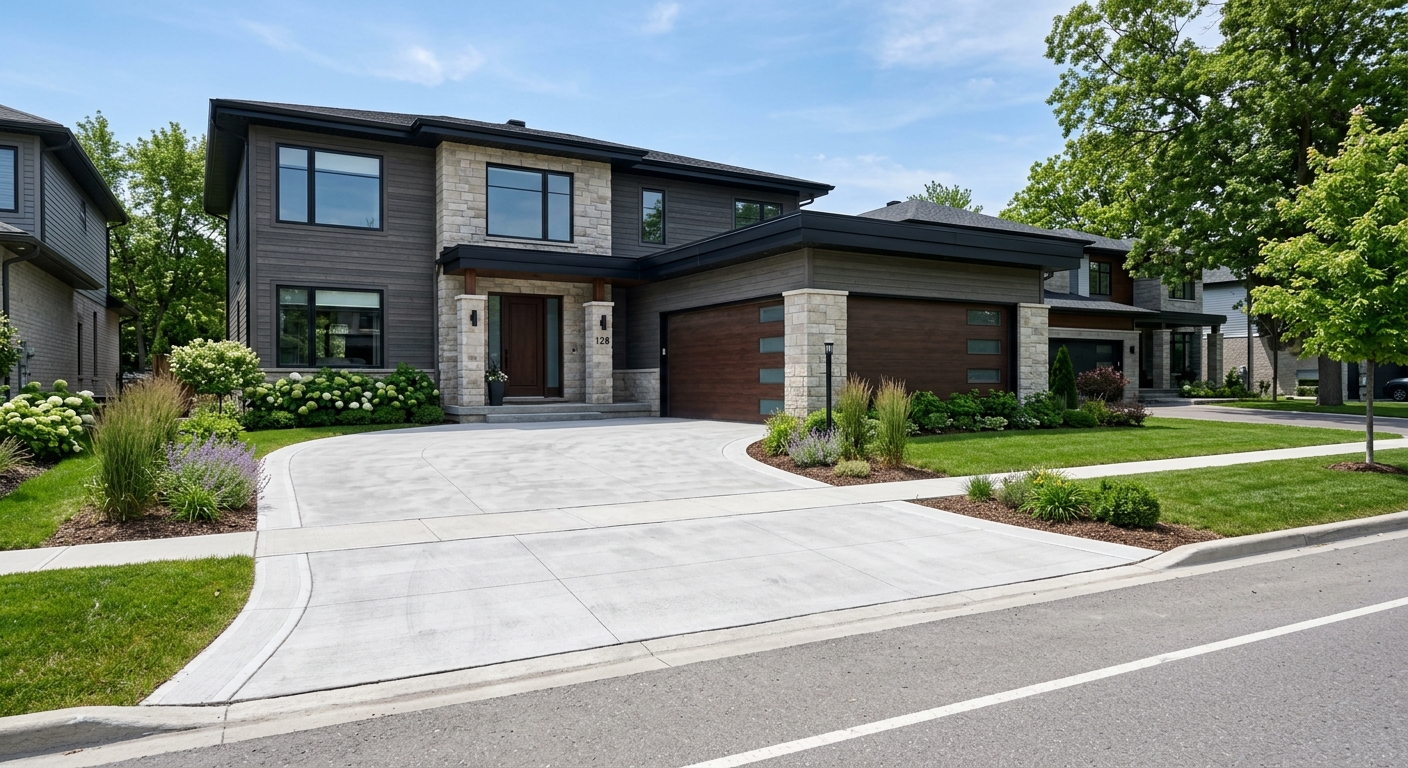
Concrete work options and costs in Chinatown
In Chinatown, Alberta, homeowners typically choose concrete because it holds up well to our long, cold winters—especially when it’s engineered for freeze–thaw. According to the 2021 Census, the area’s population is 2,250, and that smaller local market tends to concentrate demand around specific street corridors and older-adjacent infill lots where driveways and walkways get replaced often. Calgary’s housing mix includes many single-detached and low-rise residences, which is the primary driver for driveway, patio, walkway and garage slab work. (Statistics Canada, 2021 Census.)
In Calgary’s cold continental climate, concrete pricing reflects deeper frost protection and more intensive excavation. Regional engineering practice works from a design frost depth of about 1.2 m (roughly 4 ft), so footings must bear below the freeze line, and exterior slabs need proper granular base prep. Freeze–thaw cycles also push crews toward air-entrained concrete mixes, control joints, and better curing practices—particularly in the shorter exterior pour season. That means fewer “easy-weather” days, tighter scheduling, and sometimes winter-grade placement methods (insulated blankets or temporary heat) if you’re pouring near shoulder seasons.
Trade demand is especially steady around the inner-city blocks near downtown amenities and the transition to older residential streets, where access for trucks can be tight. If your contractor has to haul materials in shorter batches or manage limited staging, you’ll see it in the quote. Use the table below to compare typical options and budget bands before you request itemised pricing.
| Application |
Typical Size |
Key Spec |
Finish Option |
Price Range |
| Concrete driveway (standard broom finish) |
24 m² (approx. 260 ft²) |
Air-entrained exterior mix; control joints |
Broom finish, saw-cut joints, sealer optional |
$12,000–$18,000 |
| Exposed aggregate driveway |
24 m² (approx. 260 ft²) |
Retarder/aggregate exposure; frost-ready base |
Exposed aggregate with sealed surface |
$15,000–$22,000 |
| Stamped concrete driveway or patio |
20 m² (approx. 215 ft²) |
Stamped mat pattern; air-entrained exterior mix |
Stamped pattern (slip-resistant release, sealer) |
$15,000–$26,000 |
| Plain concrete patio or walkway |
18 m² (approx. 195 ft²) |
Exterior slab; air-entrained; proper slope |
Broom or smooth trowel with light edging |
$5,000–$9,000 |
| Garage floor (interior slab) |
37 m² (approx. 400 ft²) |
Interior mix; vapour control; slab thickness as required |
Broom or light-finish (optional densifier) |
$8,000–$14,000 |
| Foundation footings (structural, below frost) |
Varies by house plan |
Engineered rebar cage; below design frost depth |
Typical structural concrete (no decorative finish) |
$28,000–$45,000 |
Prices are estimates only and vary by project scope, site access and material selection.
What affects the price of concrete work in Chinatown
Even when two contractors price “the same” driveway or patio in Calgary and the broader region, you can still see a 30–50% gap once engineering specs, site conditions, and scheduling are factored in. The biggest driver is our freeze–thaw reality: Calgary’s design frost depth of about 1.2 m means excavation volumes and footing considerations are rarely superficial, and footings must extend below the design frost depth to reduce frost heave risk. Exterior slabs also rely on air-entrained concrete mixes to survive repeated freezing and thawing. On top of that, the practical pour season is shorter than in milder provinces, so cold-weather curing precautions (insulated blankets, heating, and tighter scheduling for proper curing) can add real cost.
De-icing salts common in Calgary winters accelerate surface wear if the slab is under-specified, which is why sealing and surface finishing matter. In Chinatown, older properties often have tighter access, buried services, or landscaping that needs careful demolition and disposal; that can shift labour hours quickly. For example, replacing a standard broom-finished driveway near a garage access point may land near the $12,000–$18,000 band, while an exposed aggregate option can push higher because of extra labour for exposure and more stringent finishing and sealing steps. A similar jump happens when stamped concrete is selected—still frost-ready, but with added material handling and finishing time, which aligns with the $15,000–$26,000 range.
Conversely, if your site already has a compacted base from previous work and you have easy truck access, you may avoid some excavation and form complexity. In an area like Chinatown where many lots were developed earlier, those “hidden” variables often explain why one quote feels unexpectedly high or unexpectedly low.
| Price Factor |
Why It Matters |
Cost Impact |
| Frost line depth — determines footing depth and form height |
Footings must bear below the design frost depth to limit frost heave and seasonal movement |
Deeper excavation and more concrete; can increase structural scope meaningfully |
| Site preparation — excavation, grading, compacted granular base |
Proper grading and compaction prevent settlement and reduce cracking in exterior slabs |
Extra haul-off, deeper demo, and longer equipment time raise costs |
| Reinforcement — rebar or wire mesh requirement |
Controls cracking and improves performance under loads (driveways, garage floors, some patios) |
Material and labour to place supports/tie steel |
| Mix design — air-entrainment and compressive strength spec |
Air-entrainment and strength rating improve freeze–thaw durability |
Higher-spec concrete and additional testing/checks |
| Finish type — broom vs. stamped vs. exposed aggregate |
Finish determines slip resistance, aesthetics, and labour/time on the pour |
Stamped/exposed work adds materials, tools, and skilled labour |
| Pour size and concrete truck access to site |
Short access can mean more trips and slower placement |
Truck fees, staging labour, and schedule impacts |
| Cold-weather curing precautions — heating and blankets |
Ensures concrete reaches proper early strength and avoids scaling |
Insulation blankets/heaters and added supervision |
| Control joint pattern and sealing cost |
Joints guide shrinkage cracking; sealing helps with de-icing salt exposure |
Additional cutting labour and sealer materials/crew time |
Permits & regulations in Alberta
In Alberta, structural concrete work typically needs a building permit. That includes footings, foundation walls, and grade beams—anything that forms part of the primary structural system. In many cases, engineered drawings must be reviewed through the municipal permitting process before the crew excavates or places reinforcement. For concrete flatwork such as patios, walkways, driveways, and garage slabs, a permit is often not required unless the work affects lot grading, drainage, impervious surface coverage limits, or municipal right-of-way conditions. Because Chinatown projects can be on tighter urban lots with existing services and drainage patterns, it’s smart to confirm with the local authority before breaking ground.
Start by requiring your contractor to provide: (1) a valid Alberta licence information (as applicable for the work they’re performing), (2) liability insurance certificate, and (3) WSIB/WCB clearance or coverage confirmation. Step-by-step: ask for their certificate of insurance and verify the coverage is active and the contractor is named correctly; then request their WSIB/WCB clearance letter or confirmation and confirm the effective dates match your construction window. For licence verification, use the online registry the province provides for trade/business status (and ask your contractor for their business number or registration details so you can match the record).
Also, get references for similar-scale jobs in the Calgary area—especially exterior slabs engineered for freeze–thaw. A contractor who can’t explain frost considerations or provide comparable local photos will be a higher risk, regardless of how low the initial number looks.
Getting concrete right in Chinatown's freeze-thaw climate
Concrete failure in Chinatown, Alberta usually traces back to a few repeat offenders: inadequate base prep, under-specified air entrainment, and rushed curing. In a cold continental climate with frequent freeze–thaw cycles, water gets into pores and around weak surfaces; when it freezes, it expands. If your mix doesn’t have the right air content and curing conditions aren’t controlled, you’ll often see scaling, spalling at edges, and rapid deterioration—especially where de-icing salts hit.
Spec the job with local fundamentals. First is base preparation: excavate to the right level for your soil and frost strategy, then install and compact a granular sub-base. Second is mix design: air-entrainment is essential for exterior durability, and you should expect a target air content of about 5–7% for exterior flatwork, along with a minimum 32 MPa compressive strength specification. Third is control joints: they’re not optional aesthetics—proper spacing reduces random cracking. Fourth is curing: plan for at least 7 days under proper conditions, and in cold weather, use insulated blankets or temporary heat to keep early-age concrete warm enough to develop strength. Fifth is sealing: a penetrating sealer applied after the cure (commonly 28 days post-pour) helps repel salts and water from the surface.
To ask smarter questions, compare how much extra cost you’re paying for the right spec versus decorative upgrades. For example, upgrading from a plain broom-finished driveway to stamped concrete can shift you toward the $15,000–$26,000 band because of extra labour and materials—worth it if the underlying frost-ready specs are still correct. But if someone offers “cheap concrete” without confirming air-entrainment and the base, you’re likely saving money only up front while paying later for patching and resealing.
| Spec |
Why It Matters in Chinatown |
What to Ask For |
Impact if Skipped |
| Compacted granular base (depth?) |
Stable support prevents settlement and helps exterior slabs handle freeze expansion |
“What granular base depth and compaction method are you using for my soil?” |
Uneven cracking, rocking slabs, and early edge deterioration |
| Air-entrained concrete mix (target air %?) |
Air voids provide relief during freeze–thaw to reduce scaling and spalling |
“Confirm air content target (about 5–7% for exterior flatwork) and mix design sheet.” |
More freeze–thaw damage, scaling within a few seasons |
| Compressive strength (MPa rating) |
Adequate strength supports durability and resists surface wear |
“Minimum 32 MPa compressive strength—show the mix spec.” |
Surface wear, deeper cracking, reduced lifespan |
| Control joints (spacing per ACI guidelines) |
Joints control where shrinkage cracks happen in freeze-heavy regions |
“What joint spacing are you using, and are they saw-cut at the right timing?” |
Random cracking and wider repairs over time |
| Minimum 7-day curing period |
Proper curing ensures early-age strength before winter exposure |
“How do you plan for curing if temps drop—blankets/heating included?” |
Reduced strength, scaling, and compromised edges |
| Penetrating sealer (when applied after cure) |
Helps repel water and de-icing salt intrusion on exterior surfaces |
“Apply after cure—commonly 28 days post-pour. Will you include sealer type and coverage?” |
Faster salt-related surface breakdown |
How to choose a concrete work contractor in Chinatown
Choosing the right concrete contractor in Chinatown, Alberta is mostly about verification and clarity. Start with Alberta coverage checks: request a current certificate of liability insurance and confirm the policy is active for the construction period and covers concrete work activities. Next, verify WSIB/WCB coverage: ask for a clearance letter or confirmation showing their workers are covered and that the dates are current. If the contractor won’t provide documentation quickly, treat that as a warning sign.
Then get 2–3 itemised written quotes—not just a lump sum. You want a breakdown that shows labour versus materials, concrete supply, excavation/grading, rebar/wire mesh, vapour barriers where applicable, joints and cutting, and whether sealing is included. Clarify exclusions: is demolition and disposal included? Is permit pulling included for structural work? Are site protection and sidewalk/drive access restoration part of the scope? For warranty, ask for both workmanship warranty length and whether there’s any product/manufacturer warranty tied to the sealer or specialty mix, and whether it’s transferable if you sell the home.
Payment schedule matters in Calgary winters too. Never pay more than 10–15% upfront; hold back a portion until the final finish, sealing (if included), and documentation are complete. Finally, ask for a written start date and a completion estimate, and make sure they spell out curing and cold-weather precautions—blankets/heating should be planned for, not improvised.
- Ask for insurance certificate and confirm coverage is active during your scheduled pour date.
- Verify WSIB/WCB clearance or coverage confirmation with effective dates.
- Require an itemised quote with line items for base prep, rebar/mesh, concrete mix, joints, and finishing.
- Confirm demolition and disposal are included (or clearly excluded).
- Ask what air content and compressive strength the mix is designed for.
- Get the joint spacing plan and cutting schedule in writing.
- Ask how they handle curing in cold snaps (blankets/heating, minimum 7-day curing).
- Confirm whether a sealer is included and the application timing (commonly after full cure).
- Check if truck access and concrete placement method are described (especially on tight Chinatown lots).
- Look for a clear warranty on workmanship and repair timelines for scaling/spalling issues.
- Use a payment schedule with a holdback until completion and cleanup.
- Request references and photos from similar freeze–thaw exterior projects in the Calgary area.
Red flags I commonly see in Chinatown concrete bids: vague scope with no specs for air entrainment; “lowest price” quotes that skip proper base compaction; contractors who refuse to list joint/cure procedures; missing insurance or unclear WSIB/WCB status; and quotes that promise decorative finishes without discussing slip resistance, sealing, or protection from de-icing salt.
Frequently asked questions — concrete work in Chinatown
What is air-entrained concrete and why does it matter here?
Air-entrained concrete is mixed with tiny, evenly distributed air bubbles that act like pressure relief during freezing. In Chinatown and across Alberta’s Calgary area, the freeze–thaw cycle is frequent, and water trapped in concrete expands as it freezes. Without the right air content, the surface can scale and eventually spall, especially near edges and around driveway entries where de-icing salts are used. For exterior slabs and flatwork, many projects target about 5–7% air, plus a minimum 32 MPa strength spec. When you compare quotes, don’t just look at the driveway band (often $12,000–$18,000); ask for the mix design details and confirm that air entrainment and proper curing are included.
How do I prepare the base for a concrete slab?
Base preparation is the foundation of durability. In Chinatown’s freeze–thaw climate, crews typically excavate to the correct bearing level, then install compacted granular sub-base in lifts, with proper grading and drainage away from the structure. The goal is to avoid settlement and to provide consistent support so the slab doesn’t “rock” and crack. For walkways and patios, this means correct compaction and a stable granular layer; for driveways, the base must also handle vehicle loads and resist seasonal movement. Your contractor should explain the granular depth and compaction method in their quote, and show they’ve planned for Calgary’s frost considerations (below the design frost depth for structural footings). If base prep is vague, expect problems regardless of finish quality.
How do I compare concrete quotes?
Start by comparing what’s actually included. For example, a standard broom driveway and a stamped driveway can both land in different bands ($12,000–$18,000 versus $15,000–$26,000), but the finish isn’t the only difference—mix design, reinforcement, and joints should be comparable. Ask each contractor to break down labour and materials, including excavation, granular base, rebar/mesh, concrete supply, saw-cut timing, and whether sealing is included. Confirm permit handling if the work is structural. In Alberta, structural items like footings and foundation walls often require permits and engineered review, while patios and walkways frequently don’t unless grading or drainage limits are affected. Finally, make sure cold-weather curing measures are described if you’re pouring near shoulder season—those details often explain the real price gap.
Can concrete be poured in cold weather in Chinatown?
Yes, concrete can be poured in cold weather in Chinatown, but it has to be engineered and protected properly. Calgary’s design frost depth and freeze–thaw pattern means the biggest risk isn’t “freezing immediately”—it’s poor early-age curing leading to scaling and reduced strength. A reputable contractor will plan for winter-grade procedures such as insulated blankets, temporary heat, and careful monitoring so the concrete reaches adequate strength before exposure. They should also adjust the schedule so curing time is protected—don’t rush the job. If someone proposes pouring without discussing curing protection or minimum curing time (typically at least 7 days), that’s a major concern for exterior flatwork. As a rule, late fall and early spring pours often cost more, which is why quotes vary.
How do I maintain concrete in Chinatown's freeze-thaw climate?
Maintenance is about keeping water and salt away from the surface and joints. For exterior slabs, plan for a penetrating sealer once the concrete has fully cured—commonly around 28 days post-pour—so de-icing salts and meltwater don’t readily penetrate. Use non-abrasive de-icers where possible and avoid heavy scraping with metal shovels that can gouge edges. Keep drainage paths clear so water doesn’t pond near your driveway or patio. Inspect seasonally for minor surface pop-outs, cracked joints, or areas where spalling begins; early repairs cost far less than waiting for widespread scaling. If your concrete has control joints, monitor them too—joints are meant to relieve stress, but they still need proper sealing/attention per the contractor’s plan.
What causes concrete to spall in Chinatown winters?
Spalling in Chinatown winters is usually tied to freeze–thaw damage plus water and de-icing salt intrusion. The most common causes are inadequate air-entrainment (not enough protected micro air voids), poor base prep leading to flexing or settlement, and insufficient curing—especially if concrete is placed when temperatures drop and protection isn’t planned. Edge areas are often worse because they’re more exposed and can lose moisture faster. Another contributor is using harsh de-icing practices without sealing; salts accelerate surface breakdown and open pathways for freeze expansion. If you’re budgeting, remember that a driveway often sits in the $12,000–$18,000 band for standard broom work, but skipping the specs that make it durable is the real bargain-killer. Ask specifically for air content targets, joint/cutting plan, and curing/blanket procedures.