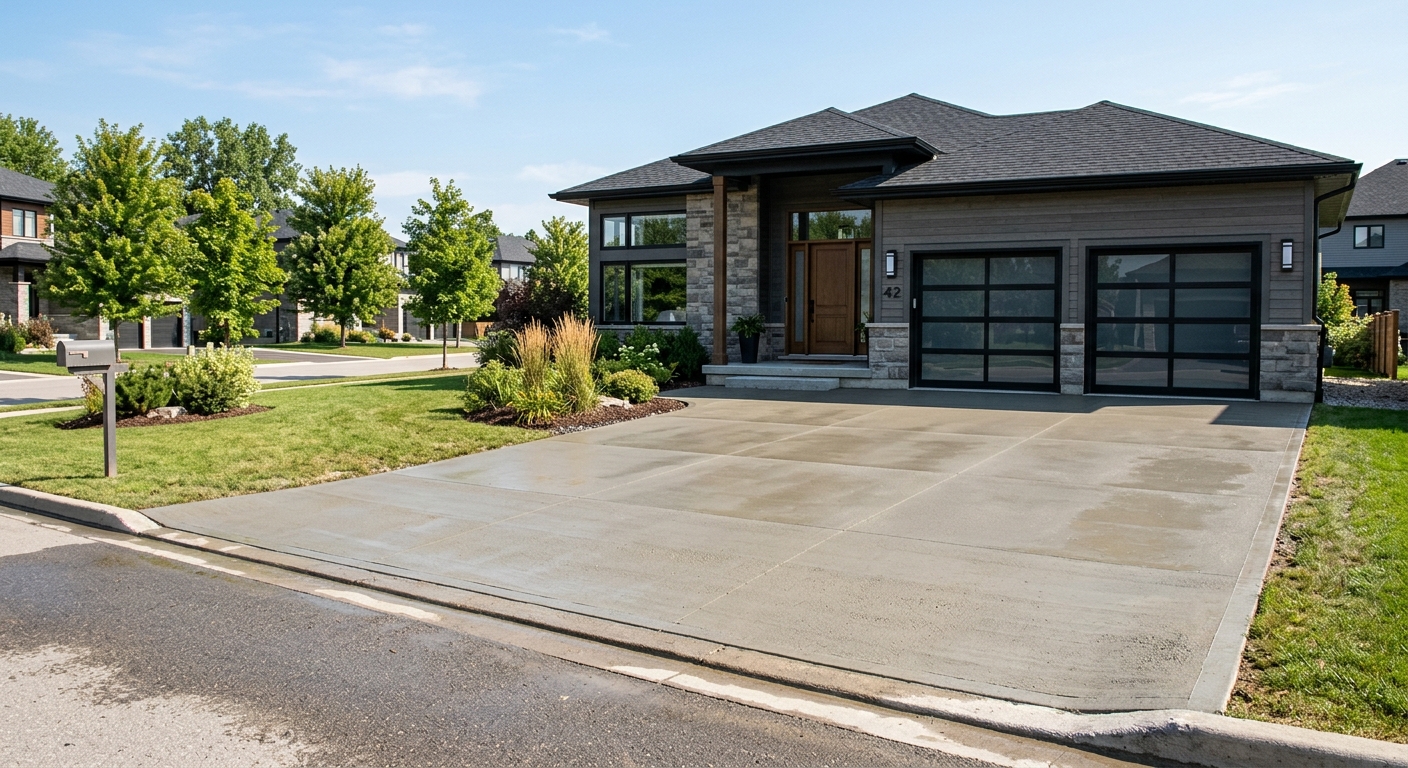
Concrete work options and costs in Aldergrove
Aldergrove homeowners typically start by comparing driveway, patio and walkway options, because concrete flatwork is one of the fastest ways to improve curb appeal and daily usability. In a community with 5,304 residents (Statistics Canada, 2021 Census), the trade is busy but still competitive—especially in neighbourhoods with lots of single-detached homes where families want longer-lasting exterior surfaces. The Calgary market context matters here too: contractors engineer every pour for Alberta’s colder freeze–thaw cycles, and that affects both materials and labour time.
In this region, Calgary’s design frost depth is about 1.2 m (roughly 4 ft). That means exterior work that touches the ground—driveways, garage slabs, decks and retaining walls—needs excavation and engineered support below that frost zone. Costs can rise quickly when access is tight (long walks, narrow gates, or steep grades) because excavation, granular base prep and concrete truck placement all take more time.
Freeze–thaw also drives mix design and detailing. Exterior slabs are typically air-entrained to resist surface scaling and freeze-related damage, and control joints are spaced to reduce random cracking. If you’re in demand areas like the more established east and central Aldergrove residential pockets (where many properties see repeated re-surfacing), you’ll often see scheduling faster and crews more booked during the workable pour season.
Below are realistic price bands you can use to compare bids; use them alongside your site conditions and finish preferences, then we’ll narrow to a tighter estimate in the next sections.
| Application |
Typical Size |
Key Spec |
Finish Option |
Price Range |
| Concrete driveway (standard broom finish) |
400 sq ft (e.g., 20' x 20') |
Air-entrained exterior mix, control joints |
Broom finish, saw-cut joints |
$12,000–$18,000 |
| Exposed aggregate driveway |
400 sq ft (e.g., 20' x 20') |
Air-entrained exterior mix, proper curing |
Exposed aggregate with sealer |
$14,000–$20,500 |
| Stamped concrete driveway or patio |
300–500 sq ft |
Air-entrained exterior mix, engineered base |
Stamp + release, integral colour (as selected) |
$15,000–$26,000 |
| Plain concrete patio or walkway |
200–350 sq ft |
Air-entrained mix, edging, joints |
Float finish or broom, simple formwork |
$5,000–$9,000 |
| Garage floor (interior slab) |
480 sq ft (e.g., 20' x 24') |
Vapour barrier + insulation as needed, wire mesh or rebar per design |
Float finish, optional broom top |
$12,500–$20,500 |
| Foundation footings (structural, below frost) |
Typical house: 1–1.5 days of excavation and placement |
Designed reinforcement, below frost level bearing |
Structural concrete (no decorative finish) |
$28,000–$45,000 |
Prices are estimates only and vary by project scope, site access and material selection.
What affects the price of concrete work in Aldergrove
In Aldergrove, it’s common to see quotes for the “same” concrete job land 30–50% apart across Calgary and Alberta. The difference usually isn’t just the slab—it’s the engineered groundwork beneath it: excavation to the right depth, granular base thickness, reinforcement decisions, and how the contractor protects curing and surface durability in cold weather.
Frost depth and freeze–thaw cycles dictate the specs. In Alberta, footings and any support that needs to resist frost movement must extend below the design frost zone; in the Calgary region that’s engineered at about 1.2 m (roughly 4 ft). Exterior slabs also require air-entrained concrete mixes to handle repeated freezing and thawing. On top of that, the pour season is shorter. If you’re trying to schedule late fall or early spring, cold-weather placement may require winter-grade mixes, insulated blankets and sometimes temporary heat—those add direct cost and can limit crew availability.
De-icing salt is another Alberta-specific reality. Salt accelerates spalling if the concrete is not properly air-entrained and sealed, which is why sealing is often recommended around 28 days after placement. You’ll often see contractors bundle sealing for driveways to improve long-term performance.
Two local examples help explain the swing in cost. First, a standard broom-finish driveway may fit the $12,000–$18,000 band, but adding stamped patterns and colouring can push the job into the $15,000–$26,000 range because it requires more labour, curing control and finishing steps. Second, a simple patio may start near $5,000–$9,000, but if your backyard access requires extra excavation and longer pumping/hoisting, the price can climb toward the higher end even without upgrading the finish.
| Price Factor |
Why It Matters |
Cost Impact |
| Frost line depth — determines footing depth and form height |
Exterior support must sit below engineered frost to avoid heave and seasonal movement |
Higher excavation increases material + labour; can add thousands on foundations |
| Site preparation — excavation, grading, compacted granular base |
Base compaction and correct elevations control settlement and cracking |
Unfavourable soil or deep removal raises granular and machine time |
| Reinforcement — rebar or wire mesh requirement |
Controls shrinkage/temperature cracking and load capacity where required |
Rebar cages cost more than light mesh; placement labour matters |
| Mix design — air-entrainment and compressive strength spec |
Air entrainment helps resist freeze–thaw damage and surface scaling |
Specified air + strength can increase material cost and requires careful curing |
| Finish type — broom vs. stamped vs. exposed aggregate |
Finishes require different labour, tooling, and timing |
Stamped/exposed aggregate typically adds labour and finishing materials |
| Pour size and concrete truck access to site |
Smaller, more complex pours need more crew time and planning |
Poor access can require extra equipment or longer setup/wait times |
| Cold-weather curing precautions — heating and blankets |
Proper curing is harder as temperatures drop in Alberta |
Winter protection can significantly raise costs for exterior slabs |
| Control joint pattern and sealing cost |
Joints reduce random cracking; sealers help against salt-driven spalling |
Sealer and proper joint layout add line items but reduce long-term failures |
Permits & regulations in Alberta
In Alberta, permits and documentation depend on what concrete you’re building. Structural concrete work—think foundation footings, foundation walls, grade beams and other load-bearing elements—usually requires a building permit, and many projects also need engineered drawings reviewed by the municipality. Concrete flatwork (driveways, patios and walkways) typically does not require a permit unless it impacts lot grading, alters drainage patterns, or conflicts with local impervious surface/servicing considerations or the municipal right-of-way. Before you dig, confirm with the local authority so you don’t end up redoing work due to grading or drainage issues.
For your contractor, verify insurance and coverage before any concrete is ordered. Step-by-step for Aldergrove homeowners:
- Ask for the contractor’s valid business registration and licence details (Alberta requirements vary by trade structure, but you want proof they’re properly established).
- Request a certificate of insurance showing general liability coverage for the work.
- Ask for proof of workers’ compensation coverage (WSIB/WCB as applicable in Alberta) so you’re not exposed if a worker is injured.
- Have them provide references from similar-scope jobs (driveways, patio slabs, or foundations), ideally in the Calgary region with comparable freeze–thaw exposure.
- When reviewing documents, ensure the dates are current and that the certificate lists the correct insured parties and jobsite address.
If a contractor can’t produce insurance and coverage documentation promptly, that’s usually a sign to pause and ask more questions.
Getting concrete right in Aldergrove's freeze-thaw climate
Concrete fails in Aldergrove most often because of inadequate base preparation, weak or wrong air-entrainment, poor curing, and sealing that comes too late or not at all. In a freeze–thaw environment engineered for about a 1.2 m design frost depth, the supporting layers must be compacted to the right depth and elevations so the slab doesn’t move seasonally. Once the base is right, the next defence is the mix: exterior flatwork should be air-entrained (typically 5–7% air content) and meet a minimum compressive strength target (commonly 32 MPa for many exterior applications per spec). If air-entrainment is missing or incorrect, water can enter the concrete and expand as it freezes—leading to scaling and eventual spalling, especially where de-icing salt is used.
To spec the job correctly, insist on a written plan for control joints, curing and sealing. Control joints are placed to limit random cracking by giving the slab a predictable “break line.” Curing matters more in cold weather: a minimum 7-day curing period is common, but you must protect the concrete so it achieves strength without premature cooling. After the slab cures (typically around 28 days), a penetrating sealer helps repel water and de-icing chemicals.
Budget reality check: upgrading from a plain broom-finish driveway to a stamped driveway can look like a big jump—often moving from the $12,000–$18,000 driveway band into the $15,000–$26,000 range. That difference is justified when the contractor also maintains correct base prep, uses air-entrained exterior mix, and doesn’t “cut corners” on curing and joint layout. If those technical pieces aren’t done, the decorative finish won’t prevent freeze–thaw damage.
| Spec |
Why It Matters in Aldergrove |
What to Ask For |
Impact if Skipped |
| Compacted granular base (depth?) |
Controls settlement and protects the slab from frost-related movement |
Confirm excavation depth and granular type; base thickness designed for your site |
Uneven support leads to cracking and premature failure |
| Air-entrained concrete mix (target air %?) |
Freeze–thaw resistance depends on correct air voids |
Ask for specified air content (commonly 5–7% for exterior flatwork) |
High risk of scaling/spalling during Alberta winters |
| Compressive strength (MPa rating) |
Strength affects durability, abrasion resistance and long-term performance |
Confirm minimum 32 MPa (or higher if engineered) |
Weaker concrete wears faster and can crack under normal loads |
| Control joints (spacing per ACI guidelines) |
Limits uncontrolled cracking from shrinkage and temperature changes |
Request joint spacing plan and saw-cut timing |
Random cracks that admit water and accelerate freeze damage |
| Minimum 7-day curing period |
Cold weather slows strength gain—protection is essential |
Ask how they cure in temperatures near/below freezing; include blankets/heating if needed |
Surface scaling and reduced strength development |
| Penetrating sealer (when applied after cure) |
Helps resist water and de-icing salt intrusion |
Confirm sealer type and application timing (commonly around 28 days) |
Faster deterioration from salt and moisture cycles |
How to choose a concrete work contractor in Aldergrove
Choosing the right contractor in Aldergrove is mostly about verification and clarity. Start with Alberta coverage and licensing documents. For insurance: request a certificate of general liability (it should match the scope and be current). For workers: ask for proof of WSIB/WCB coverage so you’re protected if someone is injured on your property. Then check that the contractor is a legitimate business and can provide references from similar freeze–thaw projects—driveways and exterior slabs should look durable after Alberta winters.
Next, get 2–3 itemised written quotes rather than a single lump-sum number. Good quotes break down labour and materials: excavation/grading, granular base, reinforcement, formwork, concrete supply, finishing, curing protection and any sealing. Make sure the scope is identical across bids—confirm whether disposal of removed soil is included, whether dowels/anchors are part of tie-ins, and whether the contractor is responsible for any permits if required for your scope. Also ask for warranty terms: workmanship warranty length, product/manufacturer warranty, and whether warranties transfer to you as the new owner or remain tied to the original purchaser.
Payment scheduling matters in concrete. Never agree to pay more than about 10–15% upfront; hold back remaining funds until the job is complete and site cleanup is done. Get a written start date and completion estimate that accounts for weather protection needs—cold-weather curing isn’t optional here.
- Verify insurance with a current certificate of general liability.
- Confirm workers’ compensation coverage (WSIB/WCB) before work starts.
- Ask for references from driveways/patios finished for Alberta freeze–thaw conditions.
- Require an itemised quote: excavation, base, reinforcement, concrete, finishing, curing protection, sealing.
- Ensure the quote includes joint layout (control joints) and saw-cut timing.
- Ask what air content and concrete strength target they use for exterior work.
- Confirm curing method in cold weather (blankets/heating if needed).
- Check whether rebar/wire mesh placement details are specified (not just “reinforced”).
- Clarify tie-ins to existing slabs, edges, and drainage management.
- Confirm disposal/haul-away is included or priced separately.
- Get warranty length in writing and understand what it covers (labour vs materials).
- Agree to a payment schedule with minimal upfront and a holdback until completion.
Concrete red flags in Aldergrove include: quotes that don’t mention air-entrainment or curing protection, promises to pour exterior slabs in cold weather without blankets/heating plans, no written joint/layout plan, refusal to provide insurance/WSIB/WCB documents, and vague scopes like “concrete and finish” with no reinforcement or base prep details.
Frequently asked questions — concrete work in Aldergrove
What is air-entrained concrete and why does it matter here?
Air-entrained concrete is mixed with tiny, evenly distributed air bubbles that give freezing water somewhere to expand without destroying the concrete. In Aldergrove and the wider Calgary region, freeze–thaw cycles and de-icing salt exposure are the main reasons exterior slabs need this. If you’re paying for a driveway that lands in the $12,000–$18,000 band, you should expect an exterior, air-entrained specification plus control joints—otherwise you may see scaling or early spalling over a few winters. Ask your contractor what air content target they’re using (commonly 5–7% for exterior flatwork) and confirm the mix is suitable for Alberta winter conditions. Proper curing and sealing matter just as much as the mix; both reduce water and salt infiltration.
How do I prepare the base for a concrete slab?
Base preparation is where long-term performance is won or lost. In Aldergrove, the goal is to remove unsuitable soil, grade to correct elevations, and place a compacted granular sub-base engineered for frost resistance and load transfer. Because the Calgary region’s design frost depth is about 1.2 m (roughly 4 ft), exterior support that needs to bear below frost must be excavated to the right depth. For slabs and driveways, contractors typically build up compacted granular layers and verify compaction before forming and pouring. When you compare quotes, insist on an itemised line for excavation and granular base prep—don’t accept “we’ll prep the base” without depth/thickness details. Poor compaction can cause settlement, leading to cracking and uneven surfaces that are difficult (and expensive) to fix.
How do I compare concrete quotes?
Start by ensuring the scope is identical. Compare the finish (broom, exposed aggregate, stamped), slab thickness assumptions, reinforcement (wire mesh vs rebar), and whether the quote includes air-entrained exterior mix, curing protection, and sealing. A driveway quote in the $12,000–$18,000 range and a stamped option in the $15,000–$26,000 range might look different mainly because of finishing labour, but the technical specs should still be comparable—especially for exterior durability in Alberta winters. Request itemised breakdowns: excavation/grading, granular base, rebar/wire mesh, concrete supply, formwork, finishing, saw-cut joints, and any winter cure measures. If one contractor includes sealer and the other doesn’t, that alone can make the “cheaper” quote costlier over time due to faster surface deterioration from salt and moisture.
Can concrete be poured in cold weather in Aldergrove?
Yes, concrete can be poured in cold weather in Aldergrove, but it must be engineered for it. The main risk isn’t just “cold air”—it’s slowed curing and potential freezing of early-age concrete before it gains strength. In this Calgary-region climate, proper cold-weather placement often requires winter-grade mixes, insulated blankets, and sometimes temporary heat to keep concrete and protection materials at appropriate temperatures. A credible contractor will describe their cold-weather plan in writing: when blankets are applied, how long they stay on, and what precautions they take for overnight protection. If a contractor is vague and simply says, “We’ll pour anyway,” that’s a red flag. Proper curing affects durability and can prevent issues like surface scaling, which commonly shows up when curing is rushed.
How do I maintain concrete in Aldergrove's freeze-thaw climate?
Maintenance is mainly about keeping water and salt exposure controlled and preventing surface damage. After installation, avoid aggressive de-icing during the earliest period—give the concrete time to cure fully (sealing is commonly applied around 28 days). Use recommended sealers and reapply as the manufacturer advises, especially for driveways that see frequent winter salting. Keep the surface clean: sand and debris can trap moisture and accelerate wear. If you notice hairline cracking, don’t ignore it—monitor and repair appropriately so water doesn’t reach deeper layers and expand during freeze–thaw. Also, manage drainage near the slab so meltwater isn’t pooling at edges. Maintenance done well helps preserve the investment, whether you selected a standard broom finish driveway or upgraded to exposed aggregate or stamped finishes.
What causes concrete to spall in Aldergrove winters?
Spalling typically happens when water enters the concrete and freezes, expanding and breaking the surface layers. In Aldergrove’s freeze–thaw climate, the most common contributors are inadequate air-entrainment, insufficient curing protection, and lack of sealing—especially where de-icing salt is used. If the contractor used a mix that wasn’t properly air-entrained for exterior conditions, or if finishing happened too late or curing was rushed in cold weather, the concrete becomes more vulnerable to scaling that can progress to spalling. Another factor is missed or poorly planned control joints; random cracking lets water migrate into the slab. Finally, inadequate base prep can lead to movement and stress concentration, which accelerates surface deterioration. When comparing bids, ask directly for the air content target, curing method, and whether sealer will be applied after cure.