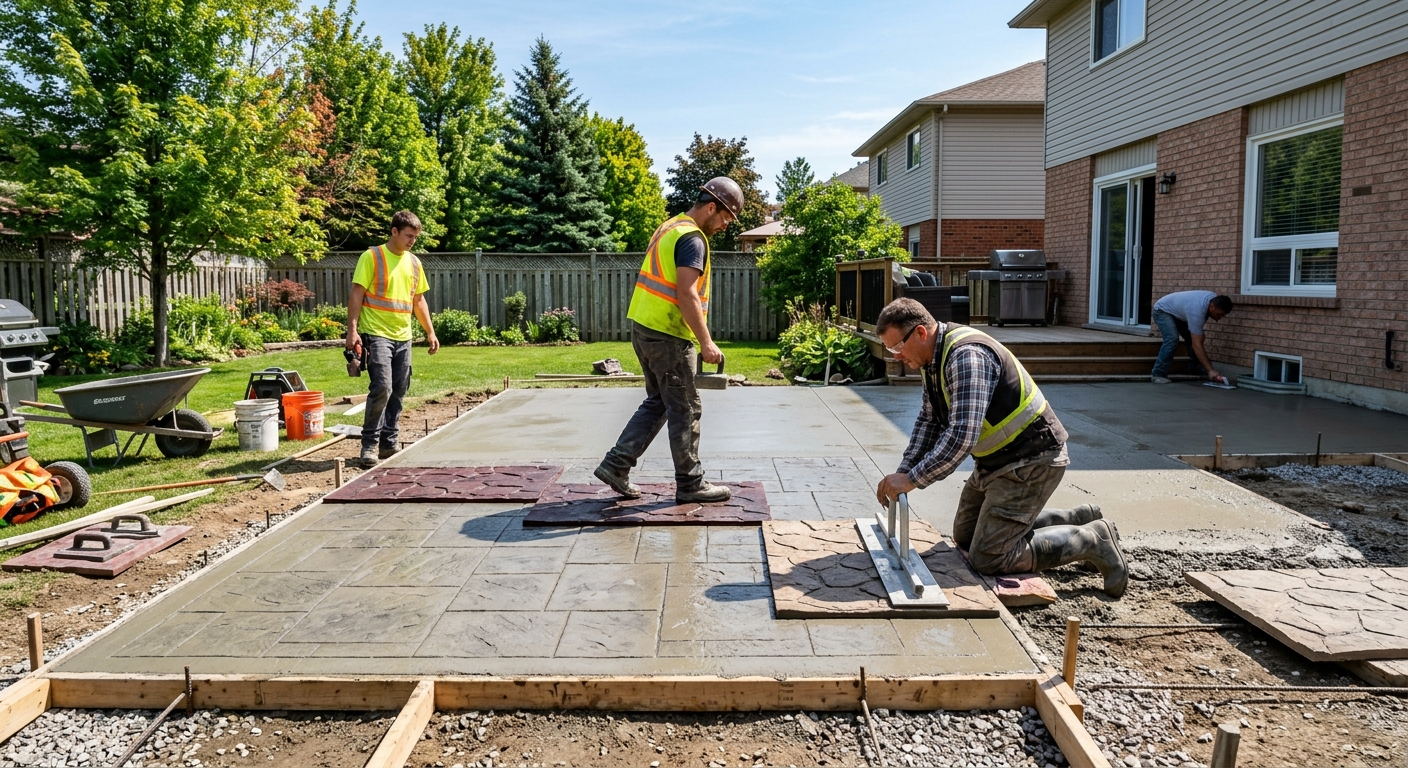
Concrete work options and costs in Hazeldean
Hazeldean, Alberta is a great place to get durable concrete flatwork—but in practice, the climate is what drives the real cost. According to the 2021 Census, Hazeldean’s population is 2,984 people (Statistics Canada, 2021 Census), and most homeowners are dealing with typical Calgary-area lots where driveways, patios, and walkways are sized to fit the home and yard layout. While the exact housing mix varies by subdivision, the demand for concrete is usually strongest for the kinds of surfaces that get daily freeze–thaw exposure: driveways for salt, patios for weekend use, and walkways with wheel traffic.
In the Calgary economic region, concrete pricing isn’t just “material cost.” The frost depth used for design is about 1.2 m (roughly 4 ft), so exterior footings must be excavated to undisturbed soil below that depth—this increases excavation time, rebar quantity, and formwork height. Frequent freeze–thaw cycles also mean exterior slabs need proper air-entrained mixes and well-planned control joints to reduce cracking and spalling. And because the outdoor pour season can be tighter, contractors often need winter-grade cold-weather measures (insulating blankets and, in some cases, temporary heat) to protect curing.
In Hazeldean, concrete crews tend to be especially busy around the Hazelwood area and nearby residential pockets where lot grading and access for forming and concrete trucks can be tight. If you’re comparing options for a driveway or planning foundation work, the table below shows realistic scopes and the typical price bands you’ll see from reputable local contractors.
| Application |
Typical Size |
Key Spec |
Finish Option |
Price Range |
| Concrete driveway (standard broom finish) |
24 ft x 12 ft (288 sq ft) |
Air-entrained exterior mix; compacted base; control joints |
Broom finish |
$12,000–$18,000 |
| Exposed aggregate driveway |
24 ft x 12 ft (288 sq ft) |
Air-entrained exterior mix; broom + wash/stone exposure process |
Exposed aggregate |
$15,000–$22,000 |
| Stamped concrete driveway or patio |
20 ft x 14 ft (280 sq ft) |
Air-entrained exterior mix; properly prepared base; release agent + stamping |
Stamped pattern with seal coat |
$15,000–$26,000 |
| Plain concrete patio or walkway |
12 ft x 12 ft (144 sq ft) |
Air-entrained exterior mix; compacted granular base; joints |
Plain float + light broom |
$5,000–$9,000 |
| Garage floor (interior slab) |
22 ft x 20 ft (440 sq ft) |
Vapour barrier (as required); insulation if specified; proper curing |
Plain/industrial trowel finish |
$6,500–$11,500 |
| Foundation footings (structural, below frost) |
Typical house perimeter (varies by plan) |
Excavate to undisturbed soil below design frost depth; engineered rebar + concrete |
Structural concrete with rebar + formwork |
$28,000–$45,000 |
Prices are estimates only and vary by project scope, site access and material selection.
What affects the price of concrete work in Hazeldean
If you get two quotes for what sounds like the same concrete job in Hazeldean, it’s common to see differences of 30–50% across the Calgary area. That range usually comes down to how carefully each contractor designs for our freeze–thaw climate and frost requirements, not just how quickly they can pour. In this region, frost depth design is about 1.2 m (roughly 4 ft), and exterior work must be supported on undisturbed soil below that line to limit frost heave and seasonal movement. On top of that, Calgary’s frequent freeze–thaw cycles require air-entrained concrete for exterior slabs, plus control joint planning and curing discipline.
Colder conditions also affect scheduling and quality. The pour season is shorter, and cold-weather placement often needs insulated blankets and sometimes temporary heat to maintain curing temperatures. If that’s missing from the price, you may see bargain rates initially—but later you can get surface scaling or accelerated deterioration. And because de-icing salt is commonly used on driveways and walkways, sealing becomes important to reduce spalling risk over time.
Concrete costs in Hazeldean can rise when excavation is tougher (rocky patches, deep topsoil removal, or poor truck access). They can drop slightly when the base is straightforward and the slab footprint is simple. A standard broom-finished driveway commonly falls within the $12,000–$18,000 band, while stamped finishes often move into the $15,000–$26,000 band because of form control, stamping labour, and higher finishing time. The good news: if your home is older and needs more grading, a contractor who includes proper excavation and base compaction will protect you long-term—even if the upfront number is higher.
| Price Factor |
Why It Matters |
Cost Impact |
| Frost line depth |
Determines footing depth and form height |
Higher excavation/formwork increases foundation pricing |
| Site preparation |
Excavation, grading, compacted granular base |
Tough access or extra haul-out can add significant labour and equipment time |
| Reinforcement |
Rebar or wire mesh requirement |
More steel and correct placement supports slab and footing performance |
| Mix design |
Air-entrainment and compressive strength spec |
Exterior-rated air content and engineered strength cost more but reduce freeze–thaw damage |
| Finish type |
Broom vs. stamped vs. exposed aggregate |
Stamped and exposed work typically increases finishing labour and materials |
| Pour size and concrete truck access to site |
Impacts pumping/hosing time and crew productivity |
Pumping, extended carry, or tight routes add labour and possible extra fees |
| Cold-weather curing precautions |
Heating and blankets |
Insulation and temperature control add daily cost but protect strength gain |
| Control joint pattern and sealing cost |
Controls cracking and limits salt-driven deterioration |
Proper joint layout plus sealers adds line-item cost, improving service life |
Permits & regulations in Alberta
In Alberta, structural concrete work generally needs a building permit and, in many cases, engineered drawings reviewed through the municipal process. Work that typically requires permits includes foundation footings, foundation walls, grade beams, and any structural elements tied into the building’s load path. In contrast, concrete flatwork such as patios, walkways, and most driveways often does not require a permit unless it affects lot grading, drainage, impervious surface coverage limits, or work occurs near a municipal right-of-way or affects how water is directed on the property. The safest approach for Hazeldean homeowners is to confirm requirements with the local authority before breaking ground.
Before you sign anything, verify the contractor carries current liability insurance and WSIB/WCB coverage for their workers (the coverage should match the type of work and the crew size). Then ask for references on similar-scale jobs in the same climate. Step-by-step, here’s what to do: (1) check the Alberta contractor listing online for the trade they claim to perform, (2) request a certificate of liability insurance naming you/the project as needed and confirm dates, and (3) ask for a clearance letter or proof of WSIB/WCB coverage—don’t accept a verbal statement. If they can’t provide these items quickly, consider it a red flag in Hazeldean’s concrete market where scheduling is tight during the colder months.
Getting concrete right in Hazeldean's freeze-thaw climate
Concrete fails in Hazeldean most often when one of five things is wrong: base prep, mix design, joint layout, curing, or sealing. In a freeze–thaw climate with a design frost depth of about 1.2 m (roughly 4 ft), the slab or footing must rest on properly compacted, correctly deep granular base and undisturbed soil below frost. For exterior flatwork—driveways, patios, and walkways—air-entrainment is non-negotiable. If the air content is too low, water entering pores will expand during freezes, leading to scaling and eventually spalling, especially where de-icing salts are used.
To spec the job correctly for Hazeldean, start with base preparation: the contractor should describe the sub-base depth, compaction method, and drainage plan. Next, require an air-entrained exterior mix targeting 5–7% air content and a minimum compressive strength of 32 MPa for typical exterior slabs (engineered requirements can be higher for foundations). Add control joints at spacing that limits random cracking—then seal after cure. Curing matters: aim for a minimum 7-day curing period under proper conditions. Finally, apply a penetrating sealer after the slab is fully cured (commonly at 28 days) to help repel de-icing salts.
As a dollar example, upgrading from a standard broom finish to a stamped driveway often moves you from the $12,000–$18,000 range into the $15,000–$26,000 range. That higher cost can be justified because stamping takes more skilled labour and time. However, the real “value” upgrade is still the durability specs: proper base compaction, correct air entrainment, and curing—those are what prevent the early deterioration that homeowners notice after the first couple winters.
| Spec |
Why It Matters in Hazeldean |
What to Ask For |
Impact if Skipped |
| Compacted granular base (depth?) |
Reduces settlement and supports the slab through frost movement |
Documented base depth and compaction method to suit local soil and frost |
Uneven settlement, cracking, and premature joint failure |
| Air-entrained concrete mix (target air %?) |
Prevents freeze–thaw damage by providing safe space for expansion |
Exterior-rated mix with target 5–7% air (as per design requirements) |
Scaling and spalling, especially with de-icing salts |
| Compressive strength (MPa rating) |
Ensures strength development and long-term durability |
Minimum 32 MPa for typical exterior flatwork (confirm engineered specs) |
Surface deterioration and reduced resistance to wear and impact |
| Control joints (spacing per ACI guidelines) |
Controls where cracks form during drying and temperature swings |
Joint pattern and spacing that limit random cracking |
Random cracking, wider cracks, and water infiltration |
| Minimum 7-day curing period |
Strength gain and durability depend on proper curing |
Confirm curing method for the pour date and temperature conditions |
Weak surface, increased scaling risk, and early failure |
| Penetrating sealer (when applied after cure) |
Helps reduce salt and water penetration on exterior surfaces |
Penetrating sealer applied after cure—commonly at 28 days |
Faster deterioration and higher maintenance costs |
How to choose a concrete work contractor in Hazeldean
Choosing the right concrete contractor in Hazeldean comes down to proof of capability, not just a low number. Start with Alberta licensing and coverage: confirm the contractor is properly authorized for the work they’re proposing, carries liability insurance, and has WSIB/WCB coverage for their workers. How to check each is straightforward: look up licensing/registration through the appropriate online registry, ask for a current certificate of insurance (verify policy dates and coverage), and request a WSIB/WCB clearance letter or proof of coverage before work begins. If they can’t provide documents promptly, keep looking.
Next, require 2–3 itemised written quotes. For concrete, a lump sum can hide major scope gaps. Ask for a labour + materials breakdown (excavation/base, reinforcement, concrete supply, finishing, and sealing if included). Read the exclusions carefully: is permit support included (if applicable), is disposal of excess soil included, and are site access and pump/hosing accounted for? A reputable contractor will specify curing measures and joint/seal scope rather than leaving it vague.
Warranty matters too. Ask for the workmanship warranty length and what “defect” means in plain terms. Confirm whether the warranty is only for the original owner or if it’s transferable. On payment schedule, don’t pay more than 10–15% upfront—hold back until the job is complete and you’ve received final documentation.
Finally, get start date and completion estimate in writing. Concrete work is sensitive to temperature, and a crew that schedules without planning for cold-weather curing will often cost you later.
- Ask for proof of Alberta authorization relevant to the work scope.
- Request a certificate of liability insurance and confirm coverage dates.
- Verify WSIB/WCB coverage with a clearance letter or proof document.
- Get 2–3 itemised quotes (excavation/base, rebar/mesh, concrete, finishing, sealing).
- Confirm whether disposal of excavated soil is included or extra.
- Check how they’ll handle tight access for trucks, forms, and finishing equipment.
- Demand written curing precautions for the pour temperature window.
- Ask about air-entrainment and exterior concrete mix design (not “standard mix”).
- Review joint layout: spacing, cut vs. tooled, and sealing responsibility if applicable.
- Clarify whether sealing is included and when sealer will be applied after cure.
- Confirm workmanship warranty length and the process for claims.
- Use a payment schedule with 10–15% maximum deposit and a holdback until completion.
Concrete contractor red flags in Hazeldean: they won’t provide insurance/WSIB documentation; they dismiss air-entrainment as optional; they promise a late-fall pour without describing heating/blankets and curing controls; they quote a foundation footing depth without tying it to frost design/undisturbed soil requirements; or they leave joints, sealing, and base compaction vague or “to be decided later.”
Frequently asked questions — concrete work in Hazeldean
What is a concrete overlay and is it suited to Hazeldean?
A concrete overlay is an additional cementitious layer placed over an existing concrete surface—often to improve appearance or restore a worn driveway without fully removing it. In Hazeldean (and across the Calgary region), overlays can be suited to certain driveways when the existing slab is structurally sound, properly prepped (cleaned, scarified, and repaired), and drained correctly. The climate is tough: freeze–thaw cycles and de-icing salts can accelerate spalling if the bond is weak or if moisture pathways remain. If your driveway is delaminating or the base has settled, an overlay usually isn’t the right fix. Pricing varies widely by thickness and prep, but homeowners should compare it against the $12,000–$18,000 driveway band for full replacement. A reputable contractor will inspect cracking patterns and tell you whether overlay prep and drainage can actually solve the root cause.
How do I seal concrete to protect it in Hazeldean?
To protect exterior concrete in Hazeldean, sealing is about repelling water and de-icing salt intrusion. Plan for a penetrating sealer rather than a film-forming coating for most driveways and walkways in this climate. The key is timing: the slab should cure fully before sealing—commonly around 28 days—so moisture from the pour can escape. Before sealing, the surface must be clean and dry; many failures happen when sealing is applied over dust, curing residue, or trapped dampness. After snow seasons begin, you’ll notice why this matters: salt-driven cycles can increase surface scaling if water is getting inside. Sealer scope is sometimes included in stamped work or walkway packages, but not always—ask for it in writing. If you’re budgeting, compare options within the $5,000–$9,000 patio/walkway or $15,000–$26,000 decorative bands and confirm sealing is included for exterior durability.
What is the difference between concrete and cement?
Cement is one ingredient used to make concrete; concrete is the full engineered mixture. Cement (typically Portland cement) acts as the binder. Concrete also includes aggregates (sand and gravel), water, and usually chemical admixtures. Depending on the project, a contractor may specify air-entrainment for exterior flatwork in Alberta so the mix can better survive freeze–thaw cycles. That’s why a “cement quality” claim isn’t the whole story—what matters is the overall concrete design: the air content, compressive strength target (commonly 32 MPa for many typical exterior slabs, though engineered specs can differ), water-cement ratio, curing method, and base prep. In Hazeldean, homeowners should focus on those performance specs and workmanship. If a quote only says “good cement” but won’t mention air-entrained mix and curing precautions, it’s not the same as a properly engineered exterior concrete job.
How much does concrete work cost in Hazeldean?
Concrete pricing in Hazeldean is influenced heavily by Calgary-area frost requirements and freeze–thaw exposure, not just the square footage. As local benchmarks, a concrete driveway typically lands in the $12,000–$18,000 range, depending on size, excavation difficulty, and finish. Patios and walkways usually fall around $5,000–$9,000 for modest projects. For decorative work like stamped concrete, homeowners often see $15,000–$26,000 once stamping, colour/finishing steps, and sealing are included. Foundation footings are a different category because they must be excavated below frost design to support structure; typical pricing often sits in the $28,000–$45,000 band depending on the house plan and engineered reinforcement. If you’re comparing quotes, make sure the cheaper price isn’t cutting out air-entrainment specs, proper base compaction, or cold-weather curing measures—those are the items that prevent early spalling.
How deep must footings be for Hazeldean's frost line?
In Hazeldean (Calgary region), design practice uses an approximate frost depth of about 1.2 m (roughly 4 ft). That means exterior structural footings for houses, garages, decks, and retaining structures generally need to be constructed below this design frost depth on undisturbed soil. The exact excavation depth and bearing conditions can vary with geotechnical conditions and your specific engineering plan, but you should expect the contractor to excavate to the required level rather than stopping “near” the frost line. This is one reason foundation work costs more here than in milder regions: excavation is deeper, formwork height increases, and there’s more engineered concrete and reinforcement. When reviewing quotes, ask what depth they’re assuming, what soil they’re bearing on, and whether the footing dimensions and reinforcement match the engineering/permit drawings.
Why does concrete crack in Hazeldean and how is it prevented?
Concrete cracks in Hazeldean mainly because it shrinks as it cures, moves with temperature changes, and—on exterior slabs—must deal with moisture freezing and thawing. In a cold continental climate with frequent freeze–thaw cycles, additional stresses show up when water gets into the slab or base and then expands during freezes. That’s why prevention starts before the pour: correct base preparation and compaction, proper air-entrained mix design for exterior work, and correct control joint placement so shrinkage cracking happens where it’s intended. Curing quality is also critical: rushing cold-weather curing can create weaker, more vulnerable surfaces. Sealing after the slab cures helps reduce salt and water penetration, which can widen existing cracks over time. If you want the most durable result, insist on a joint pattern and sealing plan in the quote—don’t accept “we’ll cut joints later” or “standard mix” language for exterior slabs.