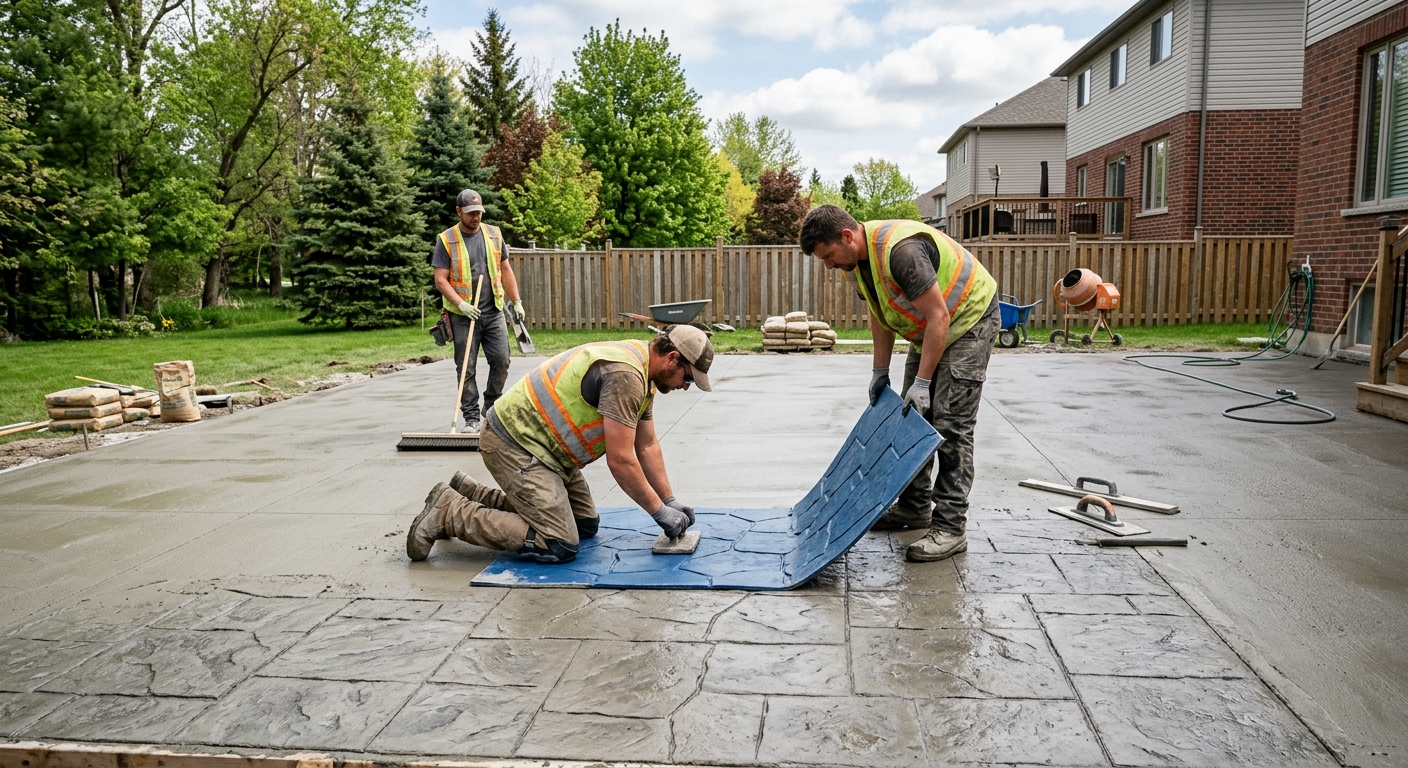
Concrete work options and costs in Westbrook Estates
Westbrook Estates, Alberta is a community where homeowners tend to invest in long-life exterior surfaces—especially for driveways, patios and walkways that get daily use in Calgary’s cold continental winters. With a population of 1,225 (Statistics Canada, 2021 Census), the local market is smaller than the downtown Calgary core, so contractor availability can swing depending on the pour season. That matters because flatwork crews are booked quickly during the warmer, longer window, and the cost reflects that demand and the tight schedule.
Most concrete flatwork in the region supports owner-occupied homes and the common housing pattern in the Calgary area—single-detached and low-rise properties—where a driveway or patio is often the “front yard workhorse.” In Calgary’s freeze–thaw climate, costs are engineered around frost and seasonal movement: the design frost depth is about 1.2 m (roughly 4 ft), meaning footings must bear below this line for houses, garages and retaining structures. Driveways and walkways also need air-entrained concrete and control joints to manage cracking and spalling from repeated freezing and thawing. The colder season is shorter, so placements late in the year may require winter-grade mixes, insulated blankets, and sometimes temporary heat to protect curing.
In Westbrook Estates, we typically see the most demand around family-focused pockets like the newer residential streets near the community’s main access routes, where homeowners often upgrade entries and back-yard outdoor living. Below is a practical comparison of common options and the real-world price ranges homeowners use for budgeting.
| Application |
Typical Size |
Key Spec |
Finish Option |
Price Range |
| Concrete driveway (standard broom finish) |
400–600 sq. ft. |
Air-entrained mix, doweled joints where needed |
Broom finish, basic edging |
$12,000–$18,000 |
| Exposed aggregate driveway |
400–600 sq. ft. |
Air-entrained mix, controlled wash timing |
Exposed aggregate with sealer-ready surface |
$15,000–$22,000 |
| Stamped concrete driveway or patio |
250–500 sq. ft. |
Air-entrained mix, integral colour option |
Stamp pattern with colour hardener/release |
$15,000–$26,000 |
| Plain concrete patio or walkway |
150–300 sq. ft. |
Compacted granular base, air-entrained mix |
Broom finish, simple scoring |
$5,000–$9,000 |
| Garage floor (interior slab) |
400–650 sq. ft. |
Vapour barrier, minimum grade prep |
Float finish with saw-cut control joints |
$9,000–$15,000 |
| Foundation footings (structural, below frost) |
Typical house/garage footing set |
Engineered rebar, concrete placement below frost |
Structural concrete only (not decorative) |
$28,000–$45,000 |
Prices are estimates only and vary by project scope, site access and material selection.
What affects the price of concrete work in Westbrook Estates
In Westbrook Estates and the wider Calgary region, quotes for the “same” concrete job can easily vary by 30–50% because the big drivers are often hidden in the details: excavation volume, granular base thickness, reinforcement requirements, cold-weather protection, and the way the finish is installed. Two contractors can quote the same square footage, but one may include proper frost-depth bearing and a thicker compacted base while the other cuts corners—those differences show up in the price and, more importantly, in how the concrete holds up through Calgary’s freeze–thaw cycles.
Climate is the anchor. Calgary’s design frost depth is about 1.2 m (roughly 4 ft), so exterior structural work needs footings that extend below that depth to prevent frost heave and seasonal movement. Exterior slabs and flatwork also require air-entrained concrete mixes because freeze–thaw can damage non-air-entrained paste and lead to scaling/spalling. The pour season is shorter than in milder provinces; when placements are pushed into colder shoulder months, contractors use winter-grade mixes, insulated blankets, and sometimes heating. That increases material and labour, but it protects the curing window. Finally, de-icing salt accelerates surface deterioration—sealing is an essential step for many homeowners.
Here are a few real Westbrook Estates examples of cost changes: (1) If your driveway subgrade is soft or has topsoil that must be removed, excavation and hauled-in granular base can move the project toward the upper part of the $12,000–$18,000 driveway band. (2) Adding reinforcement or dowels for slope changes or load areas can shift a patio from “plain” pricing toward the middle of the $5,000–$9,000 range because additional labour and steel are involved. (3) Selecting stamped concrete adds forming, stamping labour and often integral colour, which is why budgets commonly land in the $15,000–$26,000 decorative band rather than plain slab costs.
| Price Factor |
Why It Matters |
Cost Impact |
| Frost line depth — determines footing depth and form height |
Footings must bear on undisturbed soil below the design frost depth to avoid heave |
Higher excavation raises foundation/footing costs substantially |
| Site preparation — excavation, grading, compacted granular base |
Proper sub-base prevents settlement and reduces cracking risk |
Soft soils and haul-off can move the job toward the high end |
| Reinforcement — rebar or wire mesh requirement |
Controls cracking and supports structural loads where required |
Steel and extra labour for tying/chairs increase cost |
| Mix design — air-entrainment and compressive strength spec |
Air-entrainment improves durability through freeze–thaw cycles |
Engineered mixes cost more but reduce long-term spalling |
| Finish type — broom vs. stamped vs. exposed aggregate |
Finishes demand different labour time and materials |
Decorative systems can add significant labour and release/colour costs |
| Pour size and concrete truck access to site |
Access affects pumping, crew size, and scheduling |
Limited access can increase labour and equipment charges |
| Cold-weather curing precautions — heating and blankets |
Protects strength gain when temperatures drop |
Winter-grade logistics can add measurable cost |
| Control joint pattern and sealing cost |
Joint layout manages cracking; sealing helps with salt exposure |
Good detailing plus sealing increases upfront spend but extends service life |
Permits & regulations in Alberta
In Alberta, structural concrete work—such as building footings, foundation walls, grade beams and other elements that form part of the structural system—typically requires a building permit. In many cases, engineered drawings are reviewed as part of the permitting process, especially for reinforced foundations and any changes to load paths. Concrete flatwork (like driveways, patios and walkways) usually does not require a permit by itself, unless it affects lot grading, stormwater management, impervious surface coverage limits, or involves work in or near the municipal right-of-way. The safest approach for Westbrook Estates homeowners is to confirm with the local authority before breaking ground.
Regardless of permit needs, verify the contractor is set up to do the job responsibly. Ask for proof of liability insurance and WSIB/WCB coverage (or the applicable proof of clearance). Request references on similar-scale pours in the Calgary region—especially flatwork done in colder-season conditions—so you can see the finish quality and how they handle curing.
Step-by-step verification you can do: (1) Ask for the contractor’s Alberta business/licence details and check listings through the appropriate online registries used in Alberta; (2) Request a certificate of insurance and confirm it includes general liability coverage for concrete work, with current dates; (3) Ask for WSIB/WCB clearance information or proof of coverage; (4) Confirm whether the permit (if required) will be pulled by the contractor or coordinated by you, and in writing who is responsible for which steps.
Getting concrete right in Westbrook Estates's freeze-thaw climate
Concrete in Westbrook Estates fails most often when it’s treated like a “one-day” job instead of a system designed for freeze–thaw. The main problems we see are cracking from poor base preparation, and spalling/scaling from inadequate air-entrainment or rushed curing. To spec the job correctly in Calgary’s conditions, start with base preparation: excavate to the right level for your local subgrade and frost considerations, then place a properly compacted granular sub-base. If the base is weak or not compacted, the slab can settle and crack even if the mix is strong.
Next, demand the right mix design. For exterior flatwork, air-entrainment is typically targeted around 5–7% to create freeze–thaw resistant void structure in the cement paste. Also specify a minimum 32 MPa compressive strength so the concrete achieves adequate durability. Control joints are equally important: they should be cut or formed early enough and spaced to encourage cracking in planned locations rather than randomly. Curing is where many budgets get into trouble—minimum 7-day curing under proper conditions is common practice, and in cold weather the contractor should use insulating blankets and/or approved heating methods to protect early strength gain. Finally, apply a penetrating sealer after full cure (commonly around 28 days) to help repel de-icing salts.
If you’re deciding between options, the price difference can be justified. For instance, upgrading a plain broom-finished driveway toward the high end of $12,000–$18,000 is often more about solid base prep, proper mix and winter curing—not just “nice-to-have” finishes. By contrast, selecting stamped decorative concrete can raise budgets toward $15,000–$26,000; the extra cost is real, but it should only come after the freeze–thaw durability steps are done correctly.
| Spec |
Why It Matters in Westbrook Estates |
What to Ask For |
Impact if Skipped |
| Compacted granular base (depth?) |
Prevents settlement and provides drainage control under freeze–thaw |
Confirm design thickness and compaction requirements for your soil |
Cracking, uneven slabs, early surface failure |
| Air-entrained concrete mix (target air %?) |
Durable freeze–thaw performance reduces scaling/spalling |
Ask for air content target around 5–7% for exterior flatwork |
Surface scaling and spalling, especially with salt use |
| Compressive strength (MPa rating) |
Ensures strength gain for durability and load capacity |
Specify minimum 32 MPa and get batch documentation when possible |
Soft surfaces, reduced lifespan, structural concerns |
| Control joints (spacing per ACI guidelines) |
Controls where cracks occur through seasonal movement |
Ask for joint spacing plan and whether saw-cut timing will be followed |
Random cracking across visible areas |
| Minimum 7-day curing period |
Curing protects early strength and reduces cracking risk |
Confirm curing method and cold-weather protection if needed |
Weak top layer, increased scaling and cracking |
| Penetrating sealer (when applied after cure) |
Salt resistance matters during Calgary winter months |
Confirm penetrating sealer application after cure (commonly ~28 days) |
Faster deterioration from de-icing exposure |
How to choose a concrete work contractor in Westbrook Estates
Choosing the right concrete contractor in Westbrook Estates starts with verifying the basics that protect you when weather, timelines and materials get challenging. In Alberta, confirm the contractor’s Alberta business licensing details (and check for any relevant listings online). Ask for a current certificate of liability insurance—make sure it’s for the dates of your project and explicitly covers concrete-related work at your address. Then verify WSIB/WCB coverage: request proof of coverage or clearance information and confirm it applies to the workers who will be on-site.
Get 2–3 itemised written quotes rather than relying on a single number. A good quote breaks labour and materials down clearly (excavation/grading, formwork, rebar/mesh, concrete supply, finishing labour, curing protection, sealing, and disposal/haul-off if needed). Read the scope carefully: confirm what’s excluded (site landscaping restoration, snow removal after pour, permit pulling, topsoil replacement, saw-cut sealing, etc.). If your quote assumes a standard base, ask what happens if additional excavation is required due to soft soils.
Warranty matters in cold climates. Ask for the workmanship warranty length and whether any product/manufacturer warranty applies to the concrete, sealer, or decorative materials. Ask if the warranty is transferable if you sell your home. Keep payment sensible: never pay more than 10–15% upfront; use progress payments and hold back until the work is complete and cleaned up. Finally, insist on a written start date and completion estimate—cold-weather scheduling in Calgary can change, so you want the plan on paper.
- Provide proof of liability insurance with the project dates included
- Provide WSIB/WCB clearance or proof of coverage for their workforce
- Show similar recent Calgary-area flatwork and foundation work references
- Quote includes excavation depth and granular base requirements, not “allowance only” language
- Specify concrete mix details: air-entrainment and minimum strength
- Confirm curing method (especially if weather drops) and whether blankets/heating are included
- Include joint layout plan and whether joints will be cut/saw-timed correctly
- State whether sealing is included and when it will be applied (after cure)
- List reinforcement details (rebar size/spacing or mesh type) if applicable
- Confirm disposal/haul-off and who handles spoiled concrete and debris
- Provide a detailed schedule: start, concrete placement day, finishing day, cure/protection steps
- Use a payment schedule that holds back until completion and walkthrough sign-off
Concrete red flags we see in Westbrook Estates include: quoting a driveway or patio with no mention of frost-depth bearing or granular base thickness, skipping air-entrainment references for exterior slabs, offering no winter curing plan despite cold forecast, “lump sum only” pricing with vague exclusions, and refusing to provide proof of insurance/coverage or detailed itemised scope.
Frequently asked questions — concrete work in Westbrook Estates
How long does concrete take to cure?
In Westbrook Estates (Calgary area), concrete “sets” relatively quickly, but curing is a longer process. For most exterior flatwork, you should plan for at least 7 days of proper curing before you expect meaningful strength gain, and you want curing protection—especially if temperatures dip. Sealer timing is separate: penetrating sealers are typically applied after the slab has fully cured, often around 28 days, so the concrete surface has dried enough to accept the sealer and perform against salt. If the pour is in colder shoulder conditions, contractors may use insulated blankets and approved heat to keep the concrete on track. Always ask your contractor what curing method they’ll use for your specific weather window and what curing timeline they’ll guarantee in writing.
Do I need a permit for concrete work in Alberta?
It depends on what concrete work you’re doing in Alberta. Structural concrete—such as footings, foundation walls, and grade beams—typically requires a building permit and often engineered drawings reviewed as part of the municipal process. Concrete flatwork like patios, walkways and driveways usually does not require a permit by itself, but it can require approvals if it affects lot grading, stormwater management, impervious surface coverage limits, or impacts a municipal right-of-way. For Westbrook Estates homeowners, the key step is to confirm before excavation: ask the contractor whether a permit is required and who is responsible for pulling it. Also verify the contractor carries liability insurance and WSIB/WCB coverage, because the right documentation matters whether a permit is required or not.
Concrete vs pavers for a patio in Westbrook Estates?
Concrete and pavers can both work well in Alberta’s freeze–thaw climate, but they fail differently when installation details are wrong. A properly built concrete patio uses a compacted granular base, air-entrained mix, control joints, and correct curing—so it tends to crack in predictable ways and remain durable. Pavers can be excellent for design flexibility and easier individual replacement, but they still require the same fundamentals: proper base compaction, correct bedding material, proper edge restraint, and drainage. In Westbrook Estates, many homeowners choose plain concrete when they want a clean, low-maintenance surface budget—often in the $5,000–$9,000 band for typical patio sizes. If you want decorative appeal and colour without saw-cut visibility, stamped concrete can land closer to $15,000–$26,000, which is usually justified when the durability specs are handled first.
How long does a concrete driveway last?
A concrete driveway in the Calgary region can often last 20 to 30 years (and longer with good installation), but in practice it depends heavily on base prep, air-entrainment, joint detailing and maintenance. In Westbrook Estates, de-icing salts and freeze–thaw cycles are the biggest long-term stressors. A driveway built with the right granular base, air-entrained concrete, and properly planned control joints is much more likely to resist scaling and keep cracks limited to joint lines. Sealing after cure (commonly about 28 days) helps repel salt. If the contractor rushes curing in late fall/early spring or uses a non-durable mix, you may see surface pop-outs and spalling sooner. When comparing quotes near the $12,000–$18,000 driveway range, ask what’s included for air content, curing protection and sealing—those details are what extend service life.
What is air-entrained concrete and why does it matter here?
Air-entrained concrete is made with a controlled amount of tiny air bubbles intentionally added to the mix. In Alberta’s cold freeze–thaw climate, water inside the concrete can freeze and expand; without enough air voids, that pressure can break the cement paste and lead to surface scaling and spalling. With properly air-entrained concrete, there’s space for freeze expansion to relieve internal pressure, so the slab is more durable. For exterior flatwork in Westbrook Estates, you should expect a typical target air range around 5–7%, plus a minimum compressive strength spec such as 32 MPa. Ask your contractor to confirm air-entrainment and cold-weather curing plans in writing. This is one of the most important differences between a driveway that holds up through salt season and one that shows damage early.
How do I prepare the base for a concrete slab?
Base preparation is the foundation of a durable slab in Westbrook Estates. The contractor should excavate to the designed subgrade level, remove topsoil/organic material, and then place a properly graded granular base. The base needs to be compacted in lifts to reduce settlement and provide drainage control under the slab. In Calgary’s climate, the spec also needs to respect frost and freeze–thaw movement—exterior structural elements need proper bearing depth below design frost considerations, and exterior flatwork needs consistent sub-base thickness and compaction. For driveways and patios, ask how thick the granular base will be, what type of compaction is used, and how they’ll address soft spots, groundwater or inconsistent soils. A good base prep approach is one reason some budgets land toward the high end of the $12,000–$18,000 driveway band, but it’s also what prevents early cracking and uneven surfaces.