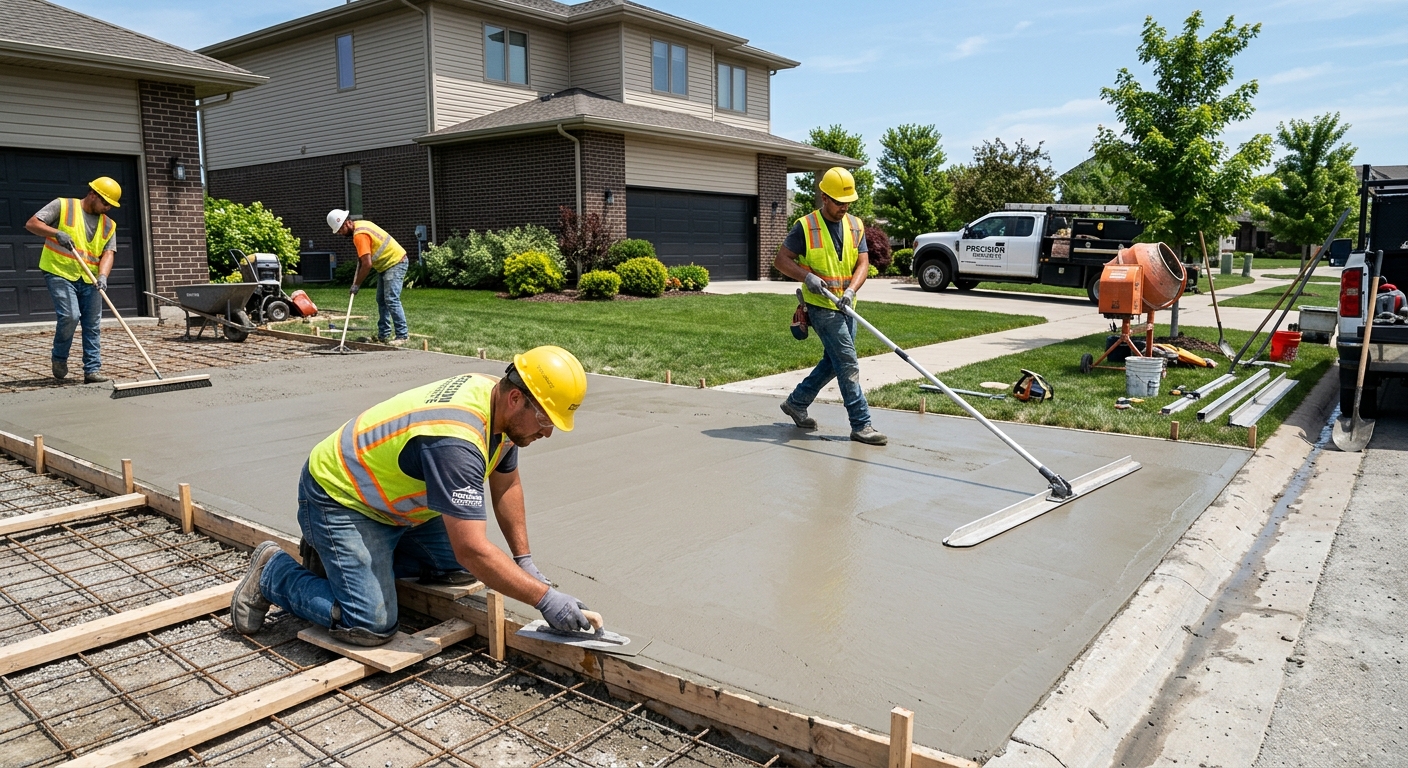
Concrete work options and costs in Kilkenny
In Kilkenny, Alberta, homeowners typically look at concrete because it’s durable, flat, and practical for Alberta winters. With a population of 5,699 in the area (Statistics Canada, 2021 Census), there’s steady demand for driveway and flatwork—especially around newer housing pockets on the Calgary side of the region and established neighbourhoods closer to major routes. Kilkenny’s concrete trade is also shaped by the broader Calgary market, where busy contractor schedules can tighten lead times during peak exterior construction months.
Cost is heavily influenced by Calgary’s cold continental climate and the engineered specs that come with it. The design frost depth is about 1.2 m (roughly 4 ft), so foundations, footings, and any frost-sensitive exterior elements need excavation and concrete volumes that go deeper than in many milder provinces. Freeze–thaw cycles also require air-entrained mixes for exterior slabs, control joints placed correctly, and curing that’s protected—particularly when pours happen late in the season. On top of that, de-icing salts and traction methods can accelerate surface wear if the concrete and sealer strategy aren’t right.
Concrete work is especially in demand in areas with ongoing infill and reno activity, like the Kilkenny-style residential corridors where driveways are often updated as homes are improved. If you’re comparing options, it’s best to look at total installed cost, not just the pour price, because premium finishes like stamped concrete usually require more prep, labour, and finish time.
Use the table below to compare typical project sizes, key specs, and realistic price ranges for Kilkenny.
| Application |
Typical Size |
Key Spec |
Finish Option |
Price Range |
| Concrete driveway (standard broom finish) |
400–550 sq ft |
Air-entrained mix, compacted granular base, control joints |
Broomed surface, standard edges |
$12,000–$18,000 |
| Exposed aggregate driveway |
400–550 sq ft |
Air-entrained mix, richer stone selection, proper curing timing |
Exposed aggregate with sealer |
$15,000–$22,000 |
| Stamped concrete driveway or patio |
250–450 sq ft |
Reinforcement where required, integral color, release agent + sealer |
Stone/brick stamp pattern, anti-slip sealer |
$15,000–$26,000 |
| Plain concrete patio or walkway |
200–350 sq ft |
Air-entrained mix, compacted base, edges protected |
Light broom finish or smooth trowel (anti-slip recommended) |
$5,000–$9,000 |
| Garage floor (interior slab) |
400–600 sq ft |
Vapour barrier (as applicable), fibre or mesh, proper curing |
Float finish with optional densifier |
$8,000–$14,000 |
| Foundation footings (structural, below frost) |
Approx. 1,000–2,000 linear ft (varies by design) |
Excavation to design frost depth (~1.2 m), rebar, engineered formwork |
Structural concrete, no aesthetic finish |
$28,000–$45,000 |
Prices are estimates only and vary by project scope, site access and material selection.
What affects the price of concrete work in Kilkenny
In Calgary’s region—including Kilkenny—quotes for the “same” concrete job can easily swing by 30–50% because the cost drivers aren’t cosmetic; they’re structural and climate-engineered. Frost protection, excavation depth, granular base preparation, and the right mix design (especially air-entrainment) change what contractors must deliver to prevent long-term cracking, scaling, and movement. When foundation work is involved, the engineered depth matters more than almost anything else, and that’s why foundation / footings in this market commonly land around the $28,000–$45,000 band. For exterior slabs, driveway and flatwork pricing often lines up with the $12,000–$18,000 range depending on thickness, base build-up, and finish complexity.
The key climate difference is freeze–thaw. In Alberta, footings and frost-sensitive elements must extend below the design frost depth (about 1.2 m here) to avoid frost heave and seasonal movement. Exterior slabs also need air-entrained concrete so the paste can resist freeze–thaw pressure. Calgary’s shorter pour season can also force cold-weather placement procedures—heated enclosures, insulating blankets, or winter-grade admixtures—which add labour and materials. Finally, de-icing salts can accelerate surface spalling, making sealing timing and product choice important.
In Kilkenny specifically, costs often rise when you have heavy excavation for a deeper frost bearing requirement, limited truck access that increases placement time, or when you need thicker slabs for vehicle loads. Costs can be lower when the site is already graded, soil conditions are favourable for compaction, and the pour can be done during a stable weather window without extended curing measures.
| Price Factor |
Why It Matters |
Cost Impact |
| Frost line depth — determines footing depth and form height |
Controls excavation volume and concrete placement below frost |
Higher excavation can push foundation work toward the upper end of $28,000–$45,000 |
| Site preparation — excavation, grading, compacted granular base |
Stable base reduces settlement and cracking in freeze–thaw cycles |
Unfavourable soils or extra haul-away can add thousands |
| Reinforcement — rebar or wire mesh requirement |
Helps control cracking and improves slab durability |
Mesh vs. rebar, spacing, and placement quality affects labour cost |
| Mix design — air-entrainment and compressive strength spec |
Air entrainment is critical for exterior freeze–thaw performance |
Specs may raise material cost, but reduces failure risk |
| Finish type — broom vs. stamped vs. exposed aggregate |
Finish dictates labour time and sealing system |
Standard broom is usually lowest; stamped/exposed can add major labour |
| Pour size and concrete truck access to site |
Impacts crew time, placement method, and equipment needs |
Restricted access can require longer labour and more staging |
| Cold-weather curing precautions — heating and blankets |
Protects early-age strength gain when temps fall |
Can increase costs materially during late-season pours |
| Control joint pattern and sealing cost |
Controls shrinkage cracking and protects surface from de-icing salts |
Skipping joints or sealing increases maintenance risk |
Permits & regulations in Alberta
In Alberta, the main permit requirement is tied to structural concrete. Work like foundation footings, foundation walls, grade beams, and other load-bearing structural elements typically require a building permit, and many projects also use engineered drawings that the municipality reviews before construction proceeds. If you’re adding a basement, underpinning, or making structural alterations, assume you’ll be in permit territory.
Concrete flatwork (patios, walkways, driveways) usually does not require a building permit by default. However, it can require review or permitting when it affects lot grading, drainage, or impervious surface rules, or when it involves municipal right-of-way issues (for example, tying into a boulevard area). Because those boundaries vary by lot and township practice, confirm with the local authority before breaking ground.
For a homeowner in Kilkenny, verify contractor compliance step-by-step:
- Ask for their Certificate of Insurance for liability coverage—confirm the company name matches the quote.
- Confirm workers’ coverage (WSIB/WCB). Request proof of clearance or coverage details.
- Use Alberta’s online contractor or licensing tools to check the applicable registration for the scope.
- Get the written estimate and confirm whether permits (if required) are included and who pulls them.
- Request references for similar-size Alberta cold-climate flatwork or foundation work.
These checks protect you when frost-related specifications are part of the work and ensure the project is built to last through Alberta freeze–thaw cycles.
Getting concrete right in Kilkenny's freeze-thaw climate
Concrete fails in Kilkenny most often when the job is built for a “nice day” instead of for the reality of Alberta winters. The common culprits are poor base preparation, inadequate air entrainment, weak curing, and control joints that don’t match the slab’s shrinkage pattern. In a freeze–thaw climate, water expands when it freezes. If your concrete doesn’t have the right air void system and the slab isn’t detailed correctly, freeze–thaw pressure can lead to scaling and spalling—especially where wheels, boots, and de-icing salts repeatedly hit the surface.
Spec the job around five essentials. First, base preparation: compacted granular sub-base to the correct depth for local soil and frost protection, so the slab doesn’t heave. Second, mix design: air-entrained concrete for exterior work with a target air content typically around 5–7%, and a minimum compressive strength of 32 MPa for many exterior applications. Third, control joints: a spacing pattern that limits random cracking; cracks are inevitable, but random cracking is costly. Fourth, curing: allow at least 7 days under proper conditions—cold-weather pours may require insulating blankets or temporary heating to protect early strength gain. Fifth, sealing: apply a penetrating sealer after proper cure (often around 28 days) to help repel moisture and de-icing impacts.
For example, upgrading from plain finishing to stamped concrete might move you toward the $15,000–$26,000 band for a driveway or patio. That’s justified when the contractor also delivers correct sub-base, jointing, and curing—because those “hidden” items prevent the finish from failing. If those are cut corners, the cheaper option becomes expensive quickly.
| Spec |
Why It Matters in Kilkenny |
What to Ask For |
Impact if Skipped |
| Compacted granular base (depth?) |
Supports the slab below frost influence and reduces settlement |
“What base depth and compaction method are you using for my soil?” |
Uneven settling, cracking, and early scaling |
| Air-entrained concrete mix (target air %?) |
Air voids let water freeze safely without damaging paste |
“Confirm the target air content (5–7%) for exterior flatwork.” |
Spalling and surface deterioration in winters |
| Compressive strength (MPa rating) |
Early and long-term strength resists traffic and weathering |
“What minimum compressive strength are you placing (e.g., 32 MPa)?” |
Soft, porous concrete that wears and chips faster |
| Control joints (spacing per ACI guidelines) |
Controls where cracks form to protect durability |
“Show me the joint spacing and layout before the pour.” |
Random cracking, more water entry, faster freeze–thaw damage |
| Minimum 7-day curing period |
Ensures proper strength gain before winter exposure |
“How will you protect curing if temperatures drop?” |
Reduced strength, scaling risk, and shortened lifespan |
| Penetrating sealer (when applied after cure) |
Repels moisture and reduces salt-driven damage |
“What sealer and application timing are you using (typically after ~28 days cure)?” |
Higher water absorption and salt-related surface breakdown |
How to choose a concrete work contractor in Kilkenny
Start by verifying the contractor’s compliance for Alberta work. Ask for proof of liability insurance—your quote should be backed by a current Certificate of Insurance naming the correct legal business. Next, confirm workers’ coverage (WSIB/WCB) and request a clearance or coverage document. For licensing, check the contractor’s registration status through Alberta’s online resources for the applicable scope of work. If you’re unsure what applies to your project, ask them directly how they’re set up for the exact concrete scope: excavation and placement, reinforcement installation, formwork, and any structural elements.
Then get 2–3 itemised written quotes—not just one lump sum. A good quote breaks down labour and materials (concrete supply, rebar/wire mesh, granular base, excavation, formwork, joints, finishing, and sealing if included). Carefully review exclusions: is disposal of excess soil included? Is permit work included where needed? Are cold-weather curing measures included if the pour is scheduled near the edge of the season?
Look for a realistic warranty on workmanship and clarify whether there’s a separate product/manufacturer warranty that’s transferable to you. Payment should be conservative: never pay more than 10–15% upfront, and hold back a portion until key completion points (base verification, finishing quality, and any required curing/sealing schedule) are done. Finally, insist on a written timeline with a start date and completion estimate.
- Confirm liability insurance and WSIB/WCB coverage with documents, not verbal promises.
- Check the contractor’s Alberta registration/clearance status for the scope you’re hiring.
- Request an itemised quote showing concrete volume, reinforcement type, and base material.
- Ask who supplies and places the granular base, and what compaction standard they follow.
- Confirm air-entrained mix and minimum compressive strength for exterior work.
- Verify control joint spacing and layout are included in the written scope.
- Ask how they’ll handle cold nights—blankets/heating or delayed pour scheduling.
- Clarify sealing: whether it’s included and when it will be applied after cure.
- Check disposal/hauling: excess soil and waste removal should be stated clearly.
- Confirm truck access plan—where the pump/boom or chutes are used (if needed).
- Review warranty length and what defects are covered (spalling, scaling, cracking).
- Ensure the contract includes start date, duration, and weather stop/continue rules.
Concrete red flags in Kilkenny include: crews promising “any weather is fine” without cold-weather curing steps, quotes that don’t mention air-entrained mix or control joints, no discussion of frost-related excavation/base build-up, payment schedules that demand most money upfront, and no written timeline or scope details for sealing and curing protection.
Frequently asked questions — concrete work in Kilkenny
How do I compare concrete quotes?
To compare concrete quotes in Kilkenny, start by ensuring you’re comparing like-for-like specs, not just total dollars. Ask each contractor to list concrete volume, slab thickness, reinforcement type (mesh vs. rebar where required), granular base depth, and whether the mix is air-entrained for exterior freeze–thaw durability. For exterior driveways, prices in this region commonly fall around $12,000–$18,000 for standard broom finish, but a “low” quote may be missing base depth, joints, or the right winter-grade curing plan. Also check whether site access, excavation, and disposal are included. A proper quote will show control joint spacing, curing protection steps if temps drop, and whether sealing is included and scheduled after cure.
Can concrete be poured in cold weather in Kilkenny?
Yes, concrete can be poured in cold weather in Kilkenny, but it needs the right process. In Calgary’s cold continental climate, early-age concrete is vulnerable if it freezes before it gains sufficient strength. Most reputable contractors will use winter-grade materials, insulated blankets, and sometimes temporary heating to keep the concrete warm enough during curing. The key is timing: rushing curing or placing late in the season without protection can lead to surface scaling and long-term durability problems. Ask the contractor what temperature range they’re able to maintain, how long they’ll protect the pour, and what curing plan is included. A properly engineered pour may be higher cost than standard-season pricing, but it protects your investment.
How do I maintain concrete in Kilkenny's freeze-thaw climate?
Maintenance in Kilkenny is mainly about managing water and salt exposure. First, don’t skip sealing: a penetrating sealer applied after proper cure (often after around 28 days) helps repel moisture and reduce de-icing salt damage. Second, use de-icing methods that are less aggressive when possible—avoid over-salting and prolonged wet contact on edges and joints. Keep joints clean so water isn’t trapped under freeze–thaw cycles. If you notice minor surface scaling, repair quickly so it doesn’t expand under traffic. Finally, inspect annually around the driveway edges and any low spots where water collects. Correct joint layout and sealing make the biggest difference in how long concrete stays serviceable through Alberta winters.
What causes concrete to spall in Kilkenny winters?
Spalling is usually a freeze–thaw and moisture problem—often made worse by air-entrainment issues. In Kilkenny, if the concrete mix doesn’t have the correct air content for exterior exposure, water in the paste can freeze and expand, breaking the surface layer. It can also happen when curing is inadequate—especially if the slab is exposed to cold too soon—resulting in lower early strength and higher permeability. Poor base prep can contribute too, because settlement creates micro-cracks that let water in, accelerating damage. De-icing salts then intensify the wear by increasing moisture cycling and chemical exposure at the surface. A quality exterior spec should address air entrainment, control joints, proper curing, and sealing to reduce the risk.
What is rebar and when is it required in Alberta?
Rebar is reinforcing steel placed inside concrete to help control cracking and add strength—especially in structural elements and load-bearing slabs. In Alberta, rebar requirements depend on design loads and the engineered slab or foundation plan. For example, structural foundation footings and foundation walls are typically engineered and reinforced, since they carry significant loads and must resist movement. For exterior flatwork like driveways and patios, reinforcement may be required based on slab thickness, soil conditions, and traffic loads; many driveway builds include mesh or rebar to support durability during freeze–thaw cycling. The best approach is to ask the contractor to specify the reinforcement type, placement, and size in the quote, and to confirm it matches the engineering or design requirements for your project.
How long does a concrete project take in Kilkenny?
Timelines in Kilkenny depend on scope, site access, and weather. For a typical exterior flatwork project—like a standard driveway or patio—expect: excavation and base prep for 1–3 days, forming/reinforcement the following day, then the actual pour and finishing in a single workday. Curing is the real “schedule driver”: even when finishing is complete quickly, concrete needs time to gain strength. Many contractors still treat 7 days as the minimum curing period for handling and light use, while full readiness for heavier loads can take longer depending on mix and temperatures. If cold-weather measures are required (blankets/heating), the job can extend by several days. Your quote should include the planned curing protection timeline, not just the pour date.