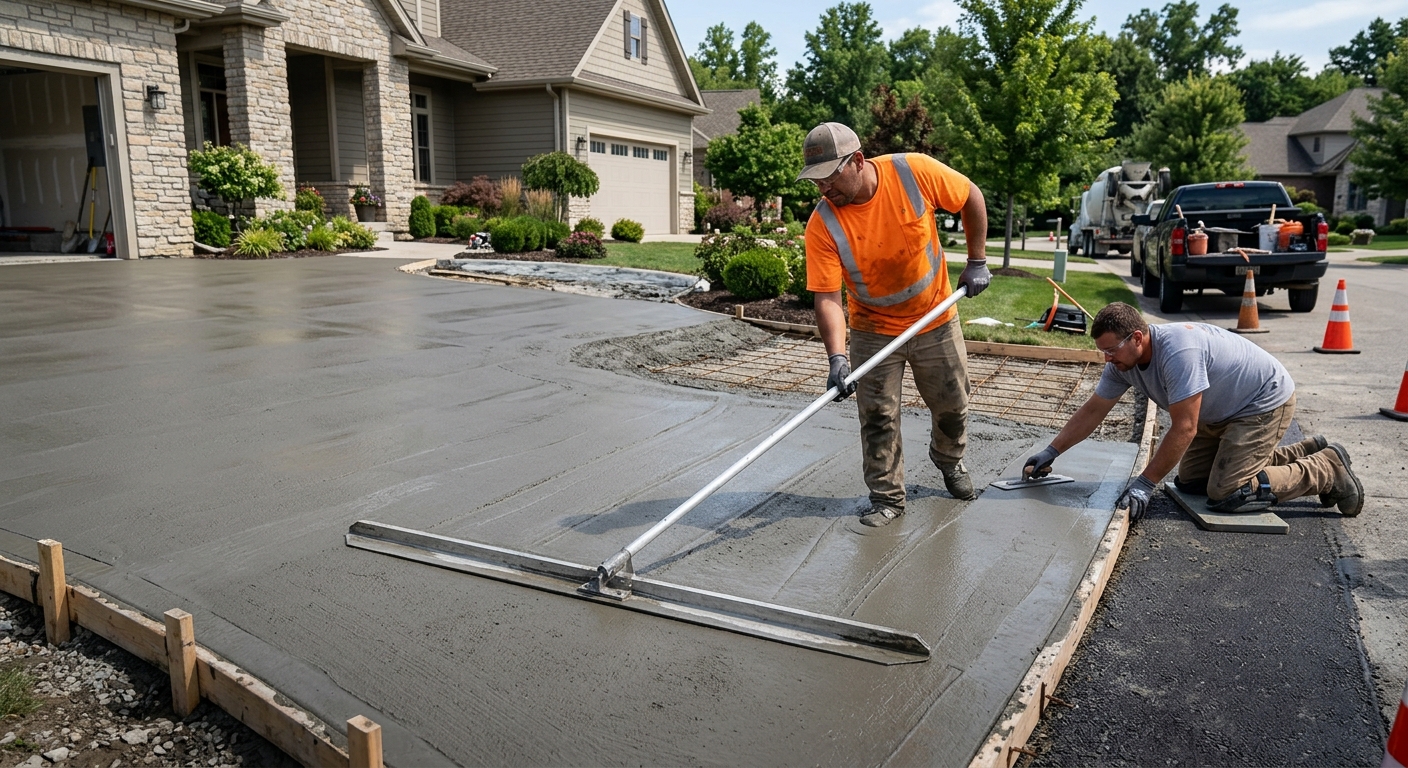
Concrete work options and costs in Kelvin Grove
Kelvin Grove, Alberta is a small community with a big-share of families who rely on concrete for driveways, patios, walkways, garage floors, and basement foundations. In the 2021 Census, Kelvin Grove’s population is 1,805 (Statistics Canada, 2021 Census). In a market this size, many homeowners plan concrete flatwork around the same seasonal windows and site realities that dominate the Calgary economic region.
Concrete pricing in Kelvin Grove is shaped as much by climate engineering as by labour availability. Calgary’s cold continental conditions bring frequent freeze–thaw cycles, and local foundation design uses a deeper frost depth (about 1.2 m, roughly 4 ft) so footings must be founded below undisturbed soil depth to limit frost heave. That drives excavation volume and foundation costs higher than in milder climates. For exterior slabs like driveways and patios, contractors also prioritize air-entrained concrete, granular base prep, and correctly spaced control joints to reduce cracking and surface scaling over the long run. When the weather turns late in the season, cold-weather curing precautions (insulated blankets and sometimes temporary heat) can add cost—though it’s usually money well spent to protect the slab.
In Kelvin Grove, demand is especially steady for concrete upgrades near newer residential pockets around the neighbourhood grid and access points where homeowners replace older asphalt and bring exterior flatwork up to today’s durability expectations. Below is a practical comparison of typical applications and realistic price bands in the Calgary area.
| Application |
Typical Size |
Key Spec |
Finish Option |
Price Range |
| Concrete driveway (standard broom finish) |
24 ft x 12 ft (288 sq. ft.) |
Air-entrained mix, compacted granular base, control joints |
Broom finish + sealer |
$12,000–$18,000 |
| Exposed aggregate driveway |
24 ft x 12 ft (288 sq. ft.) |
Air-entrained mix, wash/retarder process, proper curing |
Exposed aggregate (medium stone) |
$15,000–$21,000 |
| Stamped concrete driveway or patio |
16 ft x 20 ft (320 sq. ft.) |
Air-entrained mix, enhanced base, integral colour + release |
Stamp pattern + borders |
$15,000–$26,000 |
| Plain concrete patio or walkway |
10 ft x 16 ft (160 sq. ft.) |
Air-entrained mix, compacted base, joint layout |
Float + broom edge (or light broom) |
$5,000–$9,000 |
| Garage floor (interior slab) |
20 ft x 20 ft (400 sq. ft.) |
Minimum 32 MPa, vapour considerations, reinforced as required |
Light broom/steel-trowel top (per plan) |
$7,500–$13,500 |
| Foundation footings (structural, below frost) |
Typical house perimeter + piers |
Engineered depth below frost, rebar, formwork, inspection-ready |
Structural concrete only (not a finish) |
$28,000–$45,000 |
Prices are estimates only and vary by project scope, site access and material selection.
What affects the price of concrete work in Kelvin Grove
In Kelvin Grove and across the Calgary area, the same “size” concrete job can come back with bids that are 30–50% apart because the scope details change: excavation depth, the amount of reinforcement, truck access, drainage needs, and the concrete spec used for freeze–thaw durability. In practice, one contractor might price a slab assuming average soil and standard base thickness, while another prices for deeper frost-related excavation and engineered base prep. Those differences are where the money moves.
The big driver is frost depth and freeze–thaw. Local design expects footings to sit below the design frost depth (about 1.2 m, roughly 4 ft), so you often see more digging and more concrete volume than in warmer regions. That frost engineering also affects how contractors build exterior slabs: air-entrained concrete mixes are standard for driveways, patios and walkways to handle repeated expansion and contraction. Calgary’s shorter exterior pour season means cold-weather curing precautions are more common—insulated blankets, temperature monitoring, and winter-grade placement procedures. In addition, de-icing salt is used more heavily when surfaces are practical for winter access; that’s why sealing is often recommended, and why contractors build durability into the mix and curing rather than “just pouring and hoping.”
Two examples from Kelvin Grove homeowners: if you’re replacing a driveway with a new slab in an area with poor drainage or higher groundwater, expect extra granular base, drainage adjustments, and potentially more reinforcement—pushing the job toward the upper end of the driveway band (for instance, closer to $12,000–$18,000). If you’re choosing a stamped finish, the added labour, colour materials, and formwork typically justify moving toward $15,000–$26,000, but it’s still not “automatically worth it” if your base prep is rushed or joints aren’t planned.
| Price Factor |
Why It Matters |
Cost Impact |
| Frost line depth |
Determines footing depth and form height |
Deeper founding adds excavation, rebar, and concrete volume |
| Site preparation |
Excavation, grading, compacted granular base |
Unfavourable soil or drainage issues increase labour and materials |
| Reinforcement |
Rebar or wire mesh requirement |
More steel and chair supports add cost and coordination |
| Mix design |
Air-entrainment and compressive strength spec |
Winter-grade and air-entrained mix can raise concrete material costs |
| Finish type |
Broom vs. stamped vs. exposed aggregate |
Stamped/exposed finishes add labour time and finishing materials |
| Pour size and concrete truck access to site |
Access affects placement speed and equipment needs |
Limited access can require more labour and smaller loads |
| Cold-weather curing precautions |
Heating and blankets |
Temperature management and insulation increase contractor overhead |
| Control joint pattern and sealing cost |
Joints manage shrinkage and sealing protects surface |
Better joint layout and sealer improve durability but add line items |
Permits & regulations in Alberta
In Alberta, structural concrete work generally needs the right approvals because it affects the building structure and must be reviewed to match code and engineering requirements. For Kelvin Grove homeowners, the work that typically does require a building permit and often engineered drawings includes basement foundation walls, grade beams, footings, and any structural foundation elements that support the house. If you’re doing a foundation repair or adding a structural element, that’s also usually in permit territory.
Concrete flatwork—driveways, walkways, and patios—typically does not require a separate permit unless the project changes lot grading significantly, impacts impervious surface coverage requirements, or involves municipal right-of-way considerations (for example, work that affects a driveway approach or drainage within the municipal area). Even when a permit isn’t required, contractors should still confirm constraints with the applicable local office before breaking ground.
Step-by-step, here’s how you verify contractor credentials in Alberta: (1) confirm they carry liability insurance by requesting a current Certificate of Insurance (COI) showing coverage amounts and project name/address if available; (2) check workers coverage for WSIB/WCB by requesting proof of clearance or current coverage documentation (the exact form can vary, but the contractor should provide it on request); (3) ask for their contractor reference projects in Calgary-area conditions with freeze–thaw performance; and (4) verify any professional/engineering requirements are handled when structural elements are involved. Use these documents before signing—don’t wait until after the excavation begins.
Getting concrete right in Kelvin Grove's freeze-thaw climate
Concrete failures in Kelvin Grove usually come down to one thing: water and freeze–thaw pressure meeting a slab that wasn’t built for it. The most common problem I see is spalling and surface scaling from inadequate air-entrainment, poor curing, or weak base preparation that allows settlement. In this Calgary region, the design frost depth is about 1.2 m (roughly 4 ft), so foundation work must be below undisturbed soil depth, and exterior slabs must be engineered around repeated freezing cycles.
To spec the job correctly, focus on five controls. First, base preparation: compacted granular sub-base to the designed depth for local soil conditions and frost performance. Second, mix design: air-entrained concrete with a typical target of 5–7% air for exterior flatwork and minimum 32 MPa compressive strength (or higher if your engineer specifies). Third, control joints: spacing that limits random cracking and helps cracks form where you can manage them. Fourth, curing: plan for at least 7 days of proper curing conditions; in cold weather, contractors may need insulated blankets or heat to keep cement hydration on track. Fifth, sealing: a penetrating sealer applied after the cure period (often at/after 28 days) to help repel de-icing salts.
Here’s where cost differences can be justified. If you’re choosing a plain patio versus stamped concrete, the stamped option can push toward $15,000–$26,000 depending on size and complexity, while a plain patio/walkway often falls around $5,000–$9,000. That difference is mostly finishing labour and materials—but if the base and mix are compromised, you won’t “save” money because failures can show up as early surface damage. Ask your contractor specifically how they prevent spalling by specifying air-entrainment and curing practices for Calgary’s freeze–thaw cycles.
| Spec |
Why It Matters in Kelvin Grove |
What to Ask For |
Impact if Skipped |
| Compacted granular base (depth?) |
Reduces settlement and limits moisture movement under freeze–thaw |
“How deep is the compacted base, and what compaction standard do you meet?” |
Uneven settling, cracking, and accelerated deterioration |
| Air-entrained concrete mix (target air %?) |
Protects the paste during freeze–thaw cycles |
“What air content are you targeting (typically 5–7% for exterior flatwork)?” |
Higher risk of spalling and surface scaling |
| Compressive strength (MPa rating) |
Ensures the slab reaches required structural durability |
“What minimum MPa is the mix designed to achieve (typically 32 MPa)?” |
Lower strength leads to early wear and cracking |
| Control joints (spacing per ACI guidelines) |
Controls where shrinkage cracks form |
“What joint spacing and layout are you using, and will joints be saw-cut?” |
Random cracking and difficult-to-repair failure lines |
| Minimum 7-day curing period |
Builds durability before the slab sees winter stress |
“How will you protect the slab for curing in our late/early season weather?” |
Surface weakness, scaling, and reduced long-term performance |
| Penetrating sealer (when applied after cure) |
Repels de-icing salts and helps reduce moisture ingress |
“When will sealer be applied (commonly around/after 28 days)?” |
More salt-related deterioration and faster surface breakdown |
How to choose a concrete work contractor in Kelvin Grove
Choosing the right concrete contractor in Kelvin Grove starts with documentation you can verify. First, confirm Alberta compliance by requesting (and reviewing) liability insurance and WSIB/WCB coverage. Ask for a current Certificate of Insurance (COI) and proof of coverage/clearance for workers—reputable contractors provide this without delay. Next, ask how they handle structural scopes requiring engineering and permits, especially for footings and foundation elements. If they can’t clearly explain what’s permitted versus not permitted, treat that as a warning sign.
Then request 2–3 itemised written quotes. You want labour and materials broken out (excavation, formwork, reinforcement, concrete supply, finishing, joints, curing protection, and sealing if included) rather than one lump sum. Read the exclusions: is demolition disposal included? Is rebar chairing and proper base grading included? Will they include permits where required? Make sure winter-cure measures are described if the schedule risks cold nights.
For warranty, ask for workmanship warranty length and whether product warranties apply (and are transferable if you sell the home). For payment, keep deposits modest—no more than 10–15% upfront—and use a holdback until completion and walkthrough. Finally, get a start date and completion estimate in writing, including weather contingency so you’re not left waiting during Calgary’s shoulder-season freezes.
- Provide COI liability insurance showing coverage amounts and named insured details.
- Provide WSIB/WCB proof or clearance documentation on request.
- Show proof of prior Calgary-area projects with freeze–thaw durability (photos, addresses).
- Quotes list excavation, base prep, reinforcement, and concrete supply separately.
- Confirm whether demolition and disposal are included (and where waste goes).
- Spec air-entrained concrete for exterior slabs and confirm target air content.
- Confirm footing depth approach where structural work is involved (below design frost).
- Confirm control joint pattern and whether saw-cut joints are used.
- Ask how they protect curing in cold weather (blankets/heating/monitoring).
- Confirm sealing is included or offer a clear line item with timing.
- Use a payment schedule with a holdback until final completion and cleanup.
- Get the schedule in writing, including weather delay process and communication.
Concrete red flags in Kelvin Grove include: contractors who quote only by square footage without discussing base depth or frost considerations; missing or outdated insurance/WSIB/WCB documentation; promises to “pour anytime” without winter curing protection; vague scope language like “finish as needed” (no joint plan or sealer timing); and payment terms requesting large upfront deposits beyond 10–15%.
Frequently asked questions — concrete work in Kelvin Grove
How much does concrete work cost in Kelvin Grove?
In Kelvin Grove, concrete pricing generally tracks the Calgary market bands but varies with excavation, reinforcement, finish complexity, and access. For a typical exterior driveway in the range of about 288 sq. ft., homeowners often land around $12,000–$18,000 for a standard broom-finish slab when the base prep and freeze–thaw specs are done properly. If you choose decorative or more labour-intensive options, pricing moves up—stamped concrete driveways or patios often fall around $15,000–$26,000 depending on size and pattern density. Plain patios and walkways are commonly in the $5,000–$9,000 range for typical mid-size projects. If your site needs extra grading/drainage or limited truck access, expect the higher end of the band even for “simple” pours.
How deep must footings be for Kelvin Grove's frost line?
Kelvin Grove experiences Alberta’s deep frost exposure, and local engineering practice commonly uses a design frost depth of about 1.2 m (roughly 4 ft). That means structural footings for houses, garages, and retaining-type elements should be founded below undisturbed soil depth to reduce frost heave and seasonal movement. The exact footing depth for your house is ultimately determined by your soil conditions, engineering requirements, and municipal expectations. When contractors quote foundation work, the depth and excavation volume should be clearly stated, not guessed. If a foundation bid doesn’t speak to frost-related depth, over-excavation/compaction, and engineered requirements for rebar and concrete strength, it’s a sign the quote may miss the main cost drivers that protect the building in Calgary’s freeze–thaw environment.
Why does concrete crack in Kelvin Grove and how is it prevented?
Concrete cracks in Kelvin Grove mainly due to shrinkage, temperature swings, and movement from freeze–thaw cycles—especially when the slab is restrained or the base isn’t built consistently. In Alberta, the deeper frost and repeated freezing require engineered durability: proper granular base compaction, air-entrained concrete for exterior slabs, and a control joint layout that lets shrinkage cracks form in predictable locations. Prevention isn’t just “adding joints,” either—curing quality matters. If curing is rushed (common when you pour late and cold nights arrive), surface weakness can increase cracking and spalling risk later. The best approach is to specify air content for freeze–thaw resistance, confirm minimum strength targets, plan joint spacing, and protect curing so the slab reaches strength before winter stress arrives.
Stamped vs broom-finish concrete — cost difference?
Stamped concrete costs more than broom-finished concrete because it requires additional materials (integral colour and release agents), more labour for stamping and finishing, and tighter scheduling to manage set times—especially in Calgary-area weather shifts. A standard driveway at the typical band of $12,000–$18,000 is usually the broom-finish baseline, assuming the base prep and freeze–thaw durability specs are included. Stamped concrete driveways or patios commonly rise into $15,000–$26,000, depending on square footage, stamp complexity, borders, and whether the contractor includes enhanced base and joint/sealer details. If the only difference you’re getting is “more decoration,” don’t assume it’s worthwhile. For Kelvins Grove homes, decorative benefits are best protected when base, joints, air entrainment, and curing are upgraded alongside the finish.
When is the best time to pour concrete in Kelvin Grove?
For Kelvin Grove and the Calgary region, the “best time” is when temperatures support proper curing without excessive heating. Exterior slabs usually need a placement window where you can maintain suitable curing conditions for at least the first several days—because Calgary’s cold snaps can arrive quickly in shoulder seasons. Late fall and early spring pours can be done, but only if the contractor plans cold-weather curing precautions such as insulated blankets, temperature monitoring, and—when necessary—temporary heat. If these steps aren’t discussed in the quote, I’d treat it as a risk for scaling and long-term durability. Practically, many homeowners schedule exterior pours in the warmer portion of the season so the contractor can rely on normal curing conditions rather than paying for winter-grade placement and protective measures.
How long does concrete take to cure?
Concrete curing is a process, not a single day. In Kelvin Grove, for exterior durability you should expect at least a minimum 7-day curing period under proper conditions so the slab can develop early strength and resist early freeze–thaw stresses. Even after the slab is walkable, full performance develops more gradually. That’s why sealer timing matters: penetrating sealer is commonly applied around/after 28 days post-pour to better repel de-icing salts and reduce moisture ingress. Cold-weather curing precautions can extend “effective curing time” because the contractor may need to hold temperature and protect the slab longer to keep hydration on track. If you’re comparing quotes, ask what curing protection is included and how they’ll manage cure temperatures in Calgary’s freeze–thaw swings.