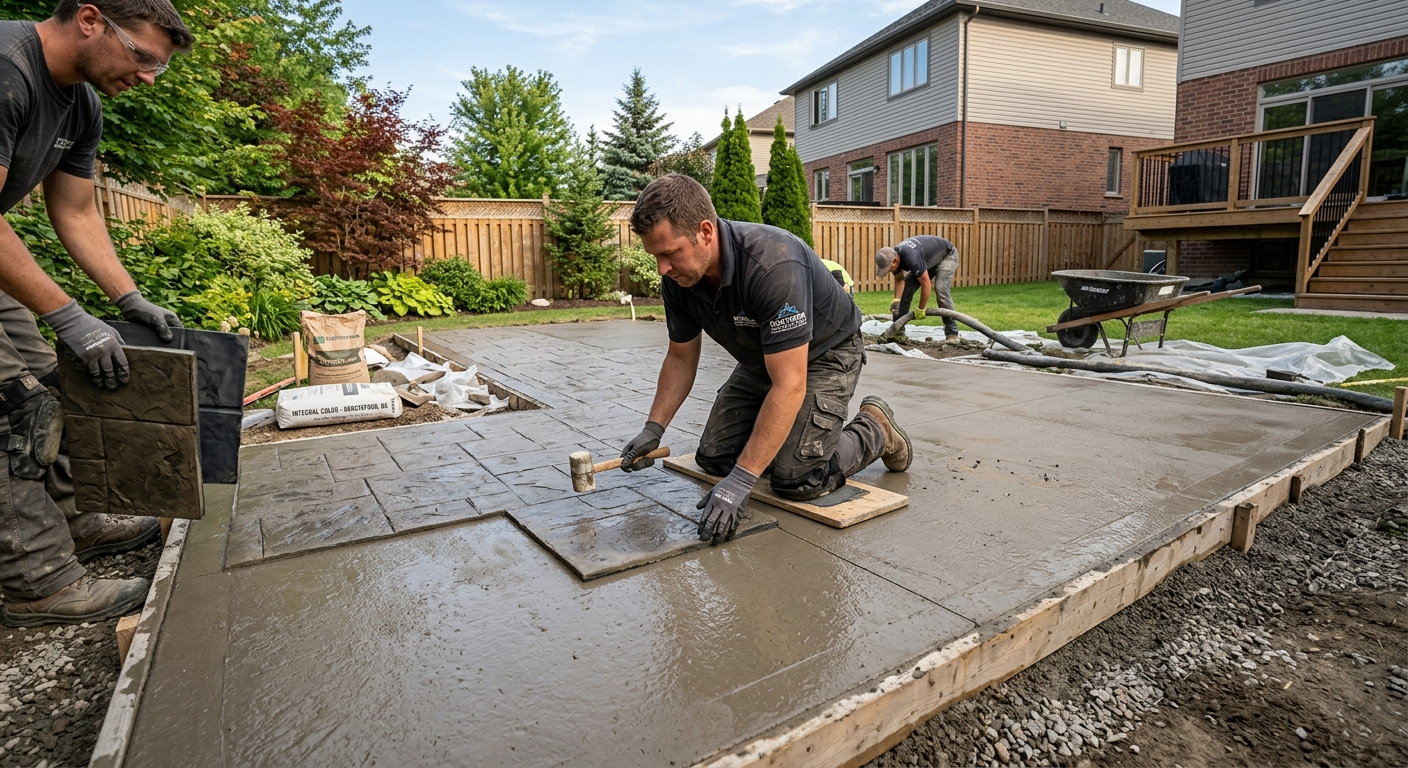
Concrete work options and costs in Minchau
In Minchau, concrete work is a practical, long-life upgrade—especially for homes that need durable driveways, patios, walkways and solid foundations. Based on Statistics Canada’s 2021 Census, Minchau and the Calgary economic region are built around a mix of households that commonly include single-detached housing forms (Statistics Canada, 2021 Census). For homeowners, that typically translates into frequent requests for exterior flatwork: driveway replacements, backyard patios, and new walkways, with many projects concentrated around newer growth pockets and established residential streets in north Calgary-area development corridors that drive contractor demand.
Pricing in the Calgary market is shaped more by climate engineering than by “square footage alone.” The design frost depth used in local practice is about 1.2 m (roughly 4 ft), so foundation-related excavations and structural footing volumes are larger than in warmer parts of Canada. Add frequent freeze–thaw cycles and you’ll see it reflected in the mix design (air-entrainment), granular base prep, and the need for properly planned curing. Pouring exterior slabs also has a shorter practical window, and cold-weather placement may require insulated blankets or temporary heat to protect curing—this is why two “similar” jobs can land at different totals.
Below are realistic Minchau price bands you can use to compare options, scope, and finish levels before you request itemised quotes from concrete contractors in the Calgary area.
| Application |
Typical Size |
Key Spec |
Finish Option |
Price Range |
| Concrete driveway (standard broom finish) |
20 ft x 10 ft (200 sq. ft.) |
Air-entrained mix, compacted granular base, control joints |
Broom finish |
$12,000–$16,000 |
| Exposed aggregate driveway |
20 ft x 10 ft (200 sq. ft.) |
Higher-spec aggregate exposure method, air-entrained mix, proper curing |
Exposed aggregate |
$15,000–$18,000 |
| Stamped concrete driveway or patio |
16 ft x 12 ft (192 sq. ft.) |
Integral colour + air-entrained mix, release agent and curing schedule |
Stamped pattern |
$15,000–$26,000 |
| Plain concrete patio or walkway |
12 ft x 12 ft (144 sq. ft.) |
Compacted base, air-entrained mix, edging and joints |
Float + light broom |
$5,000–$9,000 |
| Garage floor (interior slab) |
22 ft x 22 ft (484 sq. ft.) |
Vapour barrier (if specified), reinforcement as required, proper curing |
Standard trowel/finish |
$10,000–$18,000 |
| Foundation footings (structural, below frost) |
Typical house layout |
Excavation to design frost depth, rebar, engineered dimensions |
Structural concrete only (not decorative) |
$28,000–$45,000 |
Prices are estimates only and vary by project scope, site access and material selection.
What affects the price of concrete work in Minchau
In the Calgary region around Minchau, you can see quotes for the “same” concrete type swing by 30–50% because the job isn’t just concrete—it’s excavation, compaction, reinforcement, mix design and curing discipline. Even the most common exterior flatwork (driveways and patios) has hidden variables: soil bearing, how deep you have to remove topsoil, how much granular base is required, whether the site needs drainage adjustments, and how long the contractor must protect curing when temperatures drop.
Two Calgary-driven factors dominate most price spreads: the frost line depth and freeze–thaw cycles. In Alberta engineering practice, footings and foundation-related elements are set to bear below design frost—about 1.2 m (roughly 4 ft)—so formwork height, excavation volume, and concrete volume increase. Exterior slabs and driveways also require an air-entrained mix to survive repeated freeze–thaw. When the pour season shortens, cold-weather curing precautions (insulated blankets and sometimes temporary heat) become necessary to reach proper set and strength—these add cost and scheduling risk.
Local conditions also shift pricing in practical ways. For example, if a driveway replacement must be removed deeper due to soft subgrade, you’re effectively paying for extra base and trucking. If winter access is tight, mobilisation costs rise. A standard broom-finish driveway may land closer to the $12,000–$18,000 band, while a stamped driveway can move toward the $15,000–$26,000 range once integral colour, texture tooling, and longer curing protection are included.
Finally, compare project timeframes. Older housing stock (and older landscaping) often means there are buried services, previous pours, or drainage issues to address—each one can add thousands. With Minchau’s base requirements, it’s common for foundation work to track the $28,000–$45,000 structural band when the depth and reinforcement scope are confirmed.
| Price Factor |
Why It Matters |
Cost Impact |
| Frost line depth — determines footing depth and form height |
Footings must bear below design frost to prevent frost heave and seasonal movement. |
Medium to high (more excavation and concrete volume) |
| Site preparation — excavation, grading, compacted granular base |
Proper base supports the slab; poor prep leads to settlement and cracking. |
High (varies with soil and disposal needs) |
| Reinforcement — rebar or wire mesh requirement |
Controls cracking and adds capacity, especially on driveways and garage floors. |
Medium (material + labour for placement) |
| Mix design — air-entrainment and compressive strength spec |
Air-entrainment reduces freeze–thaw scaling risk; strength spec affects mix cost and curing discipline. |
Medium (slightly higher materials + stricter handling) |
| Finish type — broom vs. stamped vs. exposed aggregate |
Decorative finishes require specialised tooling, colour, and careful curing. |
Low to high (runs from broom to premium finishes) |
| Pour size and concrete truck access to site |
Access limits pump needs, labour, and how quickly concrete can be placed. |
Medium (pump/extra labour if access is tight) |
| Cold-weather curing precautions — heating and blankets |
Proper curing protects long-term durability in Alberta’s freeze–thaw climate. |
Medium to high (equipment + schedule protection) |
| Control joint pattern and sealing cost |
Joints manage cracking locations; sealing helps reduce surface damage from de-icing salts. |
Low to medium (small materials/extra steps but important) |
Permits & regulations in Alberta
In Alberta, the permitting and documentation approach depends on what kind of concrete you’re building in Minchau. Structural concrete work—such as footings, foundation walls, and grade beams—typically requires a building permit and is often supported by engineered drawings reviewed by the municipality. For concrete flatwork like driveways, patios and walkways, permits usually aren’t required when the work stays within typical limits and does not change lot grading or create new drainage/impervious-surface issues. However, if a project affects lot drainage, impervious surface coverage limits, or involves work close to a municipal right-of-way, you may need additional approvals—so it’s smart to confirm before breaking ground.
Step-by-step homeowner checks:
- Ask the contractor what permits (if any) they pull for the specific scope (especially for structural work).
- Request the contractor’s liability insurance certificate naming the correct project address and limits.
- Verify WSIB/WCB coverage documentation through the certificate or clearance letter provided with the quote package.
- Confirm references for similar-scale projects in the Calgary area (same frost-depth conditions and curing requirements).
- Use the online contractor listings/registries available in Alberta to confirm business status and any applicable trade/contractor registration details.
For safety and accountability, don’t start excavation until you have the confirmed scope, permit responsibilities, and proof of coverage in writing.
Getting concrete right in Minchau's freeze-thaw climate
In Minchau’s Calgary-area climate, the biggest concrete failures are almost always preventable: surface scaling, spalling, and random cracking caused by freeze–thaw stress, inadequate base preparation, or rushed curing. To spec the job correctly, focus on five practical steps.
1) Base preparation: the slab needs a compacted granular sub-base to the depth required for local soils and frost considerations. Under-filled base or weak subgrade means settlement and joint “telegraphing” into cracks.
2) Mix design: exterior flatwork should use an air-entrained concrete mix (commonly targeted at about 5–7% air for exterior exposure). Pair that with a minimum 32 MPa compressive strength spec so the slab gains adequate durability over the curing period.
3) Control joints: joints should be installed and planned to limit random cracking—especially on driveways and patios that see thermal cycling and de-icing salt.
4) Curing: allow minimum 7 days curing under proper conditions. In cold snaps, contractors should add insulation blankets or heat to protect early strength gain.
5) Sealing: apply a penetrating sealer about 28 days post-pour (after cure) to help repel de-icing salts and reduce freeze–thaw damage at the surface.
When homeowners cut corners—often on air-entrainment or curing—the result is spalling risk down the road. For example, choosing a standard broom-finish driveway in the $12,000–$16,000 range is reasonable, but a low quote that skips cold-weather protection can be false savings. Spending an extra few thousand on proper curing and sealing is usually far cheaper than redoing a damaged driveway.
| Spec |
Why It Matters in Minchau |
What to Ask For |
Impact if Skipped |
| Compacted granular base (depth?) |
Supports the slab and limits settlement during freeze–thaw movement. |
Base type and compacted depth confirmed in writing for your soil condition. |
Settlement, cracking, uneven surface, premature failure |
| Air-entrained concrete mix (target air %?) |
Reduces freeze–thaw scaling and spalling risk on exterior slabs. |
Confirm target air content about 5–7% for exterior flatwork. |
Surface scaling and spalling within a few winters |
| Compressive strength (MPa rating) |
Strength gain supports durability and resistance to traffic and salt exposure. |
Minimum 32 MPa specified. |
Weak, more crack-prone concrete and reduced lifespan |
| Control joints (spacing per ACI guidelines) |
Controls where cracking occurs under thermal cycling. |
Joint spacing plan based on slab dimensions and site conditions. |
Random cracking that is harder and costlier to manage later |
| Minimum 7-day curing period |
Early-age curing in cold conditions is critical for long-term performance. |
Protection plan if temps drop (blankets/heat as needed). |
Scaling, weak surface, compromised long-term durability |
| Penetrating sealer (when applied after cure) |
Repels de-icing salts and helps reduce salt-driven freeze–thaw damage. |
Confirm sealer type and application timing about 28 days post-pour. |
Faster surface deterioration and colour/finish wear (on decorative work) |
How to choose a concrete work contractor in Minchau
Choosing the right contractor in Minchau is mostly about verification and clarity. Start by confirming Alberta coverage details: request liability insurance (certificate of insurance) and proof of WSIB/WCB coverage, then ensure the certificate reflects the correct project address and coverage dates. If you don’t receive these documents with your quote package, treat it as a warning sign.
Next, request 2–3 itemised written quotes that break out labour and materials separately (concrete, rebar/mesh, excavation and granular base, forming, finishing, joints, sealing, and disposal). A trustworthy quote won’t hide key assumptions. Read the scope line-by-line for what’s excluded: permit fees/pulling responsibility, asphalt/turf restoration, saw-cutting depth, drainage adjustments, or haul-away and dumpster charges. If you’re comparing a broom-finish option to a stamped one, make sure colour integral vs overlay, curing protection, and sealing steps are included.
Finally, verify warranty and payment structure. A workmanship warranty should be in writing with a clear duration and what it covers. Product/manufacturer warranty should be separate and understandable. For payments, avoid large prepayments—aim to keep upfront to about 10–15%, with a holdback until completion and punch-list items are addressed. Get a start date and completion estimate in writing so scheduling risk is shared fairly.
- Confirm insurance certificate limits and correct insured name/address.
- Verify WSIB/WCB clearance or active coverage proof.
- Ask for recent photos of similar Minchau or Calgary-area freeze–thaw projects.
- Require itemised quotes (labour, materials, excavation, disposal, finishing, sealing).
- Check whether the contractor includes saw-cut control joints and sealing (if applicable).
- Confirm base prep depth, compaction method, and granular specification.
- Ask about mix design: air-entrainment and minimum compressive strength.
- Require cold-weather curing plan for any late-fall/early-spring pours.
- Clarify who pulls permits (structural work) and who pays permit fees.
- Confirm rebar/mesh type and placement (top vs middle vs properly supported).
- Get warranty terms in writing (workmanship and product details).
- Keep payment schedule conservative and hold back until completion and cleanup.
Concrete red flags in Minchau include: missing air-entrainment or curing protection in the spec, quotes that lump “concrete” without base/compaction details, no disposal plan for excess soil, verbal promises instead of written scope/warranty, and payment requests that front-load more than 10–15% without a signed agreement.
Frequently asked questions — concrete work in Minchau
How do I seal concrete to protect it in Minchau?
In Minchau and the wider Calgary area, sealing is about protecting the surface from de-icing salt and limiting freeze–thaw-driven scaling. For most exterior slabs, use a penetrating sealer applied after the concrete has properly cured—typically about 28 days post-pour. Before sealing, make sure the slab is clean, dry, and free of curing compounds, dust, or efflorescence. Ask your contractor what sealer they use, whether they include surface prep (pressure washing and repairs), and how they protect joints and edges. If you chose a broom-finish driveway around the $12,000–$16,000 range, sealing is often a cost-effective durability step compared with redoing a damaged surface.
What is the difference between concrete and cement?
Concrete is the finished construction material. Cement is one ingredient inside concrete. In practical terms, concrete usually means Portland cement (or blended cement) combined with water, sand, gravel/aggregate, and often admixtures like air-entrainment for freeze–thaw durability. That’s why your quote may specify “air-entrained concrete” and a target compressive strength—those specs relate to the full concrete mix, not just the cement component. In Alberta winters around Minchau, the mix design is especially important: the air-entrainment helps reduce spalling risk during repeated freeze–thaw cycles. So when comparing bids, focus on the total mix spec (air content and strength), curing approach, and base preparation—not only whether someone says “cement” in the sales pitch.
How much does concrete work cost in Minchau?
Costs depend on the application and how much excavation, base prep, reinforcement, and finish work is included. For Minchau homeowners, typical price bands for Calgary-tier work often land within: concrete driveway/slabs at about $12,000–$18,000, plain patios or walkways around $5,000–$9,000, and foundation footings often in the $28,000–$45,000 range when designed below frost with structural reinforcement. Stamped concrete driveways/patios generally run higher, roughly $15,000–$26,000, because labour and materials for colour, stamping, and careful curing protection add up. Two quotes may differ by 30–50% when one contractor includes deeper base prep, proper air-entrainment, and cold-weather curing safeguards and the other does not.
How deep must footings be for Minchau's frost line?
For Minchau (Calgary economic region), local engineering practice uses a design frost depth of about 1.2 m (roughly 4 ft). In practice, that means structural footings and foundation elements are set to bear on undisturbed soil below that design frost depth to reduce frost heave and seasonal movement. Your exact footing depth still depends on your geotechnical recommendations, soil conditions, and the engineered foundation plan for your house. Don’t assume a “standard depth” from a neighbour—if excavation uncovers soft or disturbed soil, additional removal and engineered base adjustments may be required. When comparing quotes for footings in the typical $28,000–$45,000 band, ensure the contractor specifies excavation depth to frost and includes reinforcement and formwork scope, not just the volume of concrete.
Why does concrete crack in Minchau and how is it prevented?
Concrete cracks in Minchau mainly because it’s exposed to thermal cycling and freeze–thaw stresses, and because slabs shrink as they cure. In a cold continental climate, temperature swings expand and contract concrete, while moisture movement can amplify damage at the surface. Prevention is mostly about engineering the slab: proper compacted granular base, correct mix design with air-entrainment for freeze–thaw durability, and a deliberate control joint pattern that limits where cracks form. A good contractor also plans curing so the slab gains strength during the critical early-age period—especially in late fall or early spring when cold-weather precautions may be needed. Sealing after cure helps reduce de-icing salt damage, but sealing isn’t a substitute for air-entrainment or joint planning. If your project includes a broom finish or decorative finish, ask what joint spacing and curing steps are specified.
Stamped vs broom-finish concrete — cost difference?
Stamped concrete usually costs more than broom-finish because it adds integral colour (or overlay options), stamping tools, more labour time, and a stricter curing schedule to preserve texture and avoid finish defects. In the Minchau market, a standard broom-finish driveway often fits the $12,000–$18,000 range, while stamped concrete driveways or patios are commonly higher, around $15,000–$26,000. The cost difference is typically justified when you want visual upgrades that mimic stone or pavers and when the contractor provides proper base prep, joint layout, and curing protection so the surface lasts through Alberta freeze–thaw cycles. If you’re choosing between the two, compare apples-to-apples: verify that air-entrainment, control joints, and sealing (where offered) are included in both quotes, not just the surface appearance.