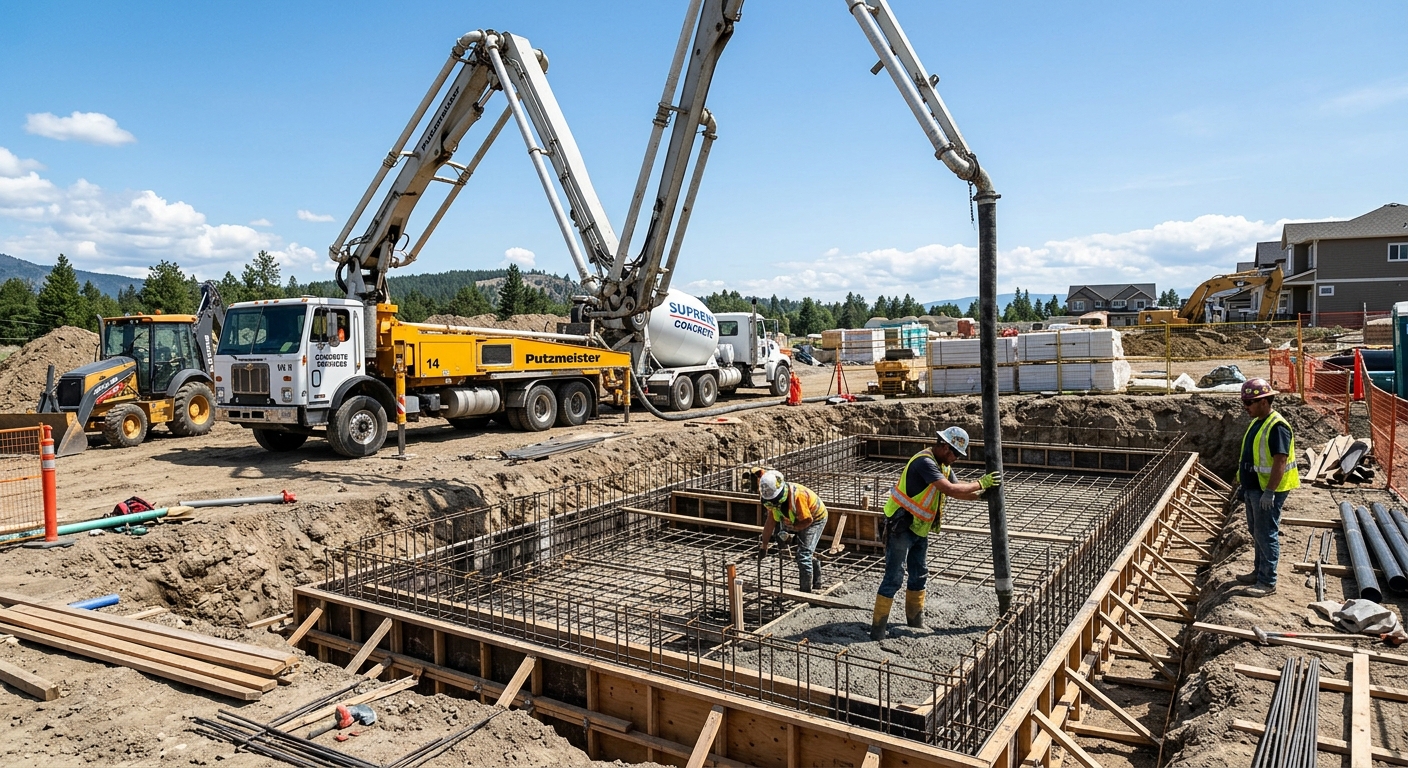
Concrete work options and costs in Keheewin
Keheewin homeowners usually have three concrete priorities: a durable driveway, walkable flatwork, and dependable foundation performance. With a population of 2,861 (Statistics Canada, 2021 Census), the local housing mix is quieter than Calgary proper, so scheduling with the best crews can matter. In this part of the Calgary economic region, concrete flatwork contractors are especially in demand around established neighbourhood pockets such as the Carrington-area style development belts on the city’s edge—where infill and ongoing landscaping drives repeat patio and driveway builds.
Cost in Keheewin isn’t just a “materials” story. Calgary’s cold continental climate is engineered around frost and freeze–thaw, with a design frost depth around 1.2 m (roughly 4 ft). That means footings and any frost-susceptible work must bear below that depth to prevent heave. Exterior slabs also need air-entrained concrete and careful control joints to reduce cracking and spalling as cycles repeat through winter. Finally, the practical pour season is shorter, and when projects run near shoulder seasons, winter-grade placement steps (insulation blankets and curing attention) can push labour and supervision costs.
The good news: when you match the spec to the climate, you get better longevity and fewer mid-winter repairs. Use the table below to compare common options—then we’ll break down what drives the biggest quote differences and how to verify a contractor in Alberta.
| Application |
Typical Size |
Key Spec |
Finish Option |
Price Range |
| Concrete driveway (standard broom finish) |
24 ft x 20 ft (480 sq ft) |
4 in slab, air-entrained mix |
Broom finish, basic edges |
$12,000–$18,000 |
| Exposed aggregate driveway |
24 ft x 20 ft (480 sq ft) |
4 in slab, polished/exposed surface prep |
Exposed aggregate with sealer-ready surface |
$15,000–$22,000 |
| Stamped concrete driveway or patio |
300–500 sq ft |
Air-entrained mix, integral colour |
Stamp pattern + release + sealer |
$15,000–$26,000 |
| Plain concrete patio or walkway |
200–350 sq ft |
4 in slab, air-entrained mix |
Tool/broom finish, light stamping optional |
$5,000–$9,000 |
| Garage floor (interior slab) |
20 ft x 22 ft (440 sq ft) |
4–5 in slab, vapour considerations |
Power trowel or broom finish |
$6,000–$12,000 |
| Foundation footings (structural, below frost) |
Typical single-family footing package |
Engineered rebar, excavation below frost depth |
Structural concrete as specified |
$28,000–$45,000 |
Prices are estimates only and vary by project scope, site access and material selection.
What affects the price of concrete work in Keheewin
In Keheewin and the broader Calgary area, it’s not unusual to see quotes for the “same” driveway or patio vary by 30–50%. The difference usually comes down to engineering depth, how much excavation is required, and whether the contractor designs for freeze–thaw instead of hoping concrete will “just last.” In Alberta, the design frost depth is a key driver: footings for homes, garages, and retaining structures must be founded below the design frost depth (about 1.2 m in this region) to reduce frost heave risk. That deeper excavation increases labour, truck time, and disposal—pushing foundation/footing work toward the higher end of the $28,000–$45,000 band.
Freeze–thaw cycles also dictate mix and finishing specs. Exterior flatwork should use air-entrained concrete to survive repeated freezing and thawing, and crews need well-spaced control joints to limit random cracking. When projects are scheduled near late fall or early spring, contractors may need winter-grade placement practices—insulated blankets, temporary heat, and added curing supervision. Those steps can add cost even if the slab size stays the same, and they protect surfaces from scaling and long-term spalling.
Two local examples: (1) a driveway built on poor subgrade or with topsoil that needs removal usually costs more than the same dimensions on native, well-compacted soil; (2) if de-icing salt use is expected (most families in the Calgary region do), a quality sealer plan helps reduce surface deterioration—though skipping it doesn’t remove the need for maintenance, it just accelerates it.
Finish choice matters too. A standard broom driveway might fit closer to the lower $12,000–$18,000 range, while stamped or high-touch finishes move you toward the $15,000–$26,000 band because of more labour and tighter curing/time management.
| Price Factor |
Why It Matters |
Cost Impact |
| Frost line depth — determines footing depth and form height |
Footings must extend below design frost to reduce heave |
Higher excavation and formwork increases cost |
| Site preparation — excavation, grading, compacted granular base |
Good base prevents settlement and cracking |
More removal/haul-off and labour can raise the quote |
| Reinforcement — rebar or wire mesh requirement |
Rebar/wire controls cracking and distributes loads |
Material + placement labour can add cost |
| Mix design — air-entrainment and compressive strength spec |
Air voids protect against freeze–thaw damage |
Specified mix and QC steps increase material cost |
| Finish type — broom vs. stamped vs. exposed aggregate |
More steps and tighter timing affect labour and waste |
Decorative finishes usually increase price |
| Pour size and concrete truck access to site |
Access affects pumping/placement time and crew efficiency |
Limited access may require pumps or multiple trips |
| Cold-weather curing precautions — heating and blankets |
Proper strength gain depends on curing conditions |
Winter steps add labour, fuel, and supervision |
| Control joint pattern and sealing cost |
Joints manage shrinkage; sealing helps resist de-icing salts |
Better detailing and sealing can reduce future repairs |
Permits & regulations in Alberta
In Alberta, structural concrete work generally requires a building permit and, for many sites, engineered drawings reviewed by the municipality. That typically includes concrete foundations and elements that form part of the structural system—such as footing foundations, foundation walls, and grade beams. For plain concrete flatwork (driveways, patios, and walkways), permits are often not required, unless the work affects lot grading, impacts stormwater/permit conditions, or triggers municipal rules around impervious surface coverage and drainage.
Before you break ground in Keheewin, do this step-by-step contractor verification:
- Ask the contractor for their proof of liability insurance (certificate of insurance) and confirm it includes work on residential construction sites.
- Request proof of coverage for work-related injury/coverage (commonly managed under WSIB/WCB). A reputable crew will provide this without hesitation.
- Verify contractor licensing/registration through the appropriate Alberta licensing registry relevant to your trade category (the contractor can point you to their registration details).
- Check references: request 2–3 recent projects of a similar scale (for example, a driveway size comparable to yours, or a footing package for a similar house type).
- Confirm whether permits/engineered drawings are included in the proposal for structural work. If not, ensure you know who is responsible.
If a quote is unusually low and the contractor can’t clearly explain how permits, engineering, and insurance are handled, treat that as a red flag—especially for footing depth and structural reinforcing details.
Getting concrete right in Keheewin's freeze-thaw climate
Concrete failures in Keheewin usually show up as surface scaling, spalling, or unexpected cracking after the first couple of winters—not because concrete “can’t” handle Alberta, but because it wasn’t specified or cured for our freeze–thaw cycles. In this Calgary region, the frost line is deeper than in many milder provinces, so base and footing depth matter. For exterior slabs, the spec needs air-entrainment and correct control joint detailing; otherwise, trapped moisture expands during freezing and degrades the surface over time.
To spec the job correctly, focus on five areas. First, base preparation: you need a compacted granular sub-base to the right depth and grade for local soil and drainage. Second, mix design: for exterior flatwork, air-entrained concrete with a target air content around 5–7% helps protect against freeze–thaw. Pair that with a minimum 32 MPa compressive strength so the concrete reaches structural capacity. Third, control joints: spacing should be planned to limit random shrinkage cracking. Fourth, curing: aim for at least 7 days under suitable conditions; in cold weather, crews may need insulated blankets or temporary heat to prevent strength gain problems. Fifth, sealing: apply a penetrating sealer after cure (commonly around 28 days post-pour) to repel de-icing salts and reduce surface deterioration.
Here’s a pricing example: a standard broom-finished patio may land near the lower end of the $5,000–$9,000 band, but if the contractor cuts corners on base compaction or uses the wrong mix, you can end up paying for patching and rework sooner—often approaching the cost of a full re-pour. Paying for correct specs upfront is typically the cheaper long-term decision in Keheewin’s climate.
| Spec |
Why It Matters in Keheewin |
What to Ask For |
Impact if Skipped |
| Compacted granular base (depth?) |
Controls settlement and reduces freeze impact at the slab edge |
Granular sub-base depth based on design and site conditions |
Uneven support, cracking, and slab movement |
| Air-entrained concrete mix (target air %?) |
Air voids protect against freeze–thaw scaling and spalling |
Target 5–7% air for exterior flatwork |
Spalling, surface loss, shortened lifespan |
| Compressive strength (MPa rating) |
Ensures strength gain for durability in cold conditions |
Minimum 32 MPa (per project requirements) |
Weak surface layers and premature wear |
| Control joints (spacing per ACI guidelines) |
Controls where cracks occur during shrinkage |
Planned joint layout and cutting schedule |
Random cracking that can widen and trap water |
| Minimum 7-day curing period |
Cold weather can delay strength development |
7 days of proper cure (and protection plan in cold) |
Reduced strength and surface scaling risk |
| Penetrating sealer (when applied after cure) |
Helps repel de-icing salts and moisture infiltration |
Penetrating sealer applied after cure (commonly ~28 days) |
Faster deterioration, more maintenance calls |
How to choose a concrete work contractor in Keheewin
Choosing a concrete contractor in Keheewin is mostly about confirming three things: credentials, clarity of scope, and how they manage curing in Alberta’s weather. Start by verifying Alberta licensing/registration relevant to the work they perform. Next, ask for a certificate of liability insurance—and confirm the coverage is active and aligned with residential construction. Finally, request proof of WSIB/WCB coverage (coverage for worker injuries). If they hesitate, can’t provide documents, or provide expired paperwork, move on.
Then compare quotes the right way. Get 2–3 itemised written quotes with a labour and materials breakdown—not just a lump sum. Specifically ask whether disposal/haul-off is included, whether permits are included for structural work, and what the quote includes for site prep (excavation, granular base, compaction tests if applicable). Scope gaps are a major reason bids swing by 30–50%.
Warranty matters too: ask for the workmanship warranty length, what it covers (cracks, spalling, settlement, joint failure), and whether manufacturer product warranties transfer if you sell your home. For payment, don’t front-load the job—never more than 10–15% upfront, and keep a holdback until key items are complete (including finishing and documented curing). Get a start date and completion estimate in writing; concrete schedules shift with freeze–thaw, but the contractor should still give realistic timing.
- Request proof of liability insurance and active coverage documents before signing.
- Verify WSIB/WCB coverage for their crew and subcontractors.
- Ask for at least two similar Keheewin-area references (driveways or flatwork, not just foundations).
- Insist on itemised quotes: excavation/grading, base materials, rebar/mesh, concrete, finishing, and sealing.
- Clarify exclusions: permit fees, engineering, pumping, disposal, cold-weather protection.
- Confirm air-entrained mix and minimum strength requirement in the written scope.
- Ask who supplies winter curing equipment (blankets/insulation) if temperatures drop.
- Check control joint layout and cutting timing (don’t accept “we’ll do it later”).
- Confirm curing plan and the protection period (minimum 7 days).
- Ask if they include sealer and when it’s applied (around 28 days post-pour for penetrating sealer).
- Review the payment schedule and keep a holdback until completion.
- Make sure the quote includes protection from early freeze conditions after placement.
In Keheewin, red flags include: promises of a “standard mix” with no mention of air-entrainment, refusal to put curing steps in writing, skipping or delaying control joints, vague scope that doesn’t address excavation/base prep depth, and asking for large upfront deposits without a clear holdback.
Frequently asked questions — concrete work in Keheewin
How long does a concrete driveway last?
In Keheewin and the Calgary region, a well-designed driveway commonly lasts 25 to 35 years, and sometimes longer with correct specifications. The big variables are base preparation, mix design (especially air-entrainment for freeze–thaw), and whether control joints and sealing were done properly. If your driveway is closer to the standard $12,000–$18,000 band and includes proper excavation and an air-entrained mix, durability is usually strong. If corners are cut on granular base or joints, hairline cracks can widen, water gets trapped, and freeze–thaw accelerates surface spalling. Also consider your de-icing habits—salts can be hard on surfaces, which is why sealing after cure (commonly around 28 days) helps.
What is air-entrained concrete and why does it matter here?
Air-entrained concrete has tiny, uniformly distributed air bubbles that give expanding water somewhere to go when temperatures drop below freezing. In Alberta’s cold continental climate, that’s critical for exterior flatwork because freeze–thaw cycles can damage the cement paste and cause scaling and spalling. In Keheewin, the key is making sure the contractor actually specifies an air-entrained mix for driveways, patios, and walkways—not just “regular concrete.” For typical exterior flatwork, crews target roughly 5–7% air content and pair it with sufficient strength (often a minimum 32 MPa spec). This is one reason higher-quality quotes can cost more up front: the right mix design and QC steps reduce long-term repair risk.
How do I prepare the base for a concrete slab?
Base prep is where most quality differences show up. For Keheewin projects, the contractor should excavate to the required depth, remove unsuitable topsoil, and install a compacted granular sub-base designed for local soil and drainage. The compacted base needs to be graded correctly so water doesn’t pond along edges—standing water increases freeze–thaw stress. You should expect compacted granular layers and careful compaction before concrete placement. Ask the contractor to explain the base depth for your specific site and confirm compaction practices. If your concrete driveway or patio is bid near the lower end of the local ranges (like the $5,000–$9,000 patio band), ask what’s included in site preparation; skipping base depth or compaction is a common reason slabs crack earlier.
How do I compare concrete quotes?
Compare quotes side-by-side using the scope, not just the total price. In Keheewin, quotes can vary by 30–50% because excavation volume, base prep, mix design, and cold-weather curing are handled differently. Ask each contractor to itemise: excavation and disposal (haul-off), granular base materials and compaction, reinforcement (rebar or mesh), concrete supply (including air-entrainment and strength), finishing, and whether sealing is included. Also confirm exclusions: permit pull responsibilities (for structural work), truck access/pumping, and cold-weather protection like insulated blankets or heating. A properly detailed quote for a driveway should align with the typical $12,000–$18,000 band for standard broom finishes, while stamped work should reflect the extra labour and time management found in the $15,000–$26,000 band.
Can concrete be poured in cold weather in Keheewin?
Yes, concrete can be poured in cold weather in Keheewin, but it requires a plan. The issue is not simply temperature; it’s curing conditions and the time needed for strength gain. In Calgary’s freeze–thaw cycle, the contractor should use cold-weather placement practices—commonly insulated blankets, wind protection, and sometimes temporary heating—so the concrete doesn’t freeze too early. The minimum curing period still matters: target at least 7 days under appropriate protection. When you request a quote, ask for their specific winter curing method and how they manage risks around overnight freezes. Also ensure the mix is appropriate for cold placement. A contractor who can’t explain curing and protection steps in writing is a risk.
How do I maintain concrete in Keheewin's freeze-thaw climate?
Maintenance in Alberta is mostly about reducing moisture and chemical attack. After your pour, allow proper cure, and if you want better long-term protection, ask for penetrating sealer after curing (commonly around 28 days). Sealer helps repel de-icing salts and reduces water penetration, which slows freeze–thaw deterioration. During winter, use de-icing products carefully—avoid over-application and sweep residue when possible. For small cracks, address them early with appropriate crack repair products to limit water getting underneath. For driveways and patios, keep drainage flowing away from the slab so water doesn’t pond at edges. With correct specs at install—air-entrainment, control joints, and proper base—maintenance costs typically stay low, but the freeze–thaw climate means periodic attention is still smart.