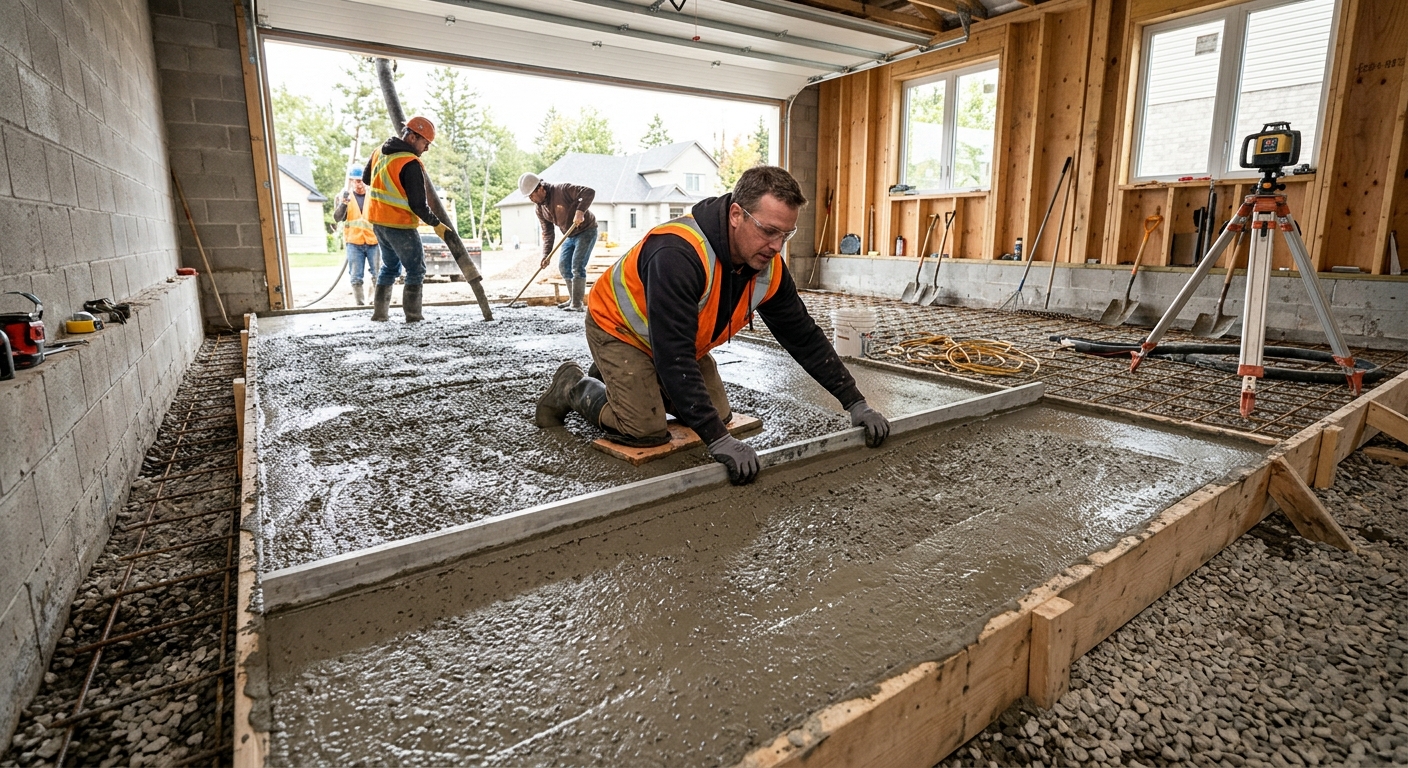
Concrete work options and costs in Kincora
Kincora, Alberta is where a lot of homeowners want “maintenance-free” outdoor concrete—driveways, patios, and walkways that can handle deep frost and Calgary-style freeze–thaw cycling. With a 2021 population of 7,030 (Statistics Canada, 2021 Census), the area is small enough that trade availability can change quickly after spring thaw, and that can show up in pricing. Most flatwork demand comes from the growing residential base; the wider Calgary region’s steady building activity keeps crews busy, especially for exterior pours when weather cooperates.
In this cold continental climate, concrete pricing is engineered around the design frost depth of about 1.2 m (roughly 4 ft). That means more excavation and larger footing/grade-beam volumes for foundations, compared with milder areas. For exterior slabs, local specs typically require air-entrained concrete and a properly prepared granular base so the slab can move slightly without pushing water into the structure. Frequent freeze–thaw cycles also make control joints, curing time, and sealing non-negotiable—skimp on them and you’ll see scaling and spalling sooner.
Concrete work is especially in demand in family neighbourhood pockets like northeast-style residential developments around Kincora Drive and nearby cul-de-sacs, where driveways and rear-yard walkouts are common additions during house build-out and landscaping. If you’re comparing bids, it helps to start with a clear menu of options—then match the finish and structural specs to your site.
Here are typical Kincora cost ranges by common application, before allowances for unusual access, removal, or site conditions.
| Application |
Typical Size |
Key Spec |
Finish Option |
Price Range |
| Concrete driveway (standard broom finish) |
24' x 20' (about 480 sq ft) |
Air-entrained mix; compacted granular base |
Broom finish with control joints |
$12,000–$18,000 |
| Exposed aggregate driveway |
24' x 20' (about 480 sq ft) |
Air-entrained mix; specialty aggregate reveal process |
Exposed aggregate texture |
$16,000–$22,000 |
| Stamped concrete driveway or patio |
24' x 20' driveway (or 12' x 20' patio) |
Air-entrained mix; integral colour |
Stamp pattern + release + sealer |
$15,000–$26,000 |
| Plain concrete patio or walkway |
12' x 16' (about 192 sq ft) |
Air-entrained mix; proper base drainage |
Float/screed with broom or light texture |
$5,000–$9,000 |
| Garage floor (interior slab) |
22' x 20' (about 440 sq ft) |
Vapour control where needed; fibre or mesh as specified |
Standard finish + curing |
$8,500–$13,500 |
| Foundation footings (structural, below frost) |
Typical single-family house footprint |
Excavation to undisturbed soil; below design frost |
Structural concrete; engineered rebar placement |
$28,000–$45,000 |
Prices are estimates only and vary by project scope, site access and material selection.
What affects the price of concrete work in Kincora
It’s common to see quotes for the “same” concrete job swing by 30–50% across Calgary and Alberta because the scope often changes without being obvious in the sales pitch. One contractor might include proper granular base prep and engineered reinforcement, while another may assume existing fill is adequate. In our market, those differences get magnified by winter engineering requirements and tighter exterior pour windows, especially for patios, walkways and driveways.
In Kincora and the Calgary region, the design frost depth of about 1.2 m (roughly 4 ft) dictates footing depth and form heights for foundations, and it influences how much excavation and backfill is required. If a base isn’t built to the correct depth for the local soil, the slab can heave. Exterior slabs also need air-entrained concrete to survive Calgary’s freeze–thaw cycles. Then there’s the curing reality: a shorter pour season means cold-weather placement may require winter-grade mixes, insulating blankets and sometimes supplemental heating to protect the concrete long enough to gain strength. Finally, de-icing salt is harsh—good sealing helps reduce surface scaling and spalling, but it costs money to do it properly.
Two quick examples from local Kincora projects: (1) removing and replacing frost-affected topsoil can push a driveway toward the upper end of the $12,000–$18,000 band because excavation volume increases; (2) moving from broom finish to stamped patterns commonly shifts you into the $15,000–$26,000 range because labour time, colour system, and finishing tools are more intensive. These price changes are normal in a growing neighbourhood where lots vary a lot in slope and servicing depth, even within the same street.
| Price Factor |
Why It Matters |
Cost Impact |
| Frost line depth — determines footing depth and form height |
Footings must bear below design frost to prevent frost heave and seasonal movement |
Major increase for foundations; higher excavation/formwork labour |
| Site preparation — excavation, grading, compacted granular base |
Proper base prevents settlement and limits water that feeds freeze–thaw damage |
Often the biggest variable; poor access or deeper demo raises cost |
| Reinforcement — rebar or wire mesh requirement |
Controls cracking and improves slab performance under loads (especially in driveways) |
Moderate cost; can be high if engineering calls for additional bars |
| Mix design — air-entrainment and compressive strength spec |
Air entrainment helps resist freeze–thaw; strength targets ensure durability |
Moderate; winter-grade protection can add cost |
| Finish type — broom vs. stamped vs. exposed aggregate |
More tools, labour steps, and colour/sealer requirements |
Drives finish upgrades; stamped/exposed typically costs more |
| Pour size and concrete truck access to site |
Large pours need efficient logistics; narrow paths increase labour and pump/placement steps |
Variable; accessibility can add significant labour and equipment |
| Cold-weather curing precautions — heating and blankets |
Protects curing strength gain and reduces scaling risk in freezing conditions |
Increases labour and equipment costs during late fall/early spring |
| Control joint pattern and sealing cost |
Joints manage cracking; sealing helps repel de-icing salt and moisture |
Small to moderate line item, but critical for long-term performance |
Permits & regulations in Alberta
In Alberta, structural concrete work—like foundation footings, foundation walls, and grade beams—typically requires a building permit and often engineered drawings that the municipality reviews as part of the permit process. For concrete flatwork (driveways, patios, walkways), a permit is usually not required unless the project affects lot grading/drainage, triggers impervious surface coverage limits, or touches municipal right-of-way conditions. Even when a permit isn’t expected for a patio or walkway, the drainage plan matters in freeze–thaw climates like Kincora because improper slope or downspout routing can lead to water pooling and freeze damage.
Step-by-step, here’s how a homeowner in Kincora can verify the contractor is set up correctly:
- Ask the contractor which scopes require permits (footings/foundation vs flatwork) and confirm they handle the documentation.
- Verify liability insurance—request a current certificate of insurance (COI) showing your project address.
- Confirm WSIB/WCB coverage (workers’ compensation) and request clearance or proof of account status.
- Check for appropriate Alberta business licensing and any trade registrations the contractor represents (you can confirm through provincial business resources and the company website documentation).
- Request references from similar-scale projects (exterior slabs in winter-cold conditions are a good indicator of how they manage curing and sealing).
If someone can’t provide proof on day one, pause and get it in writing—concrete delays get expensive fast when the weather turns.
Getting concrete right in Kincora's freeze-thaw climate
Concrete fails in Kincora mainly when water and temperature swings team up. The most common issues we see are surface scaling and spalling from inadequate air entrainment, premature freezing during curing, and base prep that doesn’t manage drainage. In freeze–thaw conditions across the Calgary area, the right spec is what keeps a driveway or patio stable for years.
To spec the job correctly, focus on five areas. (1) Base preparation: build a compacted granular sub-base to the correct depth for the local soil conditions and frost performance. If your base is shallow, the slab can heave. (2) Mix design: for exterior flatwork, use air-entrained concrete typically targeting 5–7% air content and a minimum 32 MPa compressive strength spec. (3) Control joints: place joints so cracks are encouraged along lines that you can seal and maintain. (4) Curing: plan for at least 7 days of curing under suitable conditions; in cold snaps, contractors should use curing blankets/heating as needed to protect strength gain. (5) Sealing: apply a penetrating sealer after the concrete has cured—commonly 28 days post-pour—so de-icing salts don’t quickly attack the surface.
Ask the hard questions because the lowest-bid approach sometimes “removes” the cure and air-entrainment requirements. For example, moving from a plain broom-finished patio into a protected, properly sealed exterior spec might add a few thousand dollars to a project in the $5,000–$9,000 range, but it’s often cheaper than future patching—especially once spalling starts. For driveways, proper exterior mix and base prep within the $12,000–$18,000 band can protect your investment; stamped work can cost more, but the durability requirements don’t get optional.
| Spec |
Why It Matters in Kincora |
What to Ask For |
Impact if Skipped |
| Compacted granular base (depth?) |
Limits settlement and water that freezes under the slab |
Confirm excavation depth, granular type, and compaction method |
Heaving, uneven slab, early cracking |
| Air-entrained concrete mix (target air %?) |
Creates freeze–thaw resistance by accommodating ice expansion |
Target 5–7% air for exterior flatwork and get mix details in writing |
Scaling/spalling, surface deterioration in winter |
| Compressive strength (MPa rating) |
Strength gain supports durability and load resistance |
Minimum 32 MPa spec for exterior applications |
Soft concrete, higher cracking risk, reduced lifespan |
| Control joints (spacing per ACI guidelines) |
Controls crack locations so they can be sealed and maintained |
Ask for joint layout/spacing and joint depth plan |
Random cracking; harder, less durable repairs |
| Minimum 7-day curing period |
Protects the concrete while it gains early strength in cold conditions |
Confirm curing plan and cold-weather protection if temperatures drop |
Premature freezing, weak surface, later spalling |
| Penetrating sealer (when applied after cure) |
Repels moisture and reduces de-icing salt damage |
Apply after cure, commonly 28 days post-pour |
Faster surface wear and easier water intrusion |
How to choose a concrete work contractor in Kincora
Start by verifying the contractor is properly covered before you talk price. In Alberta, ask for current liability insurance (COI showing your job address), and proof that workers are covered under WSIB/WCB (ask for clearance/proof of account status). Also confirm the company’s business details and that they can provide references for similar scopes—driveways and patios are especially sensitive to air-entrainment, base prep, and winter curing practices.
Next, don’t accept a single lump-sum number without an itemised breakdown. Get 2–3 written quotes that separate labour and materials (excavation, granular base, reinforcement, concrete mix, finish materials, joints, sealing, disposal/haul-away, and any pumping). Make sure exclusions are clearly stated—e.g., “no permit included,” “no removal of old slab,” or “no landscaping reinstatement.” For permit-heavy scopes, ensure they’re indicating whether permit pulls and engineered requirements are included.
Warranty matters in a freeze–thaw market. Ask for the workmanship warranty length, whether it’s tied to crack type or surface scaling, and what product/manufacturer warranties apply (and whether they’re transferable if you sell the home).
On payment terms, a safe standard is to avoid large deposits: typically 10–15% upfront, then schedule the remainder tied to milestones. I also recommend a small holdback until the slab is complete, cleaned, and cured to the agreed spec.
- Confirm insurance and WSIB/WCB proof before signing.
- Get start date and completion estimate in writing (weather can shift, but the plan should be clear).
- Ask what happens if the pour window closes (blankets/heating plan, reschedule policy).
- Require base prep depth and compaction method in the quote.
- Ask for the concrete mix specification: air-entrainment and strength target.
- Confirm reinforcement requirements (mesh/rebar type, size, placement).
- Ask for joint layout and sealing inclusions (not “allowance” that disappears later).
- Request disposal/haul-away included or excluded.
- Verify truck access plan: will they pump, and is that included?
- Clarify finishing details: broom vs stamped vs exposed aggregate, including colour/sealer system.
- Ensure winter curing precautions are described if work happens in shoulder seasons.
- Check cleanup and reinstatement of sod/landscaping and who supplies topsoil.
Concrete red flags I watch for in Kincora: vague mix/air specifications, “we always pour in any weather” without a curing/blanket plan, quotes that ignore base preparation depth, no written joint/sealing commitment, and payment schedules asking for most funds upfront before any sub-base work is confirmed.
Frequently asked questions — concrete work in Kincora
How do I compare concrete quotes?
Start by comparing scope and spec, not just the total number. In Kincora and the Calgary region, two driveway quotes can land far apart (often within or beyond the $12,000–$18,000 band) if one contractor includes the right granular base prep, proper air-entrained exterior mix, reinforcement (where required), and a joint/sealing plan for freeze–thaw. Ask each bidder to itemise: excavation/demo, granular base depth and compaction, concrete strength target, air content approach, reinforcement type, finish system, saw-cut control joint pattern, curing method, and whether penetrating sealer is included after cure. Also check logistics: truck access/pumping and site access time. If a quote is missing these details, it’s not apples-to-apples and can lead to change orders.
Can concrete be poured in cold weather in Kincora?
Yes, but it should be treated as a controlled pour, not a “normal summer pour.” Kincora’s cold snaps and freeze–thaw cycles mean the key is whether the contractor can protect curing concrete long enough to reach early strength. A proper cold-weather plan often includes winter-grade mix requirements, insulated blankets, and sometimes temporary heat to prevent the concrete from freezing during the critical curing window. If the quote doesn’t mention curing protection, heating/blankets, and how they manage temperature and finishing timing, be cautious. For exterior slabs, rushing curing in late fall or early spring increases risk of surface scaling and longer-term spalling, especially with de-icing salt exposure.
How do I maintain concrete in Kincora's freeze-thaw climate?
Maintenance in Alberta is about keeping water and salts off the surface and managing small damage early. First, ensure the slab gets a penetrating sealer after full cure—commonly around 28 days post-pour—since de-icing salt can accelerate surface wear. Second, use de-icers carefully: avoid over-salting and try sand/alternative traction when feasible. Third, inspect joints and edges each season. If a joint seal or caulking system is required in your build, keep it maintained so moisture doesn’t migrate underneath. Finally, clear snow promptly but don’t scrape aggressively with metal blades. In a freeze–thaw cycle environment, small issues become big if they’re left to hold water.
What causes concrete to spall in Kincora winters?
Spalling typically happens when water enters the concrete pores, freezes, and causes the surface to flake off—this is where freeze–thaw cycles do the damage. The most common cause is inadequate air entrainment, which should create microscopic air voids to relieve pressure from expanding ice. Other contributors include insufficient base drainage, poor compaction, inadequate curing, and finishing before the mix is ready in colder conditions. De-icing salts can worsen the effect by increasing surface chemistry and accelerating deterioration. That’s why durable exterior work in Kincora relies on engineered base prep, an air-entrained exterior mix, proper curing, control joints, and sealing. If you’re budgeting, expect that “spec compliance” is part of why many exterior projects land in the typical $12,000–$18,000 driveway range.
What is rebar and when is it required in Alberta?
Rebar (reinforcing bar) is steel embedded in concrete to improve tensile capacity and help control cracking. In Alberta, rebar is commonly required where structural engineers specify it—especially in foundations, footings, and grade beams that carry load and must resist movement. For driveways and patios, the exact need for rebar or mesh depends on slab design, soil conditions, thickness, and loading. Some slabs use welded wire mesh; others use rebar cages or fibres, but exterior freeze–thaw performance still depends on base prep, air entrainment, and joints. Your best protection is to ask for reinforcement details (type, size, placement) and confirm the quote matches the engineered drawings for your foundation scope.
How long does a concrete project take in Kincora?
Timelines vary with excavation, curing conditions, and finishing complexity. For a standard exterior flatwork job, you’re usually looking at about a day or two for form/setup and the pour day itself, plus additional days for curing and finishing tasks. However, cold weather can extend the schedule because contractors must protect curing concrete to prevent freezing. For decorative work—like stamped concrete—labour steps can add time for curing control and surface treatments, and projects commonly cost more within the $15,000–$26,000 stamped/decorative bands. Foundation work (footings) typically takes longer because excavation to below design frost depth and inspections/engineering coordination are part of the workflow. The contractor should give you a start date, weather contingency plan, and an estimated completion window in writing.