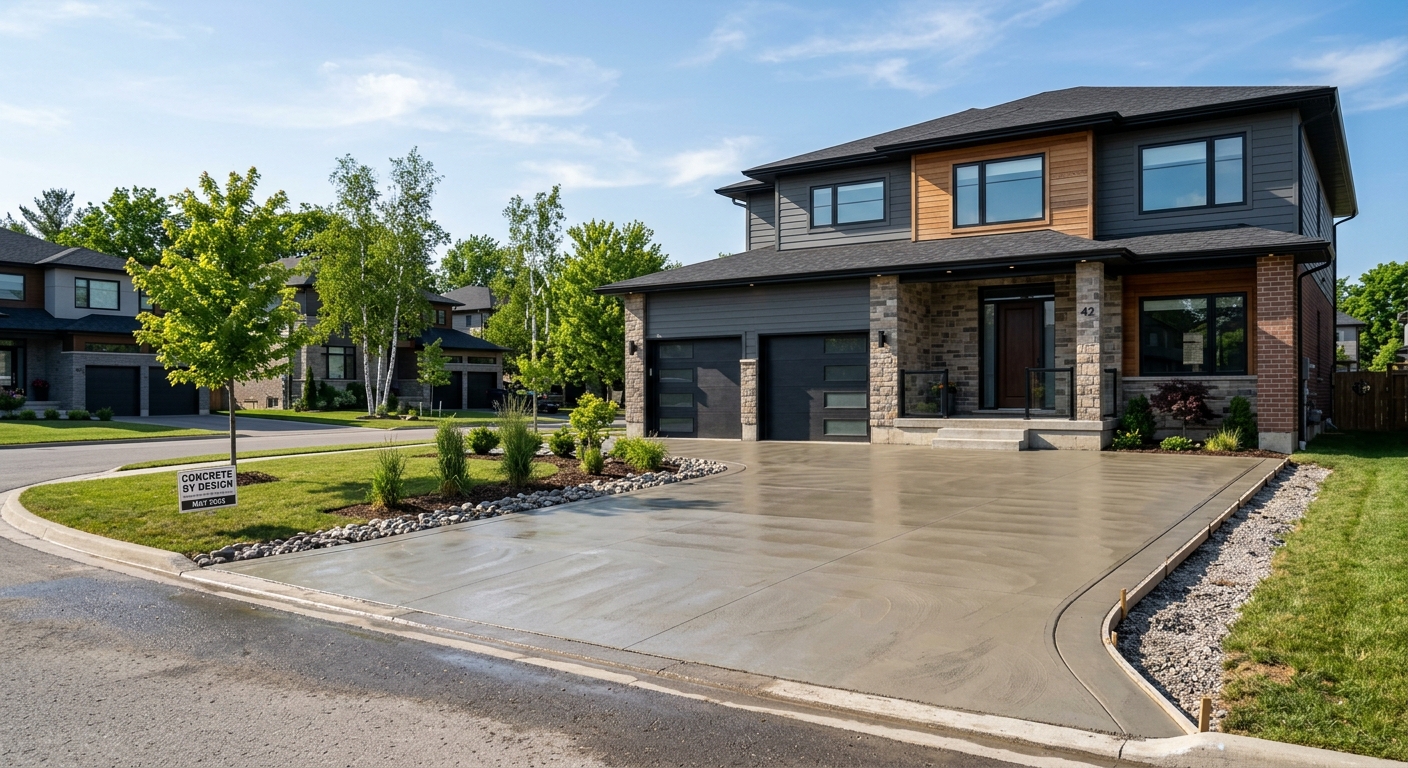
Concrete work options and costs in Montgomery
Concrete work in Montgomery, Alberta is typically busiest where homeowners want durable, low-maintenance flatwork—driveways, patios, walkways and garage slabs—because long winters and freeze–thaw cycles are hard on “cheap” installs. Montgomery’s population was 4,175 in 2021 (Statistics Canada, 2021 Census), and while that’s a relatively small base, it’s close to the Calgary market where lots of infill and renovations push demand for concrete flatwork. In many Calgary-area neighbourhoods, the dominant housing form is single-detached homes, which is the same type of property that most often needs new or expanded driveways and backyard slabs.
Pricing in Calgary can swing more than people expect even for the “same” slab. The reason is engineered spec: in Alberta, footings and foundation elements must work with a design frost depth of about 1.2 m (roughly 4 ft) or more, and exterior slabs need air-entrained concrete and proper base prep to handle repeated freeze–thaw. Labour and scheduling also play a big role—because the practical exterior pour season is shorter, crews often book earlier, and winter placement may require insulated blankets, winter-grade mix, and sometimes temporary heat to protect curing. You’ll see this especially in places like the newer developments near the Montgomery area where homeowners tend to expand garages, rework access, or add backyard living space.
Below are realistic budget ranges for common concrete options so you can compare quotes apples-to-apples, then we’ll dig into what drives the differences.
| Application |
Typical Size |
Key Spec |
Finish Option |
Price Range |
| Concrete driveway (standard broom finish) |
16 ft x 24 ft (384 sq ft) |
Air-entrained exterior mix; typical 4 in thickness; rebar reinforcement as per design |
Broom finish with control joints |
$12,000–$18,000 |
| Exposed aggregate driveway |
16 ft x 24 ft (384 sq ft) |
Air-entrained exterior mix; proper base and curing |
Exposed aggregate (e.g., washed finish) + sealant |
$15,000–$21,000 |
| Stamped concrete driveway or patio |
12 ft x 20 ft (240 sq ft) |
Air-entrained mix; integral colour or system; reinforced where required |
Stamped patterns + release + sealer |
$15,000–$26,000 |
| Plain concrete patio or walkway |
10 ft x 16 ft (160 sq ft) |
Air-entrained mix; compacted granular base |
Broom or smooth trowel edge with control joints |
$5,000–$9,000 |
| Garage floor (interior slab) |
24 ft x 22 ft (528 sq ft) |
Interior mix; vapour barrier (as applicable); engineered thickness |
Light broom + sealer (optional) |
$10,000–$16,000 |
| Foundation footings (structural, below frost) |
Typical house footing scope |
Excavation to design frost depth; engineered rebar; proper backfill and drainage |
Structural concrete placement below grade |
$28,000–$45,000 |
Prices are estimates only and vary by project scope, site access and material selection.
What affects the price of concrete work in Montgomery
In Montgomery, two contractors can price the same concrete job 30–50% apart because the “scope” often isn’t truly the same: excavation depth, base thickness, reinforcement details, concrete mix design, and whether cold-weather measures are included. In the Calgary economic region, scheduling pressure during the shorter exterior pour window also affects labour rates—crews that can properly place concrete in cold conditions (with insulated blankets, heaters, and winter-grade mix) generally cost more, but they’re protecting the long-term performance.
Frost line depth is the big driver. Footings for houses, garages, decks and retaining structures must bear on undisturbed soil below the design frost depth (about 1.2 m in practice for the region’s engineered approach). When the frost-safe depth is deeper due to site conditions, excavation volume increases, and that shows up immediately in cost. Exterior slabs also need air-entrained concrete to survive repeated freeze–thaw cycles, and that adds mix requirements and QA steps compared to “standard” mixes. Calgary’s colder placement season means the curing window is shorter; if crews rush or skip winter curing precautions, you risk surface scaling and longer-term spalling—so professional quotes often include added labour and materials for blankets/heating.
Local examples from Montgomery: a driveway replacement that requires removing thicker old concrete and hauling debris can push costs beyond the typical concrete driveway band of $12,000–$18,000. A stamped patio can land near the stamped range of $15,000–$26,000 when integral colour, reinforcement adjustments, and pattern formwork are included—those costs are justified because the finish system is labour-intensive and more sensitive to timing and curing. If your home is older with lower drainage control around the slab edge, we typically plan for higher-quality base drainage and sealant—often a small upfront increase that helps prevent early deterioration.
| Price Factor |
Why It Matters |
Cost Impact |
| Frost line depth |
Determines footing depth and form height |
More excavation and concrete if deeper frost conditions apply; can swing major structural line items |
| Site preparation |
Excavation, grading, compacted granular base |
Extra haul-away, sub-base material and compaction time increase cost |
| Reinforcement |
Rebar or wire mesh requirement |
Higher reinforcement demand for heavier loads and reduced cracking risk |
| Mix design |
Air-entrainment and compressive strength spec |
Winter-grade and air-entrained mix requirements add per-cubic-yard cost and testing |
| Finish type |
Broom vs. stamped vs. exposed aggregate |
Stamped/exposed systems add labour, materials, and stricter placement timing |
| Pour size and concrete truck access to site |
Impacts labour and whether pumps/extra gear are needed |
Pump time, shorter access routes, or multiple dispatches raise total labour and equipment |
| Cold-weather curing precautions |
Heating and blankets |
Winter placement can add line items to protect curing and prevent scaling |
| Control joint pattern and sealing cost |
Limits random cracking; sealer helps with de-icing damage |
Better joint spacing and a quality penetrating sealer add cost but improve service life |
Permits & regulations in Alberta
In Alberta, structural concrete work—think foundation elements like footings, foundation walls, and grade beams—requires a building permit. Most of the time, engineered drawings are part of the package the municipality reviews before construction begins, because those elements carry structural loads and must align with design assumptions (including frost considerations). For concrete flatwork like patios, walkways and driveways, a permit is usually not required by default; however, it can be required if the work affects lot grading, creates changes to drainage away from the house, alters impervious surface coverage limits, or touches municipal right-of-way requirements. The safest approach for Montgomery homeowners is to confirm with the local authority before breaking ground, especially if you’re tying a new slab into existing grades or reworking drainage routes.
Before you hire a contractor, verify the basics step-by-step. First, confirm they carry liability insurance—ask for a certificate of insurance showing your project address/jobsite location (or “certificate holder” information where applicable). Second, check WSIB coverage (for many construction trades) or WCB coverage depending on their registration—request proof of coverage in writing so you’re not left holding risk if a worker is hurt. Third, confirm they have the right licence(s) for the scope of work they’re performing; you can verify credentials through relevant provincial/registration listings online. Finally, ask for references on similar-scale Montgomery or Calgary-area projects so you can assess workmanship in freeze–thaw exposure conditions.
Getting concrete right in Montgomery's freeze-thaw climate
In Montgomery and the wider Calgary area, concrete most commonly fails due to a predictable combination: water gets into the slab edge or base, then freeze–thaw cycles expand it, and the surface begins to spall or scale. The fix is not “stronger concrete” alone; it’s a system. Start with (1) base preparation: compacted granular sub-base to the appropriate depth and condition for local soils and frost performance so the slab doesn’t move seasonally. (2) Mix design: specify air-entrainment at about 5–7% air for exterior flatwork and a minimum compressive strength of 32 MPa (typical structural flatwork spec in practice). (3) Control joints: add joints at a proper spacing so shrinkage cracks form where you want them. (4) Curing: target at least 7 days of proper curing conditions, and in cold weather plan for insulated blankets and/or temporary heat so the concrete reaches sufficient early strength without damage. (5) Sealing: apply a penetrating sealer after full cure—often at 28 days—to help repel de-icing salts and reduce moisture uptake at the surface.
The right questions to ask are technical and specific: “What air content are you placing for exterior slabs?” “How deep is the compacted base you’re building to?” and “Will you include cold-weather protection if we pour in fall/early spring?” If air-entrainment is inadequate, scaling and spalling become much more likely in this freeze–thaw environment. For budgeting, you might pay a bit more upfront to stay in the standard driveway band of $12,000–$18,000—versus an unrealistically low quote that “skips” winter curing or reduces base thickness. That difference is justified because repairs later are far more expensive than doing the engineered approach the first time.
| Spec |
Why It Matters in Montgomery |
What to Ask For |
Impact if Skipped |
| Compacted granular base (depth?) |
Prevents settlement and frost-related movement under load |
Confirm base depth and granular type; request compaction method/testing approach |
Uneven settling, cracking, and water pooling leading to freeze–thaw damage |
| Air-entrained concrete mix (target air %?) |
Protects against spalling from freeze–thaw cycles |
Ask for target air content (typically 5–7% for exterior flatwork) |
Surface scaling and spalling over a few seasons |
| Compressive strength (MPa rating) |
Ensures durability and strength development during cold placements |
Specify minimum 32 MPa for flatwork unless engineered otherwise |
Premature wear, cracking, and reduced long-term performance |
| Control joints (spacing per ACI guidelines) |
Manages shrinkage cracking in a predictable pattern |
Request joint spacing, sawing timing, and layout plan |
Random cracks that allow more water ingress |
| Minimum 7-day curing period |
Early strength and surface integrity depend on curing conditions |
Confirm curing plan; ask what changes in cold weather (blankets/heating) |
Weakened surface, scaling, and higher failure risk |
| Penetrating sealer (when applied after cure) |
Helps repel moisture and de-icing salts |
Ask for timing after full cure (commonly 28 days) and product type |
Faster salt damage and more frequent maintenance |
How to choose a concrete work contractor in Montgomery
Choosing the right concrete contractor in Montgomery starts with proof, not promises. For Alberta work, ask for their licence/registration details (for the scope they’re doing), liability insurance, and WSIB/WCB coverage. To check each item: (1) licensing/registration—use the relevant online registry or the contractor’s registration documentation they provide and confirm the scope matches your project; (2) liability insurance—request a certificate of insurance and verify the effective dates and that your project is covered; (3) WSIB/WCB—ask for a clearance or proof of coverage document. Don’t accept a verbal “we’re covered.” If a contractor hesitates, that’s a red flag.
Next, get 2–3 itemised written quotes. You want line items that show labour + materials, including excavation, hauling/disposal, granular base, reinforcement, formwork, concrete supply, finishing, joints, curing protection, and sealing (if included). Read the scope carefully: what’s excluded (rock removal, stump grinding, snow/ice control, trenching for drainage ties)? Is a permit pull included if required for structural work? Is disposal included, or will you be billed separately? Confirm warranty details: workmanship warranty length, product/manufacturer warranty terms, and whether warranties are transferable to future owners. For payment schedule, avoid large deposits—never pay more than 10–15% upfront, and use a holdback until completion and any deficiency walk-through is signed off. Finally, request a start date and realistic completion estimate in writing.
- Ask whether the quote includes engineered thickness and reinforcement for your loading (driveway/garage).
- Confirm air-entrainment and target air content for exterior slabs.
- Require a base spec: granular type, compacted depth, and compaction approach.
- Check whether cold-weather protection (blankets/heaters) is included for your pour date.
- Ensure control joint locations and timing (saw cut vs formed) are described.
- Ask about curing responsibilities and minimum curing duration.
- Confirm whether disposal/hauling of concrete and over-excavation is included.
- Verify concrete truck access plan (no “we’ll figure it out later”).
- Look for an item for sealing if you’re in a driveway/patio exposure zone.
- Request copies of insurance proof and WSIB/WCB clearance or coverage documentation before signing.
- Get a written warranty and what triggers it (timelines, maintenance requirements).
- Make sure the quote includes protection of landscaping and property during placement and curing.
Concrete red flags I see in Montgomery: (1) quotes that don’t mention air-entrainment for exterior work, (2) no plan for curing protection if temperatures drop, (3) skipping compacted granular base details, (4) unclear reinforcement (mesh/rebar) or “we’ll see on site,” and (5) vague timelines or no written scope for disposal and grading.
Frequently asked questions — concrete work in Montgomery
Do I need a permit for concrete work in Alberta?
In Alberta, structural concrete work such as footings, foundation walls, and grade beams typically requires a building permit, often with engineered drawings reviewed as part of the permit process. Concrete flatwork—like patios, walkways and driveways—usually does not require a permit unless it affects lot grading, drainage, impervious surface considerations, or touches municipal right-of-way areas. For Montgomery homeowners, the practical approach is to confirm with the local authority before you start, especially if you’re changing the slope away from the house or altering existing drainage paths. Also ensure your contractor’s scope clearly states whether they include any permit-related steps (when applicable), so you’re not surprised mid-project.
Concrete vs pavers for a patio in Montgomery?
For patios in Montgomery, concrete is usually the better value when you want a smooth surface, predictable maintenance, and fewer joints that can heave. Pavers can be excellent if you plan for easier spot repairs and you want a modular pattern, but freeze–thaw can still challenge paver bases if they aren’t built with the right granular depth and compaction. With concrete, you can spec air-entrained mix, control joints, and sealing to reduce salt and moisture damage over time. Based on local budget bands, plain concrete patios commonly land around $5,000–$9,000 for typical homeowner sizes, while stamped or decorative systems are higher. If drainage is poor near the house, either option can fail—so focus on base prep and water management first.
How long does a concrete driveway last?
A well-built concrete driveway in the Calgary area can often last for decades, but “lifespan” depends on the details: air-entrainment, proper base prep, joint spacing, curing, and sealing. In Montgomery’s freeze–thaw conditions, the biggest early failure mode is spalling from moisture and de-icing salt getting into microscopic surface defects. That’s why exterior slabs should use air-entrained concrete and be sealed after curing (commonly around 28 days). If your driveway is built to the standard exterior driveway spec, it can typically hold up long enough to justify the mid-range pricing—many projects fall in the $12,000–$18,000 band. A driveway built with thinner base or rushed curing might look fine initially, then deteriorate faster once winter stress cycles repeat.
What is air-entrained concrete and why does it matter here?
Air-entrained concrete is mixed to include tiny, evenly distributed air bubbles that provide “relief space” when water inside the concrete freezes. In Montgomery and the broader Calgary region, freeze–thaw cycles are frequent, and that trapped water expansion is what drives surface scaling and spalling when air content is wrong. That’s why reputable contractors specify air-entrainment for exterior flatwork and don’t treat it as optional. When you’re comparing quotes, ask for the target air percentage (often 5–7% for exterior slabs) and confirm it’s part of the mix design. It’s also tied to finishing and curing—if the crew rushes finishing or doesn’t protect curing in cold weather, you can still see premature surface damage even with the right concept.
How do I prepare the base for a concrete slab?
Base preparation is where concrete jobs are either engineered correctly or doomed early, especially in Alberta’s frost environment. Preparation generally means excavating to a frost-appropriate depth for the engineered design, then installing and compacting a granular sub-base so the slab doesn’t settle. You want the right granular type, proper grading, and consistent compaction before forms go up. For exterior slabs in Montgomery, good base prep also helps control water—if water sits under the edges, freeze–thaw will increase the risk of cracking and spalling. In quotes, don’t accept “we’ll do the base.” Ask for the base depth, granular material description, and compaction approach. Tie this to the overall frost requirement (design frost depth about 1.2 m in the region’s engineered practice) so the work matches local reality.
How do I compare concrete quotes?
To compare concrete quotes fairly in Montgomery, insist on itemisation rather than only a total price. Look for line items for excavation and disposal, granular base thickness and compaction, reinforcement (mesh/rebar and placement), concrete mix design (including air-entrainment for exterior work), finishing method, curing protection in cold weather, and sealing (for patios/driveways). A low quote that skips air-entrainment or cold-weather curing will often undercut the market in the short term but increases risk of scaling and repairs later. As a reference point, driveway budgets commonly sit around $12,000–$18,000, while stamped/decorative projects often fall around $15,000–$26,000. Finally, verify proof of liability insurance and WSIB/WCB coverage before signing, and confirm the start/completion timeline is written into the contract.