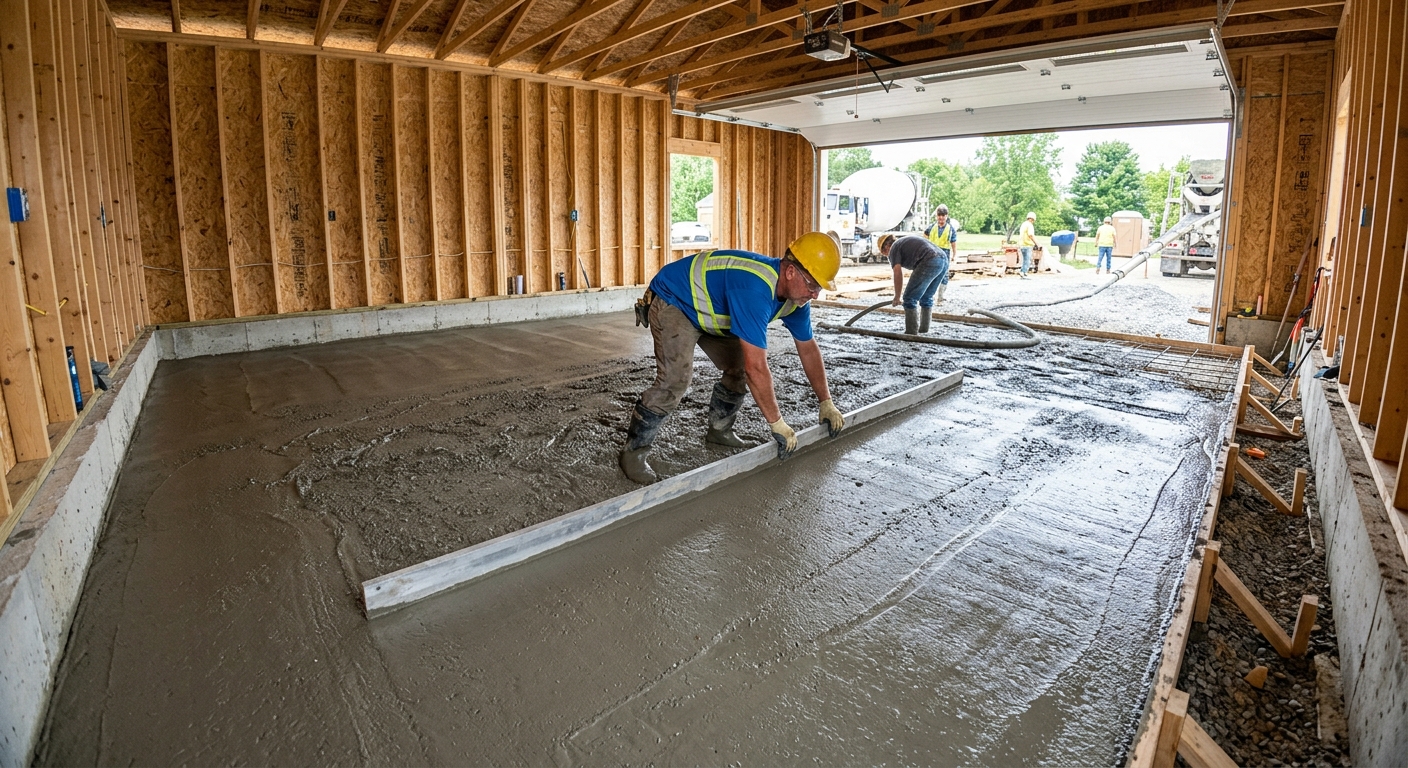
Concrete work options and costs in Chinook Park
Chinook Park, Alberta is a small community (population 1,535, Statistics Canada, 2021 Census), but it still has the same concrete demands as the broader Calgary market: driveways, patios, walkways, and foundations that must survive a cold continental freeze–thaw cycle. In a neighbourhood like Chinook Park, most homeowners are dealing with typical residential infill and established lots, so contractors often focus on practical flatwork—especially where salt use and winter traffic increase wear. Concrete work demand is also shaped by the local housing stock; where properties have older walkways or older garage pads, replacement is frequently tied to porch steps, grading corrections, and drainage improvements.
Calgary pricing is engineered around frost and freeze–thaw. Because the design frost depth in this region is roughly 1.2 m (about 4 ft), foundation and footing excavations generally run deeper and require more granular base and formwork than in milder provinces. Exterior slabs also need air-entrained mixes and a realistic pour/curing plan; cold-weather placement shortens the safe window and may require insulated blankets or temporary heat to protect early-age strength gain. Labour availability can tighten in the short exterior season, which is why two quotes for the same scope can differ quickly when schedules don’t align with weather forecasts.
In Chinook Park areas with heavier vehicle access—commonly along busier residential corridors where homeowners plan driveway expansions or upgrades—contractors see more repeat work on exposed surfaces, joint layouts, and sealing. Use the table below to compare common options and the typical price band for this tier, then we’ll break down what drives those numbers.
| Application |
Typical Size |
Key Spec |
Finish Option |
Price Range |
| Concrete driveway (standard broom finish) |
12 ft x 24 ft (288 sq ft) |
4 in slab, air-entrained mix, control joints, compacted base |
Broom finish |
$12,000–$18,000 |
| Exposed aggregate driveway |
12 ft x 24 ft (288 sq ft) |
4 in slab, proper curing, strengthened wear surface |
Exposed aggregate |
$15,000–$22,000 |
| Stamped concrete driveway or patio |
10 ft x 20 ft (200 sq ft) |
4 in slab, integral colour, air-entrained mix |
Stamped pattern + sealer |
$15,000–$26,000 |
| Plain concrete patio or walkway |
10 ft x 16 ft (160 sq ft) |
4 in slab, air-entrained mix, compacted sub-base |
Floating + broom/edge finish |
$5,000–$9,000 |
| Garage floor (interior slab) |
22 ft x 22 ft (484 sq ft) |
4 in slab, vapour barrier (as required), reinforced where specified |
Standard trowel/broom finish |
$9,500–$15,000 |
| Foundation footings (structural, below frost) |
Typical house: ~1,000–1,600 sq ft of footing area |
Engineered footing depth, rebar per design, below frost elevation |
Structural finish (trowel as required) |
$28,000–$45,000 |
Prices are estimates only and vary by project scope, site access and material selection.
What affects the price of concrete work in Chinook Park
In Chinook Park and across the Calgary economic region, it’s common to see the same concrete project priced 30–50% apart. The biggest reasons are (1) how deep and how much excavation is required for frost protection, (2) the spec for air-entrainment and strength, (3) reinforcement and base build-up quality, and (4) whether the contractor can pour and cure at the right time. When schedules get tight late in the season, contractors may carry extra crew time or mobilize for shorter windows, which shows up in the quote.
Frost line depth dictates footing depth and form height. In Alberta, footings for houses, garages and retaining elements typically need to extend below the design frost depth of about 1.2 m (roughly 4 ft). That means more digging, more granular backfill, more inspection time, and more concrete volume. Exterior flatwork is also affected by freeze–thaw cycles: Calgary-area specs typically require air-entrained concrete to help resist freeze damage, along with well-spaced control joints to reduce random cracking. If you’re pouring near shoulder seasons, cold-weather curing precautions (insulated blankets and, on some jobs, temporary heat) can add cost but protect long-term durability. Sealing is equally important because de-icing salts can accelerate surface deterioration and spalling when the surface is left unprotected.
Here are a few local examples that commonly move cost up or down in Chinook Park: adding a thickened edge or widening a driveway apron can push a standard broom driveway toward the upper end of the $12,000–$18,000 band; switching from plain to stamped concrete may still be worth it when you’re getting an aesthetic upgrade without rebuilding the whole footprint—often landing in the $15,000–$26,000 range for decorative work depending on size and pattern complexity. Conversely, if your site has easy truck access and you don’t need major regrading, your cost can stay closer to the lower end because base prep and labour are less demanding.
| Price Factor |
Why It Matters |
Cost Impact |
| Frost line depth — determines footing depth and form height |
Footings must bear on undisturbed soil below design frost to prevent heave. |
Higher excavation and concrete volume; often the largest variable on foundations. |
| Site preparation — excavation, grading, compacted granular base |
Flatwork longevity depends on proper sub-base thickness, drainage, and compaction. |
Extra trucking, disposal, and labour if the site is tight or over-excavation is needed. |
| Reinforcement — rebar or wire mesh requirement |
Controls cracking and improves load capacity, especially for driveways and garage slabs. |
Material and placement labour increase cost; can still be cost-effective versus failures. |
| Mix design — air-entrainment and compressive strength spec |
Air content and strength are critical for freeze–thaw performance in Alberta. |
Higher-spec mix costs more, but it reduces future scaling/spalling risk. |
| Finish type — broom vs. stamped vs. exposed aggregate |
Decorative finishes require more labour, materials, and curing/sealer steps. |
Stamped/exposed can move projects into the higher bands (e.g., decorative driveways). |
| Pour size and concrete truck access to site |
Large or hard-to-access pours slow down production and can require extra handling. |
Mobilization and additional crew time; sometimes alternative methods are needed. |
| Cold-weather curing precautions — heating and blankets |
Cold slows strength gain; protecting the pour helps prevent surface scaling. |
Adds direct equipment/materials and reduces flexibility in scheduling. |
| Control joint pattern and sealing cost |
Joints and sealing reduce random cracking and protect from de-icing salt exposure. |
Labour + sealant cost; usually far cheaper than premature repairs. |
Permits & regulations in Alberta
In Alberta, structural concrete work—think foundation footings, foundation walls, grade beams, and any engineered structural elements—typically requires a building permit. Many projects also need engineered drawings that are reviewed through the municipal permitting process. For concrete flatwork (driveways, patios, walkways), a permit is usually not required unless your work affects lot grading, impervious surface coverage limits, drainage routing, or municipal right-of-way requirements. In Chinook Park, the practical takeaway is this: if your pour changes how water moves across the property or touches regulated areas, confirm what’s needed before you excavate.
Before hiring, verify your contractor carries the right coverage and is properly established. Ask for: (1) proof of liability insurance, (2) WSIB/WCB clearance/coverage for their workers, and (3) references on similar-size foundation and flatwork jobs in the Calgary area. Step-by-step, homeowners should verify licensing/eligibility first via the appropriate online public registry search, then request a current Certificate of Insurance naming you and/or your builder as required by contract. For WSIB/WCB coverage, request a clearance letter or verification document that matches the time of the project—don’t accept outdated paperwork.
Finally, confirm whether the contractor includes permit coordination (if required), inspection scheduling, and disposal/grading restoration in the written scope. This is where hidden costs often appear if it’s not clarified up front.
Getting concrete right in Chinook Park's freeze-thaw climate
Concrete problems in Chinook Park usually trace back to one of five things: weak base prep, poor mix/air content, inadequate reinforcement or jointing, curing mistakes, or surfaces left unsealed against salt. In a Calgary freeze–thaw environment, water moves in and out of the surface and near-surface pores; if the concrete doesn’t have the right air-void system and if the surface is exposed to de-icing salts, you can see scaling and spalling even when the slab looks “fine” at first.
To spec the job correctly, start with base preparation: a compacted granular sub-base to the required depth for local soil and frost strategy, with proper grading to shed water away from the foundation. For mix design, ask for air-entrainment targeted at about 5–7% air content for exterior flatwork in Alberta and a minimum compressive strength of 32 MPa (unless the engineer specifies more for structural elements). Control joints should be placed to limit random cracking; spacing is typically planned so cracks occur at joints, not through the middle of the slab. Then curing: aim for at least 7 days of proper curing conditions, and if the weather is cold, require insulated blankets or heating so early-age strength development isn’t compromised. Finally, sealing: use a penetrating sealer applied after the curing period (commonly after 28 days) to repel salt-impacted moisture.
Here’s where money is well-spent: if a quote looks cheaper because it uses a lower-spec mix or skips air-entrainment, you’re saving a small amount upfront but risking premature surface failure. For context, a plain patio/walkway often falls around $5,000–$9,000, while decorative options are higher (for stamped work, think $15,000–$26,000). You don’t want the lower patio price to come at the expense of the performance specs that keep it looking good through winter.
| Spec |
Why It Matters in Chinook Park |
What to Ask For |
Impact if Skipped |
| Compacted granular base (depth?) |
Durable concrete needs a stable, drained base that prevents pumping and frost-related movement. |
Confirm base thickness, granular type, compaction method, and slope/drainage plan. |
Premature cracking, uneven settlement, and early surface deterioration. |
| Air-entrained concrete mix (target air %?) |
Freeze–thaw cycling in Alberta depends on proper air void spacing to resist scaling/spalling. |
Ask for 5–7% air content for exterior flatwork and documentation of mix design. |
Surface scaling, spalling, and loss of durability after a few winters. |
| Compressive strength (MPa rating) |
Strength gain supports long-term load capacity and abrasion resistance. |
Ask for minimum 32 MPa (or higher if engineered) at specified curing times. |
Soft, wear-prone concrete and increased risk of cracking under load. |
| Control joints (spacing per ACI guidelines) |
Joints let concrete crack predictably, reducing random cracking from shrinkage and thermal movement. |
Request joint layout plan: spacing, saw-cut timing, and edge details. |
Random cracks and water intrusion leading to freeze damage. |
| Minimum 7-day curing period |
Cold weather slows strength development; early-age protection reduces defects. |
Confirm curing method and whether blankets/heating are used in cold conditions. |
Lower strength, surface dusting/scaling, and long-term performance loss. |
| Penetrating sealer (when applied after cure) |
Salt exposure is a major driver of spalling risk on exterior flatwork. |
Ask for penetrating sealer applied after cure (commonly at/after 28 days) with a stated coverage rate. |
Faster salt-related deterioration and higher repair likelihood. |
How to choose a concrete work contractor in Chinook Park
Start by confirming your Alberta contractor is properly set up and insured. For licensing/eligibility, use the appropriate Alberta online registry resources to verify the contractor’s status before you sign anything. Then ask for a Certificate of Insurance (current date) showing liability coverage limits and the correct business entity name. For worker coverage, request WSIB/WCB verification or a clearance letter; don’t rely on “we’ll be covered” emails—get proof tied to the job period.
Next, collect 2–3 itemised written quotes. The best quotes break labour and materials down (excavation, forming, reinforcement, concrete supply, finishing, joints/saw-cutting, disposal, and sealing if included). Avoid lump-sum quotes without an explicit scope. Read exclusions carefully: What’s not included for removal, hauling/disposal, regrading, or required base depth? Is the permit pull included if it’s required for your scope? In Chinook Park, drainage and grading language matters because it impacts municipal concerns.
Warranty should be specific: ask for the workmanship warranty length and what it covers (e.g., cracking within a defined limit, surface scaling, joint failures), along with product/manufacturer warranty terms. If materials warranties are used, ask whether the warranty is transferable if you sell the home. Payment scheduling should be controlled—never pay more than 10–15% upfront. Hold back the final portion until the final clean-up, sealing (if scheduled), and any punch list are complete. Finally, get a start date and completion estimate in writing so winter scheduling doesn’t quietly extend the project.
- Request proof of current liability insurance before the contract is finalized.
- Ask for WSIB/WCB clearance or verification tied to your project timeline.
- Confirm the contractor’s experience with frost-depth and freeze–thaw specs in Calgary-area conditions.
- Require itemised quotes (labour vs. materials), not a single total with vague language.
- Check whether disposal/hauling is included or billed separately.
- Verify base depth, compaction method, and granular type are listed in the scope.
- Confirm reinforcement requirements (rebar/wire mesh) based on design and intended use.
- Ask for mix design details: air-entrainment target and 32 MPa minimum (for exterior flatwork unless engineered otherwise).
- Require a joint layout and saw-cut plan with timing expectations.
- Clarify curing plan in cold weather: blankets/heating if temperatures drop.
- Ask if penetrating sealer is included (and when it’s applied after cure) for exterior slabs.
- Use a payment schedule with a holdback until final inspection/punch list is complete.
Concrete red flags in Chinook Park include: “one-size-fits-all” mix specs that don’t mention air-entrainment; no discussion of frost depth/base thickness; quotes that exclude sealing yet assume exterior durability; pressure to pay a large deposit up front; and vague warranty language that doesn’t define workmanship coverage.
Frequently asked questions — concrete work in Chinook Park
What is rebar and when is it required in Alberta?
Rebar is steel reinforcement embedded in concrete to improve tensile strength and control cracking as loads and temperature changes act on the slab or foundation. In Alberta, whether you need rebar depends on the engineered design and the concrete element: structural foundations and footings are typically designed with rebar to resist bending and uplift forces, while flatwork like driveways may need reinforcement based on slab thickness, sub-base conditions, and expected loads. For exterior slabs in Chinook Park, the key is that freeze–thaw and salt exposure punish poorly jointed or under-reinforced concrete. That’s why good contractors tie rebar (or wire mesh where appropriate) to a written spec, not guesswork. If you’re pricing a foundation/footings scope, you’ll usually see the foundation band around $28,000–$45,000, partly because engineered reinforcement is often part of that structural package.
How long does a concrete project take in Chinook Park?
The calendar time for a concrete project in Chinook Park depends on whether you’re doing structural work (foundations/footings) or exterior flatwork (driveways/patios). Typical flatwork can be poured in a single day, but setup (locating utilities, excavation, base prep, forms, reinforcement) and curing/finishing drive the schedule. Realistically, a driveway or patio usually takes several days from start to finish, with additional time needed if the weather requires heating/blankets. Foundations/footings can take longer because excavation, inspections, and engineered rebar placement are involved, and concrete placement may occur in multiple steps. Even after pouring, you must plan for cure time—minimum 7 days for early strength in many flatwork scenarios, with sealing usually scheduled after cure (often around 28 days). Winter and late-fall pours can also add time because contractors protect early-age concrete against frost and freeze–thaw.
What is a concrete overlay and is it suited to Chinook Park?
A concrete overlay is a new surface layer installed over an existing slab after preparation, usually to improve appearance and smoothness without full replacement. It can be suitable in Chinook Park when the existing concrete is structurally sound—no major settlement, no deep spalling, and joints and drainage are still performing. However, overlays are less appropriate if the original slab has widespread cracking, significant base failure, or repeated freeze-driven movement because the overlay can end up inheriting those problems. Also, if de-icing salt has already caused extensive surface deterioration, the prep work becomes critical. For homeowners weighing cost vs. durability, a properly specified new plain patio/walkway typically lands around $5,000–$9,000, while decorative replacements like stamped concrete often fall in the $15,000–$26,000 range; overlays can seem cheaper, but only make sense when the substrate is truly stable and well prepared for Alberta’s freeze–thaw conditions.
How do I seal concrete to protect it in Chinook Park?
Sealing exterior concrete in Chinook Park is about protecting against moisture and de-icing salts that drive spalling through freeze–thaw cycles. The most common approach is a penetrating sealer that repels water while allowing the concrete to breathe. Timing matters: don’t seal too early. Most contractors apply penetrating sealer after the concrete has cured—commonly around 28 days for exterior slabs—so the surface can reach the right dryness and strength conditions. Before sealing, the surface should be cleaned and dry, and any curing residues (if used) need to be addressed per product directions. Ask your contractor what specific sealer is being used, what the coverage rate is, and whether the sealer is meant for high-salt exposure. If you’ve got a driveway or walkway, sealing is often one of the best “small cost vs. big payoff” steps to keep your slab looking good and holding up across Alberta winters.
What is the difference between concrete and cement?
Concrete is the full construction material made from cement plus aggregates (sand and gravel), water, and often admixtures like air-entrainment and plasticizers. Cement is only one ingredient inside concrete—it’s the powder component that reacts with water to create the hardened paste that binds everything together. This distinction matters because many people assume “cement is cement,” but the performance of concrete in Chinook Park depends on the full mix design, especially air-entrainment for freeze–thaw durability and the targeted compressive strength. That’s why reputable Calgary-area contractors specify mix properties (like air content and strength) and not just “we used concrete.” When comparing quotes, make sure you’re comparing concrete specs, not just the word “cement.” For exterior flatwork budgets, the base driveway band is often $12,000–$18,000, and premium finishes or specs can shift projects into higher ranges.
How much does concrete work cost in Chinook Park?
In Chinook Park, concrete pricing typically follows Calgary-area bands, but the final number depends on excavation depth, base prep, reinforcement, finishing, and weather/curing requirements. For a concrete driveway on a typical residential footprint, budgeting around $12,000–$18,000 is common for a standard broom finish. Plain patios and walkways often fall in the $5,000–$9,000 range depending on size and site access. Decorative work like stamped concrete frequently lands higher, often around $15,000–$26,000 depending on square footage and pattern complexity. For structural foundation footings (below frost), projects often land in the $28,000–$45,000 band because engineered specs drive excavation, reinforcement placement, and concrete volume. Because Alberta’s design frost depth is about 1.2 m (roughly 4 ft) and freeze–thaw cycles are tough on exterior surfaces, quotes can vary—so always compare itemised scopes.