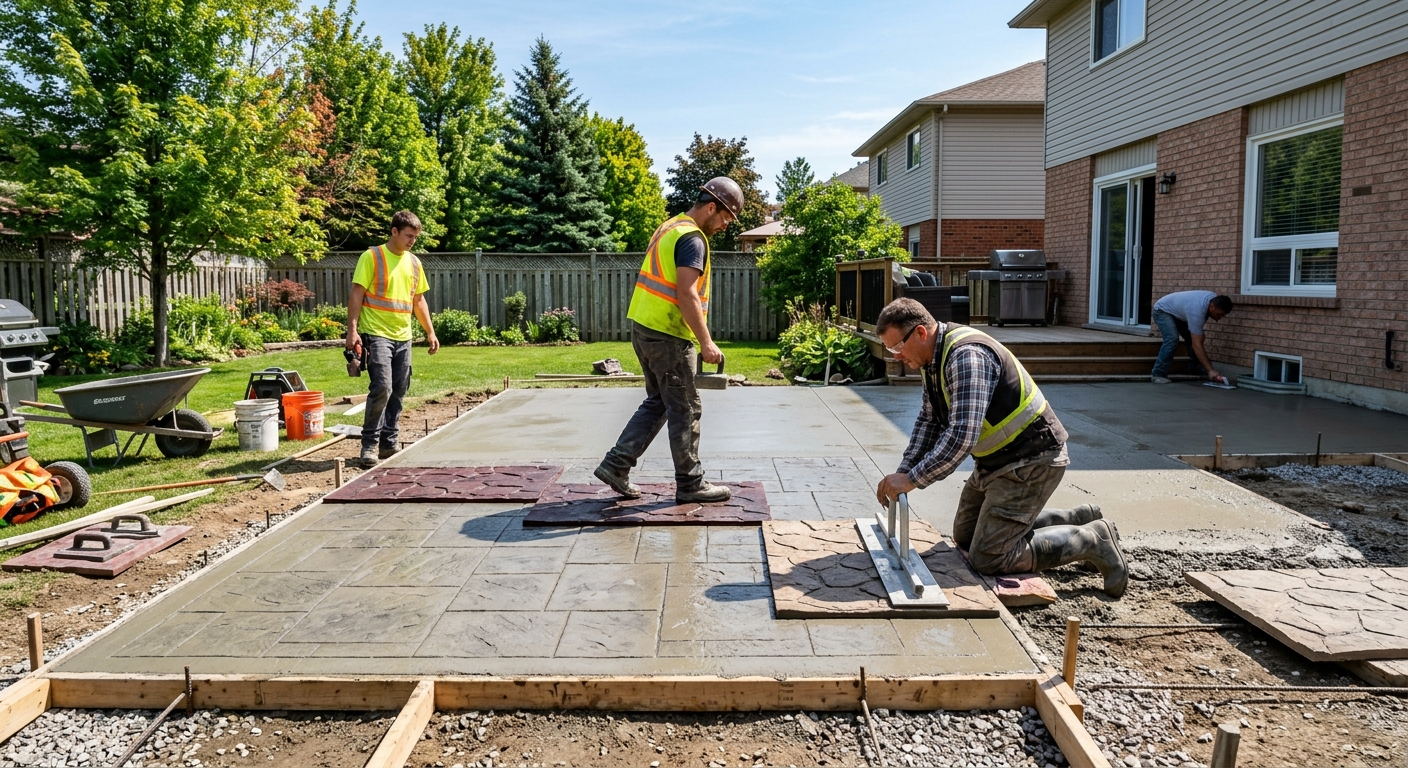
Concrete work options and costs in Vista Heights
In Vista Heights, Alberta, homeowners typically start with the flatwork that makes day-to-day life easier—driveways, patios and walkways—before they tackle the bigger-ticket foundation work. With a community population of 2,300 (Statistics Canada, 2021 Census), the local contractor pool is smaller than in Calgary core, so availability and scheduling can tighten around peak exterior pour windows. A lot of the demand is tied to the established single-detached market pattern in the broader Calgary economic region, where driveways and backyard pads get replaced as homes age and landscaping is updated.
Pricing in this area isn’t just about size. Calgary’s cold continental climate is engineered around frost and freeze–thaw, and that affects everything from excavation depth to concrete mix requirements. Regional practice uses a design frost depth of about 1.2 m (roughly 4 ft), meaning footing excavations for garages, house foundations and retaining structures must reach undisturbed soil below this line. Exterior slabs also need granular base prep, air-entrained mixes, and well-planned control joints to reduce cracking and spalling, especially where de-icing salt is used. Add the fact that the practical pour season is shorter, and cold-weather curing precautions (insulating blankets and sometimes temporary heat) can increase labour and material costs. In Vista Heights, neighbourhood demand is especially high around the newer build corridors and infill pockets where driveways and backyard access pads are often poured soon after grading.
Below is a practical comparison of common concrete options you’ll see in Vista Heights, with realistic price ranges you can use as your quote benchmark.
| Application |
Typical Size |
Key Spec |
Finish Option |
Price Range |
| Concrete driveway (standard broom finish) |
24 ft x 10 ft (240 sq ft) |
Air-entrained exterior mix, compacted granular base, control joints |
Broom finish |
$12,000–$18,000 |
| Exposed aggregate driveway |
24 ft x 10 ft (240 sq ft) |
Air-entrained exterior mix, proper curing window, polished/washed exposure |
Exposed aggregate (scrub/wash) |
$14,000–$20,500 |
| Stamped concrete driveway or patio |
20 ft x 10 ft (200 sq ft) |
Air-entrained exterior mix, release agent system, joints to manage shrinkage |
Stamped patterns with integral or surface colour |
$15,000–$26,000 |
| Plain concrete patio or walkway |
12 ft x 12 ft (144 sq ft) or 3 ft x 30 ft (90 sq ft) |
Compacted granular base, mesh where required, air-entrained mix |
Float and broom/steel trowel finish |
$5,000–$9,000 |
| Garage floor (interior slab) |
22 ft x 20 ft (440 sq ft) |
Vapour barrier (if applicable), fibres or mesh, proper mix and finishing |
Steel trowel with broom edges (where needed) |
$11,500–$17,500 |
| Foundation footings (structural, below frost) |
Varies by house; typical 1,000–1,600 linear ft equivalent forms/footings |
Excavate to undisturbed soil below design frost depth, engineered reinforcement |
Structural concrete (no decorative finish) |
$28,000–$45,000 |
Prices are estimates only and vary by project scope, site access and material selection.
What affects the price of concrete work in Vista Heights
In Vista Heights, two homeowners can receive quotes for “the same” concrete job that differ by 30–50% across Calgary and Alberta because the costs sit in the details: how deep the excavation is, what the soil needs for base preparation, how much reinforcement the design calls for, and whether the mix and curing method match winter risks. Even when the slab size is identical, the labour behind formwork, hauling, and finishing time can swing materially—especially during cold snaps when crews need to follow winter placement procedures.
Frost depth and freeze-thaw cycles are the main drivers. Footings must extend below the design frost depth (about 1.2 m here) to prevent frost heave and seasonal movement. Exterior slabs require air-entrained concrete mixes to survive repeated freeze–thaw, and that directly ties into mix pricing and quality control. Calgary’s shorter pour season also means cold-weather curing precautions—insulating blankets, temperature monitoring, and sometimes controlled heating—when you’re working late fall or early spring. Add the reality that de-icing salt can accelerate surface spalling on poorly specified slabs, making sealing and proper curing non-negotiable.
In Vista Heights, we see real examples of cost movement. A backyard pad poured on compact sandy fill after grade changes will cost less than one requiring removal of unsuitable soils and extra granular replacement to achieve a stable sub-base. A broom-finish walkway often lands in the $5,000–$9,000 range, while stamped or exposed aggregate work can climb into the $15,000–$26,000 band because colouring systems, stamp labour, and tighter curing/finishing control take more time and risk. Older neighbourhood housing stock frequently has regrading and drainage fixes before concrete can be installed correctly—sometimes turning a “simple patio” into a base + drainage scope worth thousands.
| Price Factor |
Why It Matters |
Cost Impact |
| Frost line depth |
Determines footing depth and form height |
More excavation and concrete volume; can be a major driver for foundation/footings pricing |
| Site preparation |
Excavation, grading, compacted granular base |
Unsuitable soils or poor compaction add truckloads, labour hours, and rework risk |
| Reinforcement |
Rebar or wire mesh requirement |
Materials and tie-in labour; required reinforcement can add cost even if slab area stays the same |
| Mix design |
Air-entrainment and compressive strength spec |
Exterior durability specs raise material cost and require tighter QC |
| Finish type |
Broom vs. stamped vs. exposed aggregate |
Stamped/exposed methods require additional products, skilled labour, and careful timing |
| Pour size and concrete truck access to site |
Shorter pours may need extra mobilizations; difficult access slows placement |
Hauling surcharges, waiting time, and longer crew time can increase the total price |
| Cold-weather curing precautions |
Heating and blankets |
Extra material and labour to protect curing; especially relevant in late fall/early spring |
| Control joint pattern and sealing cost |
Joints manage shrinkage; sealing helps resist de-icing salt impact |
Joint layout, saw cutting, and sealer add line-item cost but reduce long-term damage risk |
Permits & regulations in Alberta
In Alberta, structural concrete work—think foundation walls, grade beams, and footings—generally falls under the building permit process. In many cases, that also means engineered drawings are reviewed and construction must match the design. For concrete flatwork (driveways, patios, and walkways), a permit often isn’t required unless the work affects lot grading, impervious surface coverage limits, or ties into municipal right-of-way concerns. In Vista Heights, the “gray area” is usually drainage and accessibility: if the proposed slab changes how water runs off toward neighbouring properties, or if it alters grading close to a property line, ask the local authority before you break ground.
Before hiring, verify the contractor carries liability insurance and the proper worker coverage (commonly WSIB/WCB for insured trades). Then confirm their track record on projects of similar scale—especially winter work in Calgary-area conditions.
How to check, step by step:
- Ask the contractor for their certificate of insurance and confirm it covers general liability for the job in Alberta.
- Request proof of worker coverage (WSIB/WCB clearance documentation where applicable).
- Check for relevant municipal/building permit involvement: for footings/foundation, ask whether permit pulls and inspections are handled by them or coordinated with your builder.
- Look for references (photos and addresses) on recent projects that match your scope and season.
- Confirm start dates in writing—winter concrete requires planning for curing protection.
If anything is unclear—especially anything tied to foundations, drainage regrading, or right-of-way—pause and verify with the local authority first.
Getting concrete right in Vista Heights's freeze-thaw climate
The biggest concrete failures in Vista Heights come from one pattern: water gets into weak surfaces or the slab moves slightly, then freeze–thaw expands that damage. In Calgary-area conditions, that’s why base preparation, mix design, joints, and curing must be engineered together. Start with base preparation: your concrete is only as good as the compacted granular sub-base beneath it, and it must be at the right depth and compaction for your soil. Next is mix design. For exterior flatwork, specify air-entrainment at about 5%–7% air content and a minimum 32 MPa compressive strength. Those numbers aren’t “marketing”—they directly support durability through freeze–thaw cycles.
Control joints are equally important. The slab will crack as it shrinks; the goal is to place cracks in intentional locations. Joint spacing should limit random cracking and reduce how much water penetrates the concrete surface. Then plan curing: in cold conditions, curing must still achieve proper strength development. A practical minimum is 7 days under proper conditions, with extra protection (blankets and/or heat) if temperatures fall. Finally, apply a penetrating sealer about 28 days after the pour to help repel de-icing salts and reduce surface deterioration.
Ask technicians how they’ll manage each step during Calgary’s short pour window. A common decision point is broom-finish versus stamped. If a broom-finish driveway meets your functional needs and you’re budget-conscious, it often fits better within the $12,000–$18,000 driveway band. Stamped or decorative work may be justified when aesthetics and pattern durability matter, but it typically pushes you into the $15,000–$26,000 range due to additional labour, timing, and product systems.
| Spec |
Why It Matters in Vista Heights |
What to Ask For |
Impact if Skipped |
| Compacted granular base (depth?) |
Controls movement and prevents frost-related instability |
Base depth and compaction plan matched to your soil and frost considerations |
Settlement and cracking; uneven surface and premature failure |
| Air-entrained concrete mix (target air %?) |
Resists freeze–thaw damage on exterior surfaces |
Air content target (about 5%–7%) and confirmation it’s specified for exterior exposure |
Spalling/scaling and rapid surface breakdown after winters |
| Compressive strength (MPa rating) |
Ensures durability and adequate strength development |
Minimum 32 MPa and documentation of mix design/compliance |
Reduced service life and higher risk of cracking under stress |
| Control joints (spacing per ACI guidelines) |
Directs shrinkage cracking away from random locations |
Joint layout plan and saw-cut timing |
Random cracking, water intrusion, and faster deterioration |
| Minimum 7-day curing period |
Strength gain must happen even in cold weather |
How curing will be protected during temperature drops |
Scaling, weaker surface, and long-term performance issues |
| Penetrating sealer (when applied after cure) |
Helps defend against de-icing salt impacts |
Sealer type and application timing (about 28 days post-pour) |
More salt scaling and staining; earlier surface loss |
How to choose a concrete work contractor in Vista Heights
Choosing the right concrete contractor in Vista Heights is less about glossy photos and more about documented practices. First, verify Alberta credentials and coverage. Ask for their certificate of insurance (general liability) and proof of worker coverage (WSIB/WCB clearance documentation where applicable). Then confirm they’ve done similar exterior work in Calgary-area freeze–thaw conditions—driveways and patios that were poured in winter or early spring without cutting corners on curing. A contractor who can’t explain how they protect curing temperatures or how they plan joints and base prep is a risk in this climate.
Next, get 2–3 itemised written quotes—not a single lump-sum line. You want a breakdown that separates labour and materials, including excavation/disposal, forms, reinforcement (if required), concrete mix type, saw-cut control joints, curing protection, and sealing (if in scope). Also confirm exclusions: Who supplies and installs expansion joints? Is disposal included for excess soil? Are permits included where required (especially for footings/foundation-related scopes)?
Warranty matters too. Look for a workmanship warranty length and whether it’s tied to the specific scope, not just “best effort.” Ask about product/manufacturer warranties and whether they are transferable if you sell your home. On payment, never pay more than 10–15% upfront; hold back a portion until you see the final finishing, joint work, and cleanup. Finally, insist on a written start date and completion estimate—winter work often depends on protected curing logistics.
- Ask for insurance certificate and confirm job-specific coverage.
- Request WSIB/WCB proof/clearance documentation for insured workers.
- Get itemised quotes with labour and materials separated.
- Confirm base preparation scope: excavation depth, granular base, compaction method.
- Verify the mix is air-entrained for exterior exposure (with target air content).
- Ask whether reinforcement is included and where it’s placed (mesh vs rebar).
- Confirm control joint layout and saw-cut timing.
- Ask how they handle cold-weather curing (blankets/heating/monitoring).
- Clarify sealing: sealer type and application timing (about 28 days after cure).
- Confirm disposal haul-away for excess soil and concrete waste.
- Set payment terms: max 10–15% upfront; holdback for final completion.
- Insist on a written schedule: pour day, curing protection period, and finish date.
Concrete red flags in Vista Heights: quotes that omit air-entrainment specs, no mention of joint layout or saw-cut timing, unclear curing plan for cold nights, “we’ll pour whenever” scheduling without temperature safeguards, and payment terms asking for large deposits well above 15%.
Frequently asked questions — concrete work in Vista Heights
How much does concrete work cost in Vista Heights?
Concrete pricing in Vista Heights typically follows Calgary-area cold-climate realities: deeper prep, frost-aware specs, and better curing protection when temperatures drop. For driveways and larger exterior slabs, many projects land around the local bands of $12,000–$18,000 for a standard concrete driveway and $5,000–$9,000 for a typical patio or walkway. If you’re adding decorative work, stamped concrete commonly runs higher, often within $15,000–$26,000 depending on size, colour method, and complexity. Foundation footings are a different category entirely and commonly sit around $28,000–$45,000 because excavation and reinforcement are usually driven by the frost depth requirement. If you want to control cost, focus on a clear scope: base prep depth, joint plan, reinforcement, curing approach, and whether sealing is included.
How deep must footings be for Vista Heights's frost line?
In Vista Heights and the wider Calgary area, local engineering practice uses a design frost depth of about 1.2 m (roughly 4 ft). Practically, that means footings and structural supports must bear on undisturbed soil below that depth to help prevent frost heave and seasonal movement. The exact depth on your site depends on soil conditions, drainage, and your engineered foundation design, so your drawings and permit requirements govern the final number. A contractor should be able to explain how they’ll excavate to the required bearing depth and how they’ll handle any unsuitable soils encountered during digging. If a quote offers shallow excavation “because the ground seems solid,” that’s a red flag for future movement, cracking, and costly repairs in Alberta’s freeze–thaw cycle.
Why does concrete crack in Vista Heights and how is it prevented?
Concrete cracks in Vista Heights mainly because it naturally shrinks as it cures, then expands and contracts through freeze–thaw cycles and temperature swings. If the slab doesn’t have a planned strategy—especially control joints and correct base prep—cracks appear randomly, letting water penetrate and accelerating spalling when de-icing salts are used. Prevention starts with the right granular base depth and compaction so the slab can’t move. Next is specifying an exterior air-entrained mix to better withstand freeze–thaw; for many exterior projects this is about 5%–7% air content. Then you need a control joint layout sized to manage shrinkage, plus timely saw-cutting. Finally, curing must be protected—at minimum, 7 days under proper conditions—because rushed curing increases surface weakness and early cracking risk.
Stamped vs broom-finish concrete — cost difference?
Stamped concrete costs more than broom-finish because it’s labour-intensive and timing-sensitive. Broom-finished driveways and patios are typically finished for durability and traction, and pricing often sits around $12,000–$18,000 for many driveway scopes. Stamped concrete—whether a driveway apron or a patio—usually requires colour systems, release agents, stamp placement, and careful finishing to keep the pattern crisp without compromising curing. That’s why many stamped projects fall within $15,000–$26,000, depending on size and pattern complexity. Exposed aggregate is also often higher than broom due to the additional exposure process and quality control. The key is to ask for an itemised quote so you can see whether the premium is truly for finish work, or if it’s driven by larger excavation, reinforcement, or access challenges.
When is the best time to pour concrete in Vista Heights?
For Vista Heights and the Calgary area, timing is about temperatures and curing conditions, not just “season.” The best pours occur when you can plan for stable curing temperatures for the initial days, with minimal risk of freezing. Late fall and early spring can still work, but only if the contractor budgets for winter-grade methods: insulated blankets, temperature monitoring, and sometimes temporary heat to protect curing. Because Calgary’s freeze–thaw cycles are frequent, rushing placement or curing during cold snaps increases the risk of surface scaling and long-term durability issues. If you’re aiming for exterior slabs like patios, walkways, or driveways, ask the contractor how they’ll handle curing protection and what their temperature thresholds are for proceeding. In short: plan for a pour when they can guarantee curing—not just when the weather forecast looks okay for one day.
How long does concrete take to cure?
Concrete curing has two practical phases. First is early strength development, which is why many Calgary-area crews treat it as a minimum 7-day curing period under proper conditions for exterior work. During that time, the slab should be protected from freezing temperatures, heavy water exposure, and traffic impacts. Second is longer-term strength and surface durability—especially important for exterior flatwork exposed to salt and freeze–thaw. That’s where sealing comes in: a penetrating sealer is typically applied about 28 days after the pour (after adequate cure) to help repel de-icing salts. If you poured in colder weather in Alberta, the contractor should adjust curing protection and your expectations. The safest approach is to follow the contractor’s curing plan and not rush use of the slab until it meets the required handling and strength milestones.