Concrete work options and costs in Woodlands
In Woodlands, Alberta, homeowners typically choose concrete because it’s predictable, durable, and cost-effective for high-use flatwork like driveways, patios and walkways. Woodlands is a smaller community (population 5,830 per the Statistics Canada, 2021 Census), and most concrete demand is tied to new builds and upgrades around existing single-detached areas. In this Calgary-area market, trades tend to be busiest in the established pockets of South Calgary/Okotoks corridor traffic patterns, so scheduling can matter as much as the mix.
Calgary’s cold continental climate drives the price. The region is designed around a frost depth of about 1.2 m (roughly 4 ft), so footing-bearing excavations are deeper than in milder provinces. Freeze–thaw cycles also mean exterior slabs need proper granular base preparation, air-entrained concrete, and well-spaced control joints to reduce cracking and spalling. Add to that a shorter effective pour season for exterior work and cold-weather curing precautions (insulating blankets, sometimes temporary heat), and you’ll understand why two “similar” projects can come back with noticeably different numbers. Foundation work, in particular, is sensitive to site conditions like soil type, groundwater, and the amount of formwork required.
As you compare options, use the table below as a baseline for what Woodlands clients most commonly request—then match the finish and specs to how the slab will be used and exposed. Next, review the specific factors that can push the final price up or down.
| Application |
Typical Size |
Key Spec |
Finish Option |
Price Range |
| Concrete driveway (standard broom finish) |
22 ft x 10 ft (220 sq. ft.) |
Air-entrained exterior slab, compacted granular base |
Broom finish + control joints |
$12,000–$18,000 |
| Exposed aggregate driveway |
22 ft x 10 ft (220 sq. ft.) |
Air-entrained mix + delayed aggregate exposure |
Exposed aggregate + sealer-ready surface |
$15,000–$22,000 |
| Stamped concrete driveway or patio |
20 ft x 12 ft (240 sq. ft.) |
Air-entrained mix + colour hardener |
Stamp pattern + integral/overlay colour |
$15,000–$26,000 |
| Plain concrete patio or walkway |
12 ft x 12 ft (144 sq. ft.) |
Air-entrained mix + compacted base |
Float & broom, minimal grading |
$5,000–$9,000 |
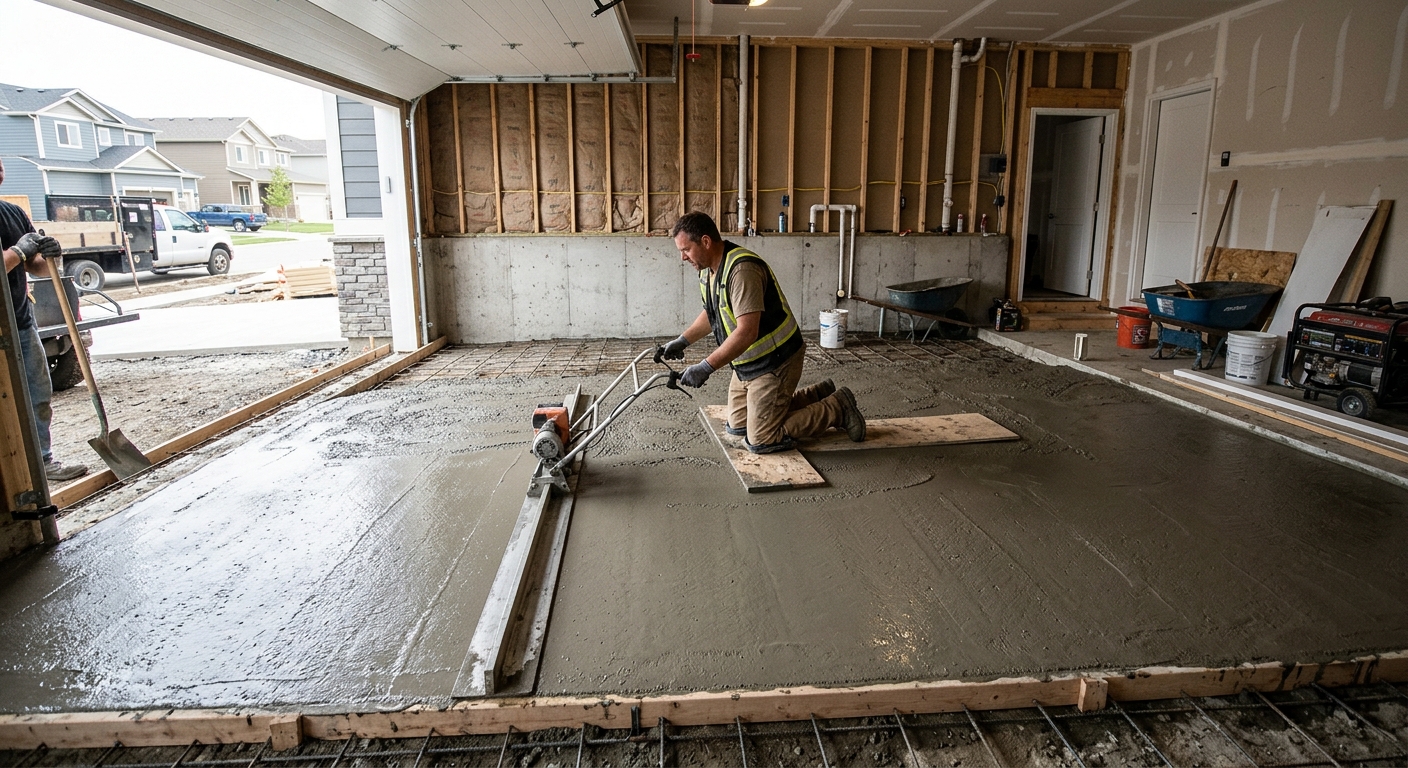
| Garage floor (interior slab) |
20 ft x 22 ft (440 sq. ft.) |
Fibre or mesh (as specified) + vapour control (if required) |
Standard trowel finish |
$6,500–$11,500 |
| Foundation footings (structural, below frost) |
Approx. 800–1,200 sq. ft. bearing area (project dependent) |
Engineered section sizes below ~1.2 m design frost depth |
Rebar cage + proper formwork |
$28,000–$45,000 |
Prices are estimates only and vary by project scope, site access and material selection.
What affects the price of concrete work in Woodlands
In Woodlands and the broader Calgary economic region, it’s common to see quotes for the “same” concrete job differ by 30–50%. The reason usually isn’t the concrete itself—it’s the engineering and construction details that protect the slab in a freeze–thaw environment. For example, frost depth and seasonal movement drive how deep contractors excavate and how tall the forms must be. In Alberta, concrete foundation work is engineered around a design frost depth of about 1.2 m (roughly 4 ft), and footings typically need to bear on undisturbed soil below that depth. That increases excavation, hauling, and labour compared with areas where frost penetration is less severe.
Exterior slabs also need air-entrained concrete to withstand Calgary-area freeze–thaw cycles. For driveway and patio work, it’s not unusual to see cold-weather placement costs creep up when the contractor needs winter-grade admixtures, insulated blankets, or temporary heating to protect curing. De-icing salt adds another layer: it accelerates surface deterioration if the wrong mix and sealing approach is used. In practice, proper sealing (typically after full cure) is what helps keep a driveway looking good longer in seasons where sanding and salt are routine.
Here are a few real Woodlands scenarios that move the needle: (1) a typical 220 sq. ft. driveway can fall toward the $12,000–$18,000 band when truck access is easy and base prep is straightforward, but it often stretches upward when excavation is deeper due to frost-bearing requirements and wetter subgrade. (2) A stamped driveway can stay near the $15,000–$26,000 band when colour/texture is integrated and the crew can pour in one continuous operation; if access or timing forces more cold-weather measures, the finish time and curing precautions increase labour.
| Price Factor |
Why It Matters |
Cost Impact |
| Frost line depth — determines footing depth and form height |
Footings must bear below design frost depth to prevent frost heave |
Higher excavation and formwork; can add thousands for poor soil |
| Site preparation — excavation, grading, compacted granular base |
Proper base reduces settlement and controls water under slabs |
More base material and compaction time increases cost |
| Reinforcement — rebar or wire mesh requirement |
Reinforcement reduces cracking from shrinkage and loads |
Material + labour; mesh-only vs engineered rebar differs |
| Mix design — air-entrainment and compressive strength spec |
Air-entrainment protects against freeze–thaw spalling |
Winter-grade admixtures and higher specs can raise material cost |
| Finish type — broom vs. stamped vs. exposed aggregate |
Complex finishing increases crew time and surface prep demands |
Stamp/exposed aggregate typically costs more than broom |
| Pour size and concrete truck access to site |
Large pours require continuous placement and efficient pumping/traffic plans |
Pumping, wait times, and extra labour for access can increase total |
| Cold-weather curing precautions — heating and blankets |
Achieving proper cure reduces scaling and long-term strength loss |
Insulated blankets/heat days add labour and equipment costs |
| Control joint pattern and sealing cost |
Joints manage cracking; sealing protects from salt and moisture |
Better joint detailing and sealing increase upfront but reduce failures |
Permits & regulations in Alberta
In Alberta, structural concrete work typically triggers permit requirements and often needs engineered drawings reviewed by the municipality. That usually includes foundations and foundation-related elements such as footings, foundation walls, and grade beams—any concrete designed to carry structural loads. Concrete flatwork like patios, walkways and driveways often does not require a permit on its own, unless it changes lot grading, impacts stormwater management, or falls under municipal impervious surface/driveway-right-of-way constraints. Because rules can be project-specific, confirm requirements with the local authority before the first excavation. Also, verify your contractor carries proper liability insurance and has WSIB/WCB coverage where applicable, and request references from similar-scale Calgary-area residential work.
To verify a contractor in Woodlands step-by-step: (1) Ask for a current certificate of insurance and confirm it lists you (or your project) appropriately and includes liability suitable for construction. (2) Request proof of WSIB/WCB clearance and keep the paperwork for your records. (3) Verify the contractor’s registration/licensing status through the appropriate provincial registry information online (search the contractor’s legal business name to confirm it matches the quote and invoicing). (4) Confirm they’re willing to provide an itemised scope and drawings/engineering letters when the work is structural. (5) For concrete that ties into a foundation or includes engineered bearing elements, ask which permits they will pull and who is responsible if anything changes.
Getting concrete right in Woodlands's freeze-thaw climate
Concrete failure in Woodlands is usually a climate-driven story: water gets under or into the slab, freeze–thaw expands it, and surface or structural cracks follow. The biggest preventable issue is spalling from inadequate air-entrainment, especially on exterior driveways and patios exposed to salt and melt cycles. To spec the job correctly for Calgary-area conditions, start with base preparation: compacted granular sub-base placed to the right depth and graded to drain. Next, specify the mix. Exterior flatwork should use air-entrained concrete with a target air content in the 5–7% range (as appropriate to the mix design), with a minimum 32 MPa compressive strength unless an engineer calls for more on a structural element. Then set a control joint plan that limits random cracking—joints are your “crack management.”
Curing is another critical point. You want at least 7 days of proper curing under suitable conditions; in cold weather, crews may need insulated blankets or temporary heat to maintain temperatures and reduce scaling risk. After the slab cures fully, apply a penetrating sealer (typically 28 days post-pour) to help repel de-icing salts and reduce moisture ingress.
As a cost example, a stamped driveway often lands in the $15,000–$26,000 band largely due to labour-intensive finishing and extra material steps. If you cut corners on joints or skip sealing, you may “save” upfront, but you’ll likely pay later in patching and surface repairs—repairs can cost a significant fraction of the original finish work. In Woodlands, the right specs usually cost less over time than trying to fix premature scaling.
| Spec |
Why It Matters in Woodlands |
What to Ask For |
Impact if Skipped |
| Compacted granular base (depth?) |
Proper base controls settlement and manages moisture below the slab |
Base depth and compacted granular type (with compaction method) |
Uneven slab, cracking, and faster deterioration |
| Air-entrained concrete mix (target air %?) |
Air entrainment improves freeze–thaw durability in Alberta winters |
Proof of air content target (5–7% for exterior flatwork) |
Spalling and scaling, especially with salt exposure |
| Compressive strength (MPa rating) |
Minimum strength helps resist wear under loads and impacts |
Minimum 32 MPa specification (or higher if engineered) |
Weakened surface and early cracking |
| Control joints (spacing per ACI guidelines) |
Controls where cracks form and limits random cracking |
Joint spacing plan and saw-cut timing |
Random cracking through the finish and trip hazards |
| Minimum 7-day curing period |
Ensures strength development and reduces surface scaling risk |
Curing method in cold weather (blankets/heat if needed) |
Reduced strength and surface damage |
| Penetrating sealer (when applied after cure) |
Repels moisture and helps protect against de-icing salts |
Sealer type and confirmation of application after full cure (about 28 days) |
Higher moisture ingress and faster spalling |
How to choose a concrete work contractor in Woodlands
Choosing the right concrete contractor in Woodlands is mostly about verifying documentation and insisting on clarity in the scope. In Alberta, confirm the contractor’s liability insurance—ask for a certificate of insurance and check that the coverage is current and relevant to construction activities. Next, verify WSIB/WCB coverage through a clearance document where applicable. These aren’t “nice to have” items; if something goes wrong on a concrete pour or during excavation, you want your contractor to be accountable.
Then get 2–3 itemised written quotes rather than a single lump sum. Ask for a labour/material breakdown that makes it obvious what’s included: excavation and disposal, base prep depth, rebar or mesh type, air-entrained mix confirmation, jointing plan, curing measures, and sealing (if included). Watch for exclusions like “surface repair not included” or “sealer optional,” because those commonly change the practical finish lifespan in Calgary freeze–thaw conditions.
Look at warranty terms. A workmanship warranty should be stated clearly (and in what time window). Ask whether there’s a product/manufacturer warranty tied to sealers or admixtures and whether it’s transferable. For payment, avoid large upfront deposits; a good rule is never more than 10–15% upfront, with a holdback until the job is complete and cleaned up. Finally, ask for the start date and an estimated completion timeframe in writing, since exterior concrete scheduling is tighter in cold snaps.
- Verify liability insurance certificate is current and matches the business name on the quote.
- Request WSIB/WCB clearance paperwork (where applicable) and keep copies.
- Ask for 2–3 recent references from Calgary-area residential flatwork.
- Ensure quotes list excavation, disposal, and base preparation explicitly.
- Confirm concrete mix is air-entrained for exterior slabs.
- Ask for a stated curing plan for cold weather (blankets/heat if needed).
- Confirm reinforcement type (mesh vs rebar) and placement requirements.
- Review joint pattern and saw-cut timing in the scope.
- Check whether sealer is included and when it will be applied (after cure).
- Confirm truck access plan, including whether pumping is needed.
- Read the warranty length and what it covers in plain language.
- Keep payment scheduled with a holdback until final acceptance and cleanup.
Concrete contractor red flags in Woodlands: vague scopes that don’t mention air-entrainment or curing, refusing to provide COI/WSIB/WCB documentation, quoting a “too-good-to-be-true” driveway near the $12,000–$18,000 band without detailing base depth, promising “no joints needed” for exterior slabs, and pushing for large upfront payments without a written schedule.
Frequently asked questions — concrete work in Woodlands
Do I need a permit for concrete work in Alberta?
In Alberta, many structural concrete items—like footings, foundation walls, and grade beams—generally require permits and often engineered drawings reviewed during the permit process. For concrete flatwork (driveways, patios and walkways), a permit is often not required by default, but it can be triggered if the work changes lot grading, affects stormwater flow, or involves municipal constraints like right-of-way considerations. For homeowners in Woodlands, the practical step is to confirm with the local authority before you excavate, especially if you’re altering drainage, adding a new driveway approach, or tying into foundation elements. A reputable contractor will clarify which permits they handle and which are homeowner responsibilities before the pour.
Concrete vs pavers for a patio in Woodlands?
Concrete and pavers can both be good choices in Woodlands’ freeze–thaw climate, but the performance story differs. Concrete patios are usually cheaper for large, simple rectangles and offer a uniform surface with controlled cracking through joints. Pavers can be more flexible for irregular shapes and allow easier partial repairs, but they still depend on excellent base prep and correct drainage. In Alberta winters, both options require a properly compacted granular base, yet concrete tends to be more consistent when air-entrainment, curing, and joint spacing are done right. If you’re targeting a straightforward patio, you’ll often see concrete land around the $5,000–$9,000 band for typical project sizes. If you want a highly decorative look, stamped concrete can also compete, especially when you value a seamless finished surface.
How long does a concrete driveway last?
A properly built concrete driveway in Woodlands can last decades, but the timeline depends on how it’s engineered for Alberta winters. The biggest life-limiting issues are inadequate air-entrainment, weak curing, poor base preparation, and missing or poorly planned control joints—these can lead to surface scaling and cracking that salt and melt water worsen. With correct freeze–thaw durability measures, proper joint spacing, and sealing applied after full cure, it’s realistic to expect long service life before major repairs become necessary. The age of many homes and upgrades in the Calgary corridor also means driveways often see frequent winter maintenance, so your contractor’s approach matters. When comparing quotes around the $12,000–$18,000 band, insist on details that protect longevity (air content confirmation, curing plan, and joint plan), not just the final colour or broom finish.
What is air-entrained concrete and why does it matter here?
Air-entrained concrete is mixed with microscopic air bubbles that give freeze–thaw expansion a safe path to reduce internal damage. In Woodlands and the Calgary region, freeze–thaw cycles are frequent, and exterior concrete gets exposed to moisture and de-icing salts. Without the right air content and mix design, water can freeze inside the concrete and force it to break down at the surface—leading to scaling and spalling over time. That’s why exterior slabs (driveways, patios, walkways) should specify air-entrainment and use an engineered mix designed for durability. When you compare quotes, don’t accept a generic statement like “standard concrete.” Ask what air content target the mix is designed for (often 5–7% for exterior flatwork) and confirm the contractor’s cold-weather curing plan so the concrete reaches strength properly before winter exposure.
How do I prepare the base for a concrete slab?
Base preparation is where most driveway and patio failures are prevented—or created. In Woodlands, the aim is a stable, well-compacted granular layer to the correct depth, with proper grading so water doesn’t sit under the slab. A contractor should excavate to the required depth, remove unsuitable soils, install a compacted granular base, and compact in lifts using the right equipment for the site. For exterior flatwork, correct base prep works together with air-entrained concrete, jointing, and curing to resist freeze–thaw movement. When you get quotes, ask what base depth they plan, what granular material is used, and how compaction will be verified. Then ask how drainage is managed at the edges and where the slab meets existing features, like the garage threshold or landscaping.
How do I compare concrete quotes?
To compare concrete quotes fairly in Woodlands, treat each quote like a spec sheet—not just a number. Ask for itemised costs that separate labour and materials, including excavation/disposal, base preparation depth, reinforcement type, the concrete mix design (air-entrained for exterior), joint pattern, finishing method, curing measures in cold weather, and whether sealing is included. Confirm what’s excluded (for example, sidewalk removal, hauling, or regrading) and whether disposal is included or billed separately. Also check timelines and payment schedules—reasonable contractors won’t demand large upfront payments without clear milestones. If one quote is near the $12,000–$18,000 driveway band but doesn’t mention air-entrainment, curing, or joints, it’s not truly comparable. The best approach is to have the contractor walk you through the scope line by line.