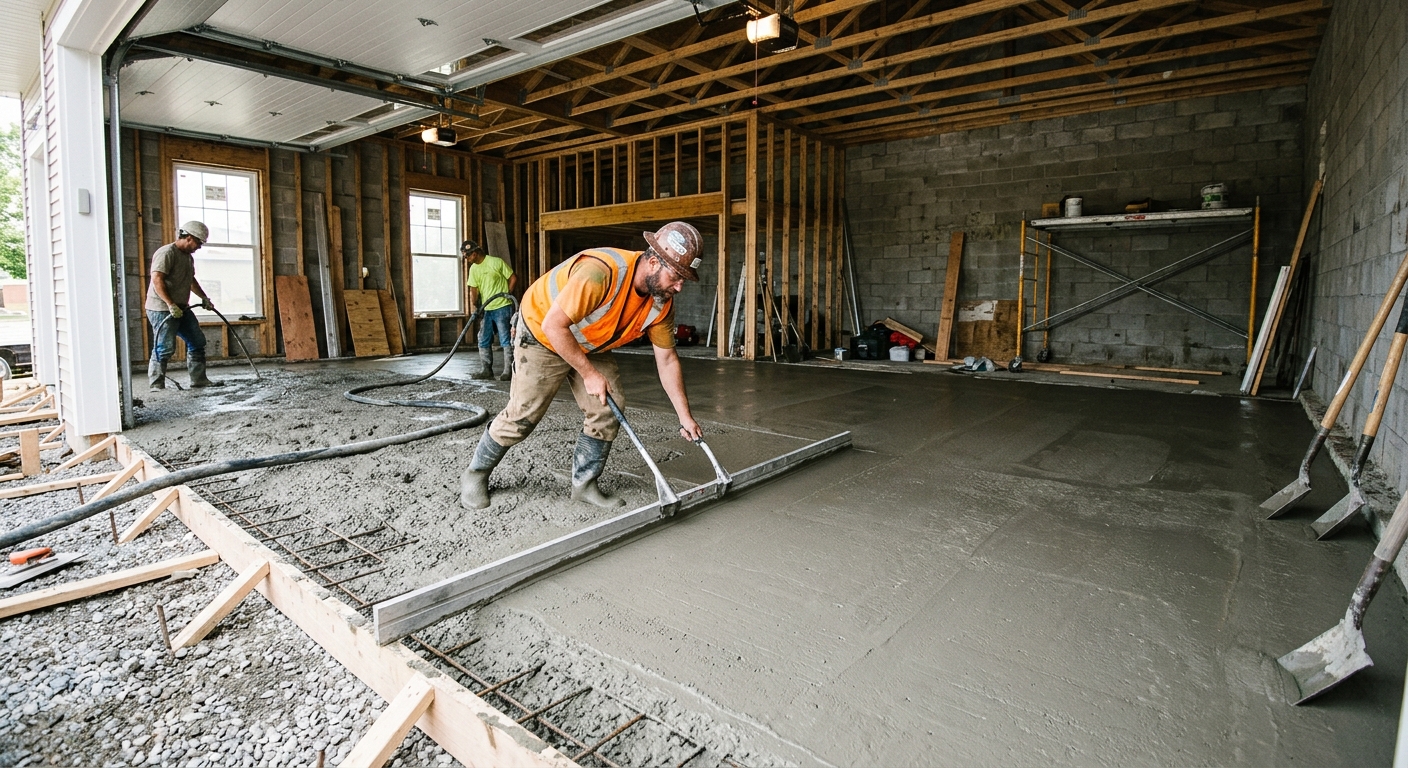
Concrete work options and costs in Skyrattler
Skyrattler is a smaller Alberta community, with a population of 1,947 residents (Statistics Canada, 2021 Census), and that scale shapes the concrete market: fewer contractors means more scheduling pressure during the main exterior pour window. At the same time, many local homeowners invest in concrete flatwork—driveways, patios and walkways—because it holds up well in a cold continental climate when it’s built to spec. In the Calgary economic region, you’ll commonly see concrete used for driveways and backyard patios serving typical suburban lots; in practice, the tradespeople who regularly work the Calgary area (including newer neighbourhood builds and infills) are especially in demand around established pockets like the communities feeding into the Calgary corridor and the Airdrie/Rocky View side of the market.
Costs in Skyrattler aren’t just “bigger or smaller.” Calgary’s freeze–thaw cycles and a design frost depth of roughly 1.2 m (about 4 ft) push footings and exterior slab bases deeper, and they also affect how we engineer control joints, air-entrainment, and curing. That’s why foundation/footing work often lands higher than in milder regions, and why exterior slab pours can be costlier in late fall or early spring when winter-grade mixes, insulation blankets, or temporary heat become necessary. Finish choices also matter: a stamped driveway includes extra labour and material overhead, while exposed aggregate increases labour due to the wash process and surface control.
Below are practical Skyrattler cost bands homeowners can use to compare bids, then we’ll break down what drives the differences.
| Application |
Typical Size |
Key Spec |
Finish Option |
Price Range |
| Concrete driveway (standard broom finish) |
400 sq. ft. (approx. 20’ x 20’) |
Air-entrained mix for exterior exposure; rebar or mesh as required |
Broom finish + edging |
$12,000–$18,000 |
| Exposed aggregate driveway |
400 sq. ft. (approx. 20’ x 20’) |
Air-entrained mix; controlled surface retarder/wash |
Exposed aggregate + sealer-ready surface |
$15,000–$22,000 |
| Stamped concrete driveway or patio |
300 sq. ft. (approx. 15’ x 20’) |
Air-entrained mix; integral colour; proper curing schedule |
Stamped pattern + release + colour hardener |
$15,000–$26,000 |
| Plain concrete patio or walkway |
200 sq. ft. (approx. 10’ x 20’) |
Air-entrained mix for exterior; proper slope and base compaction |
Float + broom or light broom |
$5,000–$9,000 |
| Garage floor (interior slab) |
480 sq. ft. (approx. 20’ x 24’) |
Vapour barrier (where specified); fibre or mesh depending on use |
Steel trowel finish or broom + finish options |
$10,000–$16,000 |
| Foundation footings (structural, below frost) |
Typical 1-storey house: 900–1,300 linear sq. ft. equivalent |
Concrete engineered for frost, soil, and drainage; below design frost depth |
Structural placement (not a decorative finish) |
$28,000–$45,000 |
Prices are estimates only and vary by project scope, site access and material selection.
What affects the price of concrete work in Skyrattler
In Skyrattler, two quotes for the “same” concrete job can easily differ by 30–50% across Calgary and the surrounding Alberta region because concrete pricing is driven by engineering specs, not just square footage. In this market, contractors often price for risk: deeper frost-bearing excavation, granular base build-up, traffic control, and how winter conditions affect curing. When a crew has to schedule around tighter exterior pour windows, labour costs and standby equipment can rise—especially when multiple trades are competing for the same equipment (excavators, pumps, vibrating tools) in the broader Calgary area.
Frost line depth is the biggest driver of variation. Footings and below-grade elements must bear on undisturbed soil below the design frost depth (about 1.2 m for local practice; up to 2.4 m in many Alberta scenarios depending on the engineered design). That means more excavation and higher concrete volumes than homeowners expect. Freeze–thaw cycling also dictates air-entrained concrete mixes for exterior slabs so the concrete survives repeated wetting, freezing and thawing without scaling and spalling. Colder regions also have a shorter pour season, so cold-weather curing precautions—insulated blankets, curing methods, and sometimes temporary heat—can add cost when the calendar turns.
De-icing salt accelerates surface wear, so sealing and proper surface preparation become more important here than in milder climates. For example, a standard driveway might land around the $12,000–$18,000 band, while a stamped option can stretch into the $15,000–$26,000 range because of added materials (integral colour/release systems) and extra finishing labour. On older properties in Skyrattler (and many Calgary-adjacent lots), you may also see higher site-prep costs due to existing base failures, settled topsoil, or drainage corrections that must be addressed before the new slab can perform.
| Price Factor |
Why It Matters |
Cost Impact |
| Frost line depth |
Determines how deep formwork and excavation must go for structural stability. |
Can add thousands via excavation and increased concrete volume. |
| Site preparation |
Includes stripping, grading, and compacted granular base to the correct thickness. |
More material hauling/compaction increases labour and equipment time. |
| Reinforcement |
Rebar or mesh placement helps control cracking under load and movement. |
Steel and placement labour can meaningfully raise the per-sq.-ft. cost. |
| Mix design |
Air-entrainment and compressive strength specs affect durability in Alberta freeze–thaw. |
Winter-rated mixes and higher-spec concrete can increase material pricing. |
| Finish type |
Broom is simpler; stamped and exposed aggregate require extra steps and tighter tolerances. |
Stamped/exposed finishes typically cost more than plain work. |
| Pour size and concrete truck access to site |
Long pushes, limited access, and extra pump/placing time add labour and coordination. |
Access constraints can add line-item time and equipment charges. |
| Cold-weather curing precautions |
Heating, insulated blankets, and controlled curing protect strength gain and surface integrity. |
Added materials and man-hours can raise costs in late fall/early spring. |
| Control joint pattern and sealing cost |
Joint spacing limits random cracking and sealing reduces de-icing salt damage. |
Proper joint saw cuts and sealer add cost but reduce long-term failure risk. |
Permits & regulations in Alberta
In Alberta, structural concrete work generally needs a building permit. That includes footings, foundation walls, grade beams, and other load-bearing foundation components. Depending on the scope, municipalities may also expect engineered drawings or design sign-off reviewed through the permit process. For concrete flatwork—patios, walkways, and most driveways—permits are often not required by default. However, you still need to confirm with the local authority if your project affects lot grading, drainage, impervious surface coverage limits, or the municipal right-of-way.
For your Skyrattler project, take a step-by-step approach when verifying a contractor:
- Ask for their proof of Alberta liability insurance (you want a current certificate of insurance showing the policy is active and the coverage limits).
- Confirm they have applicable workers’ coverage (WSIB/WCB). Get the clearance letter or proof of coverage documented in their paperwork.
- Verify their business registration and that the appropriate trade licence/registration is in place for the work they’re doing (many trades are ticketed; don’t assume “concrete” automatically covers all scopes).
- Check references for similar-scale projects done recently in the Calgary region (driveways and exterior flatwork that survived winter are a good sign).
If you’re doing a foundation pour or anything that ties into a structural system, don’t start excavation until permits are cleared. A reputable contractor will help you coordinate the documentation instead of treating it as an afterthought.
Getting concrete right in Skyrattler's freeze-thaw climate
Concrete failure in Skyrattler’s winter usually comes down to water management, freeze–thaw movement, and curing/finish quality. The way to “spec it right” starts with base prep: excavate and place a properly compacted granular sub-base to the depth engineered for local frost and soil conditions. If the base is too thin or not compacted correctly, the slab settles and the concrete cracks sooner. Next is mix design: for exterior work, air-entrainment (commonly in the 5–7% air range for many exterior flatwork placements) helps the paste tolerate freezing, reducing the risk of scaling and spalling. You’ll also want a minimum compressive strength target (often 32 MPa for typical structural and exterior durability specs) depending on the project and engineering.
Control joints are not optional trivia in this climate. They’re how you guide cracking to predictable locations, especially on driveways and patios. After placement, curing matters: aim for at least 7 days under proper conditions, and in cold weather plan for insulated blankets or controlled heat so strength gain doesn’t lag. Finally, sealing is part of durability in Alberta: a penetrating sealer applied after the cure period helps repel de-icing salt and reduces surface deterioration.
Here’s a practical cost example: if your driveway is priced at roughly the $12,000–$18,000 band for standard broom finish, paying for air-entrainment, correct base compaction and proper jointing is the “value” you can’t skip. By contrast, jumping to stamped concrete (often $15,000–$26,000) is justified when you want a decorative look—but it still must be built with the same winter durability specs. If a quote underprices the air-entrainment or base depth to meet budget, it will usually show up later as surface scaling.
| Spec |
Why It Matters in Skyrattler |
What to Ask For |
Impact if Skipped |
| Compacted granular base (depth?) |
Prevents frost-related movement and slab settlement during Alberta freeze–thaw. |
Request the engineered base thickness and compaction method (testable compaction targets where used). |
Cracking, unevenness, and early edge deterioration. |
| Air-entrained concrete mix (target air %?) |
Durability depends on the concrete resisting freeze–thaw cycles. |
Ask for air content around 5–7% for exterior flatwork (project-specific confirmation by supplier). |
Higher risk of scaling and spalling over winters. |
| Compressive strength (MPa rating) |
Affects strength gain, abrasion resistance, and structural performance. |
Confirm minimum 32 MPa (or project-engineered rating) at specified curing time. |
Reduced durability and potential premature wear under vehicle loads. |
| Control joints (spacing per ACI guidelines) |
Limits random cracking due to shrinkage and temperature swings. |
Ask for planned joint spacing and saw-cut timing. |
Uncontrolled cracks and higher water entry into the slab edges. |
| Minimum 7-day curing period |
Strength development is critical before cold snaps and early freeze cycles. |
Confirm curing plan; specify cold-weather methods if the forecast is borderline. |
Surface weakness, scaling, and long-term performance issues. |
| Penetrating sealer (when applied after cure) |
Helps repel salt and moisture that accelerate spalling in Alberta winters. |
Ask for penetrating sealer after cure—commonly around 28 days post-pour for best results. |
Faster surface deterioration from de-icing chemicals and freeze–thaw water cycling. |
How to choose a concrete work contractor in Skyrattler
Choosing a concrete contractor in Skyrattler is mostly about verification and clarity. Start by confirming Alberta licensing/registration where applicable for the scope, and don’t skip insurance. Ask for a current certificate of liability insurance and check the expiry date and coverage limits. Then verify workers’ coverage (WSIB/WCB) with the appropriate clearance letter or proof of coverage documentation. If a contractor can’t provide this promptly, that’s a major red flag.
Next, get 2–3 itemised written quotes—ideally showing labour, materials, base prep/excavation, reinforcement, concrete mix spec, finishing labour, saw-cutting, and sealing (if included). A lump sum without breakdown can hide the exact specs that control durability in Calgary’s freeze–thaw climate. Also read your scope for exclusions: is site disposal included? Is permit work included if required (especially for structural footings/foundation walls)? Is concrete pump/placing equipment included if access is tight?
Warranty matters too. Ask for the workmanship warranty length, whether it’s tied to the correct mix/design, and whether the product/manufacturer warranty is separate. If the contractor offers a transferable warranty (common with some materials and sealers), ask for the documentation. Payment schedule should be conservative: never pay more than 10–15% upfront. Hold back the remainder until the full job is complete and cleaned up to the agreed standard.
Finally, require a written start date and completion estimate, and confirm how weather and curing precautions will be handled in cold snaps.
- Request proof of liability insurance (certificate of insurance) before signing.
- Confirm WSIB/WCB coverage with clearance documentation.
- Get itemised quotes (labour vs materials vs excavation vs reinforcement).
- Verify the concrete spec: air-entrainment and minimum strength.
- Ask who supplies the concrete and how winter-grade curing is handled.
- Confirm base depth and compaction method (not just “we’ll prep it”).
- Ask about reinforcement type (rebar vs mesh) and placement height/cover.
- Confirm control joint spacing plan and saw-cut timing.
- Clarify whether sealing is included and when it will be applied.
- Check what’s included for disposal (spoils removal, haul-off, tipping fees where applicable).
- Confirm truck access plan (pumping, mats, or staging) if the site is tight.
- Use a payment schedule with a holdback until the slab passes final inspection.
Red flags in Skyrattler include: quotes that omit air-entrainment for exterior work, vague answers on base depth/compaction, no mention of curing methods in cold weather, “lowball” pricing that can’t support reinforcement or proper jointing, and refusing to provide insurance/coverage documentation up front.
Frequently asked questions — concrete work in Skyrattler
How do I compare concrete quotes?
Start by comparing apples to apples. For Skyrattler and the wider Calgary area, ask each contractor to list excavation/base prep, reinforcement type (rebar or mesh), the concrete mix spec (including air-entrainment for exterior), finishing steps, jointing plan, and whether sealing is included. Quotes that only show square footage often hide the spec differences that drive durability in Alberta freeze–thaw. If one bid lands well below the typical $12,000–$18,000 band for a broom-finished driveway, confirm what they’re assuming for base depth, compaction, and curing. Also check access and logistics: pump charges, truck access, and spoil disposal can swing pricing quickly. Finally, make sure the scope notes any permit responsibilities—especially if you’re doing structural work like footings.
Can concrete be poured in cold weather in Skyrattler?
Yes, but it must be done correctly. In Skyrattler’s winter conditions, cold-weather placement is engineered around curing so the concrete achieves strength without freezing too early. Contractors typically use winter-grade mix requirements, insulated blankets, and sometimes temporary heat or enclosure to protect the pour while it gains strength. The biggest risk isn’t the pour itself—it’s rushing curing in late fall or early spring, which can lead to surface scaling and long-term durability issues. When comparing quotes, ask how they’ll manage the cure window (timing, blankets/heating, and monitoring). A well-prepared crew can deliver durable results, but a “same process as summer” approach is where problems start.
How do I maintain concrete in Skyrattler's freeze-thaw climate?
Maintenance in Alberta is about keeping water out and reducing salt damage. For exterior flatwork like driveways and patios, ensure proper drainage so water doesn’t pond against the slab. Use a penetrating sealer after the concrete is cured—commonly around 28 days post-pour—so de-icing salt and moisture have less opportunity to attack the surface. When removing snow, avoid metal shovels that scratch the finish; scratches are where salts and water start to work. Re-apply sealer when it wears (your contractor can recommend timing based on traffic and product). If you notice spalling or widening cracks, address them early with a suitable repair system so freeze–thaw doesn’t keep expanding the damaged area over multiple winters.
What causes concrete to spall in Skyrattler winters?
Spalling usually comes from a combination of inadequate air-entrainment, freeze–thaw water movement, and poor curing. In Calgary-region conditions, if exterior concrete doesn’t have the correct air content, freezing cycles can break down the surface paste over time, leading to flaking or “scaling/spalling.” Another common contributor is insufficient base prep or weak surface conditions from cold-weather curing—strength gain is essential before winter freeze cycles hit. De-icing salt accelerates the process once water is able to penetrate the surface and edges. That’s why a durable driveway isn’t just about the finish; it’s about correct mix design, proper jointing to control cracking, and sealing. If your current slab shows spalling near edges and joints, those are often the entry points for moisture.
What is rebar and when is it required in Alberta?
Rebar is reinforcing steel used to help control cracking and improve strength in concrete. Whether it’s required depends on the design and the loading conditions—vehicle weights for driveways, whether the slab is ground-supported, and engineering requirements for foundations/footings. In Alberta, exterior flatwork often uses reinforcement (rebar or wire mesh) when the design calls for it, especially for driveways and any area subjected to heavier loads or where cracking needs additional control. For structural components like foundation footings and walls, reinforcement is typically engineered and required for load-bearing performance. When reviewing a quote in Skyrattler, ask exactly what reinforcement is included, where it will be placed (cover/spacing), and how the contractor will tie or support it so it doesn’t sit too low in the slab.
How long does a concrete project take in Skyrattler?
Timeline depends on whether you’re doing exterior flatwork or structural foundation work. For a typical driveway or patio, the site prep and form/build steps can take several days, while the pour is usually a one-day event followed by curing time. Even when the slab is “set” within hours, meaningful curing is measured in days—plan around at least 7 days for early handling and further time for full strength development. Cold-weather curing can extend the overall calendar because contractors may keep blankets in place and control curing conditions longer. Stamped and exposed finishes can add 1–3 days depending on pattern setup, wash/reveal timing, and protection needs. Foundation/footings are longer due to excavation, inspections/engineering steps, rebar placement, and structural sequencing. If you’re comparing quotes, ask for a written start date, pour day plan, and completion estimate.