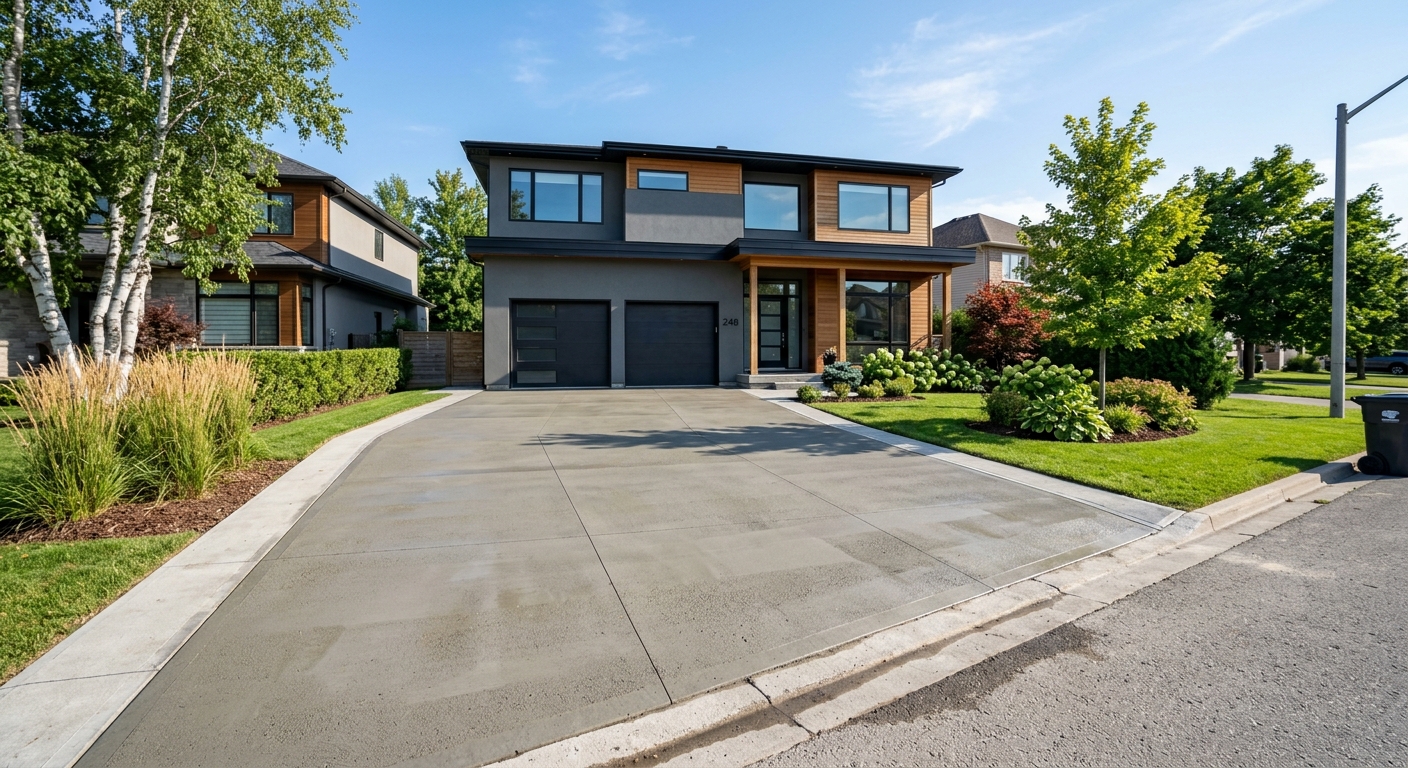
Concrete work options and costs in Britannia Youngstown
Concrete work in Britannia Youngstown is a year-round need, but it’s engineered around a cold continental climate that forces us to think about frost, freeze–thaw, and curing—not just appearance. In this community of 4,723 people (Statistics Canada, 2021 Census), most homeowners plan concrete flatwork around how their lots are set up for vehicles and entertaining, whether that’s a driveway expansion, a patio for backyard seasons, or new walkways to the front entrance. The Calgary economic region also draws steady demand from traditional home types common across the area, including many single-detached households that typically budget for driveways and exterior slabs upgrades over time.
On pricing, Calgary-area quotes can swing because winter-grade placement, air-entrained mixes, and deeper frost-protected excavation are built into the estimate. Because the local design frost depth is about 1.2 m (roughly 4 ft), foundation and footing work must extend below that level to reduce frost heave and seasonal movement. The frequent freeze–thaw cycles also push contractors to specify granular base prep, control joints, and sealing for driveways and patios to reduce surface scaling and spalling. Work is especially in demand in older, established pockets near local routes and busy service corridors—homes where residents often replace cracked slabs rather than “wait and see.”
Below are realistic cost bands you can use to compare quotes before your site visit.
| Application |
Typical Size |
Key Spec |
Finish Option |
Price Range |
| Concrete driveway (standard broom finish) |
400–500 sq. ft. |
Air-entrained exterior mix, compacted base |
Broom finish + edges/expansion joints |
$12,000–$18,000 |
| Exposed aggregate driveway |
400–500 sq. ft. |
Air-entrained exterior mix + properly timed wash |
Exposed aggregate with sealed finish |
$14,500–$22,500 |
| Stamped concrete driveway or patio |
250–350 sq. ft. |
Reinforced slab, air-entrained mix |
Stamp + colour hardener/sealer |
$15,000–$26,000 |
| Plain concrete patio or walkway |
150–250 sq. ft. |
Air-entrained mix + proper base |
Float/trowel + light broom texture |
$5,000–$9,000 |
| Garage floor (interior slab) |
400–650 sq. ft. |
Vapour barrier, fibres and/or mesh as required |
Steel-trowel finish (standard) |
$9,500–$16,000 |
| Foundation footings (structural, below frost) |
Typical house footprint |
Excavate to undisturbed soil below design frost depth |
Reinforced footings per engineered specs |
$28,000–$45,000 |
Prices are estimates only and vary by project scope, site access and material selection.
What affects the price of concrete work in Britannia Youngstown
In the Calgary region, two quotes for the “same” concrete job can differ by 30–50% because concrete pricing is really a bundle of engineering choices plus logistics. Frost depth and freeze–thaw cycles don’t just affect how we pour—they dictate how deep we excavate, what mix we use, how we prepare the base, and how we protect the slab while it cures. In Alberta, exterior footings must bear below the local design frost depth (about 1.2 m), and that higher excavation volume is a major driver behind foundation costs.
Freeze–thaw also forces air-entrained mixes for exterior slabs and driveways so the concrete can tolerate repeated expansion and contraction without scaling. When the pour season is short (and late-fall or early-spring temps are still a factor), contractors often add cold-weather procedures—insulated blankets, temporary heat, and longer scheduling—to achieve proper curing. That curing window is critical: rushing it increases the chance of surface scaling and long-term deterioration, which then creates expensive remedial work.
In Britannia Youngstown specifically, you’ll see cost changes based on soil and drainage. For example, a driveway on clay or poor drainage can require extra granular base and subgrade improvement before you ever place concrete—often pushing a standard broom driveway toward the upper end of $12,000–$18,000. If you choose a stamped or decorative option, the labour and finishing time can justify $15,000–$26,000, but only if the base is built right and control joints are planned to reduce random cracking. Finally, older homes around Calgary often have existing slabs to cut out, haul away, and tie into—disposal and saw-cutting time can add thousands compared with a greenfield pour.
| Price Factor |
Why It Matters |
Cost Impact |
| Frost line depth |
Determines footing depth and form height |
Deeper excavation and higher concrete/steel volumes |
| Site preparation |
Excavation, grading, compacted granular base |
More base/subgrade work raises costs |
| Reinforcement |
Rebar or wire mesh requirement |
Material + labour increases, especially for larger slabs |
| Mix design |
Air-entrainment and compressive strength spec |
Higher spec and exterior-grade mix pricing |
| Finish type |
Broom vs. stamped vs. exposed aggregate |
More skilled finishing and added steps |
| Pour size and concrete truck access to site |
Logistics affect labour time |
Long carries/choreographed placement can add cost |
| Cold-weather curing precautions |
Heating and blankets to achieve proper strength |
Temporary heat/blankets and scheduling changes |
| Control joint pattern and sealing cost |
Reduces cracking and helps against de-icing damage |
Additional saw cutting and sealer material/installs |
Permits & regulations in Alberta
In Alberta, structural concrete work generally falls under the “buildings/structure” umbrella, meaning you should expect a building permit and, in many cases, engineered drawings to be reviewed by the municipality. Typical items that DO require a permit include: foundation footings and foundation walls, grade beams, structural slabs that are part of the load path, and any concrete work that affects structural support or slope/drainage design tied to the building.
Concrete flatwork like patios, walkways, and most driveways usually does not require a permit—unless the work changes lot grading, affects drainage in a way that conflicts with municipal requirements, impacts impervious surface coverage limits, or touches municipal right-of-way conditions. Even if you don’t expect a permit for the slab itself, it’s still smart to confirm with local requirements before breaking ground.
To verify a contractor in Britannia Youngstown step-by-step: (1) ask for their proof of liability insurance and ensure it lists you as the certificate holder where appropriate; (2) confirm WSIB/WCB coverage (often requested as a clearance letter or account documentation); (3) verify their Alberta business details through the relevant online registry tools available to homeowners; and (4) request references on similar foundation or flatwork projects with comparable square footage. A reputable crew will provide paperwork quickly—if they dodge it, that’s a red flag.
Getting concrete right in Britannia Youngstown's freeze-thaw climate
In Britannia Youngstown, concrete failures are almost always about one of five things: base problems, mix problems, curing problems, joint planning, or surface protection. Freeze–thaw cycling means water gets into the slab’s pores and at micro-cracks; with improper air-entrainment or weak curing, water expansion contributes to scaling and—over time—spalling. That’s why “good-looking” is not enough. In Calgary-area conditions, we spec to survive winter, not just to pour on a sunny day.
To get it right, start with base preparation: compacted granular sub-base to the correct depth for frost protection and drainage so the slab doesn’t sit on unstable material. Next, use a proper mix design—exterior flatwork typically targets 5–7% air content and at least a 32 MPa compressive strength rating. Then plan control joints: their spacing must limit random cracking, especially on driveways and long walkways where contraction happens evenly only if joints are cut correctly. Curing matters: minimum 7 days under proper conditions, and when cold weather is involved, contractors may use insulated blankets or heat to protect strength development. Finally, add sealing: a penetrating sealer applied after the slab is properly cured (commonly at about 28 days) helps repel de-icing salts that accelerate surface damage.
Asking the right questions prevents the most expensive mistake—specifying the wrong air-entrained mix. For example, a broom-finish driveway may land around $12,000–$18,000, but if poor mix design leads to premature scaling, repairs can quickly erase the savings. If you’re upgrading to stamped concrete, the extra cost (often within $15,000–$26,000) is only justified when the base, joints, and air-entrainment are done properly.
| Spec |
Why It Matters in Britannia Youngstown |
What to Ask For |
Impact if Skipped |
| Compacted granular base (depth?) |
Supports slab and helps manage moisture through freeze–thaw |
Documented base depth, compaction method and granular type |
Settlement, cracking, and early deterioration |
| Air-entrained concrete mix (target air %?) |
Improves freeze–thaw durability in Calgary cold cycles |
5–7% air content for exterior flatwork |
Scaling/spalling from trapped water freezing |
| Compressive strength (MPa rating) |
Ensures structural and surface performance over winter |
Minimum 32 MPa |
Surface wear, reduced longevity, and strength shortfalls |
| Control joints (spacing per ACI guidelines) |
Limits random cracking and provides planned crack locations |
Planned joint layout and saw-cut timing |
Unsightly random cracks and increased water ingress |
| Minimum 7-day curing period |
Strength gain is required before exposing the slab to winter temps |
How curing will be protected if temps drop |
Weak surface, scaling risk, and premature failure |
| Penetrating sealer (when applied after cure) |
Helps protect against de-icing salt damage and moisture uptake |
Sealer type and application timing (after cure) |
Faster surface deterioration and higher maintenance costs |
How to choose a concrete work contractor in Britannia Youngstown
Choosing the right contractor in Britannia Youngstown starts with verification—Alberta rules and good practice protect you. First, confirm licensing/business credentials and request their liability insurance documents (certificate of insurance). Second, verify WSIB/WCB coverage: a legitimate contractor should provide proof or a clearance letter suitable for your project. If they can’t supply documentation promptly, you’re taking on unnecessary risk.
Next, insist on 2–3 itemised written quotes rather than one lump sum. You want a breakdown that shows labour versus materials, includes excavation and formwork, and lists whether reinforcement (rebar/mesh), air-entrained concrete, and disposal are priced separately. Carefully read the scope: what’s excluded (topsoil, removing existing concrete, hauling, ladder/hand excavation, permit fees if required, and curb/approach tie-ins)? For warranty, ask for workmanship coverage length, whether it covers labour for repairs, and how product/manufacturer warranties apply. Confirm if warranties are transferable if you sell your home.
Payment scheduling matters. Never pay more than 10–15% upfront; use a holdback until final grading, cleanup, and punch-list items are complete. Get the start date and completion estimate in writing, and align it with Alberta’s cold-weather realities—cold pours may require blankets/heat, and good crews schedule to protect curing.
- Confirm liability insurance (and certificate details) before signing.
- Request WSIB/WCB proof or clearance letter.
- Ask for 2–3 references on comparable jobs (driveways/slabs/foundations).
- Require an itemised quote (labour, materials, concrete mix spec, reinforcement, disposal).
- Check whether air-entrainment is explicitly included for exterior flatwork.
- Ask who supplies rebar/wire mesh and what thickness/spacing is used.
- Confirm base prep plan: granular type, depth, and compaction method.
- Get the joint plan: spacing, saw-cut timing, and sealing notes (if included).
- Clarify cold-weather curing procedures (blankets/heating) if temps drop.
- Ensure cleanup/removal of forms and waste is included.
- Review warranty terms in plain language (what’s covered and for how long).
- Use a payment schedule with a holdback until final inspection/punch list.
Concrete red flags in Britannia Youngstown: no discussion of air-entrainment for exterior slabs, unclear footing depth or frost-protection plan, “we can pour anytime” assurances without cold-weather curing steps, quotes that omit reinforcement/base prep details, and refusal to provide insurance/WSIB/WCB documentation or references.
Frequently asked questions — concrete work in Britannia Youngstown
How much does concrete work cost in Britannia Youngstown?
In Britannia Youngstown, concrete pricing follows the same Calgary-area reality: frost depth, freeze–thaw durability, and curing procedures affect labour and materials. For most homeowners, a new concrete driveway (standard broom finish) commonly falls in the $12,000–$18,000 band depending on square footage, access, and whether you’re removing an old slab. Plain patios and walkways typically land around $5,000–$9,000 for smaller projects. Foundations/footings for structural work are usually a separate scope and can run $28,000–$45,000 because excavation and reinforcement quantities increase below the design frost depth. Always compare quotes on scope—site prep and disposal can be the difference between a low and a realistic number in this part of Alberta. (Statistics Canada, 2021 Census)
How deep must footings be for Britannia Youngstown's frost line?
For homes in Britannia Youngstown, you design footings around the local frost depth—about 1.2 m (roughly 4 ft) in Alberta practice for frost protection. The key is that footings must bear on undisturbed soil below that design frost depth so the ground can’t lift and settle seasonally (which is what causes frost heave). In practical terms, deeper excavation and more formwork can be required when soil conditions are poor or when you must remove unsuitable material down to firm bearing. If you’re replacing an older foundation or changing the building footprint, expect the engineered foundation plan to drive the final footing dimensions and reinforcement. A reputable contractor won’t guess depth—they’ll follow the foundation design and excavation plan.
Why does concrete crack in Britannia Youngstown and how is it prevented?
Concrete cracks here mainly due to shrinkage and thermal movement, then freeze–thaw turns minor issues into bigger ones if water gets in. In Calgary’s freeze–thaw cycles, unplanned cracking can also let moisture reach the concrete surface, increasing the risk of scaling and spalling. Prevention starts with the right mix (air-entrained concrete for exterior flatwork), proper base preparation and compaction, and a controlled joint layout. Control joints should be spaced and cut so cracking happens where it’s expected—not randomly across the slab. Curing also matters: minimum 7 days of appropriate curing helps the slab develop strength before winter stress hits. Lastly, sealing helps reduce water and de-icer salt penetration. If your contractor dismisses joints or air-entrainment, expect future cracking sooner rather than later.
Stamped vs broom-finish concrete — cost difference?
Stamped concrete costs more than a broom-finish finish because it’s a more labour-intensive system: additional finishing steps, stamp placement, colouring, and often extra timing/crew coordination to get clean edges before set. For many Britannia Youngstown driveways and patios, broom-finish projects typically track around $12,000–$18,000, while stamped concrete often falls into $15,000–$26,000 depending on square footage and complexity. The “real” comparison, though, is whether both options include proper base prep, air-entrained exterior mix, and the same joint/sealing approach. If the cheaper quote cuts corners on mix design or curing, the surface may not last through Alberta winters, making the stamp upgrade look like the better long-term value.
When is the best time to pour concrete in Britannia Youngstown?
The best time is when temperatures support safe curing and contractors can protect the slab reliably—typically late spring through early fall. In Britannia Youngstown and the Calgary area, pours in late fall or early spring can still be done, but they require cold-weather precautions such as insulated blankets and sometimes temporary heating so the concrete reaches strength before it’s exposed to freezing conditions. A winter-grade approach is also common to keep the pour working and the finish quality consistent. The contractor should explain their plan for curing protection and scheduling, not just the pour date. If someone promises “no problem” without discussing heating/blankets, that’s a major risk in Alberta’s freeze–thaw climate, where surface scaling and long-term performance issues can show up months later.
How long does concrete take to cure?
Concrete curing is about strength gain, not just drying. For most exterior flatwork in Britannia Youngstown, plan for a minimum 7-day curing period under proper conditions before treating the slab as fully ready for typical use, and much longer for full performance. Temperature and weather protection matter: if freezing is possible, proper cold-weather curing procedures (blankets/heating) are critical so the slab doesn’t lose strength development. Even after the slab is strong enough to use, sealing is typically timed after cure—often at about 28 days—because penetrating sealers work best when the concrete has completed the majority of its curing process. If you’re comparing contractor schedules, ask how they manage curing protection in cold snaps; that’s where the longevity difference shows up against Alberta’s winters.