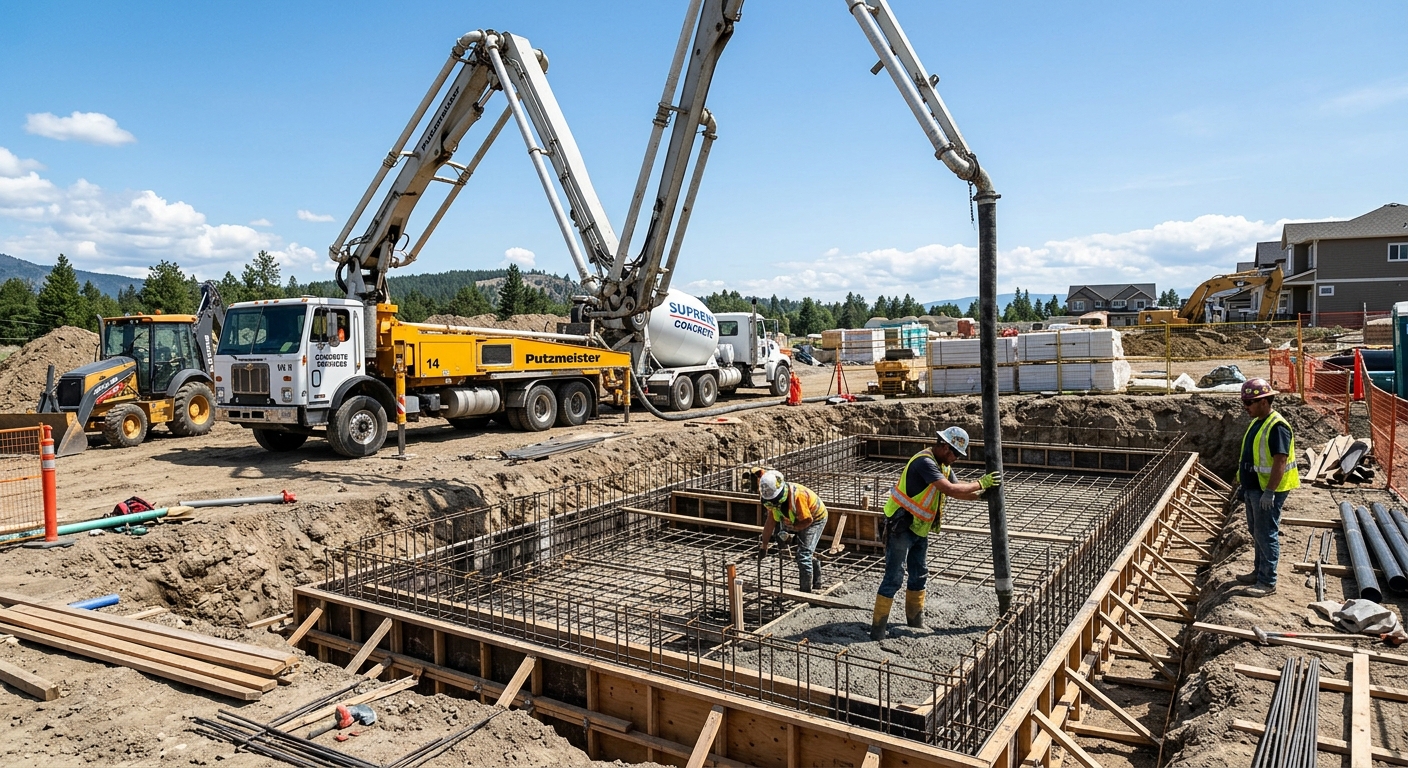
Concrete work options and costs in Parkdale
Parkdale, Alberta is a small community by Calgary standards, but the concrete demand is steady—especially for the driveways, patios, and walkways that sit right outside the front doors. With a 2021 population of 3,193 (Statistics Canada, 2021 Census), most projects are owner-driven, and contractors tend to be booked around the best exterior pour window. You’ll also see a lot of practical, long-term homeowners’ choices in this area; in many Calgary-area neighbourhoods, single-detached and townhome lifestyles create consistent needs for exterior concrete flatwork. Calgary’s cold continental climate changes the cost picture: our frost depth design is about 1.2 m (roughly 4 ft), freeze–thaw cycles are frequent, and that means deeper excavation, engineered footing support, air-entrained mixes, and careful curing. Late-fall and early-spring pours also require winter-grade placement steps—insulated blankets and sometimes heated enclosures—so contractors factor that risk into pricing.
In Parkdale, work is particularly in demand around established residential pockets near local roadways where access for concrete trucks and compacting equipment is easier. Jobs in these areas often move faster because the sites are more straightforward to reach, but that can still be offset by base depth requirements and the amount of reinforcement.
Below is a realistic cost comparison for common concrete options in the Calgary market. Use it as a baseline, then tighten the numbers with a site visit and an itemised quote.
| Application |
Typical Size |
Key Spec |
Finish Option |
Price Range |
| Concrete driveway (standard broom finish) |
20 ft x 10 ft (400 sq. ft.) |
Air-entrained concrete, compacted granular base |
Broom finish + joints |
$12,000 – $18,000 |
| Exposed aggregate driveway |
20 ft x 10 ft (400 sq. ft.) |
Staged wash/expose process, air-entrained mix |
Exposed aggregate finish |
$14,500 – $22,500 |
| Stamped concrete driveway or patio |
20 ft x 10 ft (400 sq. ft.) |
Reinforcement where needed, frost-safe detailing |
Stamped pattern with integral colour |
$15,000 – $26,000 |
| Plain concrete patio or walkway |
12 ft x 16 ft (192 sq. ft.) |
Air-entrained concrete, compacted sub-base |
Broom or light trowel (depending on slope) |
$5,000 – $9,000 |
| Garage floor (interior slab) |
22 ft x 22 ft (484 sq. ft.) |
Vapour control as applicable, reinforced slab |
Light broom finish |
$7,500 – $13,500 |
| Foundation footings (structural, below frost) |
Typical home footprint (engineered) |
Excavation to design frost depth (~1.2 m), reinforced footings |
Structural concrete (not decorative) |
$28,000 – $45,000 |
Prices are estimates only and vary by project scope, site access and material selection.
What affects the price of concrete work in Parkdale
Even when homeowners describe “the same job,” concrete quotes in Calgary-area markets can swing by 30–50%. The reason is that concrete pricing isn’t just about the cubic metres—it’s about engineered excavation depth, freeze–thaw durability specs, reinforcement, access for forming and trucks, and how carefully crews can protect curing. In Parkdale and the broader Calgary economic region, the design frost depth is about 1.2 m, and footing and foundation details must bear on undisturbed soil below that depth. That alone pushes foundation scope costs toward the higher end of the $28,000 – $45,000 band for footings. For exterior slabs, frequent freeze–thaw cycles also require air-entrained mixes and a smart joint/sealing plan, which can raise base costs on driveways in the $12,000 – $18,000 range.
Here are a few local conditions that typically raise costs in Parkdale: (1) harder excavation due to deeper frost-related dig requirements, (2) limited access for a 10-wheeler/boom or wheelbarrow distance, and (3) soil that needs more granular base prep or additional reinforcement. Costs can come down when sites are flat, forms are straightforward, and truck access is direct—especially on simple rectangular patios and driveways with minimal demolition.
Timing matters too. When crews pour near the edge of the season, cold-weather curing precautions (insulated blankets, monitoring temperatures) can add labour and materials costs, and rushing curing increases long-term failure risk—surface scaling and spalling usually aren’t “fixable forever.” If you’re planning work on an older home foundation footprint, expect more site work if there are changes to grading or drainage around the perimeter.
| Price Factor |
Why It Matters |
Cost Impact |
| Frost line depth — determines footing depth and form height |
Footings must bear below design frost to prevent frost heave |
Higher excavation = higher labour and concrete volume |
| Site preparation — excavation, grading, compacted granular base |
Proper base reduces settlement and pumping during freeze–thaw |
Can add major time if soil is unsuitable or access is tight |
| Reinforcement — rebar or wire mesh requirement |
Controls cracking and improves durability under loading |
Material + placement labour increases cost |
| Mix design — air-entrainment and compressive strength spec |
Air entrainment protects against freeze–thaw damage |
Upgraded mix can raise material cost but reduces failures |
| Finish type — broom vs. stamped vs. exposed aggregate |
Finish affects labour, timing, and post-processing |
Stamped/exposed typically adds cost versus broom finish |
| Pour size and concrete truck access to site |
Long carries and multiple loads increase placement time |
Access issues can push the job toward the high end of the band |
| Cold-weather curing precautions — heating and blankets |
Concrete needs protected curing to reach strength and durability |
Adds equipment and labour during colder pour windows |
| Control joint pattern and sealing cost |
Joints manage shrinkage cracking; sealing reduces salt-driven spalling |
Skipping either often leads to earlier surface deterioration |
Permits & regulations in Alberta
In Alberta, structural concrete work—specifically footings, foundation walls, and grade beams—typically requires a building permit and, in many cases, engineered drawings reviewed by the municipality. Concrete flatwork like patios, walkways, and driveways usually does not require a permit unless it changes lot grading significantly, affects impervious surface coverage limits, or impacts municipal right-of-way areas (for example, driveway tie-ins at the curb/approach). Because Parkdale homeowners often coordinate new flatwork alongside regrading, downspout redirection, or drainage changes, it’s worth confirming the permit/approval requirements before excavation.
Here’s a practical step-by-step way to verify a contractor in Parkdale: (1) Check the contractor’s business details and status using Alberta’s online registries for the relevant licence information, then confirm it matches the company name on the quote; (2) Ask for a certificate of insurance (COI) showing general liability coverage with your project address listed or at least your municipality named; request the COI to be issued by the insurer (not just a screenshot from an email); (3) Confirm coverage for workers through WSIB/WCB documentation—don’t accept “we’ll take care of it” language; and (4) Ask for references from similar-scale residential foundation or flatwork jobs (same season and similar access constraints) and verify timing overlaps are realistic.
If a job scope includes structural elements or anything tied into foundation drainage and grading, ask directly whether the contractor will pull permits and whether that cost is included—or if it’s your responsibility to arrange.
Getting concrete right in Parkdale's freeze-thaw climate
Concrete fails in Parkdale’s winter because water infiltrates the slab and then expands during freeze–thaw cycles. If the base isn’t properly compacted, the slab can settle and “open up” cracks. If the concrete mix isn’t air-entrained, freeze–thaw cycles create internal damage that shows up as surface scaling and eventual spalling. The right approach is to spec everything for durability, not just appearance. In Calgary-area practice, we engineer exterior work around the design frost depth (~1.2 m) and the reality of repeated freeze–thaw, especially on driveways, walkways, and patios exposed to tire loads and de-icing salts.
To spec the job correctly, start with base preparation: compacted granular sub-base to the depth engineered for your soil and frost conditions. Next, use an air-entrained concrete mix; for exterior flatwork, target about 5–7% air and confirm minimum compressive strength (commonly 32 MPa for durable residential exterior work). Then control cracking with a proper joint plan and cure the concrete properly. In our market, minimum 7-day curing under correct conditions is key. Finally, apply a penetrating sealer after the concrete has cured—typically at about 28 days—so salts don’t accelerate deterioration.
As a dollar example: upgrading from a plain broom-finish patio to a properly sealed, jointed exterior slab may cost only a few hundred to about $1,000 more depending on size and access, but it can prevent a “cheap” rebuild in a few years. In contrast, paying for decorative finishes like stamping without prioritizing freeze–thaw durability is the kind of mismatch that leads to expensive rework later. Ask your contractor the technical questions below—those details are what protect your surface.
| Spec |
Why It Matters in Parkdale |
What to Ask For |
Impact if Skipped |
| Compacted granular base (depth?) |
Reduces settlement and pumping during freeze–thaw |
“What depth of compacted granular base and what compaction target?” |
Cracks, uneven surface, faster wear on edges |
| Air-entrained concrete mix (target air %?) |
Prevents internal freeze–thaw damage and spalling |
“Confirm air content—target 5–7% for exterior flatwork.” |
Scaling/spalling, especially where de-icing salts splash |
| Compressive strength (MPa rating) |
Ensures durability and strength gain under winter conditions |
“Minimum 32 MPa—what mix design will you place?” |
Lower long-term performance and surface degradation |
| Control joints (spacing per ACI guidelines) |
Manages shrinkage cracking in a predictable pattern |
“What joint spacing are you planning and where exactly?” |
Random cracking that’s harder to repair cleanly |
| Minimum 7-day curing period |
Cold nights slow strength development |
“How will you protect curing if temperatures drop?” |
Weak surface, higher risk of scaling |
| Penetrating sealer (when applied after cure) |
Repels moisture/salts and slows surface deterioration |
“Sealer applied at ~28 days after pour—what product type?” |
Faster salt-driven breakdown and rough, porous surface |
How to choose a concrete work contractor in Parkdale
Choosing a contractor in Parkdale comes down to proof and clarity. First, verify Alberta licensing status for the scope you’re hiring for. Then confirm they carry liability insurance with a current certificate of insurance (COI) and that workers are covered under the proper WSIB/WCB system. Don’t rely on “we’re insured” without paperwork—ask for COIs that match the company on the quote and include the project address or municipality, and ask them to name the responsible insurer.
Next, get 2–3 itemised written quotes (not lump sums). You want labour + materials breakdown so you can see whether the difference is base prep depth, reinforcement, mix design, finish complexity (like stamping), or cold-weather curing protections. Read the scope line-by-line: what’s excluded (demo, haul-away, permit pull, drainage tie-ins), what’s included (forms, joints, curing blankets, sealer), and what tolerances apply. For warranties, ask for a workmanship warranty length and whether product/manufacturer warranties apply to materials like sealers or admixtures. Clarify if warranties are transferable if you sell your home—many homeowners care about this for resale.
Finally, protect your cash flow. For concrete, never pay more than 10–15% upfront; hold a completion holdback until the final cleanup, inspection, and any required touch-ups are done. Get a timeline with a start date and completion estimate in writing so scheduling aligns with Calgary-area curing realities.
- Request proof of liability insurance (COI) and confirm it matches the quoting company.
- Confirm WSIB/WCB coverage before work begins.
- Ask whether a permit is required for your specific scope and whether they handle it.
- Require itemised quotes: excavation/base, reinforcement, concrete supply/mix, forming, finishing, joints, curing, sealer.
- Ask for the engineered footing/foundation approach if any structural work is included.
- Confirm air-entrainment and minimum compressive strength (commonly 32 MPa for durable exterior work).
- Ask what control joint layout and sealing plan they use for freeze–thaw durability.
- Verify how they’ll handle cold-weather curing (blankets/heating, temperature monitoring).
- Confirm site access assumptions: truck route, pump/telebelt use, and concrete carry distance.
- Check whether disposal/haul-away of demo material is included.
- Get start/completion dates in writing and ask about weather contingency.
- Review warranty terms in writing, including whether it’s transferable.
Concrete red flags in Parkdale: vague “standard mix” wording without air-entrainment specs, quotes that don’t mention base depth or compaction, no plan for winter curing when temperatures dip, refusal to provide itemised pricing (labour vs materials), and workmanship warranties that are shorter than expected or not provided in writing.
Frequently asked questions — concrete work in Parkdale
Concrete vs pavers for a patio in Parkdale?
For patios in Parkdale, concrete often wins on cost predictability and longevity when it’s built for Calgary’s freeze–thaw cycles. A plain concrete patio or walkway typically falls around $5,000 – $9,000 for common residential sizes, assuming proper base prep and air-entrained mix. Pavers can be great for colour variety and easier local repairs, but they depend heavily on edging restraint and consistent sub-base compaction. With freeze–thaw and de-icing salt, a well-built concrete slab with control joints and sealing tends to hold up well. If you choose pavers, ask for the exact base thickness, compacted granular specs, and how they’ll maintain drainage so water doesn’t migrate under the stones.
How long does a concrete driveway last?
In Parkdale/Calgary’s climate, a concrete driveway can last 20–30 years when it’s designed around frost depth, built on a properly compacted base, and finished with the right mix. Durability here is less about “how thick is it?” and more about freeze–thaw resistance: air-entrained concrete for exterior use, correct jointing, and a sealing plan that helps resist salt-driven surface deterioration. If your driveway is in the mid-range of the typical cost band—say around $12,000 – $18,000—you’re usually paying for the right materials and process, not just volume. If a quote is very low without those details, expect earlier cracking or scaling.
What is air-entrained concrete and why does it matter here?
Air-entrained concrete is designed with microscopic air bubbles that give freezing water space to expand without destroying the paste. In Parkdale, the freeze–thaw cycle and frequent temperature swings are exactly why air entrainment is a “must” for exterior flatwork like driveways, patios, and walkways. Without it, freeze–thaw damage accelerates into scaling and spalling—often first near edges, joints, and areas hit by de-icing salt. When you’re comparing quotes, ask for the mix design confirmation, including a target air content typically about 5–7% for exterior flatwork, and a minimum compressive strength (commonly 32 MPa). Contractors who cannot state those specs are the ones most likely to cut corners.
How do I prepare the base for a concrete slab?
Base prep is where most long-term performance is won or lost. For Parkdale’s frost depth conditions (about 1.2 m design), crews must remove unsuitable topsoil, grade the area properly, and place compacted granular base to the engineered depth for local soil and frost performance. The base should be compacted in lifts, not just “tamped once,” and then verified for level/slope before forms and rebar go in. Good contractors also plan drainage so water doesn’t pool. If you want a concrete patio or walkway, ask your contractor to state the granular base depth and compaction approach in the quote. Skipping or under-compacting base can cause settlement and random cracking later.
How do I compare concrete quotes?
To compare concrete quotes fairly in Alberta, treat each quote like an engineering spec, not just a price tag. Ask for itemised line items: excavation and grading, granular base depth, reinforcement type and placement, concrete mix design (including air-entrainment and minimum strength), forming and finish type, joints, curing precautions, and sealing. If one quote includes sealing and the other doesn’t, you’ll see a misleading “cheap” number. Similarly, cold-weather placement steps (insulated blankets and temperature protection) can change total cost. As a reference point, foundation/footings usually land around $28,000 – $45,000 and driveways around $12,000 – $18,000 in the local band—so differences within those ranges should be traceable to scope and durability specs.
Can concrete be poured in cold weather in Parkdale?
Yes, concrete can be poured in cold weather in Parkdale, but it shouldn’t be “pour and hope.” Calgary’s cold continental conditions mean contractors must protect curing so the concrete reaches strength safely and resists surface scaling. Proper winter placement can include winter-grade mixes, insulated blankets, heated enclosures when necessary, and temperature monitoring so curing doesn’t stall. The risk isn’t just immediate—rushing curing can lead to long-term surface issues that show up after several freeze–thaw cycles. When evaluating a quote, ask how they’ll handle temperatures overnight, how long blankets/heating will stay on, and whether curing protection is included in the price. If a contractor doesn’t address cold-weather curing precautions, that’s a major concern.