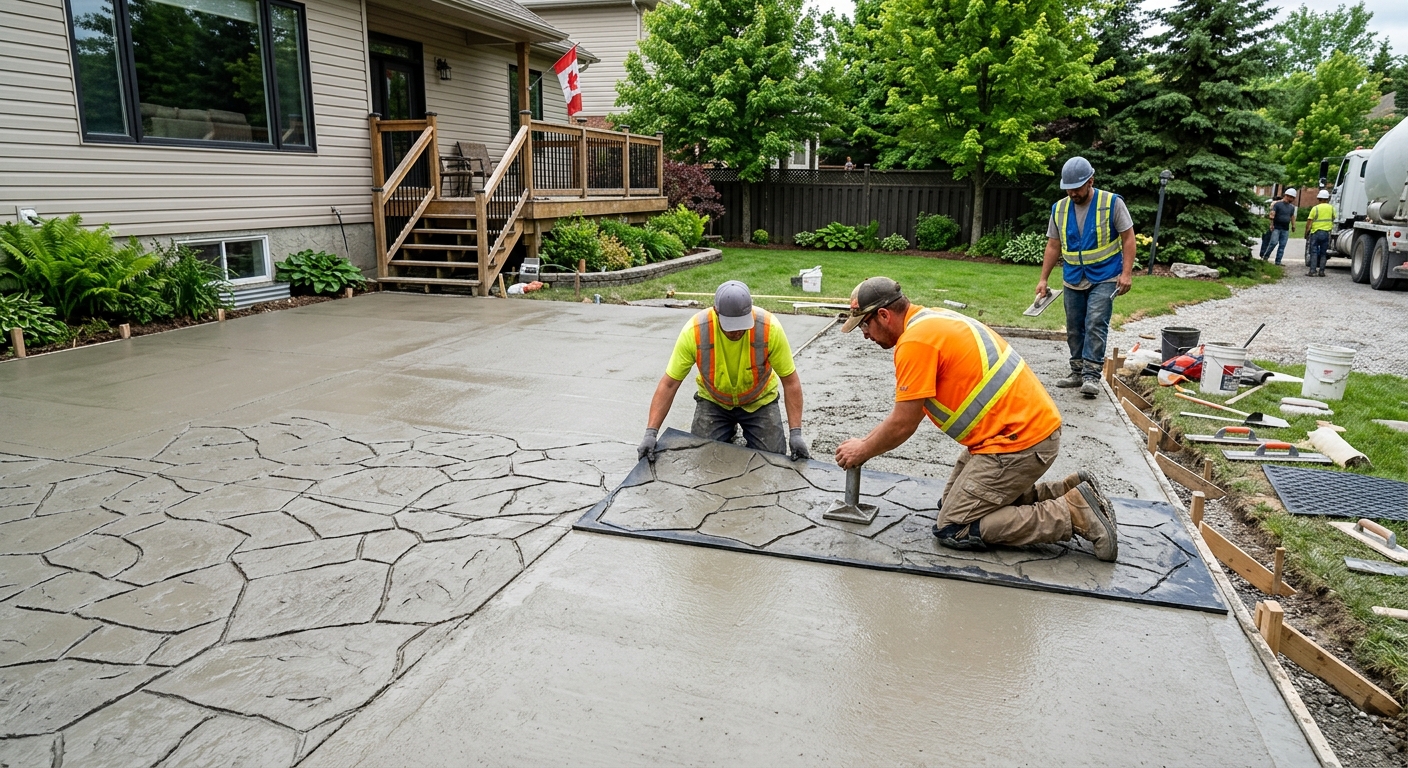
Concrete work options and costs in Mactaggart
Mactaggart, Alberta is a small community with big winter expectations for concrete. With a 2021 population of 1,681 (Statistics Canada, 2021 Census), demand is steady rather than constant, so when crews are scheduling foundation pours and flatwork for Calgary-area subdivisions, availability can affect your timeline and final price. This part of the Calgary market is also shaped by typical family home builds, so concrete flatwork—especially driveways and patios—stays in high circulation for homeowners upgrading exterior living space.
In Calgary’s cold continental climate, concrete pricing is engineered around frost and freeze–thaw. Alberta’s deeper frost protection requirements mean exterior footings and below-grade work often involve more excavation and larger footing volumes, pushing foundation costs higher than milder regions. On the slab side, freeze–thaw cycles make granular base prep and air-entrained concrete non-negotiable for durable driveways and walkways. The pour season is also shorter, so cold-weather placement may require winter-grade mixes, insulated blankets, and sometimes temporary heat to protect curing—costs that are reflected in quotes.
Within Mactaggart, demand tends to spike for exterior upgrades along established residential streets where access for concrete trucks and excavation is straightforward. If you’re planning a driveway and approach near busier pickup routes or where landscaping is already in place, contractors often prioritize those jobs—again affecting price and lead time. Use the ranges below as a practical starting point, then compare bids using the spec checklist in later sections.
| Application |
Typical Size |
Key Spec |
Finish Option |
Price Range |
| Concrete driveway (standard broom finish) |
24 m2 (approx. 10 ft x 26 ft) |
4 in slab, air-entrained mix, rebar reinforcement, control joints |
Broom finish |
$12,000–$18,000 |
| Exposed aggregate driveway |
24 m2 (approx. 10 ft x 26 ft) |
Air-entrained mix, proper curing, surface retard/exposed method, joint layout |
Exposed aggregate (seeded or wash method) |
$15,000–$22,000 |
| Stamped concrete driveway or patio |
30 m2 (approx. 320 sq ft) |
Air-entrained mix, stamped mats, release agents, sealant |
Stamped pattern (wood/stone look) |
$15,000–$26,000 |
| Plain concrete patio or walkway |
20 m2 (approx. 215 sq ft) |
4 in slab, granular base, joints as required |
Float/trowel + light broom or broom only |
$5,000–$9,000 |
| Garage floor (interior slab) |
45 m2 (approx. 484 sq ft) |
4 in slab, vapour barrier where required, reinforcement, curing protection |
Steel trowel finish |
$10,000–$16,000 |
| Foundation footings (structural, below frost) |
Per home/garage footprint (typ. 60–120 m of footing line) |
Engineered reinforcement, excavate to design frost depth, structural mix |
Formed/finished as required for foundation walls |
$28,000–$45,000 |
Prices are estimates only and vary by project scope, site access and material selection.
What affects the price of concrete work in Mactaggart
If you’ve received two quotes for what looks like the “same” concrete job in the Calgary region, it’s not unusual to see a 30–50% difference. The gap usually comes from the details: how deep the excavation goes, how much granular base is installed and compacted, what reinforcement is used, and whether the contractor is building for Calgary’s freeze–thaw reality rather than treating concrete like a simple pour. In practice, the region’s logistics and seasonal labour also matter—late fall and early spring pours often cost more because cold-weather curing precautions become mandatory.
Cold-engineered requirements are the biggest driver. Because the design frost depth in the Calgary area is about 1.2 m (roughly 4 ft), footings and structural excavation must reach undisturbed soil below that depth to prevent frost heave and seasonal movement. Exterior slabs and driveways also need air-entrained concrete mixes to survive freeze–thaw cycling, and they require a well-graded granular base with correct compaction. Finally, de-icing salts accelerate surface spalling in poorly specified mixes, so sealing and jointing strategy are part of “durability pricing,” not optional extras.
In Mactaggart, a typical cost jump you’ll see is between a standard broom-finished driveway and decorative finishes: decorative work usually adds stamping steps, colour hardeners, or aggregate exposure, which often moves you toward the $12,000–$18,000 baseline for standard flatwork and up into higher decorative territory. Another common variable is site conditions—rocky subgrade or limited truck access can turn a straightforward patio into an excavation-and-haul project, pushing the job beyond the $5,000–$9,000 patio range.
Even how your home is staged matters. Older lots with mature landscaping can require more selective demolition and restoration, adding labour and disposal costs; newer builds tend to be faster, which helps keep concrete driveway and walkway pricing closer to the lower end.
| Price Factor |
Why It Matters |
Cost Impact |
| Frost line depth — determines footing depth and form height |
Footings must extend below design frost protection to prevent frost heave. |
Higher excavation and formwork; can add substantial cost on foundations and retaining walls. |
| Site preparation — excavation, grading, compacted granular base |
Proper drainage and compaction reduce settlement and future slab cracking. |
Rock removal, haul-away, and additional granular supply increase labour/materials. |
| Reinforcement — rebar or wire mesh requirement |
Controls cracking and supports load, especially on driveways/garage slabs. |
Upgrades from mesh-only to rebar typically add cost but improve durability. |
| Mix design — air-entrainment and compressive strength spec |
Air entrainment helps concrete resist freeze–thaw damage; strength spec affects structural performance. |
Winter-grade and properly designed mixes can raise concrete line-item costs. |
| Finish type — broom vs. stamped vs. exposed aggregate |
Finish methods are labour-intensive and require correct timing/curing. |
Decorative finishes usually add steps and materials, increasing total price. |
| Pour size and concrete truck access to site |
Long carries or difficult access can require smaller placements or additional labour. |
May increase pumping/handling costs and add scheduling complexity. |
| Cold-weather curing precautions — heating and blankets |
Prevents early freezing and surface scaling when temperatures drop. |
Winter blankets/heaters and labour monitoring can add a meaningful premium. |
| Control joint pattern and sealing cost |
Joints manage cracking; sealing helps resist de-icing salt spalling. |
Proper jointing/layout and sealers add line-item cost but reduce long-term repairs. |
Permits & regulations in Alberta
In Alberta, structural concrete work typically needs a building permit, and it’s often tied to engineered drawings. That includes footings and foundation walls, grade beams, and other load-bearing structural elements. If your project involves modifying the structural system or bearing surfaces, assume you’ll need a permit and sometimes municipal review before work starts.
Concrete flatwork like patios, walkways, and driveways usually does not require a permit by default. However, permits or review can come into play if the work affects lot grading, changes surface water drainage, or relates to impervious surface and right-of-way considerations. The safest approach is to check with the local authority before breaking ground—especially if you’re altering swales, downspouts, or tying into existing retaining features.
For your due diligence in Mactaggart: first, verify the contractor has liability insurance and confirm the coverage is current (ask for a certificate of insurance). Next, verify WSIB/WCB coverage status—most trade contractors provide a clearance letter or equivalent proof. Then confirm what licence/registration applies to their work scope through the appropriate Alberta contractor resources and by matching the company name on their proposal to their insurance documents.
Step-by-step: (1) ask for their insurance certificate and WCB/WSIB clearance; (2) match dates and project address on documents; (3) request permit/engineering responsibility details in writing; and (4) check references on similar basement footing or flatwork jobs in the Calgary area.
Getting concrete right in Mactaggart's freeze-thaw climate
In Mactaggart and the broader Calgary region, the main way concrete “fails” isn’t usually immediate—it's what happens after multiple freeze–thaw cycles. The most common long-term problems are surface scaling and spalling on driveways and walkways, random cracking from poor jointing or settlement, and uneven heaving where base prep or frost-bearing depth is wrong. To spec the job correctly, treat base, mix, joints, curing, and sealing as a system, not separate choices.
1) Base preparation: install a compacted granular sub-base to the right depth for local soil conditions and frost considerations, with proper drainage and compaction. Don’t pour over soft spots or organic material—concrete will crack even if the mix is perfect.
2) Mix design: for exterior flatwork, require air-entrainment (typically 5–7% air content) and a minimum 32 MPa compressive strength spec for durability. This is what helps prevent freeze–thaw damage.
3) Control joints: plan the joint spacing to limit random cracking. Joints should be cut or formed at the right timing so cracking follows the weak points you design.
4) Curing: plan for a minimum 7-day curing period under proper conditions. In cold snaps, curing protection (insulation blankets and sometimes heat) is essential so the slab doesn’t freeze too early.
5) Sealing: apply a penetrating sealer after curing—typically around 28 days post-pour—so de-icing salt doesn’t accelerate deterioration at the surface.
A dollar example: upgrading a standard broom-finished driveway with correct air-entrainment, proper jointing, and a penetrating sealer can cost less than the difference between a decorative option and a basic one, while still protecting the slab from the real local damage mechanism. If you’re choosing between “looks” and “lasts,” in Calgary’s freeze–thaw climate the durability spec usually pays back first.
| Spec |
Why It Matters in Mactaggart |
What to Ask For |
Impact if Skipped |
| Compacted granular base (depth?) |
Reduces settlement and helps manage water under the slab through cycles. |
Confirm designed sub-base depth, compaction method, and drainage plan. |
Settlement cracks, rocking slab, accelerated failure at edges. |
| Air-entrained concrete mix (target air %?) |
Air bubbles provide space for freeze–thaw expansion. |
Specify air content (commonly 5–7% for exterior flatwork) and air test results. |
Spalling and scaling, especially where de-icing salt hits. |
| Compressive strength (MPa rating) |
Ensures structural capacity and durability for Alberta conditions. |
Require minimum 32 MPa and document mix design. |
Higher risk of surface damage and reduced service life. |
| Control joints (spacing per ACI guidelines) |
Directs cracking and reduces random shrinkage cracks. |
Ask for the joint layout plan and timing of cutting/finishing. |
Random cracks that can open and trap water. |
| Minimum 7-day curing period |
Proper strength gain protects against early freeze damage. |
Confirm curing method and protection plan for cold weather. |
Weak surface, scaling risk, and uneven performance over time. |
| Penetrating sealer (when applied after cure) |
Repels moisture and reduces de-icing salt driven deterioration. |
Schedule sealer around 28 days post-pour (after full cure) and specify product type. |
Faster spalling and staining, higher likelihood of costly resurfacing. |
How to choose a concrete work contractor in Mactaggart
Choosing the right concrete contractor in Mactaggart starts with verification. In Alberta, confirm they carry current liability insurance—request a certificate of insurance and ensure it matches the company name on the quote. Next, verify WSIB/WCB coverage: ask for a clearance letter (or equivalent proof) so you’re not left dealing with workplace injury coverage issues. If a contractor won’t provide documentation up front, that’s a red flag.
Then get 2–3 itemised written quotes. You want labour and materials broken out separately, not one lump number that hides differences in mix design, base depth, or reinforcement. Ask whether disposal is included (and where debris goes), whether permits are included if needed, and what’s excluded (existing concrete removal, excavation, snow/ice conditions, landscaping restoration, and sealing). For structural jobs (footings/grade beams/foundation walls), engineered drawing responsibilities and permit coordination should be spelled out clearly.
Warranty matters too: confirm workmanship warranty length and what it covers (cracking due to poor prep is often excluded if base was inadequate). Also ask about manufacturer warranties on products like sealers, and whether those warranties are transferable to you as the homeowner. For payment, never pay more than 10–15% upfront; hold back a portion until the final surface and finishing items are complete. Finally, require a written start date and completion estimate, especially if you’re trying to pour in a tight Alberta weather window.
- Request proof of current liability insurance (certificate of insurance) and confirm coverage matches the project.
- Verify WSIB/WCB coverage with a clearance letter or equivalent documentation.
- Ensure the quote is itemised: excavation, base materials, reinforcement, concrete line-item, finishing, joints, sealing.
- Confirm whether control joint cutting is included and who supplies cutting equipment.
- Ask for the planned slab thickness and base depth, not just “concrete thickness.”
- Require the air-entrainment and compressive strength spec in writing for exterior flatwork.
- Clarify cold-weather curing plan: blankets, temperature monitoring, and protection timeline.
- Confirm disposal/haul-away is included if excavation is required.
- Ask whether prep includes removal of topsoil/organics and compaction testing.
- Check warranty terms for workmanship and product; request details in writing.
- Use a payment schedule with a holdback until completion and final cleanup.
- Get an estimated pour date and contingency plan for Alberta temperature swings.
Concrete contractor red flags I see in the Mactaggart/Calgary market: quotes that don’t mention air-entrainment for exterior slabs, “we always do 4 inches” without discussing base depth and compaction, refusal to provide insurance/WSIB/WCB documentation, vague warranty wording, and proposals that treat cold-weather curing as optional rather than engineered protection.
Frequently asked questions — concrete work in Mactaggart
Do I need a permit for concrete work in Alberta?
In Alberta, structural concrete work such as footings, foundation walls, and grade beams typically requires a building permit, and it’s commonly tied to engineered drawings reviewed as part of the process. Concrete flatwork like most patios, walkways, and standard driveway work usually doesn’t require a permit unless it changes lot grading, affects drainage, or conflicts with municipal surface/impervious requirements or right-of-way constraints. For a homeowner in Mactaggart, the practical move is to call or check with the local authority before you start excavation—especially if you’re adjusting downspouts, changing swales, or building near drainage paths. Also confirm your contractor’s responsibilities for permits (if required) and ensure they carry liability insurance and WSIB/WCB coverage.
Concrete vs pavers for a patio in Mactaggart?
Concrete and pavers both work well in Mactaggart, but the freeze–thaw demands the “right” installation. Concrete patio slabs rely on proper base prep, air-entrained mix (5–7% air content is typical for exterior durability), joints, and curing to avoid scaling and random cracking. Pavers can tolerate some movement better when the base is built correctly, but they still need correct sub-base compaction and proper edge restraint to keep from shifting during freeze–thaw. In terms of money, a plain concrete patio or walkway typically falls in the $5,000–$9,000 band, while stamped or decorative options move higher. If you want a low-maintenance, monolithic surface, concrete is often the best fit; if you want easy local repairs after future utility work, pavers may be worth considering.
How long does a concrete driveway last?
A properly built concrete driveway in the Calgary region is often designed to last decades, but “service life” depends heavily on how it’s spec’d for freeze–thaw. The biggest durability factors are air-entrainment, correct granular base prep, reinforcement selection, control joint layout, and curing protection when temperatures are dropping. In a Mactaggart driveway, de-icing salt is also a factor—without sealing, surface deterioration and spalling can show up earlier. If you’re comparing quotes, don’t just look at the driveway total; verify whether the contractor includes the durability steps that protect against scaling. Typical driveway pricing tends to sit in the $12,000–$18,000 range for standard broom-finish flatwork, and higher finishes usually add cost mainly for appearance—but durability specs should remain consistent regardless of finish choice.
What is air-entrained concrete and why does it matter here?
Air-entrained concrete includes microscopic air bubbles intentionally mixed into the concrete. In Alberta’s cold winters and freeze–thaw cycles, those bubbles give expansion space when water in the concrete freezes, reducing scaling and spalling at the surface. Without air-entrainment, exterior slabs on Calgary-area lots can deteriorate faster, especially where moisture and de-icing salts concentrate—near wheel paths and garage approaches. For Mactaggart exterior flatwork, you should ask for air-entrainment typically in the 5–7% range for durability, and confirm the contractor also plans correct curing and sealing after the slab reaches full cure (often around 28 days). When contractors cut corners on air content, you may see surface damage within a few winters, which is far costlier than the incremental mix spec.
How do I prepare the base for a concrete slab?
Concrete base preparation is what separates a long-lasting slab from one that cracks and heaves. The contractor should excavate to remove topsoil/organics and grade the area for drainage, then install a compacted granular base to the designed depth for your site and frost considerations. In Mactaggart, because the region uses a design frost depth around 1.2 m (roughly 4 ft), the goal is to ensure any slab or foundation bearing meets frost-protection requirements and that water doesn’t sit under the concrete. You should also confirm compaction methods and that reinforcement is placed correctly (including chairs/donuts for proper cover where required). For driveways and walkways, ask whether they’re installing air-entrained concrete and including a control joint pattern. A good quote ties base prep to the durability spec—it shouldn’t be vague.
How do I compare concrete quotes?
Comparing concrete quotes in Mactaggart gets easier when you force like-for-like specifications. Start by ensuring each quote includes the same slab thickness, granular base depth, compaction approach, and reinforcement type. Then compare mix design: exterior work should be air-entrained and meet a durability strength spec (commonly minimum 32 MPa). Next, review finishes: standard broom finishes are typically in the $12,000–$18,000 driveway band, while decorative options like stamped work usually land higher—often within the $15,000–$26,000 range depending on size and complexity. Finally, check what’s included: permit pull if required, haul-away/disposal, cold-weather curing protection, joints, and sealing. Ask for a start date and completion estimate in writing, and confirm liability insurance and WSIB/WCB coverage so the job doesn’t stall mid-project.