Concrete work options and costs in Idylwylde
In Idylwylde, Alberta, concrete work is usually about durable exterior flatwork that can handle Calgary’s cold continental freeze–thaw cycles. With a local population of 1,767 (Statistics Canada, 2021 Census), the market is smaller than Calgary proper, so contractors often prioritize projects with clear access, good scheduling, and ready permitting. For many homeowners, the typical need is driveway and patio upgrades on single-detached neighbourhood properties—exactly the kind of work that uses air-entrained concrete, compacted granular bases, and tight control-joint spacing to limit cracking and scaling. This is also why quoting can feel “engineered” rather than simple: in this region, the design frost depth is about 1.2 m, meaning exterior and structural foundation work must bear below the frost line to reduce frost heave and seasonal movement.
Those frost-driven excavation volumes raise foundation and footing costs compared with milder parts of the province. Freeze–thaw cycles also affect exterior slabs: you’ll see higher material costs for winter-grade mixes and the labour time to prep granular base, place air-entrained concrete, and manage curing—especially in late fall or early spring. In areas like the more actively developed pockets near the Calgary commuting corridor within Idylwylde, demand for driveway and walkway replacements is steady, particularly when homeowners are coordinating broader landscaping and regrading.
Below is a realistic comparison of common options and typical price ranges so you can line up like-for-like specs before you request quotes.
| Application |
Typical Size |
Key Spec |
Finish Option |
Price Range |
| Concrete driveway (standard broom finish) |
20 ft x 10 ft (200 sq ft) |
Air-entrained mix, compacted granular base, control joints |
Broom finish, light edging |
$12,000–$18,000 |
| Exposed aggregate driveway |
20 ft x 10 ft (200 sq ft) |
Air-entrained mix, proper cure, wash/expose timing |
Exposed aggregate with clear sealer |
$13,500–$20,500 |
| Stamped concrete driveway or patio |
18 ft x 12 ft (216 sq ft) |
Air-entrained mix, reinforced as needed, release agent |
Stamped pattern + colour integral or stain |
$15,000–$26,000 |
| Plain concrete patio or walkway |
12 ft x 10 ft (120 sq ft) |
Air-entrained mix, compacted sub-base, edging |
Float and broom (non-slip) finish |
$5,000–$9,000 |
| Garage floor (interior slab) |
22 ft x 20 ft (440 sq ft) |
Vapour barrier, reinforcement, fibre or mesh, proper thickness |
Power float + saw-cut joints |
$9,000–$14,500 |
| Foundation footings (structural, below frost) |
Per engineered plan (varies by home) |
Excavation to design frost depth, rebar, formwork, structural concrete |
Structural, below-grade finish |
$28,000–$45,000 |
Prices are estimates only and vary by project scope, site access and material selection.
What affects the price of concrete work in Idylwylde
In Idylwylde and the broader Calgary region, it’s not unusual to see the “same” concrete job come in 30–50% apart between quotes. The big drivers aren’t just the concrete itself—they’re what’s happening underneath and around the pour: excavation depth, granular base preparation, reinforcement choices, truck access, and how carefully crews manage curing in cold snaps. Two contractors can both quote “a driveway,” but one might include thicker base prep and air-entrained winter-grade concrete for freeze–thaw durability, while another leaves those details vague.
Frost depth is the foundation of the entire cost equation in Alberta. Exterior footings and foundation systems must extend below the design frost depth (about 1.2 m here) to reduce frost heave and seasonal movement. In parallel, exterior slabs require air-entrained concrete so the freeze–thaw cycle doesn’t drive scaling or spalling. Because the pour season is shorter, winter-grade mixes, insulated curing blankets, and sometimes heated enclosures add both materials and labour. Finally, de-icing salt accelerates surface wear—so sealing and edge protection become part of “long-term cost,” not an optional extra.
Here are a few practical examples from Idylwylde that commonly push costs up or down: a driveway replacement on a sloped approach often needs more grading and re-compaction, increasing both excavation and granular base costs. Conversely, a simple, flat back-lot walkway with clean access can stay near the lower end of the $5,000–$9,000 patio/walkway band. A foundation job that requires deeper excavation to reach firm bearing below frost can move toward the $28,000–$45,000 footing range quickly, especially if shoring or extra formwork is required. Even “interior” garage slabs can vary if reinforcement, vapour barrier, or thickness changes for moisture and load needs—especially on older housing sites where subgrade conditions aren’t uniform.
| Price Factor |
Why It Matters |
Cost Impact |
| Frost line depth |
Determines footing depth and form height for structural stability |
Can increase excavation volume substantially, pushing foundation/footings toward the upper band |
| Site preparation |
Excavation, grading, and compacted granular base prevent settlement and frost movement |
Additional haul-off and re-compaction commonly add thousands |
| Reinforcement |
Rebar or wire mesh reduces cracking and supports load-bearing slabs |
Material + labour time increases; omission can reduce cost but harms durability |
| Mix design |
Air-entrainment and compressive strength specs are critical for freeze–thaw resistance |
Upgraded air-entrained and winter-grade concrete can add cost but prevents spalling |
| Finish type |
Broom vs. stamped vs. exposed aggregate changes labour and material workflow |
Stamped/exposed work pushes driveway or patio budgets upward within the bands |
| Pour size and concrete truck access to site |
Smaller pours may require more mobilizations; difficult access increases labour and pumping/hoist needs |
Pumping, waiting time, and extra crew hours add cost |
| Cold-weather curing precautions |
Heating and insulating blankets protect strength gain and prevent surface scaling |
Winter curing methods can add a noticeable premium |
| Control joint pattern and sealing cost |
Joint spacing controls cracking; sealing helps resist de-icing salt damage |
Deliberate joint layouts and sealing add cost now but reduce long-term repairs |
Permits & regulations in Alberta
In Alberta, structural concrete work generally needs a building permit, especially when the concrete supports the building. That typically includes footings, foundation walls, grade beams, and any structural foundation elements that are part of the engineered building system. Municipal review may include checks of engineered drawings, bearing conditions, and formwork/inspection requirements. For homeowners, the key is to separate “structural concrete” from “non-structural flatwork.”
Concrete flatwork like patios, walkways, driveways and garage slabs usually does not require a permit by default. However, permits can come into play if the work affects lot grading, changes drainage patterns, impacts municipal impervious surface coverage rules, or touches municipal right-of-way requirements (for example, ties to boulevard work). In Idylwylde, always confirm requirements before breaking ground—especially if your scope includes regrading, catch basins, or changes to how water runs off the property.
To verify a contractor in Alberta, start with their business presence and licensing/registration details through the province’s relevant online resources for trades/contracting (where applicable), then confirm insurance. Ask for a certificate of liability insurance showing your project address or naming you as additional insured if required. For WSIB/WCB, request proof of coverage (or a clearance letter where available). Finally, verify references from similar concrete scopes (driveways and footings of comparable size) and ask which inspections they’ve coordinated—so you don’t get surprises mid-pour.
Getting concrete right in Idylwylde's freeze-thaw climate
Concrete fails in Idylwylde’s winters when the system isn’t built as a whole: sub-base support, mix design, joint layout, curing, and surface protection all have to work together. The most common homeowner-visible issue is spalling and surface scaling, typically tied to inadequate air-entrainment, rushed curing, or poor base compaction that lets water collect and freeze under the slab. In a freeze–thaw climate, even a driveway that “looks fine” at month one can degrade faster if the mix and curing aren’t engineered for Calgary-area winters.
To spec the job correctly, start with base preparation: compacted granular sub-base to the depth needed for local soil and frost performance, not just a thin gravel layer. Next, require an air-entrained exterior mix (commonly in the 5–7% air range for durable flatwork in severe freeze–thaw exposure) with a minimum 32 MPa compressive strength. Then lock in control joints: spacing should be frequent enough to encourage cracking where it’s planned, not random through the slab. Curing is equally critical—aim for at least 7 days under proper conditions, and in cold weather, ensure the contractor uses approved curing methods such as insulation blankets and, where required, temporary heat so the concrete reaches strength. Finally, plan sealing: a penetrating sealer applied after proper cure (often around 28 days) helps repel de-icing salt and reduces surface damage.
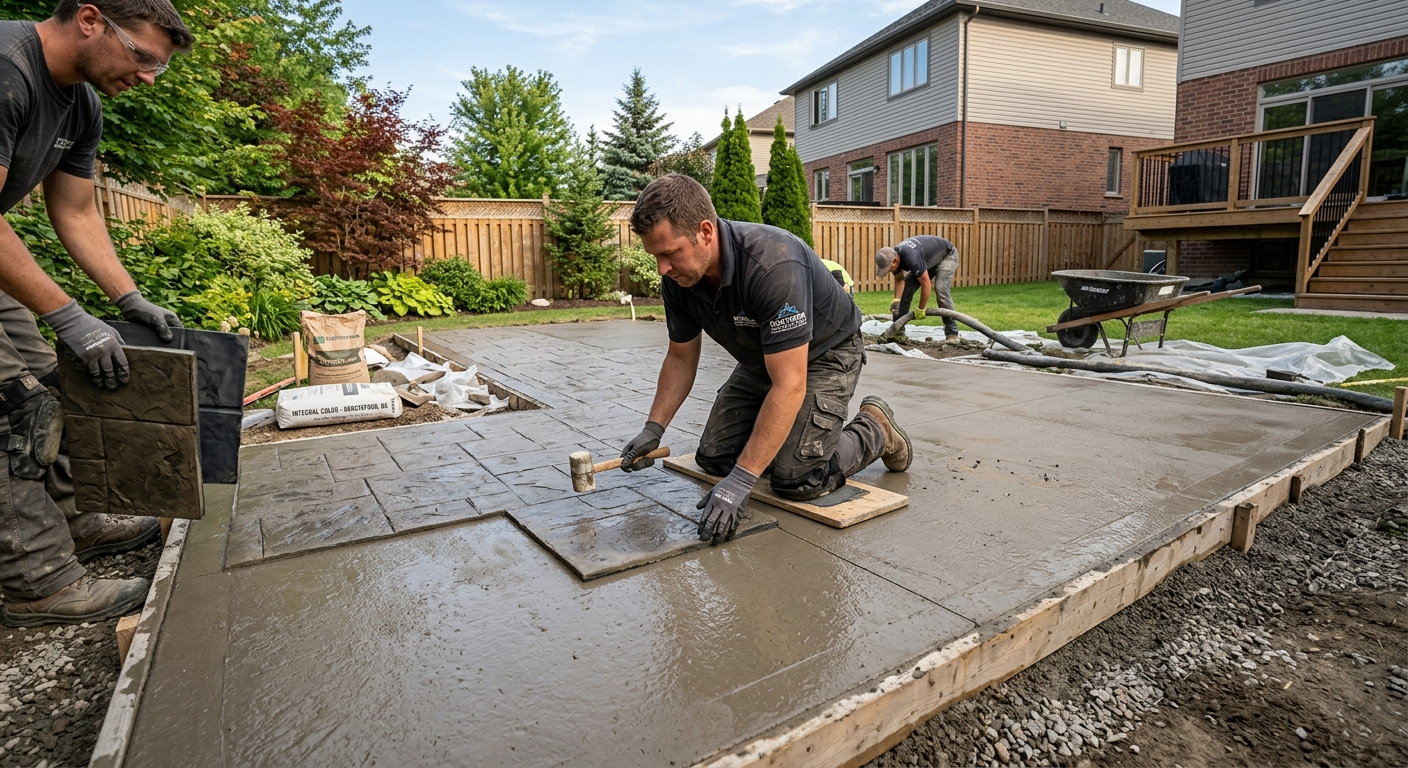
If you’re choosing between finishes, remember: stamped concrete costs more due to labour and materials, but it’s usually justified when you’re replacing an area that’s highly visible and you want the aesthetic. For example, moving from a plain patio/walkway budget in the $5,000–$9,000 range to a stamped option can add meaningful cost—just make sure the contractor doesn’t cut corners on base prep and air-entrainment to “fund the stamping.”
| Spec |
Why It Matters in Idylwylde |
What to Ask For |
Impact if Skipped |
| Compacted granular base (depth?) |
Supports the slab through frost movement and reduces settlement |
Confirm granular thickness and compaction method to suit soil and frost needs |
Higher risk of uneven settling, cracking, and premature failure |
| Air-entrained concrete mix (target air %?) |
Air pockets let concrete expand safely during freeze–thaw |
Request air content target (commonly 5–7% for exterior flatwork) |
Spalling and scaling increase dramatically in winter seasons |
| Compressive strength (MPa rating) |
Ensures adequate strength gain for structural and durability requirements |
Minimum 32 MPa for the slab/placement scope |
Weaker concrete can crack, abrade faster, and fail under loads |
| Control joints (spacing per ACI guidelines) |
Controls where shrinkage and temperature cracks occur |
Ask for planned joint spacing and saw-cut timing |
Random cracking and wider, less manageable defects |
| Minimum 7-day curing period |
Strength development is temperature- and time-dependent in cold weather |
Confirm curing schedule and protection plan |
Scaling, surface weakness, and reduced long-term durability |
| Penetrating sealer (when applied after cure) |
Helps resist de-icing salt and reduces moisture ingress |
Sealer application after full cure (often around 28 days) |
Faster surface deterioration and more visible winter wear |
How to choose a concrete work contractor in Idylwylde
Choosing the right contractor in Idylwylde starts with proof and paperwork, not just price. In Alberta, verify liability insurance first—ask for a current certificate of insurance and confirm coverage limits are appropriate for concrete work (excavation, trucks, and finishing equipment). Next, check WSIB/WCB status by requesting evidence of coverage or a clearance letter where that applies. Don’t assume “they’re local” means they’re covered; ask before signing and keep copies of documents for your records.
For quotes, request 2–3 itemised written estimates with a breakdown that separates labour and materials (concrete mix, rebar/mesh, granular base, formwork, finishing, sealing). Make sure the scope is identical: include excavation and disposal, edge restraints, vapour barriers for interior slabs where needed, and whether the quote includes permit work (when required) or any engineering/inspection coordination. Avoid apples-to-oranges pricing by requiring line items for base depth and reinforcement details—these are the places where “cheap” quotes often get trimmed.
Warranty matters too. Ask for a workmanship warranty length, plus the product/manufacturer warranty if a specific sealer or decorative system is used, and whether it’s transferable if you sell the home. On payment, a good rule is to never pay more than 10–15% upfront; hold back a portion until the job is complete and surfaces are protected. Finally, get the start date and completion estimate in writing—concrete crews schedule around weather windows in Calgary’s climate.
- Confirm liability insurance and request a certificate before work begins.
- Verify WSIB/WCB coverage with proof or a clearance letter.
- Ask for 2–3 references from similar projects (driveways, patios, and/or footings) completed recently.
- Require itemised quotes: labour vs. materials, not one lump sum.
- Confirm excavation scope, granular base thickness, and compaction requirements.
- Specify air-entrained mix and minimum 32 MPa compressive strength for exterior work.
- Document reinforcement plans (rebar size/spacing or mesh type) where applicable.
- Ask how they handle cold-weather curing (blankets/heating) if work spills into shoulder seasons.
- Require the control joint plan and timing of saw cutting.
- Clarify what’s included for cleanup and disposal of excess material.
- Get a written warranty for workmanship and confirm product warranty terms if applicable.
- Agree on a payment schedule with a meaningful holdback until completion and final protection/sealing.
Common red flags in Idylwylde include: a contractor who won’t show insurance/WSIB/WCB documents, quotes that don’t specify air-entrainment for exterior slabs, refusing to detail base thickness/compaction and reinforcement, starting late without a plan for cold-weather curing, and pushing for large upfront deposits (well beyond 10–15%) without milestones tied to deliverables.
Frequently asked questions — concrete work in Idylwylde
What is air-entrained concrete and why does it matter here?
Air-entrained concrete includes tiny, evenly distributed air bubbles in the mix. In Alberta—especially around Idylwylde and the Calgary area—those air voids let water in the concrete freeze and expand without breaking the surface, which is how you prevent premature scaling and spalling. For exterior flatwork (driveways, patios, and walkways), you should expect air-entrainment to be part of the spec, commonly targeted in the 5–7% air range for durable freeze–thaw performance. If a quote doesn’t mention air-entrainment or curing protection, it’s a sign the contractor may be optimizing for short-term appearance rather than long-term durability. Even within the $5,000–$9,000 patio/walkway range, the right mix and curing are what protect your investment through multiple winter cycles. (Statistics Canada, 2021 Census)
How do I prepare the base for a concrete slab?
Base preparation is where good concrete jobs are won or lost in Idylwylde. The contractor should excavate to the required depth, remove organics/soft material, and build a compacted granular base designed to resist settlement and frost movement. Ask for the granular thickness and compaction method (equipment used and how they confirm compaction). Proper drainage matters too—concrete fails faster when water collects at edges or under the slab and repeatedly freezes. For driveways and walkways, ensure they include subgrade prep, granular base, edging/constraints, and a clear plan for how the concrete will be supported during placement. If you’re comparing bids and one quote is far lower than others, check whether it includes the granular base depth and compaction details—those omissions often lead to cracked slabs and costly rework later.
How do I compare concrete quotes?
To compare concrete quotes in Idylwylde, focus on like-for-like specs instead of the total number. Ask each contractor to provide itemised pricing that breaks down labour and materials, and confirm the same scope: excavation depth, granular base thickness, reinforcement (mesh/rebar or not), and finishing method. For exterior work, require confirmation of air-entrained concrete and minimum compressive strength (commonly 32 MPa for slab scopes). Also compare weather and curing allowances—cold-weather curing (insulated blankets and/or heat) can change price because it’s labour and materials, but it’s essential for durability. A clear example: a standard broom driveway in the $12,000–$18,000 band might appear comparable to another quote until you see that one includes air-entrainment, proper base prep, and sealing, while the other doesn’t. The “cheaper” bid may look good on day one and cost more after a winter or two.
Can concrete be poured in cold weather in Idylwylde?
Yes, concrete can be poured in cold weather in Idylwylde, but it must be engineered for it. Calgary-area winters and shoulder-season cold snaps affect curing and strength gain—without protection, you can see scaling, surface weakness, or long-term durability problems. A reputable contractor will plan cold-weather curing: insulated blankets, controlled heat where appropriate, and procedures that help the concrete reach adequate strength before exposure. Ask the contractor what the “winter plan” is before you approve the schedule. Also confirm the mix is suitable for cold placement and that they won’t rush the curing window. If the quote is close to the lower end of the driveway range (for example, within $12,000–$18,000) but doesn’t mention cold-weather methods, ask directly what they do to protect curing. In this climate, curing precautions aren’t optional—they’re part of the quality spec.
How do I maintain concrete in Idylwylde's freeze-thaw climate?
Maintenance in Idylwylde is mainly about managing moisture and de-icing salt. Start with sealing: after the concrete has fully cured (often around 28 days), apply a penetrating sealer to help repel salt and water. Re-seal on a typical homeowner cycle when the surface no longer beads water—your contractor can advise based on your specific finish and traffic. During winter, avoid over-salting; use sand where possible and shovel promptly to reduce abrasion. For minor surface issues, address them early rather than waiting for spalling to widen. If you have joints, keep them clean and properly maintained so water doesn’t pool and freeze at the edges. The biggest “maintenance mistake” is neglecting what looks small in spring; freeze–thaw can turn minor surface wear into larger repairs surprisingly fast.
What causes concrete to spall in Idylwylde winters?
Spalling in Idylwylde winters is usually caused by inadequate air-entrainment, poor curing, or water getting into the slab and freezing repeatedly. When air-entrainment isn’t correct, the freeze–thaw pressure can break down the near-surface paste, leading to scaling and spalling. Cold-weather placement without heating/blankets can also prevent proper strength development, which increases surface vulnerability. Water pathways matter too: if the base prep or drainage is off, water can collect at low spots or along edges and freeze under load, accelerating damage. De-icing salt compounds the problem by increasing moisture penetration and chemical attack on the surface. If your contractor is promising a “budget” finish but isn’t explicit about air content, curing, and sealing, you’re taking the biggest risk. For exterior flatwork, make those items non-negotiable—even when you’re budgeting within the $5,000–$9,000 patio/walkway band.