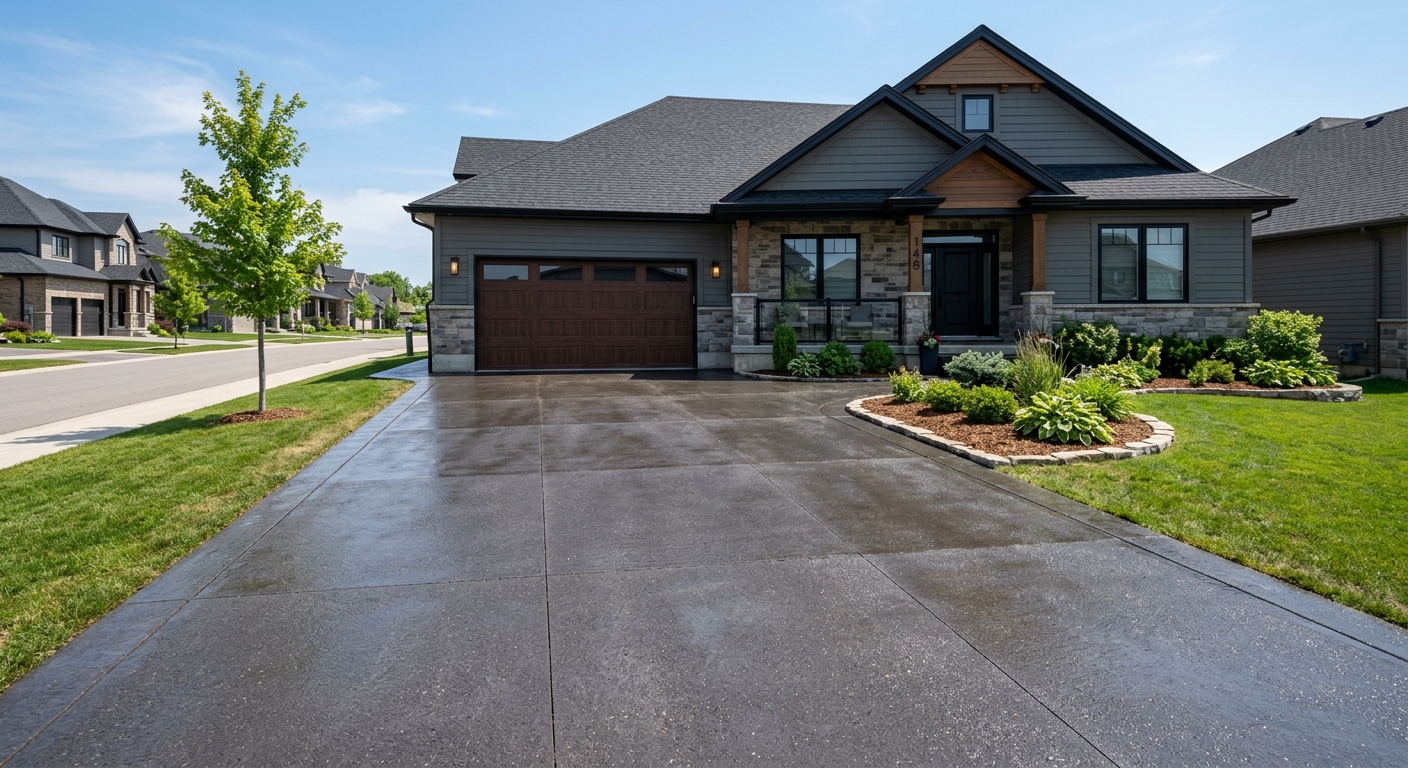
Concrete work options and costs in Stettler
In Stettler, concrete projects are common because the town’s housing stock is largely made up of single-detached homes (67.5% of dwellings) and a significant portion of homes were built before 1981 (60.5%). That matters: older driveways, stoops, and walkways often need replacement due to cracking, settlement, and surface scaling. With 1,745 homeowner households (73.3% of households own), you’ll also see steady demand for exterior flatwork that improves curb appeal and everyday usability.
In the Camrose–Drumheller region, pricing is shaped by cold continental winters and frequent freeze–thaw cycles. Stettler sits in a continental frost environment with a frost line around 1.2 m (about 4 ft). For structural work, that means deeper excavation and more concrete and forming to reduce frost heave risk. Exterior slabs and driveways also need air-entrained concrete for freeze–thaw durability, plus properly planned control joints to manage cracking from temperature swings.
There’s also a practical timing factor: the pour season is shorter (late spring through early fall). When winter weather interrupts progress, contractors may need heating, insulated blankets, and slower schedules to reach safe finishing and proper curing. You’ll typically feel this in Stettler neighbourhoods where housing turnover and renovations are active—areas like the older core and established residential pockets near downtown see consistent demand for new driveways, walkways, and porch/step repairs. From there, costs branch into finish level, base prep, and structural requirements.
Use the table below to compare typical scope and pricing ranges before you request quotes.
| Application |
Typical Size |
Key Spec |
Finish Option |
Price Range |
| Concrete driveway (standard broom finish) |
24 ft x 10 ft (240 sq ft) |
Air-entrained mix for exterior + control joints |
Broom finish, edges sealed |
$3,400–$5,200 |
| Exposed aggregate driveway |
24 ft x 10 ft (240 sq ft) |
Air-entrained mix + proper curing for scaling resistance |
Washed/exposed aggregate finish |
$4,200–$6,600 |
| Stamped concrete driveway or patio |
20 ft x 12 ft (240 sq ft) |
Air-entrained mix + integral color |
Stamp pattern with release + sealer |
$4,800–$8,400 |
| Plain concrete patio or walkway |
12 ft x 8 ft (96 sq ft) |
Granular base, slope for drainage, air-entrained mix |
Broom or light trowel finish |
$1,150–$1,900 |
| Garage floor (interior slab) |
22 ft x 20 ft (440 sq ft) |
Vapour barrier + base compaction; air content less critical than exterior |
Powder-float finish |
$6,200–$9,800 |
| Foundation footings (structural, below frost) |
Typical 1,000–1,600 sq ft of footing length/area |
Reinforced concrete placed below design frost depth |
Structural concrete formwork |
$180–$260 |
Prices are estimates only and vary by project scope, site access and material selection.
What affects the price of concrete work in Stettler
In Stettler and across the Camrose–Drumheller economic region, you can see the same concrete job priced 30–50% differently depending on how the quote handles the “hidden” essentials: frost protection, base preparation, mix design, and finishing/curing in cold weather. The biggest driver is that exterior concrete in Alberta must be designed to survive freeze–thaw cycles, not just “look good” at the pour.
Every structural and exterior decision ties back to frost depth. Footings must extend below the local frost line (about 1.2 m / 4 ft in this corridor) to reduce the risk of frost heave. That requirement drives deeper excavation, more forming, and more concrete than projects in milder climates. For slabs and exterior flatwork, contractors commonly use air-entrained concrete mixes to resist scaling and spalling during repeated temperature swings. Also, Stettler’s shorter pour season means more scheduling pressure: if temps drop, contractors may need heating, insulated blankets, and extra labor time for safe placement and finishing.
De-icing salt is another cost-influencer. Salt can accelerate surface damage, so sealing and correct jointing become part of long-term durability. You’ll typically feel this in Stettler renovations where older driveways built in place start to break up over a few winters. For example, a plain patio/walkway might land near the $12–$20 per sq ft band when base and drainage are straightforward, while stamped concrete often pushes to the $20–$35 per sq ft band because color, stamping steps, and sealer are more involved.
Local conditions can also lower cost: a smaller, well-drained yard with easy access may reduce excavation and trucking time. But if soil is inconsistent, water is pooling, or the job needs thicker base and more subgrade work, costs climb quickly—often more than customers expect.
| Price Factor |
Why It Matters |
Cost Impact |
| Frost line depth — determines footing depth and form height |
Prevents frost heave by placing structural concrete below design frost |
Higher excavation and forming; can add significant cost on foundations and footings |
| Site preparation — excavation, grading, compacted granular base |
Controls settlement and reduces moisture trapping under slabs |
More granular and labor increases unit pricing for driveways/sidewalks |
| Reinforcement — rebar or wire mesh requirement |
Improves load capacity and crack resistance for exterior and structural pours |
Material + placement labor; often essential for thicker slabs/footings |
| Mix design — air-entrainment and compressive strength spec |
Air-entrainment helps resist freeze–thaw scaling and spalling |
Incremental material cost, but avoids premature surface failure |
| Finish type — broom vs. stamped vs. exposed aggregate |
Finish level affects labor, curing, and sealing demands |
Stamped/exposed typically cost more than standard broom finishes |
| Pour size and concrete truck access to site |
Limits how much concrete can be placed efficiently |
Restricted access can increase labor time and add equipment or extra trips |
| Cold-weather curing precautions — heating and blankets |
Cold temperatures slow strength gain and increase early-age risk |
Adds direct costs and can compress scheduling across multiple crews |
| Control joint pattern and sealing cost |
Manages cracking location and reduces salt/moisture damage |
Jointing and sealing add line-items but protect surface life |
Permits & regulations in Alberta
In Alberta, structural concrete work typically needs a building permit—especially for work like footings, foundation walls, and grade beams that are part of the structural system and must align with the approved drawings. Many projects also require engineered drawings that the municipality (or the permitting authority) reviews before construction begins. Concrete flatwork like patios, walkways, and driveways usually does not require a permit unless it changes lot grading, affects impervious surface coverage limits, or touches municipal right-of-way requirements.
Before breaking ground in Stettler, verify what applies to your exact scope. Then confirm the contractor’s documentation. A legitimate concrete contractor should carry current liability insurance and have the proper worker coverage (WSIB/WCB coverage as applicable for their crews). Step-by-step, here’s what to check:
- Ask for their Alberta business information and confirm it matches what’s on any quote or contract.
- Request a certificate of insurance (COI) showing liability coverage and effective dates.
- Ask for proof of worker coverage (WSIB/WCB) and verify it covers the people working on your site.
- Look for a clearance letter or coverage document when work is scheduled (some contractors provide updated paperwork close to start date).
- Verify references on similar-sized pours in Central Alberta/nearby communities where freeze–thaw durability specs are standard.
If you’re unsure about permitting for drainage/grade changes, confirm with the municipality in advance—doing it up front avoids delays and costly rework.
Getting concrete right in Stettler's freeze-thaw climate
Concrete failures in Stettler’s freeze–thaw climate are usually preventable when the job is specified correctly. The most common issues I see are surface scaling and spalling from inadequate air-entrainment, cracking from poor control joint planning, and premature movement due to weak base preparation or trapped moisture. Stettler’s frost environment (around 1.2 m / 4 ft in this corridor) reinforces why exterior slabs and any structural elements must be placed with the correct depth and drainage strategy.
To spec the job properly, start with base preparation: excavate and install a compacted granular sub-base to the right depth for your soil and drainage conditions. Then lock in the mix design: for exterior flatwork, specify air-entrained concrete with an air content target commonly in the 5–7% range for freeze–thaw resistance, and a minimum 32 MPa compressive strength as a baseline for durability. Next, address control joints—use a logical spacing plan so cracks form where they’re least damaging rather than randomly. Finally, curing matters: in cold shoulder conditions, plan for at least 7 days of curing under suitable protection so the slab reaches strength safely.
For maintenance, plan for sealing: a penetrating sealer applied after full curing (often around 28 days post-pour) helps repel de-icing salts and reduces moisture-related damage. If you skip sealing entirely, expect faster surface wear—especially if you use salt regularly.
Pricing example: a standard broom-finished driveway is often close to the $14–$22 band for typical driveway/slab work, while stamped concrete commonly ranges in the $20–$35 per sq ft band. That extra cost is justified when you’re paying for higher finishing labor, integral color, and careful curing/sealing—not when the base and joints are skipped. The durability difference comes from the fundamentals, not just the pattern.
| Spec | Why It Matters in Stettler |
What to Ask For |
Impact if Skipped |
| Compacted granular base (depth?) |
Reduces settlement and limits moisture under exterior slabs through winter |
Ask for sub-base depth based on your soil and drainage; include compaction requirements |
Settlement and pumping, leading to cracks and rough ride surfaces |
| Air-entrained concrete mix (target air %?) |
Improves freeze–thaw resistance in Stettler’s winter cycles |
Confirm air content target (commonly 5–7% for exterior flatwork) |
Scaling/spalling risk increases significantly |
| Compressive strength (MPa rating) |
Strength gain supports durability under snow load and thaw stress |
Specify minimum 32 MPa for the intended exposure class |
Weaker early-age surfaces can deteriorate faster |
| Control joints (spacing per ACI guidelines) |
Controls cracking location from temperature and moisture movement |
Ask for joint spacing/locations and saw-cut timing plan |
Random cracks, water ingress into edges, and accelerated wear |
| Minimum 7-day curing period |
Ensures strength development in cold or variable weather |
Ask how the slab is protected if daytime/night temps are low |
Surface damage and reduced long-term performance |
| Penetrating sealer (when applied after cure) |
Repels salts and reduces moisture uptake that drives freeze–thaw damage |
Schedule sealer after cure (commonly around 28 days post-pour) |
Faster surface deterioration and more frequent repairs |
How to choose a concrete work contractor in Stettler
Choosing the right concrete contractor in Stettler comes down to proof, not promises. Start with Alberta compliance and coverage. Verify liability insurance by requesting a certificate of insurance (COI) showing active dates and job-site coverage. For workers, ask for confirmation of WSIB/WCB coverage (and/or a current clearance letter where provided). Then confirm their business details match your contract and quote. If a contractor can’t provide coverage paperwork quickly, that’s a major risk—especially with freeze–thaw exposure where rework is expensive.
Next, get 2–3 itemised written quotes. Look for a breakdown that separates labour, concrete, granular/base materials, reinforcement, saw cutting/control joints, disposal, and sealing (if included). Avoid lump-sum quotes that don’t state concrete thickness, base depth, and mix requirements—those omissions are where costs spike later.
Read the scope carefully: is excavation and granular placement included? Is permit paperwork included where it’s required for structural work? Is disposal of excess soil included? Ask who is responsible for cleanup and what “substantial completion” means.
Warranty matters too. Ask for a workmanship warranty length, whether it’s tied to proper maintenance (like sealing), and whether any manufacturer concrete product warranty is transferable to you.
Payment schedule: don’t pay more than about 10–15% upfront. Hold back the remainder until the job is complete and cleaned, and defects (like finishing issues or joint problems) are addressed. Finally, get start date and completion estimate in writing so the crew isn’t rushing to meet a late-season window.
- Ask for COI and confirm liability coverage is current.
- Verify WSIB/WCB coverage for their crews before work begins.
- Request at least two recent references for similar Stettler-sized pours.
- Get a quote that states slab thickness, base depth, and reinforcement type (if applicable).
- Confirm the concrete mix includes air-entrainment for exterior flatwork.
- Check whether control joints and their timing (saw-cut) are included.
- Ask about curing protection if temperatures are borderline.
- Clarify what’s included for drainage/grading tied to the slab.
- Confirm whether rebar mesh or rebar chairs are included and how they’re placed.
- Ensure sealing responsibilities and timing are written into the scope (if offered).
- Request disposal and haul-away details in the quote.
- Use a holdback and pay the final amount after inspection and touch-ups.
Concrete red flags I see in Stettler include quotes that don’t mention air-entrainment for exterior work, missing details on base depth/compaction, no plan for control joints, contractors asking for large upfront deposits, and “we’ll seal later” that isn’t included or scheduled in writing.
Frequently asked questions — concrete work in Stettler
Can concrete be poured in cold weather in Stettler?
Yes, concrete can sometimes be poured in Stettler during colder stretches, but it depends on temperature, wind, and whether the contractor can protect the pour. In Alberta’s cold continental conditions and with a frost line around 1.2 m in this corridor, the risk is early-age freezing before the concrete gains enough strength. A reputable contractor will use cold-weather practices such as heating the placement area, insulating blankets, and controlling the curing environment so the slab reaches safe strength. If the forecast is truly winter-cold, many contractors will schedule for late spring to early fall because safer curing and finishing are harder in deep cold. If you’re comparing quotes, ask how they’ll manage curing time and protection; that’s where costs and quality diverge.
How do I maintain concrete in Stettler's freeze-thaw climate?
Maintenance in Stettler is mainly about controlling moisture and salts. First, keep water from pooling: ensure the surface slopes away from your home and downspouts aren’t dumping onto the slab edge. Second, use de-icing carefully—salt can accelerate surface wear and scaling, especially on exterior flatwork exposed to freeze–thaw cycles. A penetrating sealer applied after full cure (often around 28 days post-pour) helps repel moisture and salts. Re-seal schedules vary by product and traffic, but the key is not waiting until the surface is already pitted or spalling. If you’re choosing between finishes, don’t assume stamped alone equals “low maintenance”; all exterior slabs need good base prep, proper jointing, and sealing for long-term performance.
What causes concrete to spall in Stettler winters?
Spalling in Stettler winters is usually linked to freeze–thaw damage at the surface. The most common cause is inadequate air-entrainment, which prevents the concrete from resisting internal freezing expansion. Other contributors include poor finishing and curing in cold weather, weak or poorly compacted granular base that allows movement, and water trapped at slab edges or through cracks. Control joints also matter: without the right joint pattern, cracks form where they want to, letting moisture enter and then expand during freezing. Finally, aggressive de-icing salt can speed up damage if the slab wasn’t sealed. If you’re budgeting, remember: a driveway at the $14–$22 band with proper air-entrainment and joints will usually outperform a cheaper “minimal spec” pour over multiple winters.
What is rebar and when is it required in Alberta?
Rebar (reinforcing steel) is embedded in concrete to help carry tensile forces and reduce cracking, especially in structural elements like footings and foundation walls. In Alberta, whether rebar is required depends on engineering design and the specific structural application—many foundation and footing designs require reinforcement placed at specified cover depths. For exterior flatwork like driveways, some projects use wire mesh or rebar depending on slab thickness, soil conditions, and expected loads. Even when reinforcement isn’t required everywhere, good practice is to specify the slab thickness and base prep properly, because reinforcement can’t compensate for weak subgrade or poor drainage. If your quote doesn’t clearly state thickness and reinforcement type/placement, ask for those details before signing.
How long does a concrete project take in Stettler?
For typical Stettler residential work, the “active work” on site is often a day or two, but the curing and protection timeline controls when you can use the slab safely. For a small patio or walkway, excavation, forming (if needed), pour, finishing, and curing setup might take 1–2 days depending on weather and access; full strength development still takes time. Driveways can take a couple of days of trades activity. The longer part is curing protection: exterior slabs commonly require at least 7 days of proper curing, and if temperatures are cool, the contractor may extend protection to ensure strength gain. If you’re comparing quotes, ask whether the schedule includes curing/blanketing steps; that can change cost and readiness time. For larger structural work, timelines are typically tied to permitting and inspections.
What is a concrete overlay and is it suited to Stettler?
A concrete overlay is a new layer of concrete placed over an existing slab to restore appearance and surface function, usually after preparation like grinding or removing weak areas. In Stettler’s freeze–thaw climate, overlays can be a good option when the existing concrete is structurally sound, the base isn’t pumping, and there aren’t widespread voids or major joint failures. However, overlays aren’t a cure-all for movement: if the underlying slab is already lifting or settling, the new layer can crack and spall again. That’s why proper assessment matters—often including checking joints, drainage, and the condition of the base. If your existing surface is only cosmetically worn, an overlay can cost less than full replacement; but if the slab is failing, replacement is usually the durable choice.