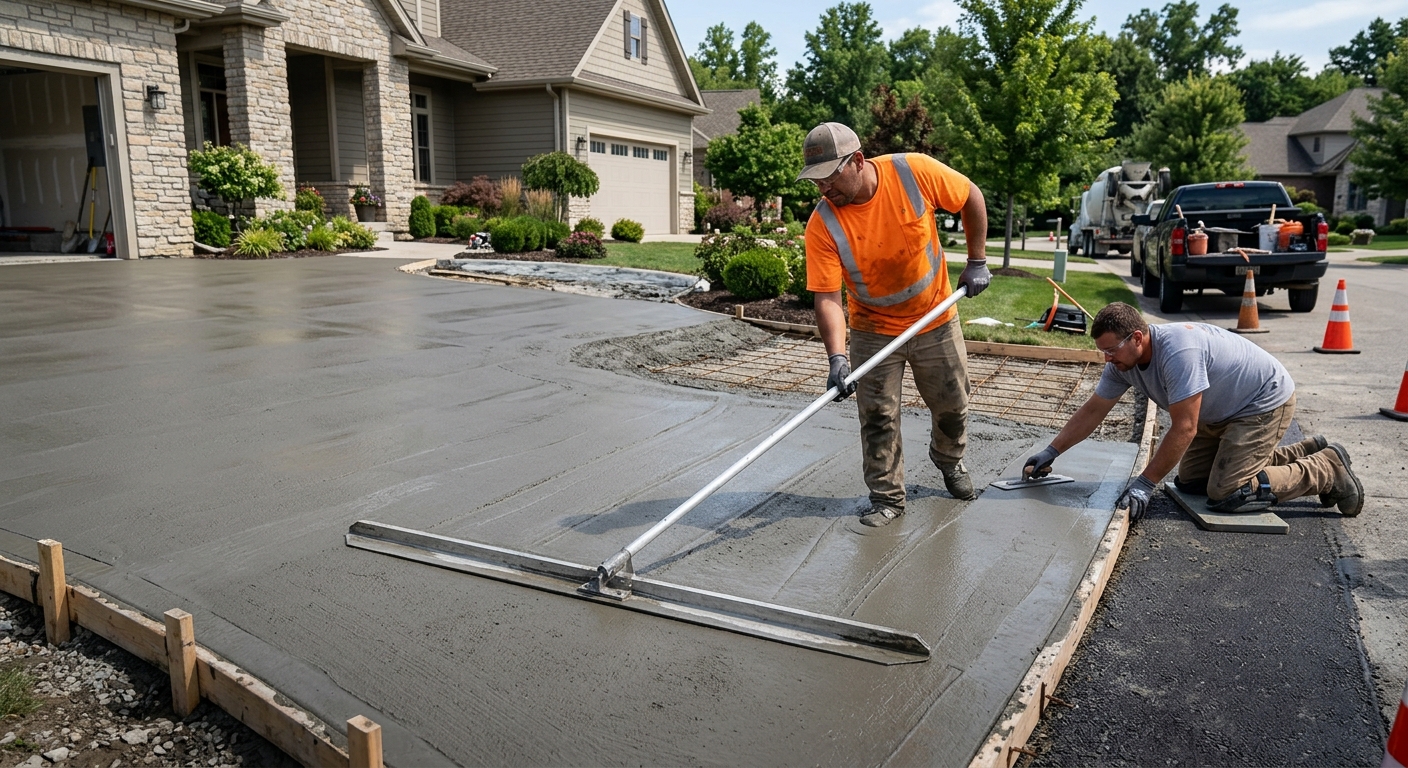
Concrete work options and costs in Pineridge
Pineridge, Alberta is a town where concrete is a year-round necessity—but it has to be engineered for winter. Most homeowners here rely on concrete flatwork and foundations because the area’s housing mix is dominated by single-detached homes, the kind of properties that typically need a driveway, patio, walkway, and footings as they build or renovate (Statistics Canada, 2021 Census). With a population of 9,850 (Statistics Canada, 2021 Census), demand is steady, and contractors who do consistent work around Calgary and nearby communities get booked faster when exterior pour season is short.
In the Calgary economic region, the cold continental climate and frequent freeze–thaw cycles are the main reason concrete pricing is higher than in milder provinces. Local engineering practice generally targets a design frost depth around 1.2 m (roughly 4 ft), so foundation footings and any below-grade supports must bear on undisturbed soil below that level. Exterior slabs also need air-entrained mixes and a well-prepped granular base, plus control joints to reduce cracking and spalling as temperatures swing. If you’re pouring in late fall or early spring, the curing window is tighter—contractors may need insulated blankets or temporary heat to protect the slab while it gains strength.
In Pineridge, trade demand is especially strong around newer infill/expansion pockets and streets where homeowners are adding garages, widening driveways, or rebuilding walkways. Below is a practical comparison of common concrete options so you can line up scope and budget before you request quotes.
| Application |
Typical Size |
Key Spec |
Finish Option |
Price Range |
| Concrete driveway (standard broom finish) |
10 m x 3 m (approx. 30 m²) |
Air-entrained, compacted granular base, control joints |
Broomed surface, sealer optional |
$12,000–$18,000 |
| Exposed aggregate driveway |
10 m x 3 m (approx. 30 m²) |
Air-entrained, proper curing before wash/finish |
Exposed stone aggregate (light to medium exposure) |
$14,000–$22,000 |
| Stamped concrete driveway or patio |
30 m² patio OR 30 m² driveway section |
Air-entrained, integral colour, release agent |
Stamp texture (brick/flag/ashlar styles) |
$15,000–$26,000 |
| Plain concrete patio or walkway |
25 m² (typical backyard patio) |
Air-entrained, compacted sub-base, joints |
Smooth or broom finish |
$5,000–$9,000 |
| Garage floor (interior slab) |
7 m x 4 m (approx. 28 m²) |
Vapour barrier (if specified), reinforced slab |
Broom or light trowel finish |
$6,500–$12,000 |
| Foundation footings (structural, below frost) |
Typical single-detached footprint (engineered) |
Excavation to frost depth, rebar, engineered geometry |
Structural concrete (no decorative finish) |
$28,000–$45,000 |
Prices are estimates only and vary by project scope, site access and material selection.
What affects the price of concrete work in Pineridge
In Pineridge and the wider Calgary region, you’ll often see quotes for what looks like the “same” concrete job swing by 30–50%. The difference usually isn’t the concrete itself—it’s how deep contractors excavate, how much granular base they install, what reinforcement is used, and what winter-proofing they plan for. Labour availability also changes fast during the exterior season, so “same-day” scheduling can cost more when multiple crews are chasing a short window.
Frost and freeze–thaw cycles dictate the specifications. Footings for houses, garages, decks and any below-grade work must extend below the design frost depth (commonly about 1.2 m in Alberta) so the foundation bears on undisturbed soil and avoids frost heave. On top of that, exterior flatwork needs air-entrained concrete mixes designed to survive repeated freeze–thaw. In colder periods, contractors may shorten the pour season and use cold-weather curing precautions—insulated blankets and temperature management—to hit proper curing strength. Finally, de-icing salt accelerates surface spalling, so sealing is often recommended for driveways and patios.
In practice, a few local scenarios move cost quickly. A backyard regrade that lowers the slab height can reduce excavation and base depth; conversely, frost-sensitive soils that require deeper removal increase excavation volume. Accessibility matters too: if a driveway pour requires trucking over soft ground or repeated deliveries, you may see additional site prep and protection costs. For budgeting, a plain patio typically aligns with the $5,000–$9,000 band, while stamped work tends to align with the $15,000–$26,000 band because of colour, release, stamping labour, and finish detailing.
| Price Factor |
Why It Matters |
Cost Impact |
| Frost line depth — determines footing depth and form height |
Exterior and structural work must bear below frost to prevent heave and seasonal movement |
Major cost driver (more excavation and concrete volume) |
| Site preparation — excavation, grading, compacted granular base |
Correct base depth and compaction control settlement and cracking |
Moderate to major swing depending on soil and regrade needs |
| Reinforcement — rebar or wire mesh requirement |
Controls cracking and improves slab performance under load and freeze–thaw |
Moderate increase (materials + placement labour) |
| Mix design — air-entrainment and compressive strength spec |
Air void system improves freeze–thaw durability in Calgary-area winters |
Moderate increase versus basic mixes |
| Finish type — broom vs. stamped vs. exposed aggregate |
Decorative finishes require additional steps and tight workmanship timing |
Stamped/exposed typically adds significant labour and materials |
| Pour size and concrete truck access to site |
More volume and limited access affect equipment time and delivery logistics |
Often adds cost when access is tight or multiple short loads are needed |
| Cold-weather curing precautions — heating and blankets |
Concrete needs protection to develop strength and limit surface scaling |
Can add noticeable cost in late fall/early spring |
| Control joint pattern and sealing cost |
Joints manage shrinkage cracking; sealer helps protect against de-icing salt |
Small-to-moderate cost, but big difference in long-term appearance |
Permits & regulations in Alberta
In Alberta, the key difference is whether the concrete work is structural. Concrete that is part of the building’s structural system—such as foundation footings, foundation walls, grade beams, and other engineered below-grade components—usually requires a building permit, and engineered drawings are commonly reviewed through the municipal process. For homeowners in Pineridge, that means foundation and footing scopes need proper approvals before excavation starts.
Concrete flatwork (patios, walkways, and many standard driveways) typically does not require a permit unless it affects lot grading, stormwater drainage, impervious surface coverage limits, or the municipal right-of-way. If your project involves changing slopes toward the street, tying into existing drainage, or altering elevations that impact neighbouring drainage patterns, confirm with the local authority before you pour.
Here’s how to verify your contractor is set up correctly in Alberta, step-by-step. First, request the contractor’s business information and verify the proper Alberta licence status through the online registry for the applicable trade category. Second, ask for a current certificate of insurance (general liability) showing coverage amounts that make sense for concrete work at your scale. Third, confirm WSIB/WCB coverage (or a valid exemption if applicable) and ask for proof/clearance documentation. Finally, read the quote: reputable crews will specify who is pulling permits (if needed), what inspections are planned, and whether disposal and traffic protection are included.
Getting concrete right in Pineridge's freeze-thaw climate
In Pineridge, concrete doesn’t fail because it “isn’t strong enough”—it fails when it can’t handle repeated freezing, thawing, and salt exposure. The biggest culprits are inadequate base prep, a mix that isn’t properly air-entrained, and poor curing or finishing timing. The fix is specifying the right build-up for local soils and frost depth and holding the workmanship to a clear standard.
Start with (1) base preparation: excavate to the required depth for the frost-sensitive zone and install compacted granular sub-base to the engineer/contractor’s spec. Next is (2) mix design: for exterior flatwork in Alberta, request air-entrainment to target about 5–7% air content for freeze–thaw durability and a minimum 32 MPa compressive strength (unless your engineered design calls for higher). (3) Control joints: layout joints to manage shrinkage cracking—don’t rely on “random cracking” to look fine. (4) Curing: plan for at least 7 days of proper curing conditions; in cold weather, blankets and/or heat may be necessary to prevent surface scaling and to reach strength. (5) Sealing: apply a penetrating sealer after the slab has cured (commonly at about 28 days) so de-icing salts don’t aggressively attack the surface.
When you’re comparing options, pay attention to what’s actually included. Example: if a broom-finish patio comes in near the $5,000–$9,000 band but the lower quote skips a proper granular base depth or air-entrainment details, it may look fine at first and then develop spalling in winter. A correctly specified mix and finish plan is what justifies paying closer to the upper end—because the goal is fewer repairs, not lower first cost.
| Spec |
Why It Matters in Pineridge |
What to Ask For |
Impact if Skipped |
| Compacted granular base (depth?) |
Reduces settlement and movement during freeze–thaw cycles |
State base depth, compaction method, and granular type |
Premature cracking, uneven slab, trip hazards |
| Air-entrained concrete mix (target air %?) |
Air voids let water expand safely as temperatures change |
Target 5–7% air for exterior flatwork and cold-weather placement plan |
Higher risk of spalling and surface scaling |
| Compressive strength (MPa rating) |
Strength gain supports durability through winter loading |
Minimum 32 MPa (or higher if engineered) |
Weaker surface, more wear and damage over time |
| Control joints (spacing per ACI guidelines) |
Controls shrinkage cracking so cracks appear where planned |
Joint spacing plan and saw-cut timing |
Random cracking and water pathways that worsen freeze–thaw |
| Minimum 7-day curing period |
Concrete needs time and conditions to develop strength |
Curing method in cold weather (blankets/heating if needed) |
Surface defects, scaling, and reduced long-term performance |
| Penetrating sealer (when applied after cure) |
Helps protect against de-icing salt attack |
Sealer type and application timing after cure (commonly around 28 days) |
Faster surface deterioration and roughness/etching |
How to choose a concrete work contractor in Pineridge
Choosing a concrete contractor in Pineridge is less about flashy photos and more about whether they’ll spec the job correctly for Calgary’s freeze–thaw conditions. Start by verifying Alberta licensing for the trade category they operate under, and insist on proof of liability insurance. Ask for WSIB/WCB coverage documentation (or a clear explanation of the basis for any exemption where applicable). Don’t accept verbal promises—request certificates and keep them with your contract paperwork.
Next, get 2–3 itemised written quotes. You want labour and materials broken out, not just a single lump sum. The quote should show what’s included for excavation, granular base depth and compaction, reinforcement, air-entrained mix requirements, control joints, curing protection in cold weather, and whether sealing is included. Confirm permit responsibility where structural work is involved, and ask whether site cleanup and disposal of excess material are included—these “small” line items often explain quote differences.
Warranty matters. Ask for a workmanship warranty period and confirm how long it applies and what it covers (e.g., replacement of spalling or settlement defects, not just cosmetic touch-ups). Also ask whether the product/manufacturer warranty is transferable to you if it’s a branded material system. For payment, never pay more than about 10–15% upfront; hold back the remaining amount until forms are removed, surfaces are finished, and the site is cleaned. Finally, get a start date and completion estimate in writing so weather delays are clearly planned and communicated.
- Provide proof of Alberta licensing for the applicable trade category.
- Show current general liability insurance certificate (with coverage limits listed).
- Provide WSIB/WCB clearance or coverage documentation.
- Use an itemised quote (excavation, base, rebar/mesh, concrete mix spec, joints, finish, curing).
- Confirm air-entrainment and minimum strength (e.g., 5–7% air for exterior and 32 MPa minimum).
- Ask for the control joint plan (spacing and saw-cut timing).
- Request curing method details for your planned pour date.
- Ask whether penetrating sealer is included and when it will be applied after cure.
- Verify disposal and cleanup are in scope (excess soil and packaging).
- Confirm equipment and truck access plan (especially if access is tight).
- Get a written timeline with milestones and weather contingencies.
- Clarify warranty terms in writing, including what counts as a defect and response timing.
Concrete contractor red flags in Pineridge: they won’t specify air-entrainment or joint spacing, they minimize the importance of curing blankets/heating in cold conditions, they quote “same price” without discussing granular base depth, they request large upfront payments (beyond 10–15%), or they won’t provide insurance/WSIB/WCB documentation or references from similar-size pours.
Frequently asked questions — concrete work in Pineridge
How deep must footings be for Pineridge's frost line?
In Pineridge and across the Calgary region, footings generally need to bear below the design frost depth to prevent frost heave and seasonal movement. Local practice commonly targets about 1.2 m (roughly 4 ft) as a design frost depth when calculating footing support. The exact depth on your project can vary with soil conditions and the engineered foundation plan, but a reputable contractor won’t guess—they’ll follow the design and municipal requirements. If someone proposes shallow footings “to save money,” that’s usually a false economy: more movement risk means you may pay for repairs later. For homeowners planning work around single-detached builds, budget accordingly because excavation and footing volumes often drive foundation costs more than the concrete itself (Statistics Canada, 2021 Census).
Why does concrete crack in Pineridge and how is it prevented?
Concrete cracking in Pineridge is usually about shrinkage, settlement, and freeze–thaw cycling—not about “bad” concrete alone. The two prevention levers that matter most are (1) proper base preparation and compaction so the slab doesn’t move and (2) control joints placed at the right spacing to concentrate cracking where it’s intended. Exterior slabs also need air-entrainment because trapped water expands when temperatures drop; if the mix lacks correct air voids, freeze–thaw can worsen surface deterioration and allow water into micro-cracks. Sealing helps protect against de-icing salt attack. If you’re comparing quotes for a driveway in the $12,000–$18,000 band, the best value is often the one that clearly includes the right base depth, joint plan, and air-entrained mix—not just the lowest number.
Stamped vs broom-finish concrete — cost difference?
Stamped concrete costs more because it’s not only a different finish—it’s a different workflow. Stamping requires integral colouring or colour hardener, release agent, stamp mats, and careful timing, plus more detailed finishing around edges and patterns. A broom-finish driveway is usually simpler and quicker to place and finish, which is why it often falls in the $12,000–$18,000 range for a typical driveway size. Stamped work commonly aligns with the $15,000–$26,000 band depending on area and complexity (patterns, borders, and whether it’s a driveway or patio). The cost difference is justified when the quote includes air-entrainment, proper curing protection in your pour window, and a joint/sealing plan—otherwise the decorative surface can still crack or spall.
When is the best time to pour concrete in Pineridge?
For Pineridge and the Calgary region, the best time is typically when temperatures stay consistently above freezing and crews can cure the slab without excessive heating or blanket costs. Late spring through summer often gives the most predictable results because concrete reaches strength reliably. Pours in late fall or early spring can be done, but they require cold-weather precautions: insulated blankets and sometimes temporary heat to protect curing. This is one reason exterior pricing can change quickly—winter-grade mixes and curing protection are real added labour and materials. If you’re planning a patio or walkway, aim to schedule early enough that your contractor can cure properly; for driveways, confirm whether the quote includes cold-weather curing measures if forecasts shift.
How long does concrete take to cure?
Concrete strength develops over time, but the practical homeowner timeline is: it’s generally placed and finished on the pour day, it should cure properly for at least 7 days for early handling and durability, and many protective steps are tied to full cure timing. In Alberta’s freeze–thaw climate, curing is critical—rushing it increases scaling risk and can reduce long-term performance. For example, penetrating sealers are commonly applied after the slab has fully cured, often around 28 days, so the product can bond and repel de-icing salts. The right answer also depends on temperature, wind, and whether the contractor used blankets/heating. Ask your contractor what curing method they’ll use for your exact pour date and what you can do (or shouldn’t do) during the curing period.
Do I need a permit for concrete work in Alberta?
In Alberta, structural concrete work usually requires a building permit—think foundation footings, foundation walls, and grade beams—often with engineered drawings reviewed by the municipality. Concrete flatwork like patios, walkways, and many driveways typically does not require a permit unless it affects lot grading, stormwater drainage, impervious surface limits, or the municipal right-of-way. Because requirements can hinge on your site plan, always confirm with the local authority before breaking ground. Separately, even when a permit isn’t required, you should verify your contractor is properly licensed, carries liability insurance, and has WSIB/WCB coverage. Ask for their certificate of insurance and clearance documentation during the quoting stage so you’re not guessing later.