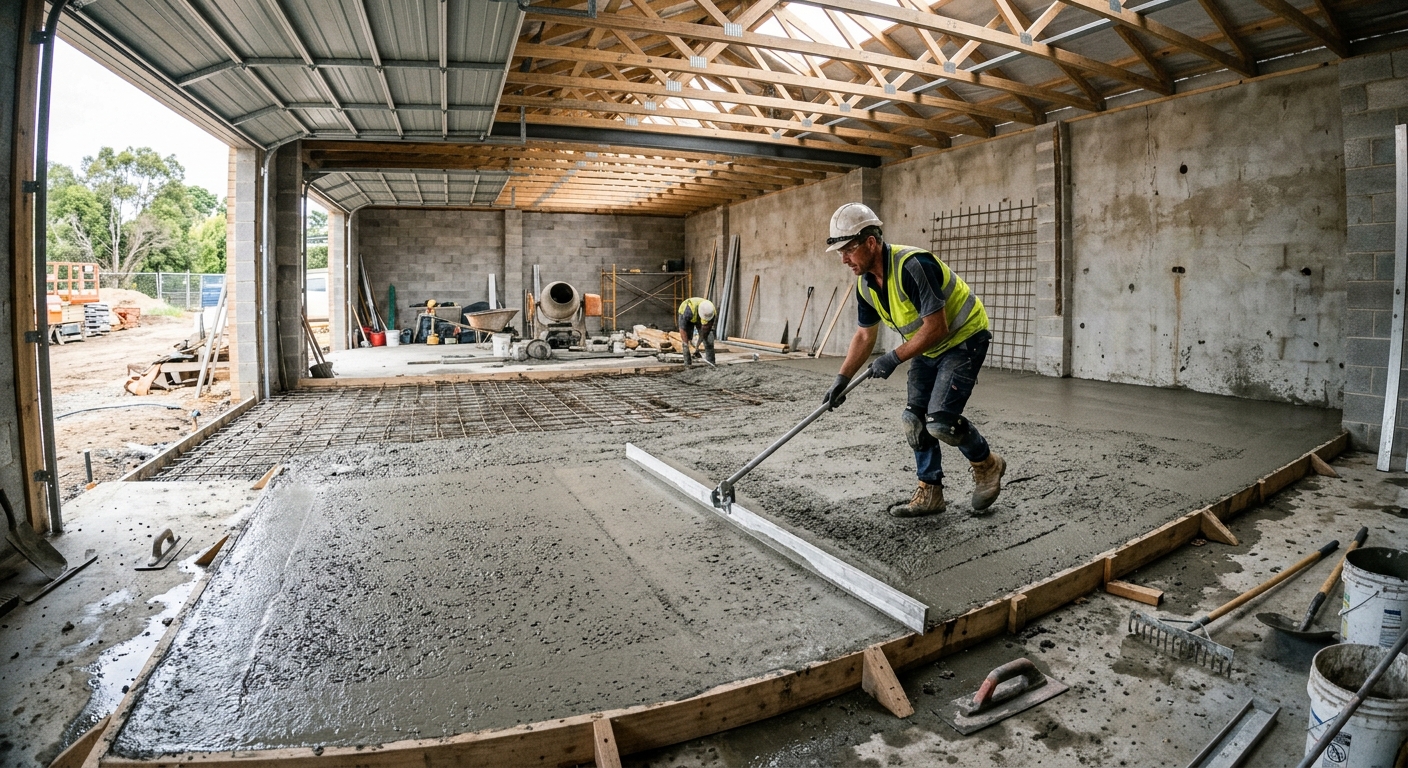
Concrete work options and costs in Glamorgan
Concrete work in Glamorgan, Alberta is shaped by how people build and how the weather attacks. With a population of 6,575 (Statistics Canada, 2021 Census), the area’s concrete demand is driven by owner-occupied homes and garages typical of the Calgary region. In neighbourhoods around Glamorgan where families are expanding driveways, adding patios, and renewing aging flatwork, the “standard” job is usually not standard at all once you price in frost protection, reinforcement, and finish detailing. Calgary’s cold continental climate means concrete is engineered for freeze–thaw, with local practice assuming a design frost depth of about 1.2 m (roughly 4 ft). That drives excavation depth and foundation/footing volumes, and it also shortens the practical exterior pour season—especially late fall and early spring—so winter-grade placement and curing precautions can add cost. At the same time, frequent freeze–thaw cycles increase the need for air-entrained mixes and properly spaced control joints to reduce cracking and spalling. Where contractors stay busy—think homes on busier approaches near 37 Avenue and the corridor-style streets leading toward Calgary—quotes can tighten up around your preferred schedule. The good news is that once you compare like-for-like specs, costs become easier to understand. Use the table below as a realistic starting point for what Glamorgan homeowners typically budget for driveway, patio, and foundation work, then we’ll break down the biggest price drivers and what to verify in every quote.
| Application |
Typical Size |
Key Spec |
Finish Option |
Price Range |
| Concrete driveway (standard broom finish) |
24 ft x 10 ft (240 sq. ft.) |
4 in slab, compacted granular base, control joints |
Broom finish + edges, basic sealer optional |
$12,000–$18,000 |
| Exposed aggregate driveway |
24 ft x 10 ft (240 sq. ft.) |
Vibrated air-entrained mix, base prep, joints |
Exposed aggregate (wash/retard) + sealer |
$15,000–$21,500 |
| Stamped concrete driveway or patio |
20 ft x 12 ft (240 sq. ft.) |
Air-entrained mix, engineered base, joints |
Stamped pattern + colour hardener + release |
$15,000–$26,000 |
| Plain concrete patio or walkway |
12 ft x 12 ft (144 sq. ft.) |
4–5 in slab, compacted base, edge forms |
Plain broom or light trowel finish, joints as needed |
$5,000–$9,000 |
| Garage floor (interior slab) |
22 ft x 20 ft (440 sq. ft.) |
Vapour barrier (as applicable), reinforced slab |
Plain broom finish or light trowel |
$10,000–$16,500 |
| Foundation footings (structural, below frost) |
Typical single-family footing perimeter |
Excavation to below design frost + rebar, concrete strength as engineered |
Structural finish (not decorative) |
$28,000–$45,000 |
Prices are estimates only and vary by project scope, site access and material selection.
What affects the price of concrete work in Glamorgan
Homeowners in Glamorgan often see the same “driveway size” come back with quotes that differ by 30–50% across Calgary and Alberta. The reason is usually not the concrete itself—it’s the engineered extras: deeper excavation for frost protection, granular base thickness, reinforcement detailing, and the cold-weather controls needed to make sure it cures properly. In this region, frost line depth and freeze–thaw cycles dictate every spec. Footings and foundation elements must bear on undisturbed soil below the design frost depth (about 1.2 m for local engineering assumptions) to prevent frost heave and seasonal movement. Exterior slabs also need air-entrained concrete mixes to survive repeated freeze–thaw, plus well-planned control joints to control where cracking happens. Because the practical pour season is shorter, late-season work may require heated enclosures, insulated blankets, and winter-grade placement steps—those add real labour and equipment time. De-icing salts accelerate surface damage, so sealing becomes more than an aesthetic choice; it’s part of long-term durability. On a typical Glamorgan driveway budget, choosing a plain broom finish often aligns with the lower end of the local driveway band (about $12,000–$18,000), while decorative systems like stamped or exposed work usually land higher because of forming complexity, release/colour materials, and extra finishing labour. As a concrete example: if your driveway needs additional excavation to reach stable granular sub-base (for soft soils or poor drainage), you may spend more on prep than on finish—sometimes narrowing the price gap between standard broom and a more decorative option once you compare full-scope quotes.
| Price Factor |
Why It Matters |
Cost Impact |
| Frost line depth — determines footing depth and form height |
Footings must extend below design frost to reduce frost heave risk |
Higher excavation and concrete volume can add thousands |
| Site preparation — excavation, grading, compacted granular base |
Stable base reduces settlement and keeps slab level through seasons |
Extra hauling/compaction increases labour and equipment time |
| Reinforcement — rebar or wire mesh requirement |
Controls cracking and improves load capacity on exterior flatwork |
Material and placement labour can raise cost notably |
| Mix design — air-entrainment and compressive strength spec |
Air-entrainment improves freeze–thaw durability; strength meets design |
Higher-spec mix and quality control adds material cost |
| Finish type — broom vs. stamped vs. exposed aggregate |
Decorative finishes require more labour and specialized materials |
Stamped/exposed typically land above standard driveway/patio ranges |
| Pour size and concrete truck access to site |
Hard-to-reach sites require pumping, smaller loads, or more labour |
Pumping/wait times and access labour can add significant cost |
| Cold-weather curing precautions — heating and blankets |
Proper curing prevents scaling and early-age damage |
Winterization equipment and labour can add thousands on exterior pours |
| Control joint pattern and sealing cost |
Joints manage cracking; sealing improves resistance to de-icing salts |
More layout and material time increase total project budget |
Permits & regulations in Alberta
In Alberta, structural concrete work generally triggers permit and engineering review. For Glamorgan homeowners, that means work such as foundation walls, grade beams, and structural footings/underpinning typically requires a building permit, and engineered drawings are often reviewed by the municipality or through the permitting process. Concrete flatwork—like patios, walkways, and standard driveways—usually does not need a permit when it’s not changing lot grading, drainage, or triggering impervious surface limits, and when it doesn’t affect municipal right-of-way requirements. Still, you must confirm with the local authority before breaking ground, especially if you’re regrading the yard, lowering a slope to the street, or tying into existing foundation drains.
Before signing a contract, verify three things in writing. First, confirm contractor insurance: request a Certificate of Insurance showing general liability (and, where applicable, additional insured details for the homeowner or project entity). Second, confirm WCB coverage (workers’ compensation) so you’re not exposed if a worker is injured on site. Third, check contractor licensing/registration through the appropriate Alberta registry the contractor references in their documentation. Step-by-step: (1) ask for the COI and confirm dates and project location; (2) request proof of WCB coverage; (3) ask for examples of similar-scale concrete flatwork or structural pours; (4) ensure the quote states who pulls permits (if needed) and who is responsible for inspections; and (5) keep all documents with your contract so any dispute can be resolved using the written scope.
Getting concrete right in Glamorgan's freeze-thaw climate
Concrete failures in Glamorgan are usually a repeat story: water gets in, freeze–thaw expands it, and weak surfaces spall. The fix starts before the pour—base preparation must reach the right depth and be compacted to support the slab through the region’s deep frost conditions (local engineering assumes a frost depth of about 1.2 m). Next is mix design: exterior flatwork should use air-entrained concrete (commonly around 5–7% air) so freeze–thaw doesn’t destroy the paste. Control joints are also critical; they’re where cracking is allowed to happen in a controlled way, rather than randomly through visible areas like driveway edges and patio corners. Curing matters as much as thickness. In cold weather, you can’t “hope it sets”—you need proper curing for structural and durability outcomes. Finally, sealing is your protection against de-icing salts; in this market, a penetrating sealer applied after full cure helps repel salts and slows surface deterioration.
When you’re choosing specs, ask what’s included and why. For instance, if a contractor quotes a plain broom driveway near the local band of $12,000–$18,000 but proposes a minimal base and no air-entrainment, it may be cheaper up front and more expensive later due to spalling. Conversely, spending more for proper air entrainment, reinforcement placement, and a correct joint pattern is often the difference between a driveway that looks good for years and one that needs repairs after a couple of harsh winters.
| Spec |
Why It Matters in Glamorgan |
What to Ask For |
Impact if Skipped |
| Compacted granular base (depth?) |
Supports the slab and prevents settlement under deep frost conditions |
Specify base thickness, material type, and compaction testing method |
Uneven settling, cracking, and faster wear at slab edges |
| Air-entrained concrete mix (target air %?) |
Improves resistance to freeze–thaw cycling and surface scaling |
Target air content (commonly 5–7% for exterior flatwork) and confirm mix design |
Higher risk of spalling and scaling over winter cycles |
| Compressive strength (MPa rating) |
Ensures durability and load performance for the service life |
Minimum compressive strength (commonly 32 MPa for typical exterior flatwork spec) |
Premature cracking, reduced durability, and potential structural concerns |
| Control joints (spacing per ACI guidelines) |
Keeps cracking controlled where it won’t ruin the appearance or performance |
Planned joint spacing, layout, and saw-cut/formed method schedule |
Random cracks, trip hazards, and more frequent patching |
| Minimum 7-day curing period |
Develops strength and durability before the slab sees harsh temperatures |
Concrete curing plan for cold weather (blankets/heating if needed) |
Surface scaling and weakened early-age performance |
| Penetrating sealer (when applied after cure) |
Repels moisture and de-icing salts that accelerate spalling |
Confirm sealer type and timing (commonly 28 days post-pour) |
Faster surface deterioration and higher long-term maintenance costs |
How to choose a concrete work contractor in Glamorgan
Choosing the right contractor in Glamorgan comes down to proof and clarity. In Alberta, verify the contractor’s ability to legally perform the work and protect you if something goes wrong. Start by requesting (1) a Certificate of Insurance showing current general liability coverage; (2) proof of WCB/workers’ compensation coverage; and (3) the contractor licensing/registration details they rely on for their work (ask them to provide the reference and the exact business name on the policy/permit paperwork). For COIs, confirm the policy is active and that the job location matches your address.
Next, get 2–3 itemised written quotes—break out labour, excavation/base prep, reinforcement, concrete supply, finish work, and any heating/blankets for cold-weather pours. Avoid “lump sum only” quotes that don’t show what’s included. Read the scope line-by-line: ask who handles permits if structural work is involved, who disposes of concrete/soil, and whether rebar/mats and control joint sawing are included. Warranty matters too: ask for workmanship warranty length, whether there’s a product/manufacturer warranty for specific sealers/finishes, and whether it’s transferable if you sell the home. On payment scheduling, never agree to pay more than 10–15% upfront. Hold back the balance until concrete finishes are completed, cleaned, and you’ve confirmed curing/sealing steps are done. Finally, demand a start date and a completion estimate in writing, with weather contingencies—Calgary’s freeze–thaw swings can affect exterior schedules.
- Request COI and verify dates and jobsite address match your project.
- Confirm WCB/workers’ compensation coverage (ask for documentation, not just a verbal claim).
- Verify contractor business name matches the insurance certificate and quote.
- Ask whether permits are required for your scope (especially grade changes or structural footings).
- Get itemised quotes: excavation/base, reinforcement, concrete, finishing, joints, sealing.
- Confirm air-entrainment and minimum strength in writing for exterior work.
- Ask about control joint layout and saw-cut timing (or formed joints where appropriate).
- Require a curing plan for cold weather (blankets/heating if pour conditions demand it).
- Confirm base prep method: granular material type, compaction expectations, and any testing.
- Check whether truck access/pumping is included (and what happens if access is limited).
- Use a clear payment schedule: 10–15% max upfront, holdback until complete.
- Ask for 2–3 local references from similar Glamorgan/Calgary jobs with photos.
Concrete red flags in Glamorgan: quotes that ignore frost depth and show no base prep detail, no mention of air-entrained concrete for exterior flatwork, vague curing language (“it’ll cure fine” without blankets/heating plans), no documentation for insurance/WCB, and contracts that don’t spell out joints, reinforcement, or sealing responsibilities.
Frequently asked questions — concrete work in Glamorgan
How much does concrete work cost in Glamorgan?
In Glamorgan, pricing depends on the scope and the engineered details needed for Calgary’s freeze–thaw climate. For many homeowners, concrete driveway and flatwork budgets fall into established bands: a typical driveway (about 240 sq. ft.) with a standard broom finish often comes in around $12,000–$18,000, while decorative stamped options typically budget higher, commonly $15,000–$26,000 depending on pattern, thickness, and base prep. Plain patios and walkways often land near $5,000–$9,000 for smaller projects. Foundation footings are a different category due to excavation below the design frost depth; those can commonly fall around $28,000–$45,000 for typical residential footing scopes. Expect quotes to vary—by 30–50%—if one contractor includes proper granular base, air-entrainment, reinforcement, joints, and cold-weather curing precautions while another doesn’t.
How deep must footings be for Glamorgan's frost line?
For Glamorgan and the broader Calgary region, the design frost depth used for engineering practice is about 1.2 m (roughly 4 ft). That depth matters because frost heave risk rises when footings bear on soil that can freeze and thaw with seasonal moisture movement. The practical takeaway for homeowners is that excavation must reach undisturbed soil below that design frost level, and form height/volume of concrete increases as a result. Your exact footing depth may still change based on engineered drawings for the foundation design, soil conditions, and drainage details. If a contractor proposes setting footings shallower than the engineering requirement, that’s a major concern. For structural scopes in Alberta, you should also expect permits and, often, engineered drawings to be part of the process before concrete is placed.
Why does concrete crack in Glamorgan and how is it prevented?
Concrete can crack in Glamorgan mainly because of thermal movement and moisture cycling through freeze–thaw. Even well-built slabs expand and contract with temperature, and if the slab isn’t designed to “control” where cracking happens, hairline cracks can appear randomly. Prevention is about controlling variables: proper granular base and compaction (so the slab doesn’t settle), air-entrained concrete for durability, and an intentional control joint layout. Joints should be spaced appropriately and cut/scheduled so the slab relieves stress at the joints instead of through the field. Sealing also helps protect the surface from de-icing salts that can accelerate damage along microcracks. In Calgary-area projects, rushing curing in late fall or early spring can increase surface issues, so cold-weather precautions (insulated blankets/heating when needed) are part of prevention, not just convenience.
Stamped vs broom-finish concrete — cost difference?
Stamped concrete generally costs more than a broom-finish because it adds labour time and specialized materials. A broom-finished driveway for many homeowners lands near $12,000–$18,000 when base prep, joints, and air-entrainment are done properly. Stamped concrete often falls higher, commonly $15,000–$26,000, because it requires consistent finishing timing, pattern stamping tools, release agents, colour hardeners or integral colouring, and additional labour to maintain crisp edges and texture under cold conditions. The key is that price differences are usually justified only when the contractor also matches the same structural quality—base, reinforcement, mix design, and curing. If one quote “upgrades the finish” but reduces base thickness or skips air-entrainment, the cheaper stamped option can still fail early, leading to repairs that erase the initial savings.
When is the best time to pour concrete in Glamorgan?
For Glamorgan and Calgary, the best exterior pour window is typically late spring through early fall, when temperatures support proper curing without extreme cold. That said, good contractors can and do pour in shoulder seasons by using cold-weather curing precautions—often insulated blankets, controlled heat, and winter-grade approaches—so concrete reaches the required early strength safely. The risk period is late fall or early spring: freeze–thaw cycles can start quickly, and inadequate curing can lead to scaling and durability problems. A professional will assess the forecast, specify a curing plan, and place concrete in a way that respects the curing window. If your project is structural (footings/foundation elements), timing can be affected by permit schedules and inspection windows as well. Your best move is to ask for a stated start date, completion estimate, and contingency plan in writing.
How long does concrete take to cure?
Concrete curing depends on temperature and the mix design, but for exterior work in Alberta, homeowners should plan for a minimum curing period of about 7 days before the slab sees full service conditions. In cold weather, that window can require additional precautions to achieve proper early-age strength development. For durability and sealing readiness, many sealing systems are applied after full cure—commonly around 28 days post-pour—once the surface is stable and ready to receive penetrating sealer. In Glamorgan’s freeze–thaw climate, skipping or rushing curing is one of the fastest routes to surface scaling and early deterioration. When you compare quotes, ask specifically what curing method is included (blankets/heating if needed), whether the contractor schedules sawing of control joints appropriately, and when sealing will be done. Those items often matter as much as slab thickness for long-term performance.